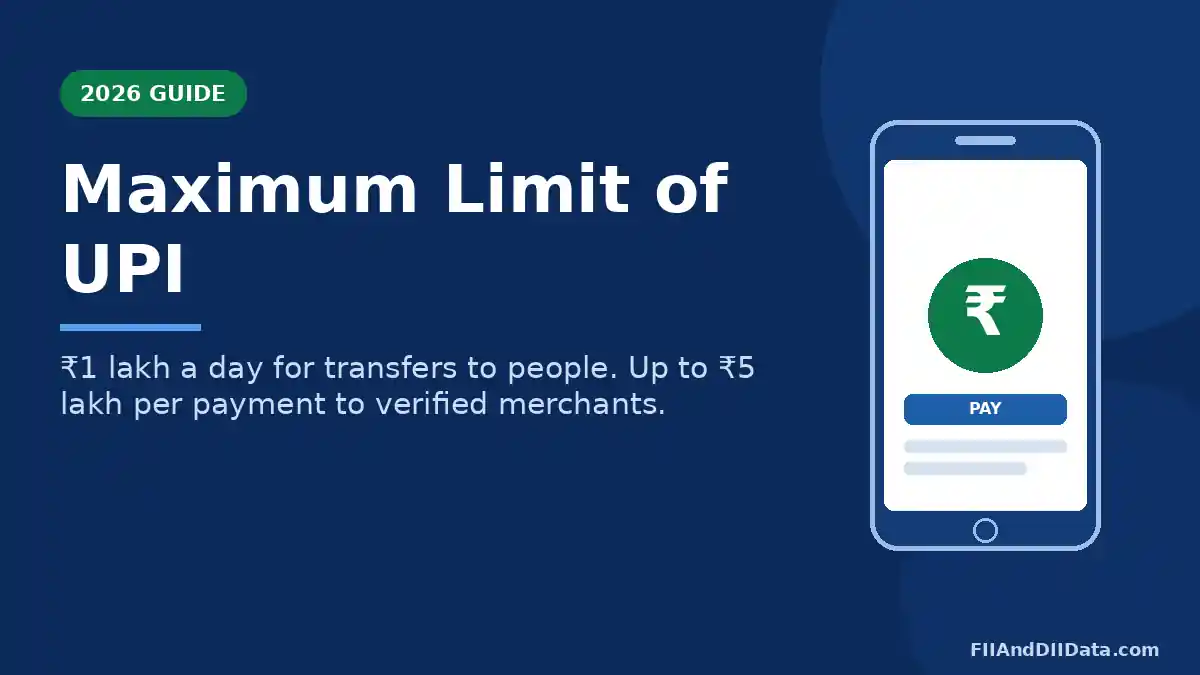
The maximum limit of UPI for a normal money transfer to another person is ₹1 lakh in 24 hours from one bank account. Some banks set a lower cap. For payments to verified merchants in certain categories, such as insurance, mutual funds, tax and hospitals, a single UPI payment can go up to ₹5 lakh, and the daily total can reach ₹10 lakh (₹15 lakh for IPO and RBI Retail Direct).
These limits are set by NPCI, the body that runs UPI. Your bank can then apply its own, lower limit. Your UPI app (Google Pay, PhonePe, Paytm, BHIM and others) does not decide the amount. That is why the same bank account shows the same limit in every app.
This guide covers the full list of current limits, what changed in September 2025, worked examples of how the 24-hour window behaves, common mistakes, and exactly what to do when you hit the cap. If you are new to UPI, our UPI guides hub has every setup and troubleshooting guide in one place.
Maximum limit of UPI at a glance
| Type of payment | Per transaction | Per day (24 hours) |
|---|---|---|
| Person to person (P2P) | ₹1 lakh | ₹1 lakh |
| Normal merchant payment (shops, online orders) | ₹1 lakh | ₹1 lakh |
| Verified merchants in special categories | ₹2 lakh to ₹5 lakh | ₹2 lakh to ₹15 lakh |
| New user or new device (first 24 hours, Android) | ₹5,000 | ₹5,000 |
| UPI Lite (no PIN) | ₹1,000 | Wallet balance up to ₹5,000 |
Most banks also cap P2P transfers at 20 successful payments in 24 hours. Your bank can set the amount or count lower than shown above. The smallest UPI payment allowed is ₹1, as Google Pay’s help page notes.
Who sets the maximum limit of UPI?
Three parties are involved, and it helps to know which one is blocking you:
- NPCI sets the ceiling for each type of payment. No bank or app can go above it.
- Your bank can set a lower limit for your account, for some account types, or for some categories. SBI, for example, lists ₹2 lakh for insurance and capital market payments to verified merchants, below NPCI’s ₹5 lakh ceiling for those categories.
- Your UPI app only passes the request to your bank. Paytm’s help page says it does not set a separate UPI limit. Google Pay adds its own count rule (150 P2P payments in 30 days), but not a separate amount cap.
So the real maximum limit of UPI for you is the lower of two numbers: NPCI’s ceiling for that payment type and your bank’s own setting.
Maximum limit of UPI for sending money to a person
For P2P transfers, the cap is ₹1 lakh per bank account in a rolling 24-hour window. It is not a calendar-day limit, and it does not reset at midnight.
Worked example: the rolling 24 hours
Say you send ₹40,000 to your landlord at 10 AM on Monday and ₹35,000 to your sister at 3 PM. You have used ₹75,000. At 8 PM you try to send ₹30,000 to a friend. It is declined, because only ₹25,000 is left in the window. You could send ₹25,000 now. At 10 AM on Tuesday, Monday’s ₹40,000 payment turns 24 hours old and drops out of the count, so ₹65,000 becomes free again. The ₹35,000 frees up at 3 PM on Tuesday.
Google Pay’s help page lists three P2P limits that apply together:
- Up to ₹1 lakh in successful payments from one bank account in 24 hours.
- Up to 20 successful payments in 24 hours.
- Up to 150 successful payments in 30 days (Google Pay).
Whichever you hit first stops further transfers. The NPCI changes of September 2025 did not raise this P2P cap. If you need to send more than ₹1 lakh to a family member in one day, use IMPS, NEFT or RTGS through net banking or your bank’s app. The count rules are explained in detail in our guide on UPI transactions per day.
Higher UPI limits for verified merchants (category-wise)
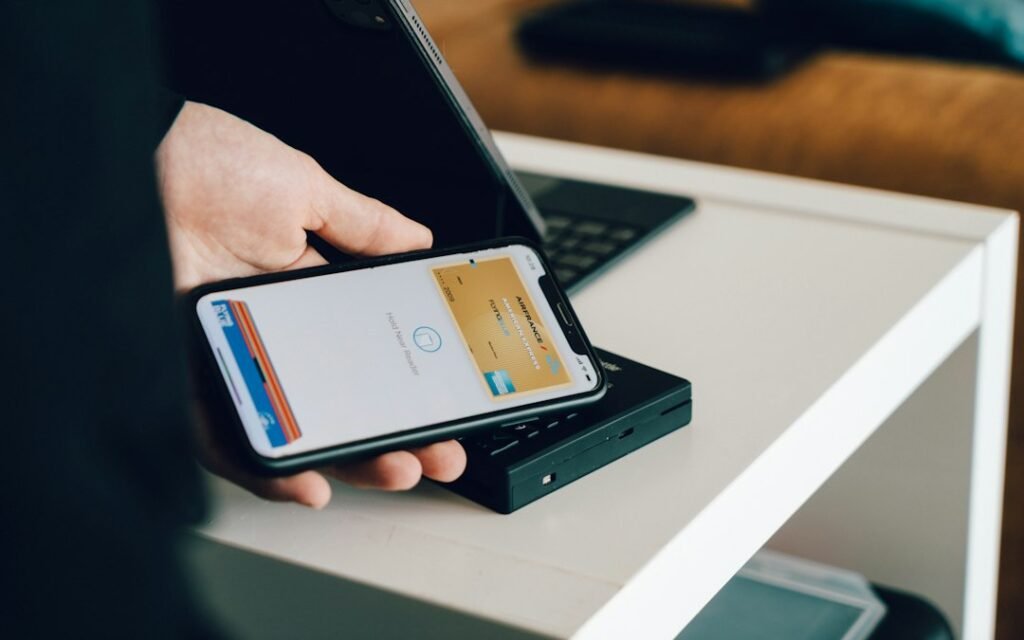
From 15 September 2025, NPCI raised the limits for person-to-merchant (P2M) payments in selected categories. These higher limits work only when the merchant is verified by NPCI. In Google Pay, a verified merchant shows a green tick next to its banking name, and the app shows a message like “You can pay up to ₹X” before you enter your PIN.
| Merchant category | Per transaction | Total per day |
|---|---|---|
| Capital markets (mutual funds, broking) | ₹5 lakh | ₹10 lakh |
| Insurance premiums | ₹5 lakh | ₹10 lakh |
| Government e-Marketplace (EMD) | ₹5 lakh | ₹10 lakh |
| Travel | ₹5 lakh | ₹10 lakh |
| Credit card bill payments | ₹5 lakh | ₹6 lakh |
| Collections (loan EMIs etc.) | ₹5 lakh | ₹10 lakh |
| Business/merchant (pre-approved) | ₹5 lakh | No separate daily cap listed |
| Jewellery | ₹2 lakh | ₹6 lakh |
| FX retail through BBPS | ₹5 lakh | ₹5 lakh |
| Digital account opening: term deposits | ₹5 lakh | ₹5 lakh |
| Digital account opening: initial funding | ₹2 lakh | ₹2 lakh |
| Tax payments | ₹5 lakh | ₹10 lakh |
| Hospitals and education | ₹5 lakh | ₹10 lakh |
| IPO and RBI Retail Direct (G-Secs) | ₹5 lakh | ₹15 lakh |
Source: Google Pay India help page on standard UPI limits, based on NPCI rules, checked on 30 October 2026. A payment can still fail if your own bank keeps a lower limit. HDFC Bank’s UPI page, for example, still lists ₹2 lakh per transaction for capital markets and ₹5 lakh for IPO applications, and SBI lists ₹2 lakh for insurance and capital markets. If a large payment fails, check with your bank.
Example: paying a ₹3 lakh insurance premium
Suppose your annual health insurance premium is ₹3 lakh. If the insurer is a verified merchant and your bank allows the full NPCI ceiling, one UPI payment of ₹3 lakh can go through, because the insurance limit is ₹5 lakh per payment. If your bank caps insurance payments at ₹2 lakh, the same payment will be declined. In that case, pay ₹3 lakh through net banking or the insurer’s other payment options, or ask your bank about its current limit before the due date.
Limits for new users and new devices
When you register UPI for the first time, add a bank account again, or reset your UPI PIN, a cooling period applies. This is a fraud check, not a bug.
- Android: up to ₹5,000 in the first 24 hours.
- iPhone: Google Pay allows ₹5,000 every 24 hours for the first 3 days (₹15,000 in total). SBI says ₹5,000 per day for the first 5 days on iOS. The exact period depends on the bank and app.
After this window ends, the full limit applies on its own. You do not need to apply for it. Plan big payments around this: if your rent of ₹25,000 is due on the 1st, do not change phones or reset your PIN on the 30th.
UPI Lite and other usage limits
UPI Lite is a small on-device balance for quick payments without a PIN. Since RBI’s change announced in December 2024, one UPI Lite payment can be up to ₹1,000 and the UPI Lite balance can hold up to ₹5,000. Read our guide on how to use UPI Lite for setup steps.
NPCI also added limits on system checks from 1 August 2025. These do not move money, but you may see an error if you cross them:
- Balance checks: 50 per day in each UPI app.
- Viewing the list of linked accounts: 25 times per day.
- Status checks for a pending payment: 3 per day, with at least 90 seconds between checks.
- AutoPay mandates run outside peak hours: before 10 am, between 1 pm and 5 pm, and after 9:30 pm.
Maximum limit of UPI by app and bank
Because the cap belongs to the bank account, the app you choose does not change it. What does change is how each bank applies the count and category rules:
| Bank or app | Regular daily limit | Count rule | Guide |
|---|---|---|---|
| SBI | ₹1 lakh (P2P and P2M) | 20 P2P a day; no count limit for P2M | SBI UPI limit |
| HDFC Bank | ₹1 lakh (P2P and P2M) | 20 transactions, P2P and P2M together | HDFC UPI limit |
| Google Pay | Your bank’s limit | 20 a day and 150 in 30 days (P2P) | Google Pay limit |
| Paytm | Your bank’s limit | Most banks: about 20 a day | Paytm limit |
Common mistakes that cause declined UPI payments
- Thinking the limit resets at midnight. It runs on a rolling 24 hours, as the example above shows.
- Switching apps to get a fresh ₹1 lakh. The same bank account carries the same used-up limit in every app.
- Paying a big bill to an unverified merchant. Without NPCI verification, the normal ₹1 lakh cap applies even for insurance or school fees.
- Resetting the PIN just before a large payment. The ₹5,000 cooling limit starts again.
- Counting only the amount. Twenty small transfers can block you even if you have sent far less than ₹1 lakh.
What to do when you hit the maximum limit of UPI

- Wait for the 24-hour window to move. Count from the time of each payment in that window.
- Pay from a different bank account. The ₹1 lakh limit applies to each bank account, not to your phone or app.
- Use IMPS, NEFT or RTGS from net banking for large transfers to people. RBI sets no minimum or maximum for NEFT, RTGS is meant for ₹2 lakh and above, and IMPS works 24×7. Your bank sets the actual daily caps for each.
- For large merchant payments, check that the merchant shows as verified. Otherwise the normal ₹1 lakh cap applies.
- If a payment failed but money left your account, read UPI transaction failed: when you get your money back.
There is no setting that lifts the P2P cap. Our guide on how to increase UPI limit explains which workarounds are real and which are scams.
Safety tips for high-value UPI payments
- You enter your UPI PIN only to send money, never to receive it.
- No bank or app asks for your UPI PIN or OTP to “increase” or “unlock” a limit. Calls offering this are fraud.
- Check the payee’s verified banking name on the screen before you enter the PIN.
- Save the UPI reference number (UTR) for every large payment.
- If you are cheated, call the national cybercrime helpline 1930 and inform your bank at once.
FAQs
What is the maximum limit of UPI per day?
For transfers to people and normal shop payments, it is ₹1 lakh per bank account in 24 hours. Verified merchants in categories like insurance, tax, IPO and hospitals allow more, up to ₹10 lakh or ₹15 lakh a day.
What is the maximum limit of UPI per transaction?
₹1 lakh for P2P and normal merchants. Up to ₹5 lakh for verified merchants in eligible categories (₹2 lakh for jewellery), subject to your bank’s own limit.
Can I send ₹2 lakh to a friend through UPI in one day?
Not from one bank account. You can send ₹1 lakh from each of two different bank accounts, or use IMPS or NEFT for the full amount.
Is the UPI limit different on Google Pay, PhonePe and Paytm?
No. The limit comes from NPCI and your bank. Paytm’s help page says the same: the app does not set a separate limit.
Does the UPI limit reset at midnight?
Usually it works on a rolling 24-hour basis, as HDFC Bank and Google Pay state. Some banks may count differently, so check in your app if a payment is declined.
Is there a charge for crossing the UPI limit?
No. HDFC Bank’s FAQ says the payment is simply denied. No money is deducted for a declined payment.
Does UPI Lite count toward the ₹1 lakh limit?
UPI Lite runs from a separate on-device balance of up to ₹5,000. How a bank counts top-ups and Lite payments may vary by bank/app; check in your app.
Conclusion
For everyday use, think of the maximum limit of UPI as ₹1 lakh a day per bank account, with about 20 transfers a day. For big, planned payments like insurance, tax, mutual funds or hospital bills, a verified merchant can take up to ₹5 lakh in one go, if your bank allows it. For anything else above ₹1 lakh, use IMPS, NEFT or RTGS. Browse all our UPI guides or more personal finance guides.
Sources: NPCI, Google Pay Help: Standard UPI transaction limits, HDFC Bank UPI limit page, SBI YONO blog on UPI limits, Paytm support, RBI. Checked 30 October 2026.
This guide is for general information only. Limits and features can change; check your bank or UPI app for the latest details. FIIAndDIIData.com is not affiliated with NPCI or any UPI app.