The simplest answer to how to save money for a wedding is to fix a full-cost target, add inflation and a buffer, and save a fixed sum every month in safe deposits that mature before the wedding date. A wedding that costs ₹10 lakh today needs about ₹13.1 lakh in three years, and with retail inflation at 5.54% in September 2026 and food inflation at 7.74%, waiting to plan only makes the number bigger.
Key Takeaways
- CAIT estimated 46 lakh weddings and ₹6.5 lakh crore of spending in the 2025 season, about ₹14.1 lakh per wedding on average.
- A ₹10 lakh wedding today needs about ₹13.1 lakh in three years once you add 6% yearly cost growth and a 10% buffer.
- With ₹2 lakh already saved, that target needs about ₹26,600 a month for 36 months at a 7% return.
- Money needed within three years belongs in FDs, RDs or Post Office time deposits, which paid 6.9% to 7.1% for 1 to 3 years in Oct to Dec 2026.
- Gifts received on the occasion of your own marriage are not taxed, even from friends, as per the Income Tax Department.
Table of contents
- How Much Does a Wedding Cost in India?
- How to Save Money for a Wedding: Set the Real Target
- A Worked 3-Year Wedding Savings Plan
- Where to Keep Your Wedding Fund
- Wedding Loan vs Saving: What Borrowing Really Costs
- Wedding Gifts, Gold and Tax Rules
- How to Save Money for a Wedding Without These Mistakes
- Wedding Fund Checklist: From 3 Years to the Big Day
- FAQs
- The Bottom Line
How Much Does a Wedding Cost in India?
There is no official survey of household wedding budgets in India, so the best public benchmark comes from trade estimates. The Confederation of All India Traders (CAIT) estimated that about 46 lakh weddings would take place between 1 November and 14 December 2025, generating about ₹6.5 lakh crore of business, as reported on 31 October 2025.
Divide one by the other and the average comes to roughly ₹14.1 lakh per wedding. Treat that as a rough guide, not a target. A few very large weddings pull the average up, and most middle-class families spend far less. CAIT’s breakdown also shows where the money goes: jewellery about 15% of spending, clothes and sarees 10%, catering 10%, and event management 5%.
The lesson for your own plan is simple. Jewellery, food and clothes are the big three, and all three rise with prices. That is why the number you write down today will not be the number you pay later. The next section shows how to build the real target.
How to Save Money for a Wedding: Set the Real Target
A good wedding target has three layers. First, today’s cost of the wedding you actually want. Second, the extra cost from price rises until the wedding date. Third, a buffer for things that always come up late, such as extra guests, outfit alterations and travel for relatives.
Take a wedding that costs ₹10 lakh at today’s prices, planned three years from now. CPI inflation, the change in the Consumer Price Index that tracks everyday prices, was 5.54% in September 2026 as per MoSPI, and food inflation was higher at 7.74%. Since catering and jewellery tend to rise faster than average, we assume 6% a year for this example.

- Cost today: ₹10.0 lakh
- Cost after three years at 6% a year: ₹11.9 lakh
- Plus a 10% buffer: ₹13.1 lakh
Split the wedding budget before you start saving
Break the target into categories so every family member knows the limits. It also tells you early which item to cut if savings fall behind. Here is one sample split of the ₹11.9 lakh base cost. The shares are our illustration, not a rule.
| Category | Share | Amount |
|---|---|---|
| Venue and catering | 35% | ₹4.17 lakh |
| Jewellery | 20% | ₹2.38 lakh |
| Decor, photography and music | 13% | ₹1.55 lakh |
| Clothes and makeup | 12% | ₹1.43 lakh |
| Travel and guest stay | 10% | ₹1.19 lakh |
| Gifts and rituals | 10% | ₹1.19 lakh |
| Buffer (kept separate) | 10% extra | ₹1.19 lakh |
| Total target | ₹13.1 lakh |
If both families or both partners share the cost, agree on who pays for which rows now, not a month before the wedding. With the target and split in place, you can work out the monthly number.
A Worked 3-Year Wedding Savings Plan
Assume the couple already has ₹2 lakh set aside for the wedding and keeps it in Post Office time deposits at about 7%. Over three years, that ₹2 lakh grows to about ₹2.47 lakh. The rest of the ₹13.1 lakh target must come from monthly saving, which we also assume earns 7% a year in deposits.
| Time to wedding | Target (6% growth + 10% buffer) | ₹2 lakh savings grows to | Monthly saving needed |
|---|---|---|---|
| 2 years | ₹12.4 lakh | ₹2.30 lakh | ₹39,180 |
| 3 years | ₹13.1 lakh | ₹2.47 lakh | ₹26,624 |
| 4 years | ₹13.9 lakh | ₹2.65 lakh | ₹20,353 |
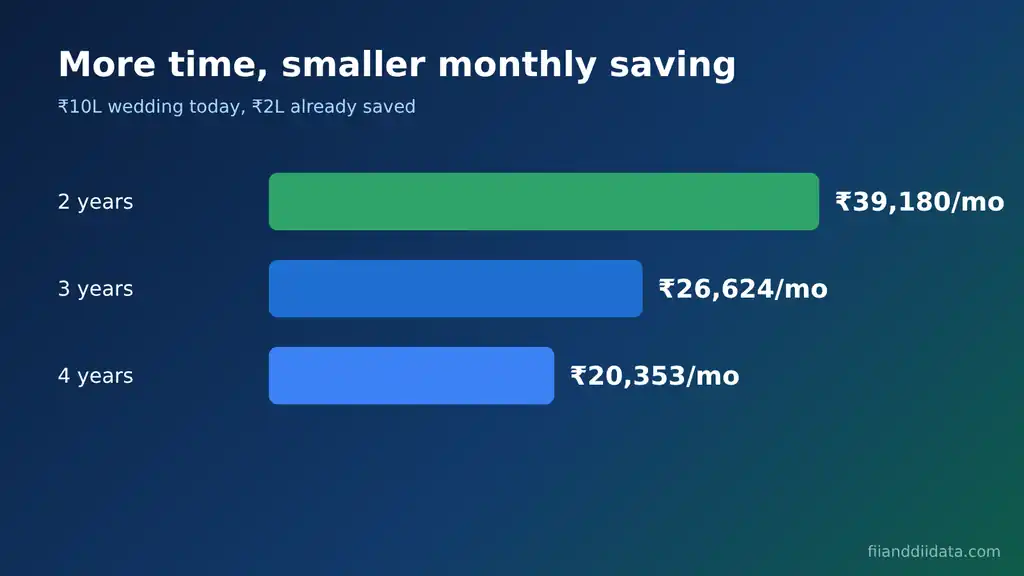
Time is the strongest lever. Moving from a two-year plan to a four-year plan cuts the monthly amount by almost half, even though the target itself rises. If the couple ignores inflation and the buffer and saves only for ₹10 lakh, they would put away about ₹18,860 a month and still fall about ₹3.1 lakh short on the wedding date.
How to save money for a wedding faster
- Open a separate wedding account. Money mixed with your salary account gets spent on daily life.
- Automate on salary day. Set a recurring deposit or standing instruction for the day after salary credit.
- Add windfalls. Putting a ₹50,000 bonus into the fund at the end of years one and two lowers the 3-year monthly amount from ₹26,624 to about ₹23,840.
- Trim the budget, not the plan. The 50 30 20 budgeting rule shows how to fit a fixed goal into your monthly spending.
- Cut guest count first. Catering is charged per plate, so every 50 guests removed saves a visible amount.
- Book early, in the off-season if you can. Venues and decorators price peak dates higher.
Our guide to setting financial goals with inflation uses the same method for any dated goal. Once the monthly figure is clear, the next question is where to park it.
Where to Keep Your Wedding Fund
A wedding has a fixed date that rarely moves. That makes safety more important than return. A 15% fall in an equity fund six months before the wedding cannot be waited out, because the caterer still needs to be paid.
For the October to December 2026 quarter, the government kept small savings rates unchanged. Post Office time deposits (TDs) pay 6.9% for one year, 7.0% for two years, 7.1% for three years and 7.5% for five years, with quarterly compounding. At 7.1%, ₹1 lakh in a 3-year Post Office TD grows to about ₹1.24 lakh.
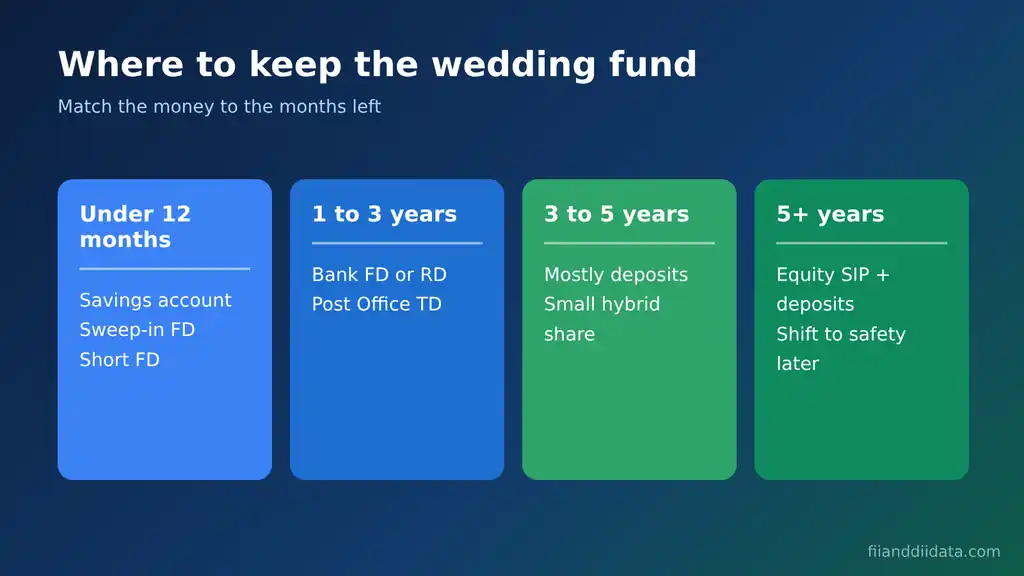
| Time left to the wedding | Suitable options | Why |
|---|---|---|
| Under 12 months | Savings account, sweep-in FD, short FD | Money must be ready and stable |
| 1 to 3 years | Bank FD or RD, Post Office 1 to 3 year TD (6.9% to 7.1%) | Fixed, known returns |
| 3 to 5 years | Mostly deposits, Post Office 5-year TD (7.5%), small hybrid share | Some growth, low risk |
| More than 5 years | Equity SIP plus deposits, shift to safety two years before | Time to recover from market falls |
Match deposit maturity dates to the vendor payment schedule, not just the wedding day. Advances for venues and jewellery are often paid months earlier. Parents planning a child’s wedding 10 or more years away can use equity, but should move it to deposits as the date gets close. Large foreign and domestic fund flows can swing markets sharply in a short time, which you can track on our FII and DII data page. Keep your emergency fund separate too, so a medical bill does not eat the wedding money. If saving still falls short, many families think of a loan, so let us price one.
Wedding Loan vs Saving: What Borrowing Really Costs
A “wedding loan” is usually just a personal loan. It is unsecured, so the rate depends on your income, employer and credit score, and it is normally much higher than what a deposit earns. Check the actual rate on your bank’s own website before you decide.
To see the cost, take the ₹3.1 lakh shortfall from the earlier example. At an illustrative rate of 12% a year for three years:
- EMI: about ₹10,300 a month for 36 months.
- Total interest paid: about ₹60,700.
- The same ₹3.1 lakh saved in advance would have earned interest instead of costing it.
The bigger risk is timing. The EMI starts right when a new couple is setting up a home, and it can delay goals like an emergency fund or a house down payment. If you must borrow, keep it small, compare the full cost including processing fees, and avoid unregulated loan apps. Some costs, though, can be eased by knowing the tax rules on gifts.
Wedding Gifts, Gold and Tax Rules
Many couples receive cash and jewellery that can fund part of the wedding or the first year after it. The Income Tax Department’s guide on gifts, which reflects the Income-tax Act, 2025 as amended by the Finance Act, 2026, sets out the rules clearly:
- Gifts received on the occasion of the marriage of the individual are not taxed, whether they come from relatives or friends.
- Outside marriage, gifts from non-relatives are taxed in full once the total in a year exceeds ₹50,000.
- Jewellery, shares and bullion count as “prescribed movable property”, so the same ₹50,000 rule applies to them.
- Gifts from relatives, such as parents, siblings and their spouses, are not taxed on any occasion.
The marriage exemption applies to the bride or groom, not to their parents. Keep a simple list of who gave what, with bank transfer records, so you can show the source later if needed. For gold, buying small amounts over time spreads the price risk instead of buying everything in the final month. Next, the mistakes that most often break a wedding budget.
How to Save Money for a Wedding Without These Mistakes
- Planning at today’s prices. In our example this alone leaves a ₹3.1 lakh gap.
- No buffer. Late additions to the guest list and last-minute shopping are almost certain.
- Equity money due within two years. A market fall near the date forces you to sell at a loss.
- Using the emergency fund or retirement savings. It leaves the new household exposed.
- Not agreeing on who pays. Unclear sharing between families leads to double spending or gaps.
- Paying advances without receipts. Always get written terms for cancellation and refunds.
- Borrowing on credit cards. Revolving card dues cost far more than a planned loan.
More everyday slips are covered in our list of common money mistakes to avoid. To stay on track, use a simple timeline.
Wedding Fund Checklist: From 3 Years to the Big Day
| When | What to do |
|---|---|
| 36 months before | Fix guest count range, city and total target; open a separate account; start the monthly transfer |
| 24 months before | Review the target for price changes; move any equity money into deposits |
| 12 months before | Book venue and key vendors; match FD maturities to advance payment dates |
| 6 months before | Buy jewellery in parts; confirm the buffer is untouched |
| 1 month before | Keep final payments in a savings or sweep account; track every payment in one sheet |
| After the wedding | Record gifts received; move leftover money to the emergency fund or next goal |
FAQs
How to save money for a wedding in India on a middle-class salary?
Write down today’s cost of the wedding you want, add about 6% a year for price rises and a 10% buffer, and divide the gap by the months left. Open a separate account, automate the transfer on salary day and keep money due within three years in FDs, RDs or Post Office deposits.
How much does an average Indian wedding cost?
CAIT estimated about 46 lakh weddings and ₹6.5 lakh crore of spending in the 1 November to 14 December 2025 season, which works out to about ₹14.1 lakh per wedding. Large weddings pull this average up, so many families spend much less.
How much should I save every month for a wedding?
In our example, a ₹10 lakh wedding at today’s prices needs about ₹13.1 lakh in three years. With ₹2 lakh already saved and a 7% return, that means about ₹26,600 a month, or about ₹20,350 a month if you have four years.
Is it better to take a personal loan for a wedding or save?
Saving is cheaper. A loan of ₹3.1 lakh at an illustrative 12% for three years costs about ₹60,700 in interest, while the same money saved earns interest. If you must borrow, keep the amount small and compare full costs from regulated lenders.
Are wedding gifts taxable in India?
Gifts received on the occasion of your own marriage are not taxed, even from friends, as per the Income Tax Department. On other occasions, gifts from non-relatives become fully taxable once their total in a year exceeds ₹50,000.
The Bottom Line
Saving for a wedding works best when the target is honest. Start from today’s cost, add price rises and a buffer, split it by category and agree on who pays what. Then turn the gap into one monthly number and automate it.
Keep the money safe as the date gets closer, because a wedding date does not wait for markets to recover. Every year of extra lead time lowers the monthly burden and reduces the need to borrow. Your next step: write down the wedding year, guest range and today’s cost, and work out your monthly figure using the table above. For more guides, visit our blog.
Sources: Income Tax Department, Tax treatment of gifts received by an individual or HUF (Income-tax Act, 2025 as amended by Finance Act, 2026); Indian Bank, small savings scheme rates (1 Oct to 31 Dec 2026); MoSPI, CPI press release for September 2026; CAIT wedding season estimate as reported by Angel One (31 October 2025).
Disclaimer: This article is for educational purposes only and is not investment advice. Please consult a SEBI-registered advisor before making investment decisions. Rates and rules change; check the latest terms with your bank, post office or the Income Tax Department.