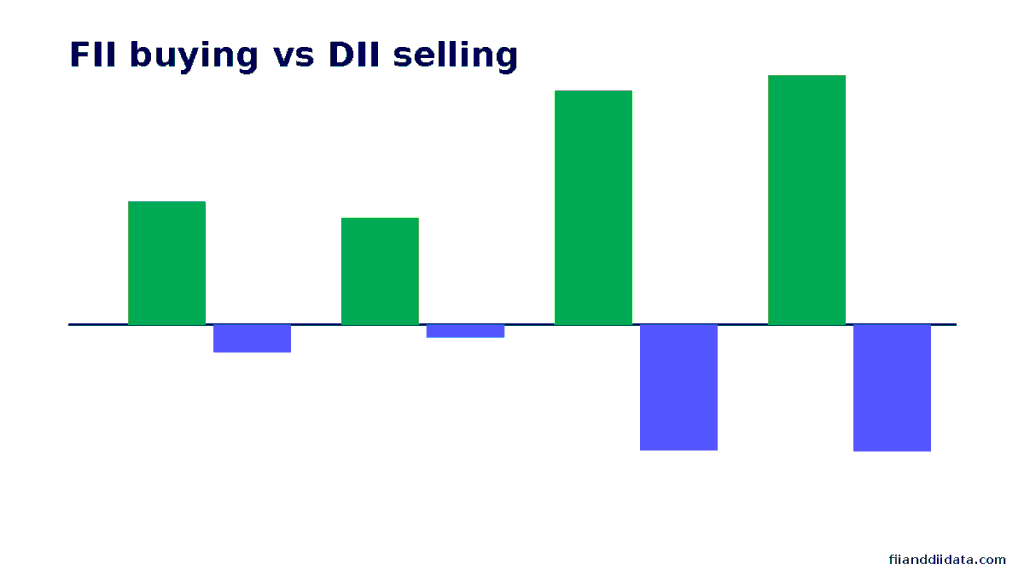
The FII buying streak in Indian equities stretched to four sessions on Wednesday, 4 November 2026, as foreign institutional investors bought a net ₹7,284 crore in the cash market. That is their biggest single-day purchase since 28 October 2025, and it came while domestic institutions sold ₹3,712 crore. After a month of heavy foreign selling, the money is coming back fast, and the Nifty closed at a two-month high of 23,960.60.
Key Takeaways
- FIIs have net bought ₹20,835 crore across four sessions from 30 October to 4 November 2026.
- DIIs sold ₹8,601 crore over the same four days, booking profit after buying ₹62,220 crore in October.
- Cheaper crude, a firmer rupee near 94.6 per dollar and falling bond yields set up the turn.
- The Nifty rose 5.6% in five sessions, but FII index futures were still net short as of 3 November.
In this article:
- FII buying streak: the day-by-day numbers
- Why DIIs sold into the rally
- What pulled foreign money back
- How to read a buying streak: a worked example
- Will the FII buying streak last? A 5-point checklist
- Common mistakes traders make with streaks
- FAQs
- The Bottom Line
FII Buying Streak: The Day-by-Day Numbers
Foreign institutional investors (FIIs, also called foreign portfolio investors or FPIs) turned buyers on 30 October and have not stopped since. Each day’s figure below is the provisional cash-market number, which NSE releases around 6 PM IST. NSDL publishes final FPI figures on the next working day, so small revisions are normal. You can track every session on our FII DII data today page.
| Date | FII net (₹ crore) | DII net (₹ crore) | Combined net (₹ crore) |
|---|---|---|---|
| 30 Oct 2026 | +3,599 | -818 | +2,781 |
| 2 Nov 2026 | +3,115 | -392 | +2,723 |
| 3 Nov 2026 | +6,837 | -3,679 | +3,158 |
| 4 Nov 2026 | +7,284 | -3,712 | +3,572 |
| 4-day total | +20,835 | -8,601 | +12,234 |
Two things stand out. The daily amounts are getting bigger, and the three November sessions alone add up to ₹17,236 crore of foreign buying. Compare that with October 2026, when FIIs sold a net ₹45,162 crore, according to NiftyTrader. Our report on the ₹6,837 crore session covered Tuesday; Wednesday topped it. So who was on the other side of these trades?
Why DIIs Sold Into the Rally
Domestic institutional investors (DIIs) include mutual funds, insurers, banks and pension funds. They were the market’s main support in October, buying ₹62,220 crore while foreign funds sold. Now the roles have flipped. DIIs have been net sellers for four straight sessions.
When prices rise quickly, fund managers often trim holdings that have run up, rebalance toward cash, or meet redemptions. With the Nifty up 5.6% in five sessions, according to Business Standard, some profit booking is expected. You can compare these swings over a longer period on our monthly FII DII data page.
What Pulled Foreign Money Back
Several pressure points behind October’s selling eased at the same time.
Crude oil and the rupee behind the FII buying streak
Brent crude fell more than 7% on Monday, 2 November, on hopes of a US-Iran deal, and traded near $102.50 on Wednesday afternoon, well below last week’s six-month high near $118, as reported by Business Standard. Lower oil reduces India’s import bill and supports the rupee. The rupee firmed to about 94.6 per dollar on 4 November, a two-week high, and is now 2.4% above its May record low of 96.96. A steadier rupee means smaller currency losses for foreign investors.
Bond yields and the US midterm result
The 10-year government bond yield fell to about 7.26%, its third straight decline. Markets also read the Democratic sweep in the US midterm elections as a possible push toward ending the West Asia crisis. Independent analyst Ambareesh Baliga added a caution: “Trump’s reaction is more important than the poll outcome.”
How to Read a Buying Streak: A Worked Example
A useful way to read the numbers is to look at net institutional flow, which is FII net plus DII net.
- On 4 November: ₹7,284 crore (FII) minus ₹3,712 crore (DII) = ₹3,572 crore of net institutional buying.
- DII selling offset about 51% of FII buying that day (3,712 divided by 7,284).
- Over four sessions: ₹20,835 crore minus ₹8,601 crore = ₹12,234 crore, with DIIs offsetting about 41%.
The takeaway: the headline FII number overstates the push on prices. Net flow of ₹3,572 crore was still strong enough to lift broader indices, with the Nifty Midcap 100 up 1.55% and the Nifty Smallcap 250 up 1.97% on Wednesday. The Sensex closed 0.50% higher at 77,301.40, and the Nifty gained 0.63% to 23,960.60, according to Kotak Neo. Not every sector joined in, though. The Nifty IT index fell 1.5%.
Will the FII Buying Streak Last? A 5-Point Checklist
We use these five checks before treating a short run of foreign buying as a real change in direction.
- Confirm with NSDL. Match the provisional NSE figures with NSDL’s final FPI data the next working day.
- Watch index futures positioning. As of 3 November, FIIs were still net short about 2.03 lakh index futures contracts, though they added 30,442 contracts on the long side that day, per Quantsapp. Cash buying with a large futures short can partly reflect hedged trades. Our participant-wise open interest data shows this daily.
- Track crude and the rupee. If Brent climbs back toward $118 or the rupee slips toward 96, the main support for this buying weakens.
- Check breadth. On 4 November only 88 Nifty 500 stocks fell. Broad buying is healthier than buying in a few heavyweights.
- Look at DII capacity. If DIIs keep selling into strength, the market depends more on foreign money. SIP inflows give DIIs room to buy dips.
Right now, checks three and four look positive, while check two is mixed.
Common Mistakes Traders Make With Streaks
- Treating one record day as a trend. Four sessions follow a month of heavy selling.
- Ignoring the DII side. The net institutional flow is what matters for price, not the FII figure alone.
- Calling the data real time. Official numbers come after the close. Intraday estimates are guesses.
- Buying only because FIIs bought. IT fell even on a strong day. Stock selection still matters.
- Skipping the macro. Crude, the rupee and US policy moved this streak. A reversal in any of them can end it.
For more context, see our coverage of FII buying in November 2026, which covers the first day of this run.
FAQs
What is an FII buying streak?
An FII buying streak is a run of consecutive trading sessions in which foreign institutional investors are net buyers in the cash market. As of 4 November 2026, the current streak is four sessions long, with total net buying of ₹20,835 crore.
How much have FIIs bought in November 2026 so far?
Based on provisional NSE data, FIIs net bought ₹3,115 crore on 2 November, ₹6,837 crore on 3 November and ₹7,284 crore on 4 November 2026. That adds up to ₹17,236 crore in the first three sessions of the month.
Why are DIIs selling when FIIs are buying?
DIIs often book profit when prices rise quickly. After buying ₹62,220 crore in October 2026, they sold ₹8,601 crore over the four sessions to 4 November as the Nifty rallied 5.6% in five sessions.
When is FII DII data released each day?
NSE releases provisional FII and DII cash market figures around 6 PM IST on trading days. NSDL publishes final FPI data on the next working day. The figures are not available in real time during trading hours.
Does FII buying mean the market will keep rising?
Not necessarily. FII buying supports prices, but the trend depends on crude oil, the rupee, global rates and earnings. As of 3 November, FIIs were still net short in index futures, so the signal is not yet one-sided.
The Bottom Line
Foreign investors have bought ₹20,835 crore of Indian shares in four sessions, and Wednesday’s ₹7,284 crore was their largest single day in more than a year. Cheaper oil, a firmer rupee and lower yields made India attractive again.
Still, the run is young, DIIs are selling into it, and FIIs were still net short in index futures as of 3 November. The practical next step: check the NSDL final figures and the next few sessions of FII and DII data before changing your portfolio based on this rally.
Sources: Trendlyne FII DII data (4 Nov 2026); Business Standard (4 Nov 2026); Kotak Neo (4 Nov 2026); Quantsapp (3 Nov 2026); NiftyTrader FII DII data (3 Nov 2026). More analysis on our blog.
Disclaimer: This article is for educational purposes only and is not investment advice. Please consult a SEBI-registered advisor before making investment decisions.