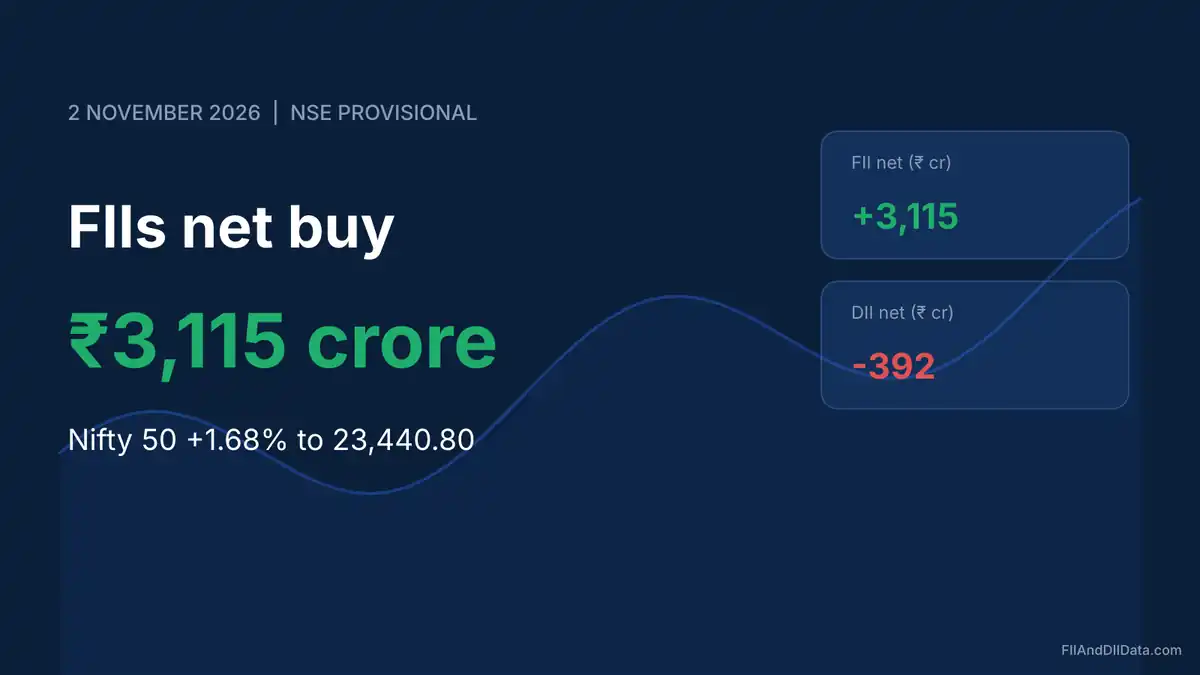
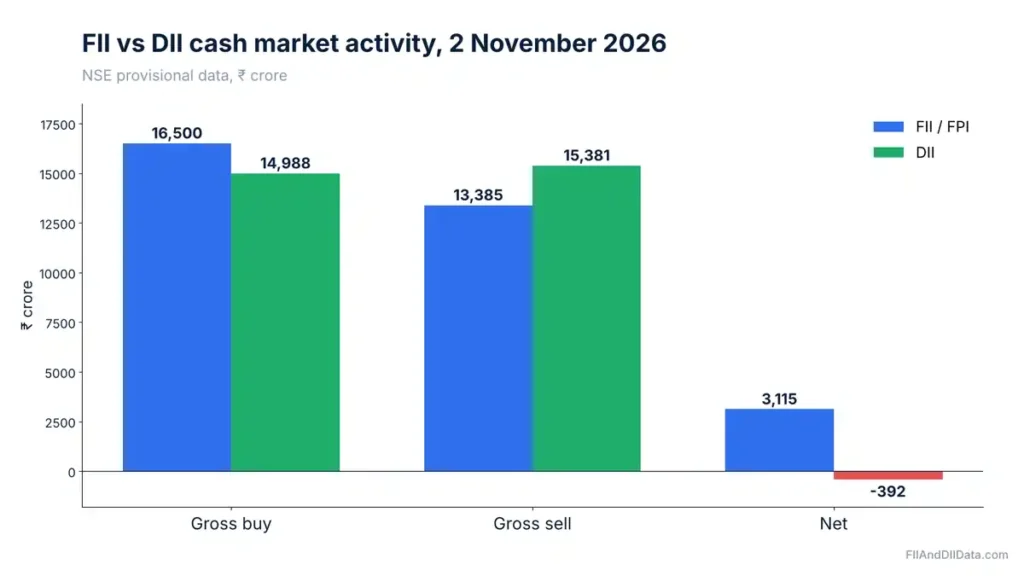
FII buying November 2026 started with a clear signal: foreign institutional investors bought a net ₹3,115 crore of Indian shares on Monday, 2 November, while domestic institutions sold ₹392 crore. The Nifty 50 jumped 1.68% to 23,440.80, its third straight gain. After a month in which FIIs sold more than ₹45,000 crore, investors now want to know if this is a turn or a pause.
Key Takeaways
- FIIs bought a net ₹3,114.70 crore in the cash market on 2 November 2026 (NSE provisional data).
- DIIs were small net sellers at ₹392.20 crore, a rare role swap after October.
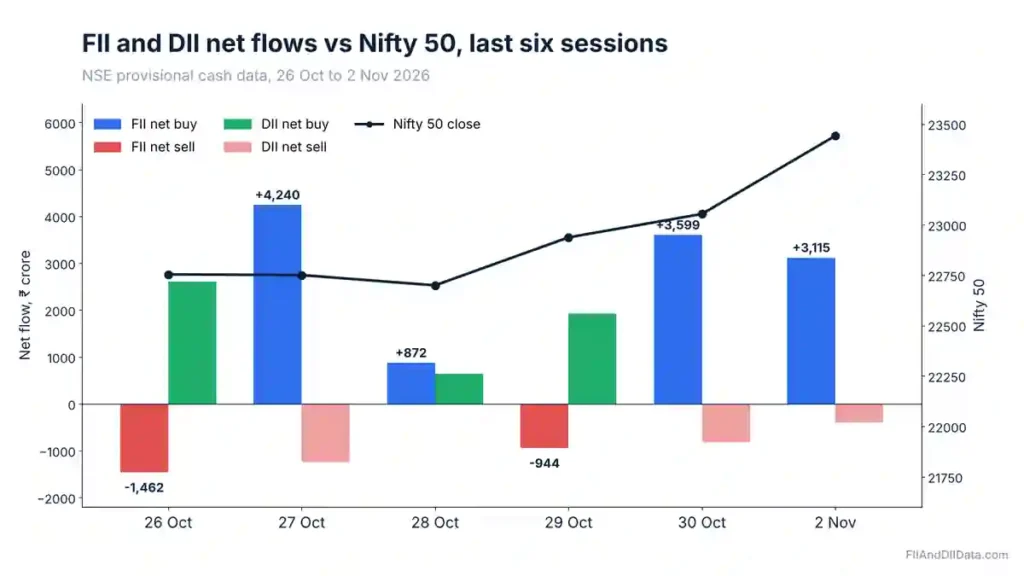
- Over the last six sessions, FIIs net bought about ₹9,420 crore and were buyers on four of six days.
- Reliance rose 11.6% after record quarterly profit and Brent crude eased to about $110.
- One strong day does not reverse ₹45,162 crore of October selling. Watch the next five sessions.
In this article:
- What happened on 2 November
- Six sessions of FII and DII data
- Why FIIs turned buyers
- How to read the numbers: a worked example
- What could stop the buying
- Checklist: 5 signals to track
- FAQ
- The Bottom Line
FII Buying November 2026: What Happened on 2 November
NSE provisional figures show FIIs bought shares worth ₹16,499.50 crore and sold ₹13,384.80 crore on 2 November, leaving a net purchase of ₹3,114.70 crore. DIIs bought ₹14,988.50 crore and sold ₹15,380.70 crore, a net sale of ₹392.20 crore. You can track each day on our FII DII data today page, which updates after NSE releases its provisional data around 6 PM IST.
The market reaction was strong. The Sensex rose 1,233.25 points (1.66%) to 75,692.78 and the Nifty 50 gained 387.70 points to 23,440.80, according to IIFL Securities’ closing report. Bank Nifty added 0.58% to 55,002.20. So who was doing the buying, and why now?
Six Sessions of FII and DII Data: Is This a Real Shift?
A single day can mislead. The better test is the recent run of data. The table below combines the last week of October with 2 November.
| Date | FII net (₹ cr) | DII net (₹ cr) | Nifty 50 close |
|---|---|---|---|
| 26 Oct | -1,462 | +2,610 | 22,753.20 |
| 27 Oct | +4,240 | -1,250 | 22,749.75 |
| 28 Oct | +872 | +643 | 22,698.85 |
| 29 Oct | -944 | +1,924 | 22,936.75 |
| 30 Oct | +3,599 | -818 | 23,053.10 |
| 2 Nov | +3,115 | -392 | 23,440.80 |
| Total | +9,420 | +2,717 | +3.0% |
FIIs were net buyers on four of the six days and added about ₹9,420 crore in total. The Nifty rose about 3.0% from the 26 October close. IIFL Securities also reported that foreign portfolio investors bought ₹13,213.41 crore of Indian equities in the last week of October, a figure that includes deals outside the exchange cash market. Our weekly FII DII report for the week ending 30 October has the full breakdown.
Why FIIs Turned Buyers
Crude oil cooled
Brent crude fell about 3% to near $110 a barrel on 2 November, down from a high of $118 the week before, as talks involving Iran and Qatar raised hopes of easing tension. Lower oil helps India’s import bill and the rupee, two things foreign funds watch closely.
Reliance results lifted the index
Reliance Industries jumped 11.60% to ₹1,300 after reporting its highest-ever quarterly profit of ₹29,550 crore, up 33.8% year on year. With a weight of about 7.3% in the Nifty 50, it was the biggest contributor to the day’s gain. Nifty Energy rose 3.92% and Nifty Metal 3.21%, while Nifty IT slipped 0.50%.
A rotation away from AI-heavy markets
The Nasdaq fell nearly 2.9% on Friday on AI-spending concerns. Market strategist V K Vijayakumar noted that a weaker AI trade can push global funds toward cheaper markets such as India. If that rotation continues, it supports more FII buying in November 2026. But how much does ₹3,115 crore really move the needle?
How to Read FII Buying November 2026 Numbers: A Worked Example
Net figures hide the size of trading. Here is how we read the 2 November data in three steps:
- Gross activity: FIIs traded ₹16,499.50 + ₹13,384.80 = ₹29,884.30 crore. The net buy of ₹3,114.70 crore is about 10.4% of that. A net share above 10% shows a clear one-sided bias.
- Context against October: FIIs sold a net ₹45,161.71 crore in October (NSE provisional). The six-session buying of ₹9,420 crore covers only about 21% of that outflow.
- Index impact: Reliance’s 11.6% rise multiplied by its 7.3% weight adds roughly 0.85 percentage points, about half of the Nifty’s 1.68% gain. The rally was narrower than the headline suggests.
Compare these numbers with the full history on our FII DII monthly data page. Next, the risks that could cut this run short.
What Could Stop the FII Buying Streak
- A weak rupee: The rupee closed at 94.86 per dollar on 2 November, down 10 paise, as per PTI. Currency losses reduce returns for foreign investors.
- High US yields: The US 10-year Treasury yield stood at 4.927% on 2 November. Safe returns near 5% make emerging markets less attractive.
- Event risk: US midterm elections on 3 November and the next round of crude headlines can swing global risk appetite.
- Tax uncertainty: SEBI has reportedly asked the government to remove the 12.5% long-term capital gains tax for foreign investors, according to a Reuters report carried by Business Standard. It is only a pre-Budget proposal, and foreign outflows this year have reached a record $31 billion.
Our earlier analysis on whether FIIs will come back to India covers these drivers in more depth. So what should you track this week?
Checklist: 5 Signals to Track This Week
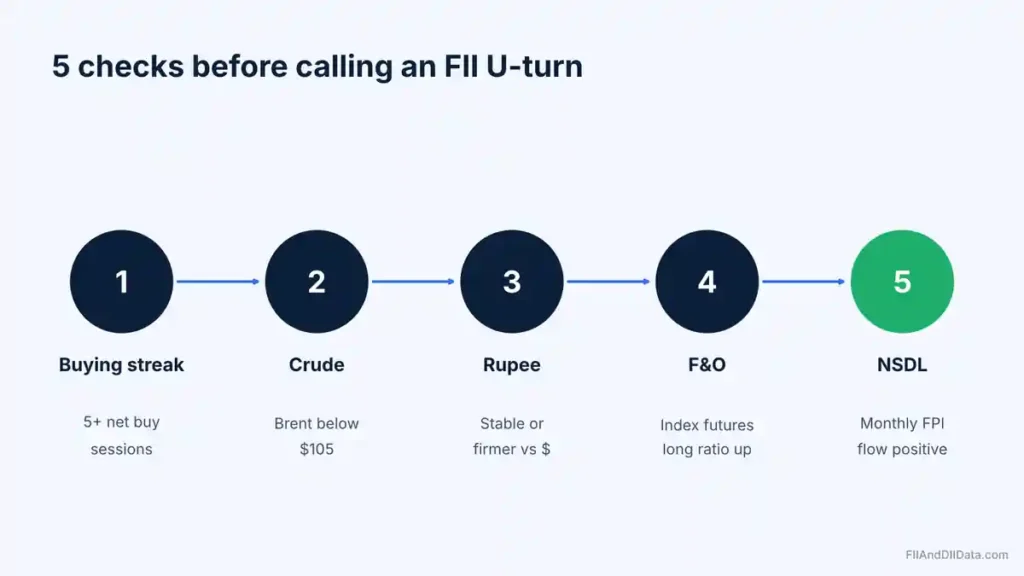
- Buying streak: Look for five or more net buy sessions in a row in the cash market.
- Crude: Brent holding below $105 would ease pressure on India’s import bill.
- Rupee: A stable or firmer rupee against the dollar makes Indian assets cheaper for foreign funds.
- F&O positioning: A rising FII long ratio in index futures shows conviction. Check our participant-wise open interest and FII options activity tracker.
- NSDL monthly flow: November FPI data turning positive on a depository basis confirms the trend.
Common mistakes when reading FII buying November 2026 data
- Treating one day of buying as a new trend.
- Mixing NSE provisional figures with NSDL data, which also counts primary market deals such as IPOs.
- Ignoring DII flows. DIIs bought ₹62,220.11 crore in October and absorbed most of the FII selling.
FAQ
How much did FIIs buy on 2 November 2026?
FIIs bought a net ₹3,114.70 crore in the cash market on 2 November 2026, as per NSE provisional data. DIIs sold a net ₹392.20 crore.
Is FII buying November 2026 a trend reversal?
Not yet. FIIs bought about ₹9,420 crore over six sessions, which covers roughly 21% of the ₹45,162 crore they sold in October. A longer streak and positive NSDL data would make the case stronger.
Why did the Nifty rise on 2 November 2026?
The Nifty 50 rose 1.68% to 23,440.80 as Reliance jumped 11.6% on record profit, Brent crude eased to near $110 and FIIs turned net buyers.
When is FII DII data released?
NSE releases provisional FII and DII cash market data around 6 PM IST on trading days. NSDL publishes final FPI data on the next working day.
Why did DIIs sell on 2 November?
DIIs often book profits when FIIs buy and prices rise. Their ₹392 crore net sale is small compared with the ₹62,220 crore they bought in October.
The Bottom Line
November has opened with real foreign buying, softer crude and a strong Reliance result. Four buying days out of six is a clear change from October, and the Nifty has gained about 3% over that stretch.
Still, the buying so far covers only about a fifth of October’s outflow, and the rupee and US yields remain under pressure. Treat this as an early signal, not a confirmed turn. Your next step: check the daily figures on our FII and DII data dashboard each evening and tick off the five signals above before changing your positions.
Sources: NSE provisional cash market data via 5paisa and Trendlyne (2 Nov 2026); IIFL Securities closing report (2 Nov 2026); Business Standard / Reuters (2 Nov 2026); PTI rupee report via HDFC Sky (2 Nov 2026); FIIAndDIIData.com weekly report (30 Oct 2026).
Disclaimer: This article is for educational purposes only and is not investment advice. Please consult a SEBI-registered advisor before making investment decisions.