DII increased stake stocks are companies where domestic institutions, mainly mutual funds, insurers, banks and pension funds, held a bigger share at the end of a quarter than at the start. In the September 2026 quarter (Q2 FY27), DIIs lifted their stake in Pondy Oxides from 7.50% to 9.61% and in Filatex India from 2.84% to 4.59%, while DII ownership of the Nifty 500 hit a record 21.3%. Here is the list, what it means, and how to check it yourself.
Key Takeaways
- DII ownership of the Nifty 500 reached a record 21.3% in September 2026, the tenth straight quarterly rise (Motilal Oswal).
- Among stocks we tracked, the biggest DII stake jumps in Q2 FY27 came in Pondy Oxides (+2.11 points), Filatex India (+1.75) and Bhagyanagar India (+1.71).
- Mutual funds alone raised their stake in Bharat Forge from 20.74% to 21.57% between June and September 2026.
- DII buying is not one-way: in Laurus Labs, DII holding fell from 13.7% to 11.9% while FPIs bought.
- Always confirm the change in the exchange shareholding pattern, which companies must file within 21 days of quarter end.
Table of contents
- What are DII increased stake stocks?
- DII ownership in September 2026: the big picture
- DII increased stake stocks in Q2 FY27: the list
- How to read a DII stake change (worked example)
- How to verify a DII stake increase in 5 steps
- How investors use DII stake data: a checklist
- Common mistakes when following DII buying
- DII vs FII stake changes: how they compare
- FAQ
- The Bottom Line
What Are DII Increased Stake Stocks?
A domestic institutional investor (DII) is an Indian institution that invests pooled money in the stock market. The group includes mutual funds, insurance companies such as LIC, banks, and pension and provident funds. Every listed company reports how much of its equity each of these groups owns at the end of every quarter.
When the DII percentage rises from one quarter to the next, the stock is called a DII increased stake stock. The change is measured in percentage points. If DIIs owned 7.50% in June and 9.61% in September, the stake rose by 2.11 points. If you are new to the two investor groups, our guide on the difference between FII and DII explains who sits in each bucket.
Why DII increased stake stocks get attention
Institutions have research teams, long holding periods and steady monthly inflows from SIPs and insurance premiums. A rising DII stake can show that professional money is building a position. It does not guarantee returns, but it is a useful starting point for research. The next section shows how large that domestic money pool has become.
DII Ownership in September 2026: The Big Picture
According to Motilal Oswal’s October 2026 strategy report, as reported on 30 October 2026, DIIs held 21.3% of the Nifty 500 at the end of September 2026. That was up 120 basis points from a year earlier and 30 basis points from June, and it was the tenth quarter in a row of gains. In the Nifty 50, DII ownership rose to 26.2% from 24.7% a year before.
The same report shows DIIs own 22.7% of large caps, 19.8% of mid caps and 17.5% of small caps. By sector, their highest holdings were in private banks (39.1%), internet and new-age technology (32.5%), consumer (23.6%), telecom (23.3%) and capital goods (22.8%). Over the year, DIIs raised holdings in 20 of 28 sectors, led by private banks (+550 bps), insurance (+390 bps) and telecom (+310 bps).
This matters because foreign investors were heavy sellers in 2026. You can see that tug of war in our FII selling vs DII buying 2026 analysis and in the daily FII DII data today summary.

DII Increased Stake Stocks in Q2 FY27: The List
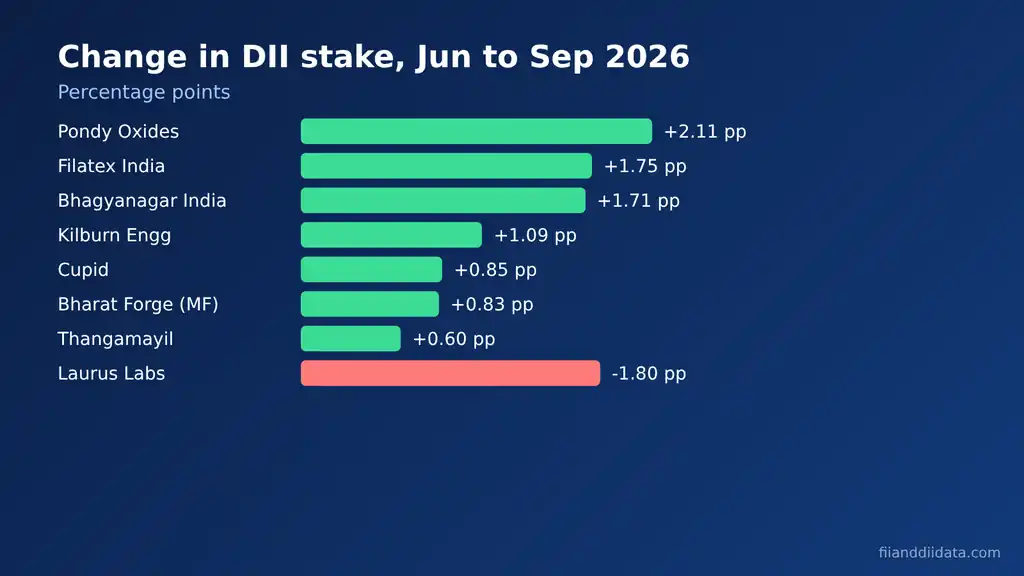
The table below collects stock-level changes between the June 2026 and September 2026 quarters from shareholding data published in October 2026. It is a sample of disclosed moves, not a full screen of every listed company. We show the change in percentage points and the relative change, which tells you how much the DII position grew compared with its own starting size.
| Stock | DII stake Jun 2026 | DII stake Sep 2026 | Change (pts) | Relative change |
|---|---|---|---|---|
| Pondy Oxides & Chemicals | 7.50% | 9.61% | +2.11 | +28.1% |
| Filatex India | 2.84% | 4.59% | +1.75 | +61.6% |
| Bhagyanagar India | 0.20% | 1.91% | +1.71 | +855% |
| Kilburn Engineering | 7.64% | 8.73% | +1.09 | +14.3% |
| Cupid | 0.34% | 1.19% | +0.85 | +250% |
| Thangamayil Jewellery | 16.43% | 17.03% | +0.60 | +3.7% |
| Bharat Forge (mutual funds only) | 20.74% | 21.57% | +0.83 | +4.0% |
| Granules India (mutual funds only) | 3.45% | 4.18% | +0.73 | +21.2% |
| Laurus Labs (for contrast) | 13.7% | 11.9% | -1.80 | -13.1% |
Three patterns stand out. First, the biggest point gains came in small companies, where a single fund can move the number. Second, in Cupid, Bhagyanagar India and Filatex India, promoters and FIIs also raised their stakes in the same quarter, so institutions and owners moved together. Third, Laurus Labs shows the opposite case: FPIs raised their stake from 28% to 30.8% while DIIs trimmed theirs.
Where mutual funds added in September 2026
Monthly fund portfolios give an earlier read than quarterly filings. In September 2026 portfolios, several schemes added Bharti Airtel, PPFAS Flexi Cap raised its Indus Towers holding from 8.66 lakh to 71.46 lakh shares, and SBI Large Cap added 98 lakh Kotak Mahindra Bank shares to reach 5.78 crore shares. These are scheme-level moves, so they show direction rather than total DII buying.
How to Read a DII Stake Change (Worked Example)
A stake change looks simple, but the same number can mean very different things. Two measures help you read it properly.
Example 1: Pondy Oxides. DIIs owned 7.50% in June and 9.61% in September 2026. The point change is 9.61 minus 7.50, or 2.11 points. The relative change is 2.11 divided by 7.50, or about 28.1%. In plain terms, the DII position grew by more than a quarter in three months.
Example 2: Bharat Forge. Mutual funds raised their stake from 20.74% to 21.57%, a gain of 0.83 points. On 5 October 2026 the company’s market value was about ₹89,945 crore. So 0.83% of the company is worth roughly ₹747 crore at that valuation. The relative change is only about 4%, because funds already owned a large slice.
Note that the rupee figure uses one day’s market value. Funds bought across the quarter at different prices, so treat it as a size check, not the amount spent. The lesson: a small point change in a large company can be a bigger money commitment than a large point change in a small one.
How to Verify a DII Stake Increase in 5 Steps
Under SEBI’s listing rules (Regulation 31 of the LODR Regulations), companies must file their shareholding pattern within 21 days from the end of each quarter. So September 2026 data was due by 21 October 2026. Here is how to check any stock.
- Open the company page on the NSE or BSE website.
- Go to the Shareholding Pattern section under corporate filings.
- Open the latest quarter and the quarter before it.
- Find “Institutions (Domestic)” in the public shareholding table and note the percentage.
- Look at the sub-rows to see whether mutual funds, insurers, banks or others drove the change.
Our explainer on the FII shareholding pattern walks through the same filing for foreign investors, so you can read both sides from one document.

How Investors Use DII Stake Data: A Checklist
Treat a rising DII stake as a filter, not a buy signal. Before you act on any name from a list of DII increased stake stocks, run through this checklist.
- Check the base. A jump from 0.20% to 1.91% is large in relative terms but still a small holding.
- Check who bought. Mutual funds, insurers and banks have different goals and time frames.
- Check two or more quarters. A steady rise, like Pondy Oxides from 0.14% in September 2024 to 9.61% in September 2026, says more than one quarter.
- Check the other holders. Note whether promoters and FIIs are buying or selling in the same quarter.
- Check valuation and liquidity. Institutional buying can push small stocks to high price-to-earnings levels.
- Check the date. The filing reflects the position on the last day of the quarter, which may have changed since.
For the market-wide picture, pair the stock view with daily flows on our FII and DII data dashboard and with monthly fund flows in our mutual fund equity inflow report. Those flows explain where the buying money comes from.
Common Mistakes When Following DII Buying
Treating the list as a recommendation. Funds buy for many reasons, including index weights, new fund launches and portfolio balancing. A stake rise is not an endorsement for your own goals.
Ignoring the time lag. Quarterly data can be up to three weeks old when it is filed and three months old by the next filing. Prices may already reflect the buying.
Mixing up points and percent. A rise from 2.84% to 4.59% is 1.75 points, not 1.75%. In relative terms it is a 61.6% increase in the DII position.
Looking only at small caps. Big money often moves in large caps, where point changes look small. The Bharat Forge example shows why rupee size matters.
DII vs FII Stake Changes: How They Compare
DII and FII stake data come from the same filing but often tell different stories. The table below sums up the main differences.
| Point | DII stake change | FII stake change |
|---|---|---|
| Main money source | SIPs, insurance premiums, pension savings | Global funds, driven by dollar flows |
| Typical behaviour in 2026 | Steady buyer; record Nifty 500 ownership | Net seller for most of the year |
| Faster data | Monthly mutual fund portfolios | Daily NSE and NSDL flows, fortnightly sector data |
| Example, Q2 FY27 | Pondy Oxides 7.50% to 9.61% | Laurus Labs 28% to 30.8% |
For the foreign side of the same quarter, see our list of stocks where FIIs increased holding in Q2 FY27. Stocks where both groups added in the same quarter, such as Filatex India (FIIs 4.03% to 6.33%, DIIs 2.84% to 4.59%), deserve a closer look.
FAQ
Which are the DII increased stake stocks in Q2 FY27?
In the stocks we tracked for the September 2026 quarter, DIIs raised their stake most in Pondy Oxides (7.50% to 9.61%), Filatex India (2.84% to 4.59%), Bhagyanagar India (0.20% to 1.91%) and Kilburn Engineering (7.64% to 8.73%). Mutual funds also raised their stake in Bharat Forge from 20.74% to 21.57%.
What does it mean when DIIs increase their stake?
It means Indian institutions such as mutual funds, insurers and banks owned a larger share of the company at the end of the quarter than at the start. It shows professional interest, but it is not a guarantee of future returns.
Where can I check DII holding in a stock?
Open the company page on the NSE or BSE website and go to the Shareholding Pattern section. Compare the Institutions (Domestic) percentage for the latest two quarters.
When is shareholding pattern data released?
Listed companies must file it within 21 days from the end of each quarter under SEBI rules. For the September 2026 quarter, the deadline was 21 October 2026.
Is DII buying good for a stock?
Steady DII buying can support prices, especially when foreign investors are selling. It is still only one input. Check valuation, earnings, debt and the size of the holding before deciding.
The Bottom Line
Domestic institutions kept adding to Indian equities through the September 2026 quarter, taking their Nifty 500 ownership to a record 21.3%. At the stock level, DII increased stake stocks in Q2 FY27 ranged from small caps like Pondy Oxides and Filatex India to a large cap like Bharat Forge, where mutual funds added about 0.83 points.
These moves are a useful research filter, but they are not buy calls. Funds buy and sell for many reasons, and the data is weeks old by the time it is public. Use the five-step check to confirm any change in the exchange filing, then judge the business on its own merits.
As a next step, pick one stock from the table, open its last four shareholding patterns, and see whether the DII trend is steady or a one-quarter spike. For more market explainers, browse the FIIAndDIIData.com blog.
Sources: INDIA IPO, Motilal Oswal ownership data (30 Oct 2026); Trade Brains, FII, DII and promoter stake changes (27 Oct 2026); Trade Brains, mutual fund stake changes (5 Oct 2026); Business Standard, Laurus Labs shareholding (27 Oct 2026); Trade Brains, Pondy Oxides institutional stake (27 Oct 2026); INDmoney, stocks bought by mutual funds in September 2026 (12 Oct 2026); SEBI LODR Regulations, Regulation 31.
Disclaimer: This article is for educational purposes only and is not investment advice. Please consult a SEBI-registered advisor before making investment decisions.