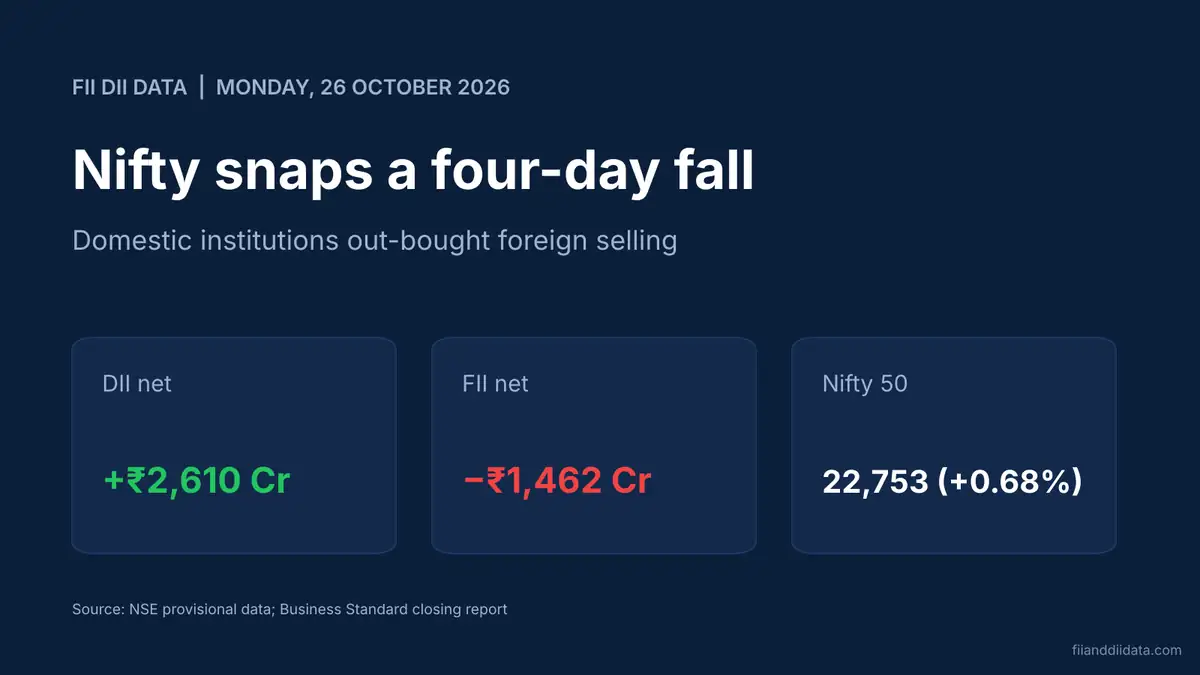
The list of FII holding increase stocks Q2 FY27 is short but telling: foreign investors raised their stake in companies such as Groww, Shyam Metalics, HFCL and HCL Technologies in the September 2026 quarter, even while selling Indian equities heavily overall. Groww saw the biggest jump among the filings we tracked, with FII holding rising 4.01 percentage points to 10.90%. This guide shows the data, explains why it happened and how to use it without getting trapped.
Key Takeaways
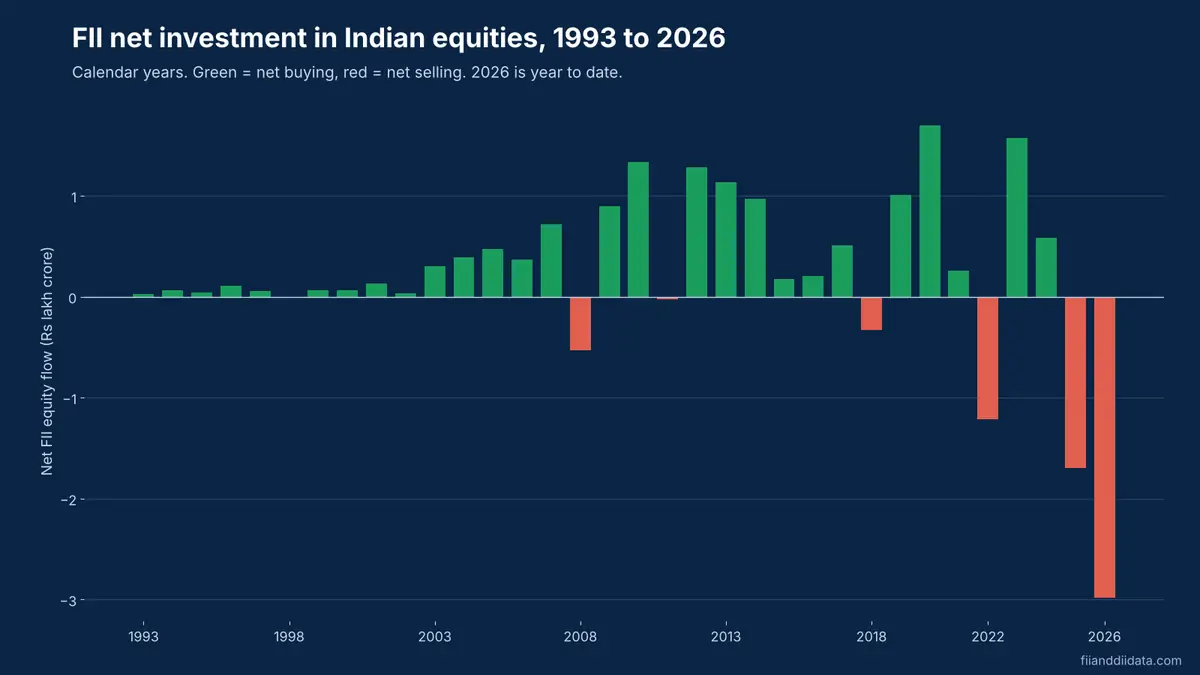
- FIIs raised stakes in select stocks in Q2 FY27 (July to September 2026) despite selling close to ₹3 lakh crore of Indian equities in 2026.
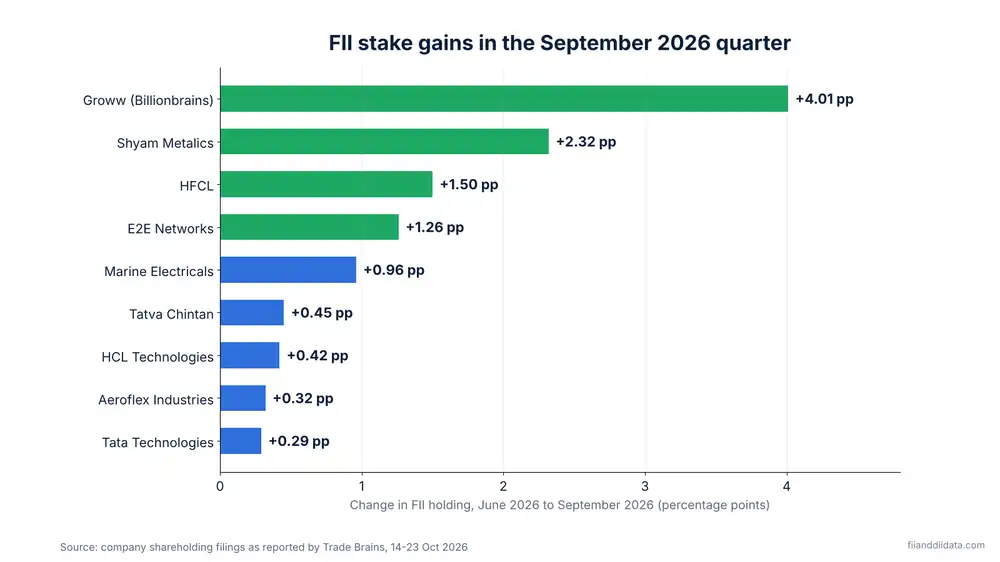
- Groww (+4.01 points), Shyam Metalics (+2.32), HFCL (+1.50) and E2E Networks (+1.26) posted the largest quarter-on-quarter gains in our data set.
- Large caps such as Eternal, Tech Mahindra and Nestle India also showed higher FII holding against the March 2026 quarter.
- A stake change in percentage points is not the same as fresh buying; buybacks, QIPs and new listings can move the number.
- Use FII stake data as a starting filter, then check results, valuation and price trend before acting.
In this article
- What an FII holding increase means
- FII holding increase stocks Q2 FY27: the data
- Large caps where FIIs added over six months
- Why FIIs bought these stocks while selling India
- How to read a stake change: worked example
- How to use FII holding increase stocks Q2 FY27 data
- Common mistakes when following FII buying
- Frequently asked questions
- The Bottom Line
What an FII Holding Increase Means in a Shareholding Pattern
Every listed company in India files a shareholding pattern with the stock exchanges each quarter. Under SEBI’s listing rules, this filing is due within 21 days of the quarter end, so data for the quarter ended 30 September 2026 was largely out by 21 October 2026. The pattern splits ownership into promoters, foreign institutional investors (FIIs, now officially called foreign portfolio investors or FPIs), domestic institutional investors (DIIs such as mutual funds and insurers) and the public.
An “FII holding increase” simply means the FII category owned a larger share of the company at the end of the quarter than at the start. It is reported as a percentage of total shares, and the change is measured in percentage points. If you are new to these investor groups, our explainer on FII holding vs DII holding covers who sits in each bucket.
Quarterly holding data is slower than the daily flow numbers on our FII DII data dashboard, but it answers a different question. Daily flows tell you how much money moved. Holding data tells you where that money ended up. The next section shows where it went in Q2 FY27.
FII Holding Increase Stocks Q2 FY27: The Data
The table below compiles quarter-on-quarter changes (June 2026 to September 2026) from company filings, as reported by Trade Brains between 14 and 23 October 2026. We sorted the stocks by the size of the change.
| Stock | FII holding, June 2026 | FII holding, Sept 2026 | Change (pp) |
|---|---|---|---|
| Groww (Billionbrains Garage Ventures) | 6.89% | 10.90% | +4.01 |
| Shyam Metalics and Energy | 2.97% | 5.29% | +2.32 |
| HFCL | 15.74% | 17.24% | +1.50 |
| E2E Networks | 1.27% | 2.53% | +1.26 |
| Marine Electricals (India) | 1.12% | 2.08% | +0.96 |
| Tatva Chintan Pharma Chem | 3.93% | 4.38% | +0.45 |
| HCL Technologies | 14.90% | 15.32% | +0.42 |
| Aeroflex Industries | 3.61% | 3.93% | +0.32 |
| Tata Technologies | 6.30% | 6.59% | +0.29 |
| Anant Raj | 10.74% | 10.96% | +0.22 |
| IREDA | 2.48% | 2.57% | +0.09 |
FII holding increase stocks Q2 FY27: where both FIIs and DIIs bought
In five of these names, domestic institutions also raised their stake in the same quarter. Groww’s DII holding rose from 10.08% to 12.73%, Tata Technologies’ from 4.48% to 5.55% and HCL Technologies’ from 18.75% to 18.95%. Tatva Chintan and IREDA saw smaller DII gains of 0.10 and 0.13 points. When both groups add at the same time, the signal is usually stronger than FII buying alone.
Notice the themes. HFCL, E2E Networks, Anant Raj, Marine Electricals and Aeroflex were grouped by Trade Brains as data centre related plays, a story that drew foreign money even in a weak market. Large established names appear too, which brings us to the six-month view.
Large Caps Where FIIs Added Over Six Months
Upstox published a separate list on 23 October 2026 that compares Q2 FY27 holding with the March 2026 quarter (Q4 FY26). Because the starting point is different, we keep these numbers apart from the table above.
- Eternal: FII holding rose from 29% to 33.01%, a gain of 4.01 points. Upstox noted the stock rallied as much as 30% during the quarter after strong results.
- Tech Mahindra: up from 18.59% to 20.76% (+2.17 points). The stock was near its 52-week high, and new deal wins grew 25%.
- Nestle India: up from 9.74% to 11.70% (+1.96 points).
- Groww: up from 2.5% to 10.9% over the same six months, which shows the June to September jump was part of a longer build-up.
- Yes Bank: FII holding stood at 47.8% in September 2026 against 44.9% a year earlier.
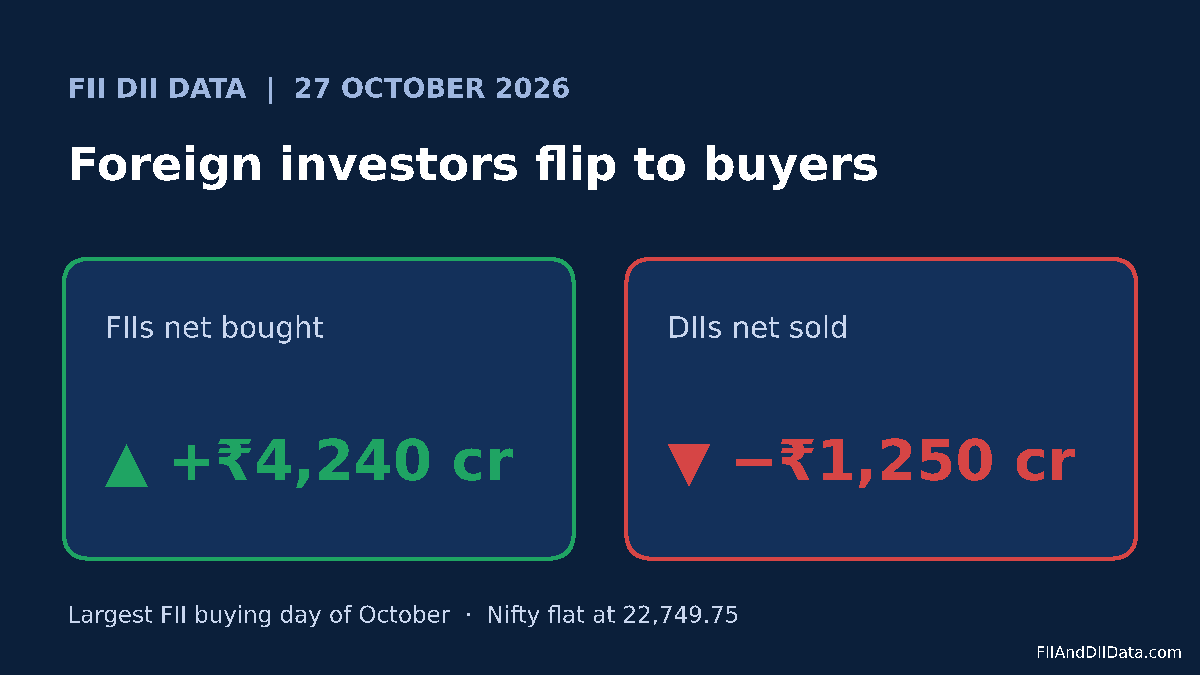
These moves stand out because the wider picture was negative. Upstox noted that FIIs had sold close to ₹3 lakh crore of Indian equities in 2026, and you can see the month-wise trail in our FPI outflow 2026 report. So why did foreign funds add to these particular stocks?
Why FIIs Bought These Stocks While Selling India
Aggregate selling and stock-level buying can happen together. A global fund may cut its overall India weight because of the rupee, crude oil or US bond yields, the factors we covered in why FIIs are selling Indian stocks. Inside that smaller allocation, it can still shift money towards companies it rates highly.
Looking at the Q2 FY27 list, four reasons show up again and again:
- Earnings momentum. Eternal and Tech Mahindra came with strong results or deal wins. Groww reported net profit growth of 54% year on year, according to Upstox.
- Structural themes. Data centres and digital infrastructure attracted money through HFCL, E2E Networks and Anant Raj.
- New listings and float changes. Recently listed companies often see ownership reshuffle as early investors exit and institutions build positions.
- Stock-specific value. Some buying comes after sharp price falls, when a fund sees the risk as already priced in.
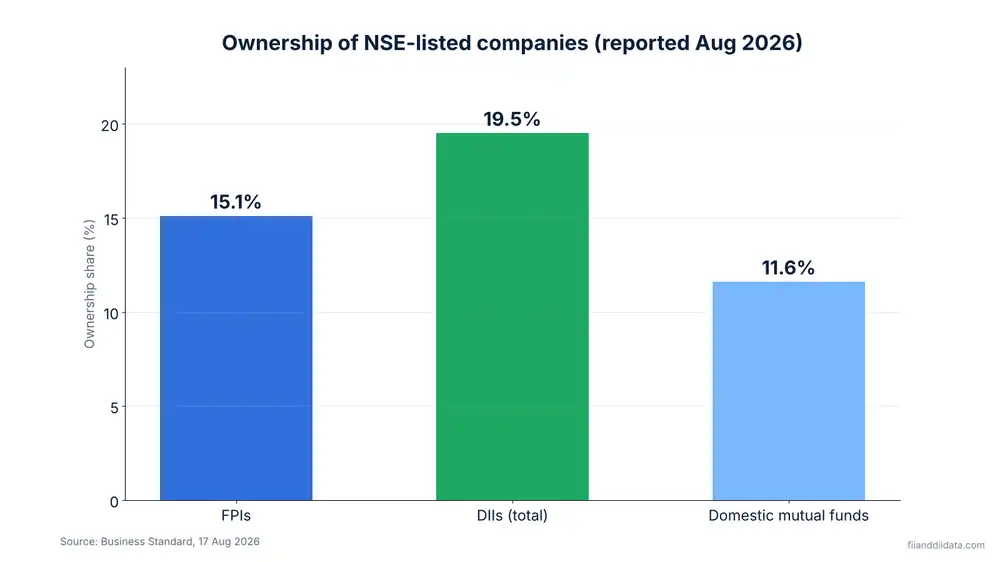
The long-term trend still favours domestic money. Business Standard reported on 17 August 2026 that FPI ownership of NSE-listed companies had fallen to 15.1%, a 17-year low, while DIIs owned 19.5% and domestic mutual funds alone held a record 11.6%. Against that backdrop, any stock where FIIs are adding is worth a closer look, but only with the right method.
How to Read a Stake Change: A Worked Example
Percentages can mislead if you do not know what moved them. Here are three simple cases using a company with 100 crore shares, where FIIs own 10 crore shares (10%).
Case 1: Real buying
FIIs buy 2 crore more shares from the market. Their holding becomes 12 crore out of 100 crore, or 12%. The change is +2 percentage points, and it reflects fresh money.
Case 2: A buyback
The company buys back and cancels 5 crore shares, none of them from FIIs. FIIs still own 10 crore shares, but the total falls to 95 crore. Their holding rises to 10.53% without a single rupee of new investment.
Case 3: Points versus percentage
Groww’s move from 6.89% to 10.90% is +4.01 points, but in relative terms FIIs now own about 58% more of the company than three months earlier. HCL Technologies’ +0.42 points on a 14.90% base is only about 3% more. For a company worth ₹1,00,000 crore, every 1 point of holding equals roughly ₹1,000 crore of shares at a constant price. Always check both the points and the base before you call a change big. With that in mind, here is a practical routine.
How to Use FII Holding Increase Stocks Q2 FY27 Data: A Checklist
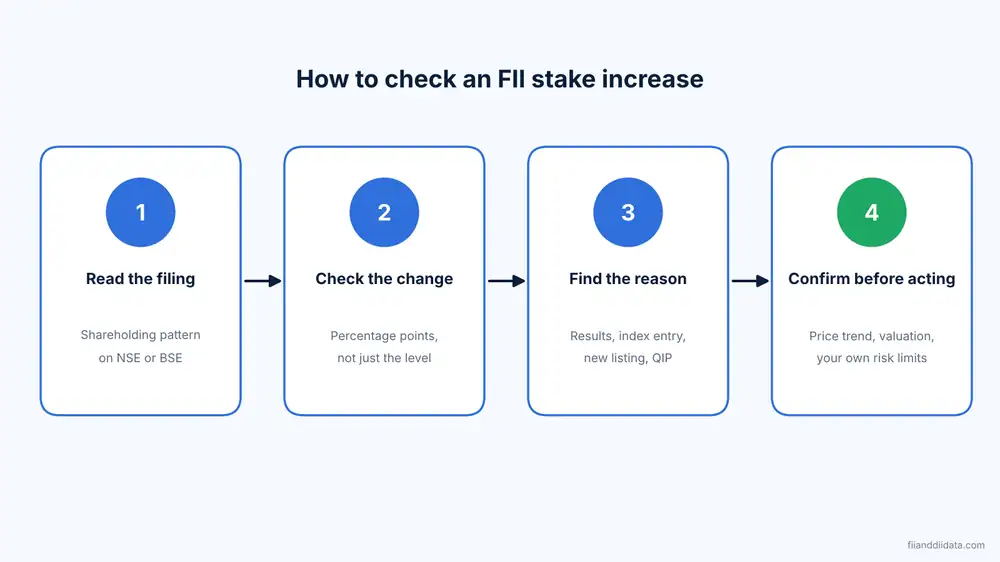
We use a four-step check before treating any FII stake increase as useful information:
- Read the filing. Open the company’s shareholding pattern on the NSE or BSE website and note the FII (FPI) figure for the last two quarters.
- Check the change. Note the percentage point change and the relative change. Ignore moves under about 0.25 points unless they repeat over several quarters.
- Find the reason. Look for a buyback, QIP, preferential issue, new listing or index inclusion. If the share count changed, the holding number may not mean new buying.
- Confirm before acting. Check quarterly results, valuation and the price trend. Then size any position within your own risk limits.
It also helps to compare stock-level data with the market-wide flows on our FII DII monthly data page. A stock that gains FII weight in a month of heavy overall selling tells you more than one that rises with the tide. Even with this routine, investors repeat a few errors.
Common Mistakes When Following FII Buying
- Treating old data as new. A September quarter filing shows the position on 30 September. FIIs may have sold since then.
- Ignoring the price already paid. Eternal rose as much as 30% in the quarter. Buying after such a move carries a different risk from buying alongside the funds.
- Mixing time frames. Some lists compare with the previous quarter, others with six or twelve months ago. Groww’s +4.01 points and +8.4 points are both correct for different periods.
- Forgetting stock-specific news. Upstox reported that Yes Bank fell 23% in six sessions after a Supreme Court ruling on AT-1 bonds, despite high FII ownership. Holding data does not protect you from events.
- Assuming FIIs are always right. Foreign funds have their own mandates, benchmarks and currency risks. Their exit can be just as fast as their entry.
Keeping these points in mind turns a headline list into a research filter. If you want to see how flows may change from here, read our view on whether FIIs will come back to India. For daily numbers, charts and all our free tools, visit our FII and DII data home page. The questions below cover what readers ask most.
Frequently Asked Questions
Which are the FII holding increase stocks in Q2 FY27?
Based on filings reported between 14 and 23 October 2026, FIIs raised their stake quarter on quarter in Groww (+4.01 points), Shyam Metalics (+2.32), HFCL (+1.50), E2E Networks (+1.26), Marine Electricals (+0.96), Tatva Chintan (+0.45), HCL Technologies (+0.42), Aeroflex (+0.32), Tata Technologies (+0.29), Anant Raj (+0.22) and IREDA (+0.09).
How do I check FII holding in a stock?
Open the company page on the NSE or BSE website and go to the shareholding pattern section. The FPI or FII figure shows foreign institutional ownership for each quarter. Compare the latest quarter with the previous one to see the change.
Is an FII stake increase a buy signal?
Not on its own. It shows that large foreign funds found value in the stock, but the data is up to three weeks old when published, and buybacks or new share issues can change the percentage without new buying. Check results, valuation and price trend first.
When is the shareholding pattern released each quarter?
Listed companies must file their shareholding pattern with the exchanges within 21 days of the end of each quarter under SEBI listing rules. For the September 2026 quarter, most filings were out by 21 October 2026.
Why do FIIs buy some stocks when they are selling India overall?
A fund can reduce its total India allocation because of global factors like the dollar, crude oil or US yields, while still moving money into companies with strong earnings or themes it likes. Net selling is the sum of many different buy and sell decisions.
The Bottom Line
The September 2026 quarter shows that foreign investors did not leave India across the board. They cut exposure overall but raised stakes in a focused set of companies, from Groww and Shyam Metalics to HCL Technologies and the data centre group. Those choices tell you where global money still sees growth.
Treat the list as a starting point, not a buy list. Shareholding data is a snapshot taken weeks ago, and share count changes can distort it. As a next step, pick two or three names from the table, run them through the four-step checklist, and track how FII flows evolve on our daily FII DII cash market summary. You can find more guides on our blog.
Sources: Trade Brains, FII and DII stake changes in Q2 FY27 (22 October 2026); Trade Brains, data centre stocks (23 October 2026); Trade Brains, Shyam Metalics stake report (14 October 2026); Upstox, top five stocks with strong FII buying in Q2 FY27 (23 October 2026); Business Standard, FII ownership at 17-year low (17 August 2026).
Disclaimer: This article is for educational purposes only and is not investment advice. Please consult a SEBI-registered advisor before making investment decisions.