The simplest answer to how to save money for a house is this: work out the full cash you need, give it a deadline, and save a fixed amount every month in products that match that deadline. For a ₹60 lakh flat, that cash is close to ₹17.7 lakh, not just the 20% down payment, and with home loan rates rising again after the RBI repo hike of October 2026, a bigger down payment matters more.
Key Takeaways
- RBI rules cap a bank home loan at 90%, 80% or 75% of the property value, so you must fund 10% to 25% yourself.
- Stamp duty, registration and move-in costs come on top of the down payment and vary by state.
- A ₹60 lakh flat bought in 5 years needs about ₹18,700 a month, if you already have ₹3 lakh saved.
- Park money by time left: savings and short FDs under 1 year, FDs and Post Office deposits for 1 to 5 years.
- Every extra ₹6 lakh of down payment on a 20-year loan at 8.25% saves about ₹12.3 lakh of interest.
Table of contents
- How Much Cash You Really Need for a House
- RBI Down Payment Rules Every Buyer Should Know
- How to Save Money for a House: A Worked 5-Year Plan
- Where to Keep Your House Fund
- Check the EMI Before You Fix the Target
- Government Help: PMAY-U 2.0 Interest Subsidy
- How to Save Money for a House Without These Common Mistakes
- Monthly Checklist for Your House Fund
- FAQs
- The Bottom Line
How Much Cash You Really Need for a House
Most first-time buyers plan only for the down payment. The down payment is the part of the price that the bank does not lend, and you pay it from your own money. But the cash you need on the day of purchase is larger than that.
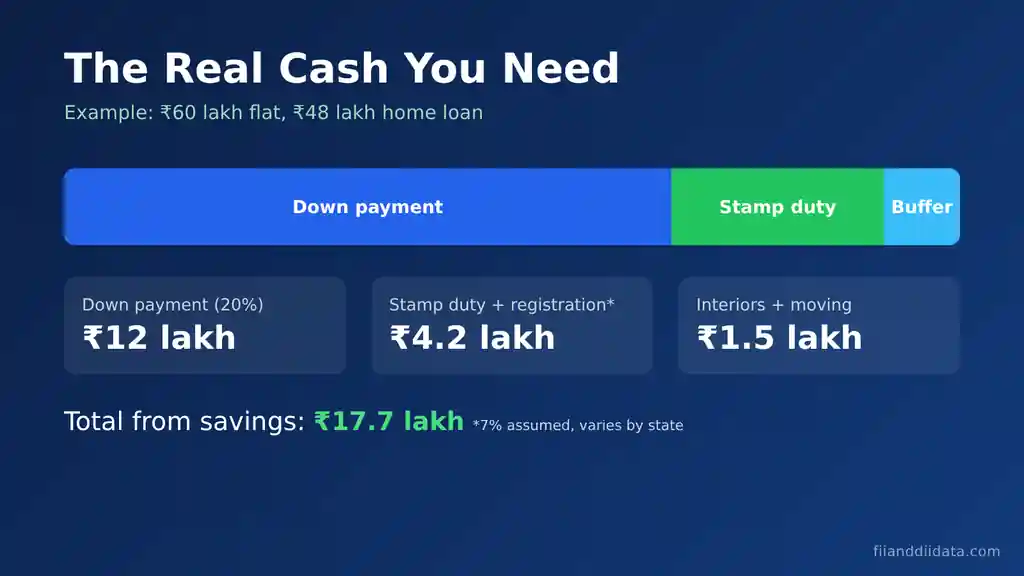
Your real target has four parts:
- Down payment: 10% to 25% of the property value, depending on the loan size (explained in the next section).
- Stamp duty and registration: a state tax and fee to register the sale deed in your name. Rates differ by state and sometimes by the buyer’s gender, so check your state’s registration department website.
- Loan and legal costs: processing fees, legal checks and valuation charges, which vary by lender.
- Move-in buffer: basic furniture, kitchen work, society deposits and the move itself.
Keep these four parts separate from your emergency fund. If you empty your emergency fund for the down payment, one job loss or hospital bill in the first year can push you into a costly personal loan. Once you know the four parts, the next question is how much of the price the bank will cover.
RBI Down Payment Rules Every Buyer Should Know
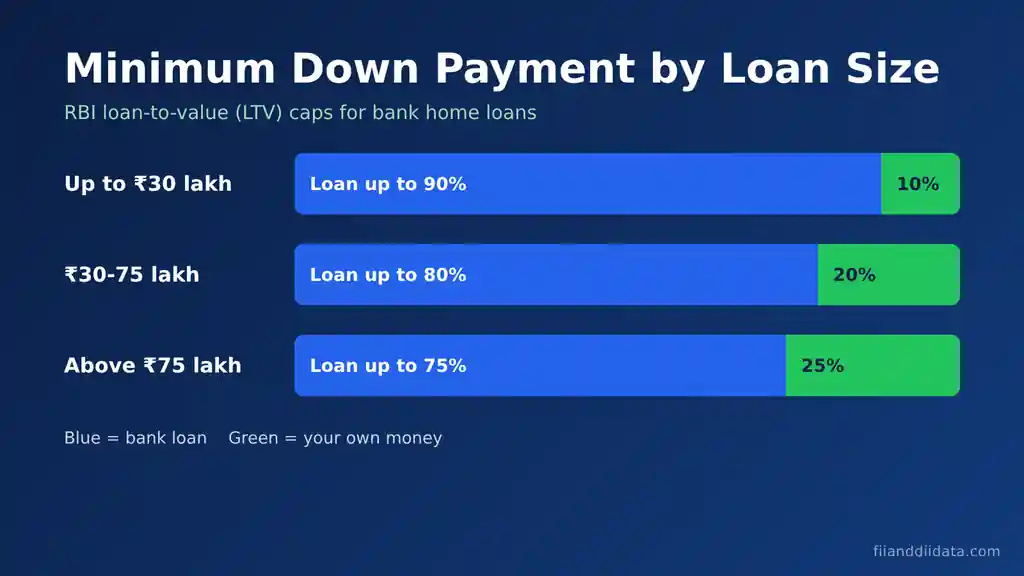
Banks cannot lend you the full price of a house. The Reserve Bank of India sets a loan-to-value (LTV) cap, which is the highest share of the property value a bank may lend. Under the RBI circular on individual housing loans dated 7 June 2017, the caps are:
| Home loan amount | Maximum loan (LTV) | Minimum down payment |
|---|---|---|
| Up to ₹30 lakh | 90% | 10% |
| Above ₹30 lakh to ₹75 lakh | 80% | 20% |
| Above ₹75 lakh | 75% | 25% |
These are ceilings, not promises. A bank can lend less than the cap based on your income, credit score and the property’s legal status. So treat the table as the smallest down payment you can plan for, and aim a little higher if you can.
The slab trap when you save money for a house over 5 years
Property prices move while you save. Suppose a flat costs ₹60 lakh today and prices rise 5% a year (our assumption for illustration, not a forecast). In five years the same flat costs about ₹76.6 lakh. That pushes the purchase into the “above ₹75 lakh” bracket, where the minimum down payment jumps from 20% to 25%. Your target moves from ₹12 lakh to about ₹19.1 lakh just for the down payment. Now let us turn these rules into a monthly number.
How to Save Money for a House: A Worked 5-Year Plan
Here is a worked example for a buyer who wants a ₹60 lakh flat in five years and already has ₹3 lakh saved for it. We assume stamp duty and registration of 7% (it varies by state) and a ₹1.5 lakh move-in buffer. We also assume the savings earn 7% a year, which is close to what safe deposits paid in late 2026.
| Item | Price stays at ₹60 lakh | Price rises 5% a year |
|---|---|---|
| Price at purchase | ₹60 lakh | ₹76.6 lakh |
| Minimum down payment | ₹12 lakh (20%) | ₹19.1 lakh (25%) |
| Stamp duty and registration (7%) | ₹4.2 lakh | ₹5.4 lakh |
| Move-in buffer | ₹1.5 lakh | ₹1.5 lakh |
| Total cash target | ₹17.7 lakh | ₹26.0 lakh |
| Existing ₹3 lakh grows to | ₹4.25 lakh | ₹4.25 lakh |
| Monthly saving needed (60 months) | ₹18,700 | ₹30,200 |
The gap between the two columns is the most useful lesson here. A small yearly rise in prices adds about ₹11,500 to the monthly saving. If ₹30,200 is too much, you have three honest options: buy a smaller flat, stretch the timeline to six or seven years, or add income from bonuses and raises.
Six steps to build the monthly habit
- Fix the target and date. Write down the city, budget and year. Vague goals rarely get funded. Our guide to setting financial goals shows how to add inflation.
- Open a separate account. Keep the house fund away from your salary account so it does not get spent by mistake.
- Automate on salary day. Set a standing instruction or recurring deposit for the day after your salary lands.
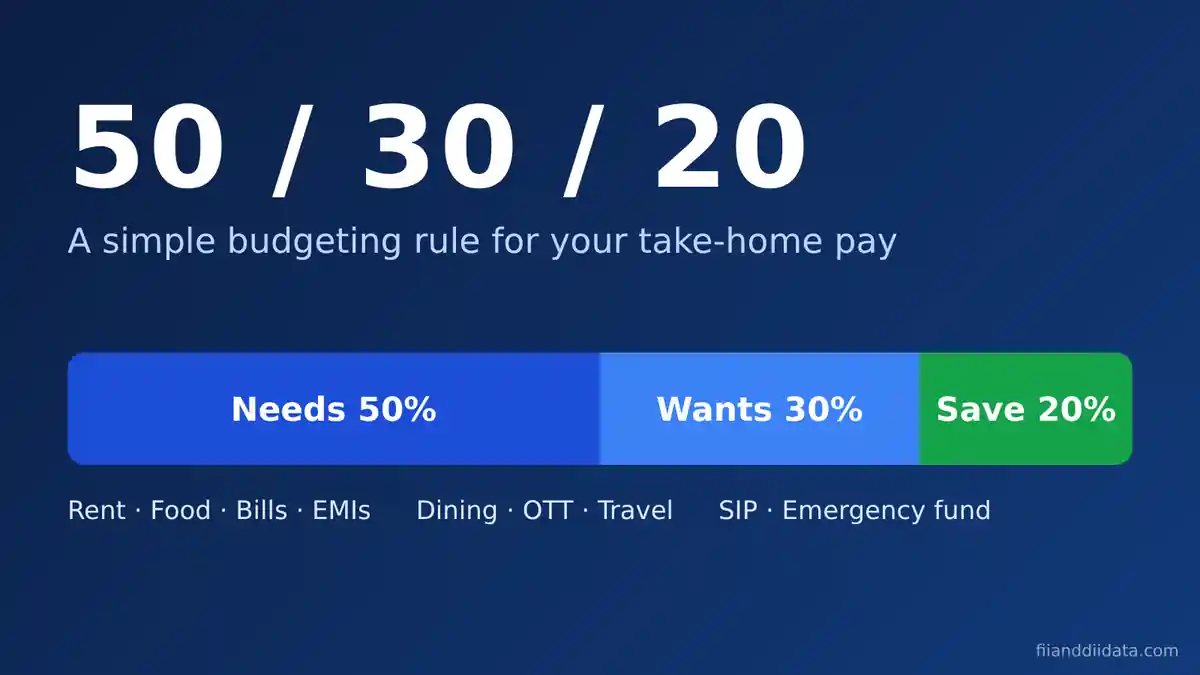
- Make room in the budget. Treat the house fund as a fixed bill. The 50 30 20 budgeting rule is a good starting split.
- Cut the biggest cost first. For many renters, that is rent. These ways to save money on rent can free several thousand rupees a month.
- Send windfalls straight in. Put at least half of every bonus, tax refund or raise into the fund before you spend it.
A monthly number is only half the job. Where you keep the money decides whether it is still there, in full, when the builder asks for it.
Where to Keep Your House Fund
A house fund is money with a fixed date. That makes safety more important than return. A 20% fall in an equity fund one year before purchase can wipe out a whole year of saving.
For the October to December 2026 quarter, the government kept small savings rates unchanged. Post Office time deposits pay 6.9% for 1 year, 7.0% for 2 years, 7.1% for 3 years and 7.5% for 5 years, with quarterly compounding. PPF pays 7.1%. At 7.5%, ₹1 lakh in a 5-year Post Office time deposit grows to about ₹1.45 lakh.
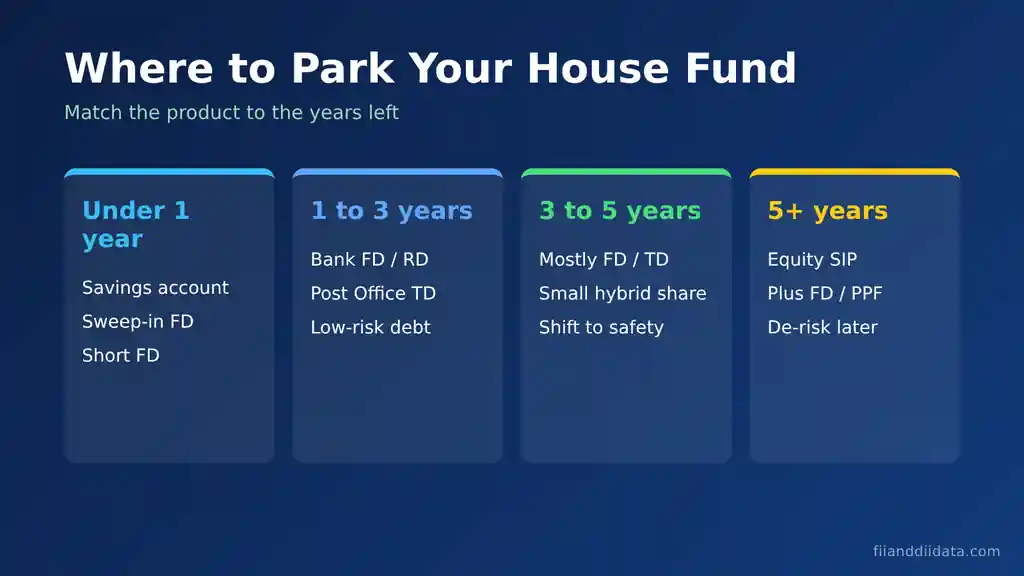
| Time left to purchase | Suitable options | Why |
|---|---|---|
| Under 1 year | Savings account, sweep-in FD, short FD | Money must be ready and stable |
| 1 to 3 years | Bank FD or RD, Post Office 1 to 3 year TD | Fixed, known returns |
| 3 to 5 years | Mostly FD or Post Office TD, small hybrid share | Some growth, low risk |
| More than 5 years | Equity SIP plus FD or PPF, shift to safety later | Time to recover from market falls |
PPF has a 15-year lock-in with limited withdrawals, so it suits only very long house plans. If part of your fund sits in equity, start moving it to deposits about two to three years before the purchase date. Market swings driven by big investors are real; you can see how foreign and domestic funds move the market on our FII and DII data page. With the fund in place, check whether the loan that follows is one you can carry.
Check the EMI Before You Fix the Target
The down payment and the EMI are two sides of the same decision. A bigger down payment means a smaller loan, a smaller EMI and less interest over the years.
Rates matter here. The RBI raised the repo rate by 25 basis points to 5.50% after its policy meeting of 5 to 7 October 2026. Business Today reported that SBI raised its external benchmark lending rate by 25 basis points from 15 October 2026, with regular home loan rates now at 7.50% to 8.80%.
Take the ₹60 lakh flat with a ₹48 lakh loan at 8.25% for 20 years:
- EMI: about ₹40,900 a month.
- Total interest over 20 years: about ₹50.2 lakh, more than the loan itself.
- If you save ₹6 lakh more and borrow ₹42 lakh, the EMI drops to about ₹35,800, a saving of ₹5,100 a month and about ₹12.3 lakh of interest over the term.
A common planning rule of thumb is to keep all EMIs within about 40% of take-home pay. On that basis, a ₹40,900 EMI needs a take-home salary of roughly ₹1.02 lakh a month. If your pay is well below that, a smaller house or a longer saving period is safer than a stretched loan. For lower-income families, a government scheme can also help.
Government Help: PMAY-U 2.0 Interest Subsidy
The Pradhan Mantri Awas Yojana Urban 2.0 Interest Subsidy Scheme (ISS) helps first-time buyers in towns and cities. As per the official PMAY-U 2.0 portal and SBI’s scheme page, the key terms are:
- Household income up to ₹3 lakh (EWS), ₹6 lakh (LIG) or ₹9 lakh (MIG) a year.
- House value up to ₹35 lakh, loan up to ₹25 lakh and carpet area up to 120 sq m.
- 4% interest subsidy on the first ₹8 lakh of the loan, up to ₹1.80 lakh, paid in five yearly instalments.
- Loans sanctioned and disbursed on or after 1 September 2024.
- The family must not own a pucca house anywhere in India.
If you qualify, a ₹35 lakh house falls in the 90% LTV bracket only if the loan is ₹30 lakh or less, so your down payment can be as low as 10% of the value. Apply through the pmaymis.gov.in portal and confirm the details with your lender. Even with help, buyers often slip on a few common points.
How to Save Money for a House Without These Common Mistakes
- Planning only for the down payment. Stamp duty, registration and move-in costs can add lakhs.
- Ignoring the LTV slab. A price just above ₹30 lakh or ₹75 lakh changes the minimum down payment.
- Keeping short-term money in equity. A market fall near the purchase date can delay your plan by years.
- Using the emergency fund. It leaves you exposed right when you take on a 20-year EMI.
- Borrowing for the down payment. A personal loan on top of a home loan raises your total EMI and hurts loan approval.
- Skipping a credit check. A weak credit score can mean a higher rate or a smaller loan.
More everyday slips are covered in our list of common money mistakes to avoid. To stay on track, use a short monthly review.
Monthly Checklist for Your House Fund
- Did the auto-transfer to the house account go through this month?
- Is the fund on track against the target in your table?
- Has the price of flats in your chosen area moved? Update the target once a year.
- Is money due within two years held only in deposits?
- Is your emergency fund still untouched and at least six months of expenses?
- Did any bonus, refund or raise go into the fund?
- Is your credit card paid in full and your credit report clean?
FAQs
How to save money for a house on a middle-class salary?
Fix a target and date, open a separate account and set an automatic transfer on salary day. Cut the largest expense first, usually rent, and send at least half of every bonus or raise to the fund. Keep money due within three years in FDs or Post Office deposits.
How much down payment is needed for a house in India?
Under RBI rules, banks can lend up to 90% for loans up to ₹30 lakh, 80% for ₹30 lakh to ₹75 lakh, and 75% above ₹75 lakh. So the minimum down payment is 10% to 25%, plus stamp duty, registration and move-in costs.
Is it better to invest in mutual funds or FDs for a house down payment?
It depends on time left. If the purchase is more than five years away, an equity SIP can be part of the plan. If it is within three years, FDs, RDs and Post Office time deposits are safer because a market fall cannot hurt them.
Can I get a 100% home loan in India?
No. RBI rules cap bank home loans at 90% of the property value even for the smallest loans, and at 80% or 75% for bigger ones. You must fund the rest, plus stamp duty and registration, from your own savings.
How long does it take to save for a house down payment?
Most buyers need three to seven years. In our example, a ₹60 lakh flat needs about ₹17.7 lakh in cash; with ₹3 lakh already saved and a 7% return, that takes five years at about ₹18,700 a month.
The Bottom Line
Saving for a house is less about finding a clever product and more about getting the target right. Count the down payment, stamp duty, registration and move-in costs, check which RBI loan slab your price falls in, and allow for prices to rise while you save.
Then make the saving automatic and keep the money safe as the date gets closer. A larger down payment also protects you from rising loan rates, which is a real concern after the October 2026 repo hike. Your next step: write down your city, budget and year, and work out your monthly number using the table above. For more guides, visit our blog.
Sources: Reserve Bank of India, Individual Housing Loans circular (7 June 2017); PMAY-U 2.0 Interest Subsidy Scheme, Government of India; Indian Bank, small savings scheme rates (Oct to Dec 2026); Business Today, SBI home loan rate hike (18 October 2026); SBI PMAY-U 2.0 scheme page.
Disclaimer: This article is for educational purposes only and is not investment advice. Please consult a SEBI-registered advisor before making investment decisions.