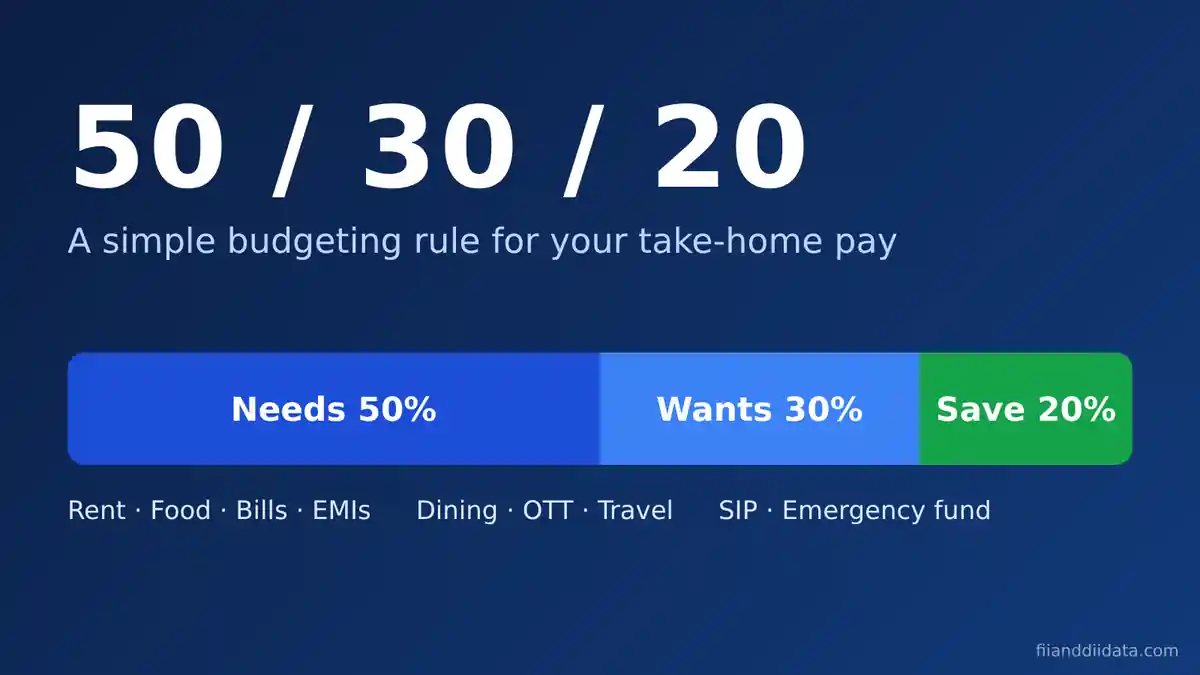
The 50 30 20 budgeting rule splits your monthly take-home pay into three parts: 50% for needs, 30% for wants and 20% for savings or extra debt repayment. On a ₹60,000 in-hand salary, that means ₹30,000 for essentials, ₹18,000 for lifestyle and ₹12,000 saved every month. With retail inflation at 5.54% in September 2026, a simple plan like this helps you keep costs in check without tracking every rupee.
Key Takeaways
- The rule divides take-home pay, not gross salary, into needs (50%), wants (30%) and savings (20%).
- On a ₹60,000 in-hand salary, the split is ₹30,000, ₹18,000 and ₹12,000 a month.
- In big cities, needs often cross 50%; a temporary 60/25/15 split is a practical starting point.
- Automate the 20% on salary day so savings happen before spending.
- Review the split every few months, since food prices rose 7.74% year on year in September 2026.
In this guide:
- What is the 50 30 20 budgeting rule?
- Needs, wants and savings: what goes where
- How to calculate the 50 30 20 budgeting rule on your salary
- The 50/30/20 split at different income levels
- Adapting the rule for metro cities and high rent
- How to set up the 50/30/20 budget in five steps
- Common mistakes to avoid
- 50/30/20 vs other budgeting methods
- FAQs
- The Bottom Line
What Is the 50 30 20 Budgeting Rule?
The 50/30/20 rule is a percentage-based budget. Instead of setting a separate limit for twenty categories, you give your money only three jobs. Half covers what you must pay, close to a third covers what you enjoy, and a fifth builds your future.
The idea was made popular by Elizabeth Warren and Amelia Warren Tyagi in their book All Your Worth: The Ultimate Lifetime Money Plan. A Money magazine article from August 2005 describes their “balanced money formula”: 50% of take-home pay for must-haves, 30% for wants and 20% for savings and paying off debt. The authors also argued that keeping fixed costs lower than 50% makes it easier to get through a job loss.
Why take-home pay, not CTC
For salaried Indians, the rule works on the amount that actually lands in your bank account each month. That is your salary after TDS, your EPF contribution, professional tax and any other payroll deductions. If you apply 50/30/20 to your CTC, your plan will look generous on paper and fall short every month. Your EPF deduction is already a form of retirement saving, so treat the 20% bucket as extra saving on top of it.
The rule is simple to state. The harder part is deciding what counts as a need and what counts as a want, which is where most budgets go wrong.
Needs, Wants and Savings: What Goes Where
A quick test helps: if skipping a payment would hurt your health, your home, your job or your credit record, it is a need. If you could pause it for three months without real harm, it is a want.
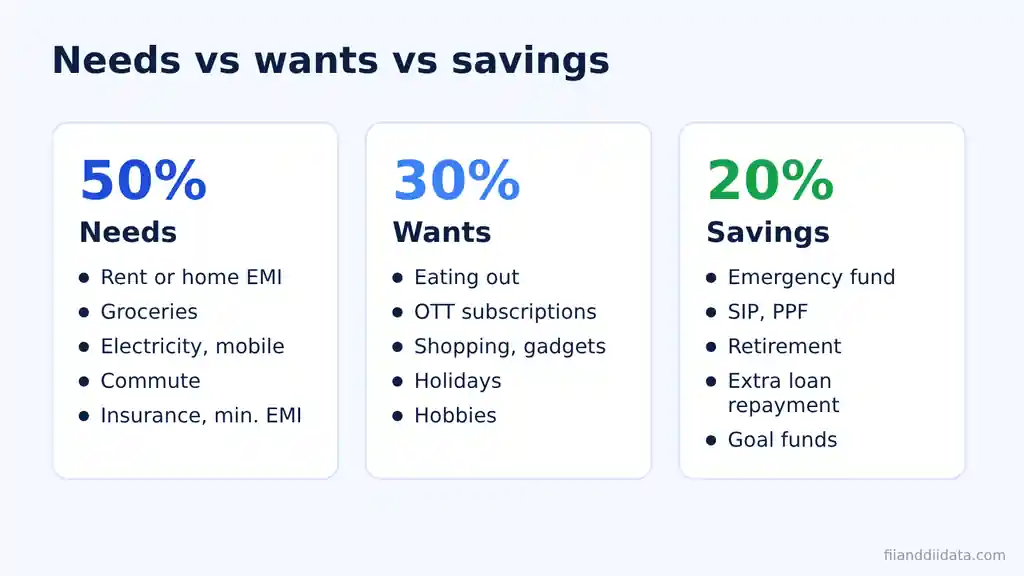
Needs (50%)
- Rent or home loan EMI, society maintenance
- Groceries and basic household supplies
- Electricity, water, cooking gas, mobile and internet
- Commute to work, school fees
- Health and term insurance premiums (spread monthly)
- Minimum EMIs on any loan and the minimum due on credit cards
Wants (30%)
- Eating out and food delivery
- OTT and app subscriptions
- Clothes beyond basics, gadgets and upgrades
- Holidays, weekend trips, hobbies and gifts
Savings and debt payoff (20%)
- Emergency fund contributions
- SIPs in mutual funds, PPF, recurring deposits
- Goal funds for a house down payment or a child’s education
- Any loan or credit card payment above the minimum
A common point of confusion is debt. The minimum payment is a need, because missing it damages your credit history. Anything you pay over the minimum to clear a loan early belongs in the 20% bucket, because it improves your net worth just like saving does.
Once each expense has a label, the maths takes less than five minutes. Here is how it looks on a real salary.
How to Calculate the 50 30 20 Budgeting Rule on Your Salary
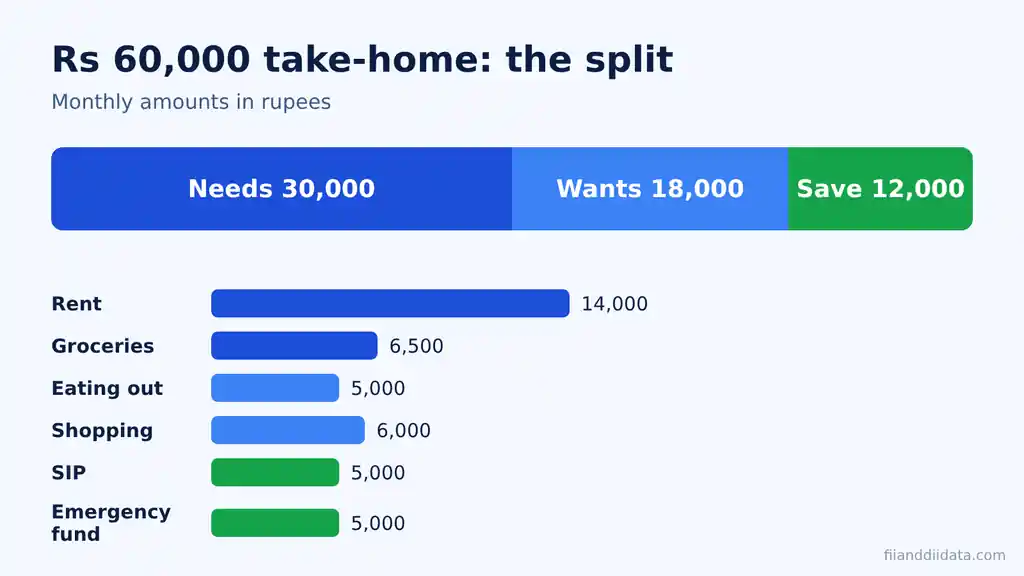
Take an example. Rahul works in Pune and receives ₹60,000 in his bank account each month after all deductions. Multiply by 0.5, 0.3 and 0.2 to get his three limits:
- Needs: ₹60,000 × 50% = ₹30,000
- Wants: ₹60,000 × 30% = ₹18,000
- Savings: ₹60,000 × 20% = ₹12,000
50 30 20 budgeting rule example: a ₹60,000 budget line by line
| Bucket | Item | Monthly amount (₹) |
|---|---|---|
| Needs | Rent | 14,000 |
| Needs | Groceries | 6,500 |
| Needs | Commute | 3,500 |
| Needs | Electricity, mobile, internet | 3,000 |
| Needs | Minimum loan EMI | 2,000 |
| Needs | Health insurance (annual premium ÷ 12) | 1,000 |
| Wants | Shopping | 6,000 |
| Wants | Travel fund | 6,000 |
| Wants | Eating out | 5,000 |
| Wants | Subscriptions | 1,000 |
| Savings | Mutual fund SIP | 5,000 |
| Savings | Emergency fund | 5,000 |
| Savings | Extra loan prepayment | 2,000 |
| Total | 60,000 |
Rahul’s needs add up to exactly ₹30,000 and his wants to ₹18,000. His ₹12,000 of savings is ₹1,44,000 a year. If his emergency target is six months of needs, or ₹1,80,000, the ₹5,000 monthly contribution gets him there in 36 months. Our guide on how to build an emergency fund explains where to park that money.
The ₹5,000 SIP also adds up over time. Assuming a 10% annual return (an illustration only; equity returns are not guaranteed and can be negative), ₹5,000 a month for 10 years would grow to about ₹10.33 lakh from ₹6 lakh invested.
The same three percentages work at any income. The next table shows how the rupee amounts change.
The 50/30/20 Split at Different Income Levels
| Monthly take-home (₹) | Needs 50% (₹) | Wants 30% (₹) | Savings 20% (₹) | Savings per year (₹) |
|---|---|---|---|---|
| 25,000 | 12,500 | 7,500 | 5,000 | 60,000 |
| 40,000 | 20,000 | 12,000 | 8,000 | 96,000 |
| 60,000 | 30,000 | 18,000 | 12,000 | 1,44,000 |
| 1,00,000 | 50,000 | 30,000 | 20,000 | 2,40,000 |
| 1,50,000 | 75,000 | 45,000 | 30,000 | 3,60,000 |
At ₹25,000 a month, fitting rent, food and travel into ₹12,500 is hard in most cities. At ₹1.5 lakh, ₹45,000 for wants may be more than you need. That is why the percentages are a starting point, not a fixed law.
The biggest strain on the rule usually comes from rent. Here is how to handle that without giving up on saving.
Adapting the 50 30 20 Budgeting Rule for Metro Cities and High Rent
Take Priya, who earns ₹40,000 in hand in Mumbai. Her rent is ₹13,000, groceries ₹5,500, commute ₹2,500, bills ₹2,300 and a minimum EMI ₹1,500. Her needs total ₹24,800, which is 62% of her income, well above the 50% mark.
Forcing a 50% cap would mean moving house tomorrow, which is not realistic. A better approach is a temporary 60/25/15 split: ₹24,000 for needs, ₹10,000 for wants and ₹6,000 for savings. She trims ₹800 from needs (a cheaper mobile plan and fewer cab rides), keeps saving every month and moves back towards 50/30/20 as her salary grows.
Inflation keeps pushing the needs bucket up
According to the Ministry of Statistics and Programme Implementation (MoSPI) release of 12 October 2026, all-India CPI inflation was 5.54% (provisional) in September 2026, and consumer food price inflation was 7.74%. If Rahul’s ₹30,000 of needs rose at the headline rate for a year, they would cost about ₹31,662. His ₹6,500 grocery bill, rising at the food inflation rate, would become about ₹7,003.
The lesson: if your salary does not rise at least as fast as prices, your needs will slowly eat into your savings. Check the split after every appraisal and every few months in between.
How to Set Up the 50/30/20 Budget in Five Steps
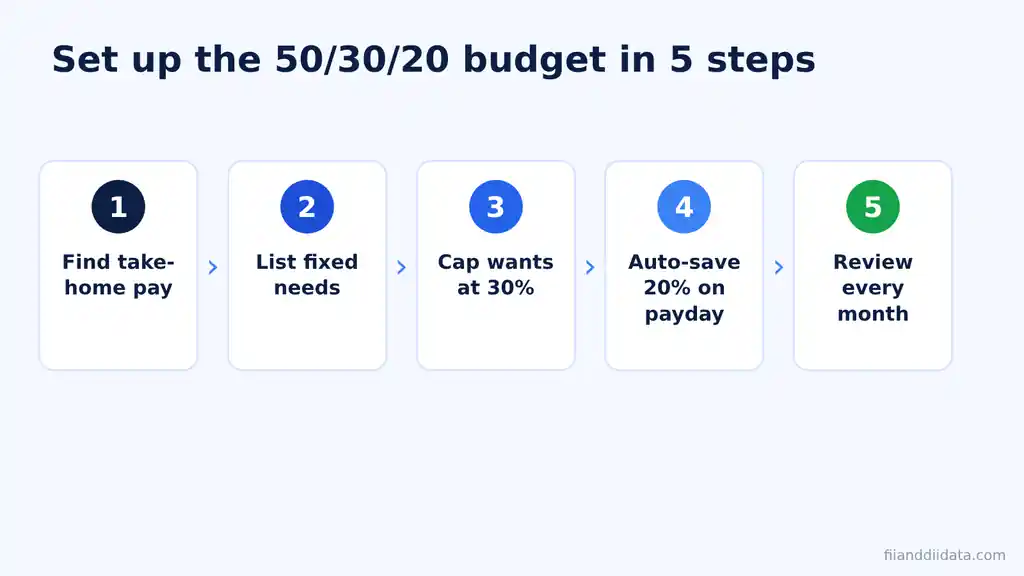
- Find your real take-home pay. Use the last three salary credits in your bank statement, not your offer letter. If you have side income, add only the regular part.
- List fixed needs. Write down rent, EMIs, insurance, school fees and bills. Convert yearly costs into monthly amounts.
- Cap wants at 30%. Set one monthly number for all lifestyle spending. Some people keep a separate debit card or UPI account just for wants.
- Auto-save 20% on salary day. Schedule SIPs, a recurring deposit or a standing instruction for a day or two after salary credit, so the money moves before you can spend it.
- Review every month. Compare actual spending with the three limits. Our guide on how to track monthly expenses shows simple ways to do it.
Monthly 50/30/20 checklist
- Did needs stay at or below 50% (or your temporary limit)?
- Did wants stay within 30%?
- Did the full 20% leave your account within two days of salary?
- Did any annual bill (insurance, school fees, festivals) arrive that you had not spread across the year?
- Did any minimum due or EMI get missed?
- Is your emergency fund closer to six months of needs than last month?
If you invest part of the 20% in equity mutual funds, it also helps to understand how big money moves in the Indian market. Our FII and DII data page tracks how foreign and domestic institutions buy and sell each day. With the setup in place, the next step is to avoid the mistakes that quietly break the rule.
Common Mistakes to Avoid With the 50/30/20 Rule
- Using CTC instead of in-hand pay. This inflates every bucket and leaves you short.
- Calling wants “needs”. A phone is a need; a new phone every year is a want. A home is a need; a bigger flat than you can afford is partly a want.
- Saving what is left over. If savings come last, they usually come to zero. Pay the 20% first.
- Ignoring yearly costs. Insurance premiums, Diwali spending and school admission fees can wreck one month. Divide them by 12 and set money aside each month.
- Skipping the emergency fund. Investing all of the 20% in equity before you have a cash buffer means you may have to sell at a loss when an emergency hits.
- Never revisiting the split. Rent hikes, a new EMI or a pay rise all change the right numbers.
The 50/30/20 rule is not the only way to budget. It helps to know how it compares with the main alternatives.
50/30/20 vs Other Budgeting Methods
| Method | How it works | Best for | Effort |
|---|---|---|---|
| 50/30/20 rule | Three broad buckets by percentage | Beginners and salaried people with steady income | Low |
| Zero-based budget | Every rupee gets a specific job until income minus spending equals zero | People who want tight control or are paying off debt | High |
| Envelope or jar method | Cash or separate accounts for each category | Overspenders who need hard limits | Medium |
| Pay-yourself-first | Fix a savings amount first, spend the rest freely | Busy people who dislike tracking | Low |
| 70/20/10 variant | 70% living costs, 20% savings, 10% debt or giving | High-cost cities or households with large fixed costs | Low |
If you want more detail than three buckets, read our guide to zero-based budgeting for beginners. For a step-by-step monthly plan, see how to create a monthly budget. Many people combine methods: they use 50/30/20 for the big picture and a detailed list only for the needs bucket. You can find more guides like these on the FIIAndDIIData.com blog.
FAQs
What is the 50 30 20 budgeting rule in simple words?
It is a way to split your monthly take-home pay into three parts: 50% for needs such as rent, food and bills, 30% for wants such as eating out and travel, and 20% for savings, investments and extra debt repayment.
Is the 50/30/20 rule applied to gross salary or in-hand salary?
Use your in-hand salary, the amount credited to your bank account after TDS, EPF, professional tax and other deductions. Applying it to CTC or gross pay makes every bucket look bigger than the money you actually have.
Does the 50/30/20 rule work on a low salary in India?
It can, but needs often take more than 50% on a low salary, especially in big cities. Start with a temporary split such as 60/25/15 or 70/20/10, cut costs where you can, and move towards 50/30/20 as your income grows.
Where do EMIs and credit card bills fit in the 50/30/20 rule?
Minimum EMIs and the minimum due on credit cards are needs, because missing them hurts your credit record. Any payment above the minimum to clear debt faster goes into the 20% savings bucket.
Should I save more than 20% if I can?
Yes. Twenty percent is a minimum, not a ceiling. If your needs are below 50% or your wants are below 30%, moving the extra into savings helps you reach goals like an emergency fund, a home down payment or retirement sooner.
The Bottom Line
The 50 30 20 budgeting rule works because it is easy to remember and easy to check. Three numbers tell you whether your month is on track, and paying the 20% first makes saving automatic instead of optional.
It is not perfect. High rent, a low salary or rising food prices can push needs well past 50%, and that is fine as a starting point. What matters is that something is saved every month and that the split moves in the right direction over time.
Your next step: open your last three bank statements, work out your average in-hand pay, and set up an automatic transfer of 20% (or whatever you can manage today) for the day after your next salary credit. If you have just started earning, our guide on managing money after getting a salary is a good companion read.
Sources: MoSPI, CPI press release for September 2026 (12 October 2026); Money magazine, “Budget for Real Life” (August 2005). Worked examples calculated by FIIAndDIIData.com.
Disclaimer: This article is for educational purposes only and is not investment advice. Please consult a SEBI-registered advisor before making investment decisions.