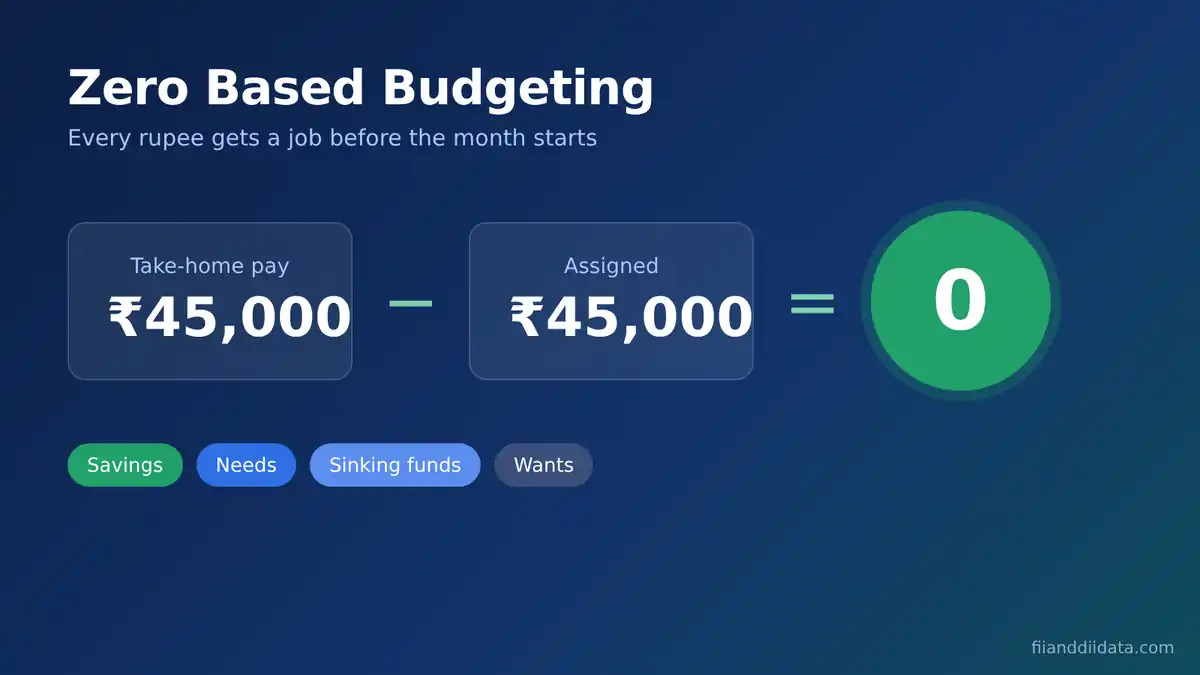
Zero based budgeting for beginners means giving every rupee of your take-home pay a job, savings included, before the month starts, so that income minus planned spending and saving equals exactly zero. It does not mean spending everything. With retail inflation at 5.54% and food inflation at 7.74% in September 2026, as per the MoSPI release of 12 October 2026, a plan where no rupee drifts is worth the effort. This guide walks through six steps and a ₹45,000 salary example.
Key Takeaways
- In a zero based budget, income minus every planned use of money, including savings, equals ₹0.
- The “zero” is on paper only; your savings and sinking funds still sit in your accounts.
- Plan on take-home pay, pay yourself first, and turn yearly bills into monthly sinking funds.
- When one line runs over mid-month, move money from another spending line, never from savings.
- Freelancers can budget last month’s income so this month is always fully funded.
Table of contents
- What is zero based budgeting for beginners?
- Why zero based budgeting helps in 2026
- Zero based budgeting for beginners: 6 steps
- Worked example: a ₹45,000 zero based budget
- How to run the budget during the month
- Zero based budgeting vs other methods
- Zero based budgeting on an irregular income
- Common mistakes and a 30-day starter checklist
- Frequently asked questions
- The Bottom Line
What Is Zero Based Budgeting for Beginners?
A zero based budget is a monthly plan in which you assign your entire take-home income to named lines: rent, groceries, EMIs, savings, a festival fund, eating out and so on. You keep assigning until nothing is left unassigned. The formula is simple: income minus all assigned money = ₹0.
Most people budget the other way round: pay the big bills, spend through the month and save whatever survives. A zero based plan flips the order, so savings get their own line on day one.
What the “zero” in zero based budgeting for beginners actually means
Beginners often worry that zero means an empty bank account. It does not. If ₹9,000 goes to your emergency fund, SIP and PPF, that money is assigned, so it counts towards the zero, yet it stays yours. The zero only says that no rupee is idle without a purpose. Your account balance can and should keep growing.
How it differs from a normal monthly budget
A normal budget sets limits for the main categories and lets the rest float. A zero based budget leaves nothing floating. Even a small buffer gets its own line, called “miscellaneous” or “buffer”. If you want the broader planning steps first, our step-by-step monthly budget guide covers them; this article goes deeper into the zero based method itself. Next, why it is worth trying now.
Why Zero Based Budgeting Helps in 2026
Prices are not rising evenly. The MoSPI CPI release for September 2026 shows food and eating out rising much faster than housing or clothing. When some lines grow faster than others, a plan that reviews every line each month catches the change early.
| CPI measure (all India, combined) | Inflation, September 2026 (YoY) |
|---|---|
| Headline CPI | 5.54% |
| Rural CPI | 6.08% |
| Urban CPI | 4.88% |
| Food (CFPI) | 7.74% |
| Restaurants and accommodation services | 9.36% |
| Clothing and footwear | 3.93% |
Here is what that means in rupees. A ₹6,000 grocery line growing at 7.74% would need about ₹6,464 a year later, or ₹464 more every month. In a loose budget, that extra amount quietly comes out of savings. In a zero based budget, you see it the day you write next month’s plan and decide which line gives way. The October 2026 CPI data is due on 12 November 2026, so update your grocery line after that release.
Zero Based Budgeting for Beginners: 6 Steps
You need your last three months of bank, card and UPI statements, your salary slip and a notebook or spreadsheet. The first plan takes about an hour. After that, each new month takes 15 to 20 minutes.
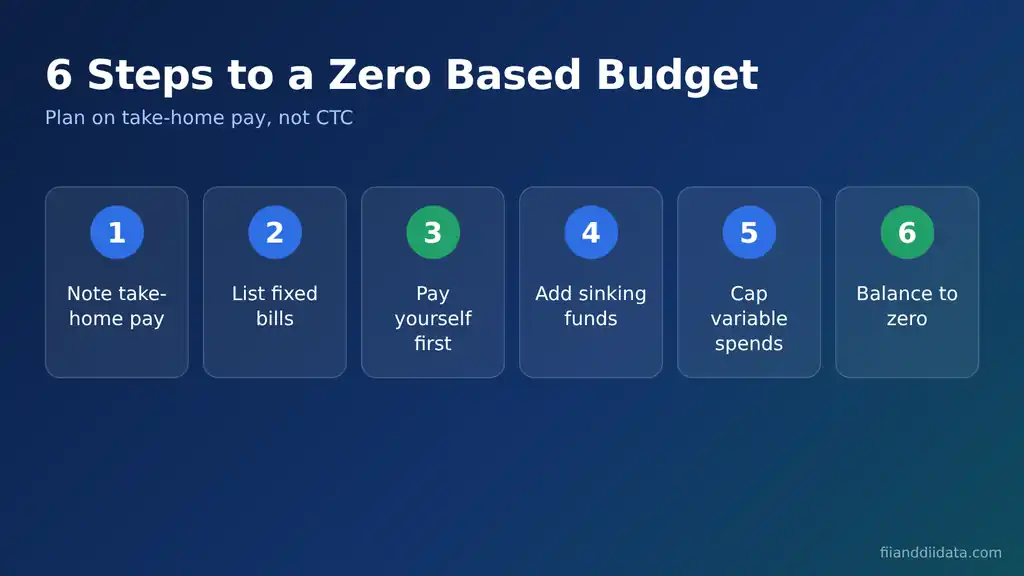
Step 1: Note your take-home pay
Write down the amount that actually reaches your account after tax, PF and other deductions, never your CTC. Bonuses and one-off income get their own plan when they land.
Step 2: List fixed bills
Fixed bills are the same every month: rent, loan EMIs, phone plan and any monthly fees or premiums. Write each one with its exact amount and due date. They form the base of every future plan.
Step 3: Pay yourself first
Before any variable spending, assign savings. A common target is 20% of take-home pay; if that is not possible yet, start at 10%. Set the transfers to leave your account a day after salary. Our guide on building an emergency fund explains how large that first safety pot should be.
Step 4: Add sinking funds for yearly costs
A sinking fund is money you set aside each month for a known future cost. Take every yearly or occasional expense, such as Diwali gifts, a health insurance premium or a laptop you will need to replace, and divide it by the number of months left. An ₹18,000 festival budget becomes ₹1,500 a month. This single step is what stops “surprise” bills from breaking the plan.
Step 5: Cap variable spending
Groceries, electricity, commute, eating out, shopping and subscriptions move from month to month. Use your three-month average as the starting cap for each line. If the total is too high, trim wants first. If you need ideas, our guide on cutting unnecessary expenses lists nine practical cuts.
Step 6: Balance to zero
Add up every line and subtract it from income. If money is left, give it a job: extra savings, a faster loan payment or a goal. If the total is negative, cut a want or lower a cap until the result is exactly ₹0. A plan that does not balance on paper will not balance in real life.
Worked Example: A ₹45,000 Zero Based Budget
Meet Ananya, 26, who works in Hyderabad and takes home ₹45,000 a month. She shares a flat, sends money to her parents and wants to build an emergency fund. After the first five steps, ₹1,000 was still unassigned, so in Step 6 she moved it to her emergency fund. Her final plan looks like this. The figures are an illustration, not a recommendation.
| Line | Group | Monthly amount | Share of pay |
|---|---|---|---|
| Emergency fund | Savings | ₹5,000 | 11.1% |
| Equity SIP | Savings | ₹3,000 | 6.7% |
| PPF | Savings | ₹1,000 | 2.2% |
| Rent (shared flat) | Need | ₹12,000 | 26.7% |
| Groceries | Need | ₹6,000 | 13.3% |
| Support to parents | Need | ₹3,000 | 6.7% |
| Commute | Need | ₹2,500 | 5.6% |
| Electricity, gas and water | Need | ₹1,800 | 4.0% |
| Health insurance (₹12,000 a year ÷ 12) | Need | ₹1,000 | 2.2% |
| Phone and internet | Need | ₹800 | 1.8% |
| Laptop replacement (₹48,000 over 24 months) | Sinking fund | ₹2,000 | 4.4% |
| Festivals and gifts (₹18,000 a year ÷ 12) | Sinking fund | ₹1,500 | 3.3% |
| Eating out and delivery | Want | ₹2,000 | 4.4% |
| Shopping | Want | ₹1,500 | 3.3% |
| Buffer (miscellaneous) | Want | ₹900 | 2.0% |
| Personal care | Want | ₹600 | 1.3% |
| OTT and subscriptions | Want | ₹400 | 0.9% |
| Total assigned | ₹45,000 | 100% | |
| Income minus assigned | ₹0 |
By group, savings come to ₹9,000 (20.0%), needs to ₹27,100 (60.2%), sinking funds to ₹3,500 (7.8%) and wants to ₹5,400 (12.0%). Counting sinking funds, Ananya is setting aside ₹12,500, or 27.8% of her pay, for the future. Her needs are ₹4,600 above the 50% a 50/30/20 rule would allow, which is common for a city renter, yet the plan still balances and still saves.
Where Ananya keeps each pot
Her essential costs are ₹27,100 a month, so a three-month emergency fund is ₹81,300. At ₹5,000 a month she reaches it in about 17 months, a little sooner with interest. She keeps it in a savings account or sweep-in deposit; bank deposits are insured by DICGC up to ₹5 lakh per depositor per bank, covering principal and interest, as per the DICGC guide to deposit insurance. For the PPF line, the rate for 1 October to 31 December 2026 is 7.1%, unchanged from the previous quarter, per the small savings rates notified by the government and published by Indian Bank. The laptop fund, needed in two years, could sit in a separate savings account or a one-year time deposit, which pays 6.9% at the post office for the same quarter. Rates change every quarter, so check them before you commit.

How to Run the Budget During the Month
Writing the plan is the easy part. Keeping it through 30 days of UPI payments is harder. Three habits help.
- Log spends twice a week. Open your UPI app and bank statement every Wednesday and Sunday, and tag each payment to a line. Small ₹50 and ₹100 payments are the ones memory forgets. Our guide on tracking monthly expenses shows simple tagging methods.
- Use the swap rule. If one line runs over, move money from another spending line so the total stays at zero. Never take it from savings or sinking funds.
- Keep savings out of sight. Move savings and sinking funds to separate accounts on salary day so they are not spent by accident.
A mid-month swap in practice
By the 18th, Ananya had spent ₹6,700 on groceries against a ₹6,000 line because of two guests. She moved ₹700 from eating out, cutting that line from ₹2,000 to ₹1,300. The plan still adds to ₹45,000 and her savings are untouched.
Zero Based Budgeting vs Other Methods
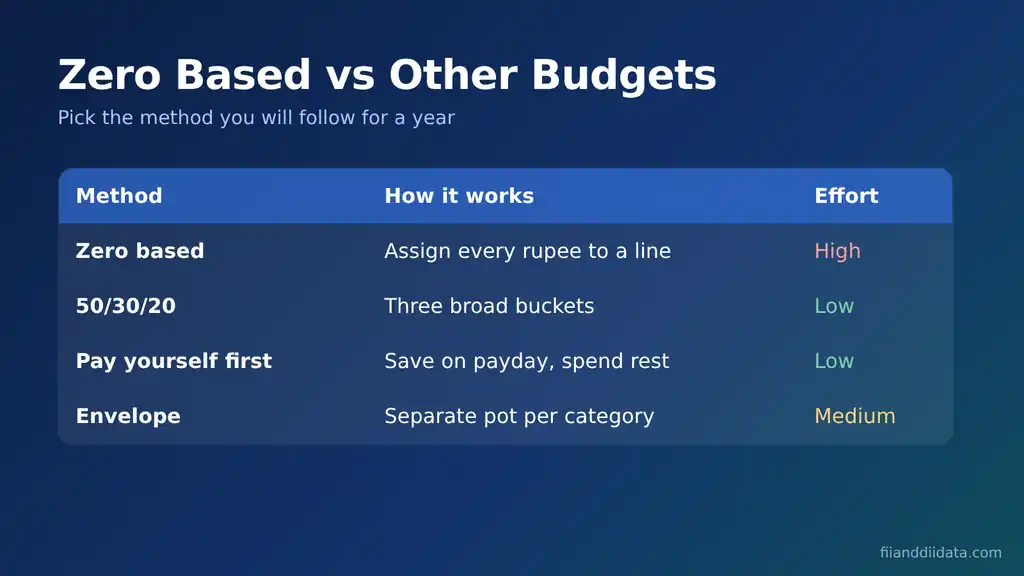
No method is right for everyone. The best one is the method you will still follow in twelve months. Here is how zero based budgeting stacks up.
| Method | How it works | Best for | Main drawback |
|---|---|---|---|
| Zero based budget | Every rupee is assigned to a line until income minus plan = ₹0 | People who feel short at month-end, families, debt payers | Needs 15 to 20 minutes of planning each month |
| 50/30/20 rule | 50% needs, 30% wants, 20% savings | Beginners with moderate rent | Needs often exceed 50% in big cities |
| Pay yourself first | Save a fixed amount on payday, spend the rest freely | Busy salaried earners | Spending can drift without line limits |
| Envelope method | A separate pot or wallet for each category | People who overspend on wants | Harder with UPI unless you use separate accounts or wallets |
The methods also mix well. A zero based plan already includes pay yourself first, and you can start with 50/30/20 buckets and later break each one into zero based lines.
Zero Based Budgeting on an Irregular Income
Freelancers, consultants and commission earners often think budgeting is impossible without a fixed salary. The zero based method handles it well if you change one rule: budget last month’s income, not this month’s. Money earned in October funds the November plan, so you always start a month with every rupee already in hand.
Take Rahul, a freelance designer who received ₹62,000 in October. His November plan assigns all of it:
| Line | Amount | Share of ₹62,000 |
|---|---|---|
| Needs (rent, food, bills, EMI) | ₹30,000 | 48.4% |
| Income buffer for lean months | ₹10,000 | 16.1% |
| Income tax set-aside (his own estimate) | ₹6,200 | 10.0% |
| Savings (emergency fund and SIP) | ₹6,000 | 9.7% |
| Wants | ₹6,800 | 11.0% |
| Sinking funds | ₹3,000 | 4.8% |
| Total | ₹62,000 | 100% |
The tax line is Rahul’s own estimate; actual liability depends on income, deductions and the tax regime chosen, so freelancers should confirm it with a tax professional. His core monthly cost is ₹36,000 (needs plus savings), so a buffer of three months, about ₹1.08 lakh, would let him pay himself a steady amount even after a weak month. Once the buffer is full, the ₹10,000 line can move to goals.
Common Mistakes and a 30-Day Starter Checklist
Mistakes beginners make with zero based budgeting
- Planning on gross pay. Deductions never reach your account. Use take-home pay only.
- Too many lines. Forty categories is a spreadsheet, not a plan. Start with 12 to 18 lines.
- No buffer line. Small surprises will come. A ₹500 to ₹1,000 buffer keeps the plan intact.
- Treating zero as “spend it all”. Leftover money goes to a job such as savings or a loan, not to extra shopping.
- Raiding savings to cover overspending. Swap between spending lines instead, and fix the cap next month.
Your first 30 days
- Day 1: Download three months of bank, card and UPI statements and find your average for each category.
- Day 2: Write the plan using the six steps and balance it to ₹0.
- Salary day: Move savings and sinking funds to separate accounts the same day.
- Every Wednesday and Sunday: Log spends and apply the swap rule if a line runs over.
- Day 25: Note any bill that came up that was not in the plan.
- Day 30: Compare planned and actual for each line, then write next month’s plan with one change, not five.
If this is your first month managing a salary, our guide on managing money after getting a salary covers the account set-up that makes this checklist easier. And if part of your savings goes into equity SIPs, our FII and DII data page shows how large institutions are moving money in Indian shares.
Frequently Asked Questions
What is zero based budgeting for beginners?
It is a monthly plan where you assign every rupee of take-home pay to a named line, including savings and sinking funds, until income minus the plan equals zero. Beginners start with 12 to 18 lines and write a fresh plan before each salary.
How do I start a zero based budget?
Note your take-home pay, list fixed bills, assign savings first, add monthly amounts for yearly costs, cap variable spending using your three-month average, and adjust until the total equals your income exactly.
Does zero based budgeting mean I spend all my money?
No. Savings, investments and sinking funds are lines in the plan, so they count towards the zero while the money stays in your accounts. Zero only means no rupee is left without a purpose.
What is the difference between zero based budgeting and the 50/30/20 rule?
The 50/30/20 rule splits pay into three broad buckets of needs, wants and savings. A zero based budget assigns money line by line. It takes more effort but gives tighter control, and it works even when needs are above 50% of pay.
Does zero based budgeting work with irregular income?
Yes. Budget last month’s income instead of this month’s, keep an income buffer for lean months, and set aside an estimate for income tax. Once the buffer covers about three months of core costs, you can pay yourself a steady amount.
The Bottom Line
Zero based budgeting is not about spending less for its own sake. It is about deciding in advance where each rupee goes, savings first, so that rising food prices or a festival month do not quietly eat into your future. The method takes a little more time than a rough budget, and it gives far more control in return.
If you dislike tracking, a simple pay yourself first plan may suit you better. But if you often wonder where your salary went, try one zero based month. Your next step: before your next salary credit, write a plan with no more than 15 lines and make it add up to exactly ₹0. For more guides on money and markets, visit our blog.
Sources: PIB, MoSPI CPI press release for September 2026 (12 October 2026); DICGC, guide to deposit insurance; Indian Bank, interest rates for small savings schemes, Q3 FY 2026-27 (1 October to 31 December 2026).
Disclaimer: This article is for educational purposes only and is not investment advice. Please consult a SEBI-registered advisor before making investment decisions.