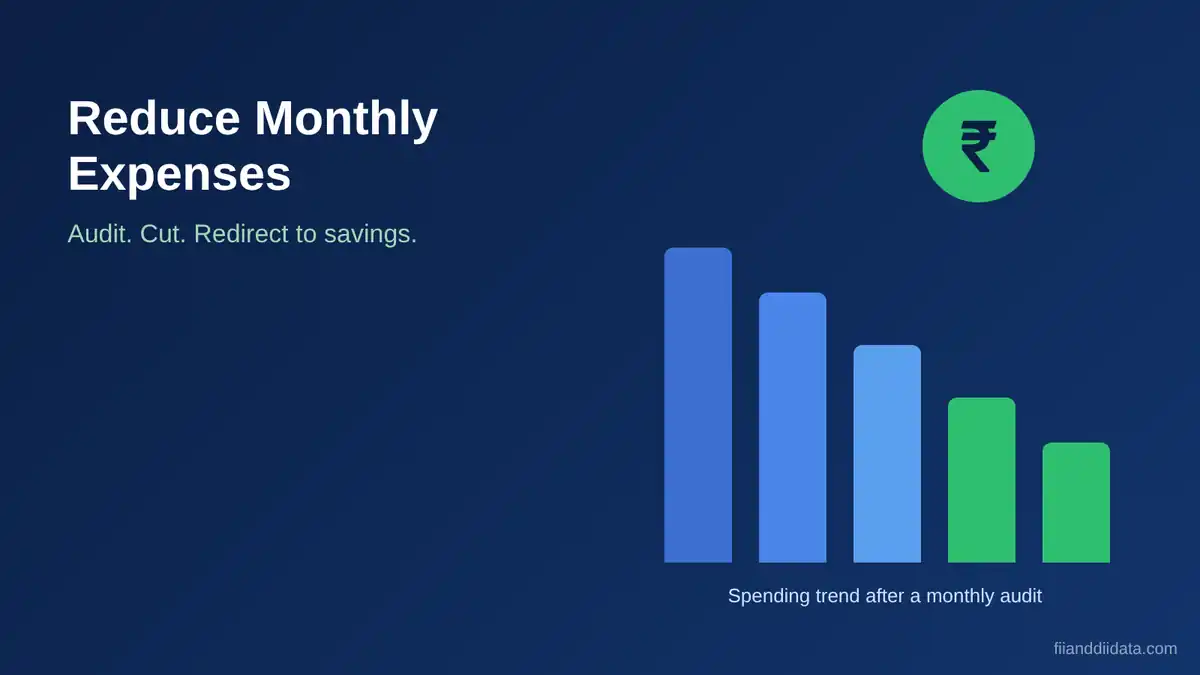
If you want to know how to reduce monthly expenses, start with a three-month audit of what you already spend, cut the variable costs first, and move every rupee you free up into savings on salary day. That matters more than usual right now: India’s retail inflation rose to 5.54% in September 2026 from 4.83% in August, and food inflation jumped to 7.74%, according to MoSPI data released on 12 October 2026.
Key Takeaways
- Food prices rose 7.74% and restaurant prices 9.36% year on year in September 2026, so groceries and eating out are the first places to look.
- Variable costs (food, fuel, shopping, subscriptions) can be cut every month; fixed costs (rent, EMIs, premiums) are best renegotiated once a year.
- A simple 5-step audit of three months of bank and UPI statements usually shows the top three spending leaks.
- In our worked example, a family earning ₹80,000 cuts spending by ₹10,500 a month and lifts its savings rate from 10.1% to 23.2%.
- Do not cut health cover, term insurance, your emergency fund or your SIPs to save money.
Table of contents
- Why reduce monthly expenses in 2026
- Fixed vs variable costs
- How to reduce monthly expenses: the 5-step audit
- 9 practical ways to cut monthly expenses
- Worked example: an ₹80,000 household
- Expenses you should not cut
- Common mistakes when cutting expenses
- Monthly expense-cutting checklist
- FAQs
- The Bottom Line
Why Reduce Monthly Expenses in 2026
Inflation is the quiet reason most households feel stretched even when their salary has not changed. When prices rise faster than income, the same lifestyle simply costs more each month. The September 2026 Consumer Price Index (CPI) release shows that the pressure is uneven: some categories are rising fast while others are barely moving.
That unevenness is useful. It tells you where cutting will give the biggest relief. The table below shows the year-on-year price change for the main CPI groups.
| CPI group (all India) | Inflation, Sep 2026 (YoY) | What it means for your budget |
|---|---|---|
| Headline CPI | 5.54% | Overall cost of living rising faster than in August (4.83%) |
| Food (CFPI) | 7.74% | Groceries are the biggest pressure point |
| Restaurants and accommodation | 9.36% | Eating out and food delivery cost much more |
| Transport | 5.01% | Fuel and commute costs rising with headline inflation |
| Clothing and footwear | 3.93% | Moderate; easy to delay purchases |
| Housing, water, electricity, gas | 2.74% | Slower rise, but usage habits still matter |
| Information and communication | 2.44% | Mobile and internet plans are a smaller but steady cost |
Here is what that looks like in rupees. If your family spends ₹12,000 a month on groceries, a 7.74% rise means the same basket costs about ₹929 more each month a year later. That is ₹11,146 a year, just to stand still. The next step is to separate the costs you can change quickly from the ones you cannot.
Fixed vs Variable Costs: Where Monthly Expenses Hide
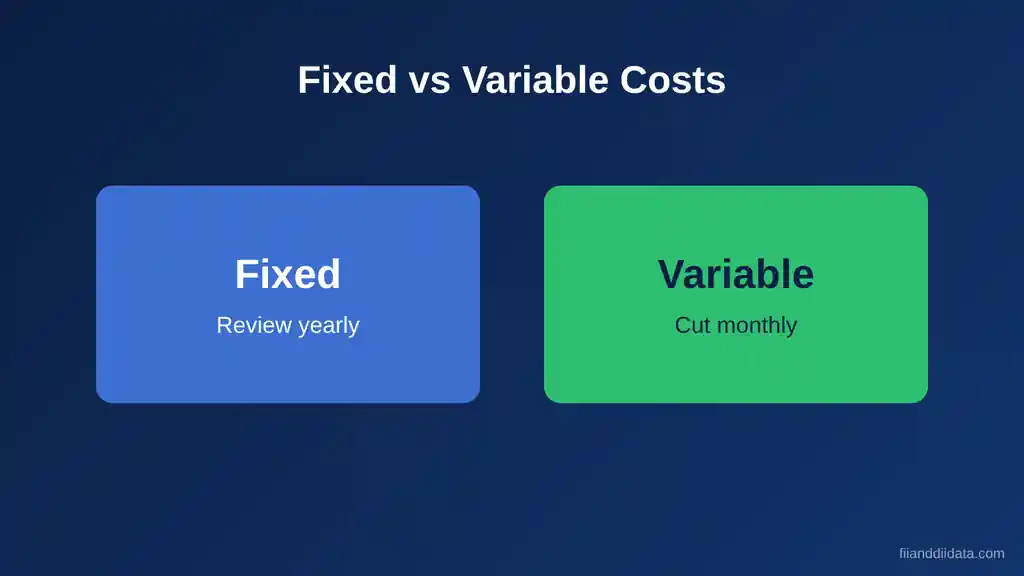
Every monthly expense falls into one of two buckets. Fixed costs stay the same each month: rent, loan EMIs, insurance premiums, school fees. Variable costs change with your choices: groceries, eating out, fuel, electricity, shopping and entertainment.
Variable costs are where you can act this month. Fixed costs are bigger but slower to move, so you review them once a year, for example when your rent agreement renews or your loan rate resets. A good plan works on both, but starts with the variable side because the results show up in your next bank statement.
If you are not sure which bucket your money falls into, our guide on tracking monthly expenses shows simple ways to tag every transaction. Once you can see the split, the audit below becomes quick.
How to Reduce Monthly Expenses: The 5-Step Audit
Most people try to cut costs from memory, which rarely works. An audit uses your real numbers. Set aside one evening and follow these five steps.
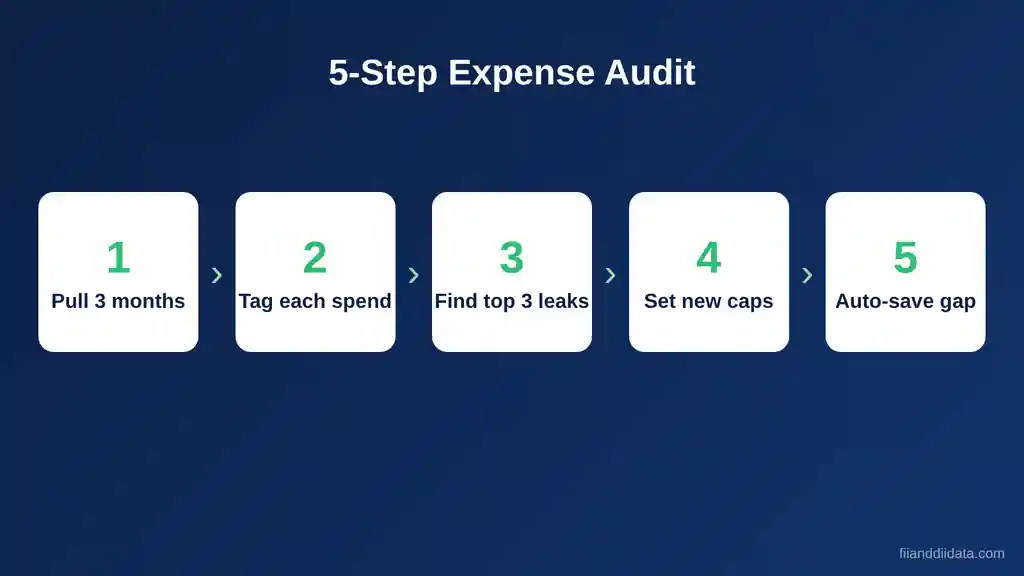
- Pull three months of statements. Download your bank account, credit card and UPI app history. Three months smooths out one-off spends like a wedding gift or a repair.
- Tag each spend. Mark every line as fixed or variable, and then by category (food, transport, shopping, bills, subscriptions).
- Find your top three leaks. Sort categories by monthly average. The top three variable categories usually hold most of what you can realistically cut.
- Set new monthly caps. For each leak, set a cap 15% to 30% below your current average. Smaller, realistic cuts last longer than dramatic ones.
- Auto-save the gap. On salary day, move the expected savings into a separate account or SIP. If the money is not in your spending account, you will not spend it.
The audit tells you where to cut. The next section explains how to cut in each common category without making daily life miserable.
9 Practical Ways to Cut Monthly Expenses
1. Plan groceries around a weekly list
With food inflation at 7.74%, groceries deserve the most attention. Plan the week’s meals, shop from a written list, buy staples like rice, dal and oil in larger packs when the unit price is lower, and check what is already in the kitchen before ordering. A 15% cut on a ₹12,000 grocery bill frees ₹1,800 a month.
2. Put a cap on eating out and food delivery
Restaurant and accommodation prices rose 9.36% in September 2026, the fastest of the major groups listed above. Delivery fees, packaging charges and platform fees add more. Decide a fixed number of orders per month, say four, and treat it as a budget line rather than a habit.
3. Audit subscriptions and auto-debits
OTT platforms, music apps, cloud storage and gym memberships are easy to forget because they renew silently. Under the RBI framework for recurring card payments (circular of 21 August 2019), your card issuer must send a pre-debit notification at least 24 hours before each charge and give you an online option to withdraw the mandate. Use those alerts as a reminder to ask whether you still need the service. For UPI AutoPay, our guide to cancelling a UPI mandate shows the steps in each app.
4. Cut electricity use, not comfort
Set the AC to 24 to 26 degrees, switch off appliances at the plug instead of leaving them on standby, use LED bulbs, and run washing machines and geysers only when needed. When an old appliance needs replacing, compare energy ratings, because the running cost over several years often matters more than the price tag.
5. Right-size mobile and internet plans
Many families pay for more data than they use. Check actual usage in your phone settings, move to a smaller plan if you are well below your limit, and consider family or bundled plans that combine broadband, mobile and OTT access instead of paying for each separately.
6. Rethink fuel and commute costs
Transport prices rose 5.01% year on year. Combine errands into one trip, carpool for office, use the metro or bus where it is practical, and keep tyres properly inflated. Even cutting two short car trips a week adds up over a year.
7. Stop paying credit card interest and late fees
Paying only the minimum due means interest is charged on the unpaid balance, and missed dates add late fees. Interest is pure cost with nothing to show for it. Set an auto-pay for the full statement amount, and if you already carry a balance, pay it down before you spend on anything optional.
8. Use a 48-hour rule for shopping
For any non-essential purchase above a set amount, say ₹2,000, wait 48 hours before buying. Remove saved cards from shopping apps so checkout takes a few extra steps. Most impulse purchases do not survive the wait.
9. Renegotiate fixed costs once a year
Ask your lender whether a lower rate is available on your home loan, compare insurance renewals instead of auto-renewing, and negotiate rent at renewal time with comparable listings in hand. One successful negotiation can save more than months of small cuts.
These nine moves are easier to judge with real numbers. The example below puts them together for one household.
Worked Example: Cutting Costs in an ₹80,000 Household
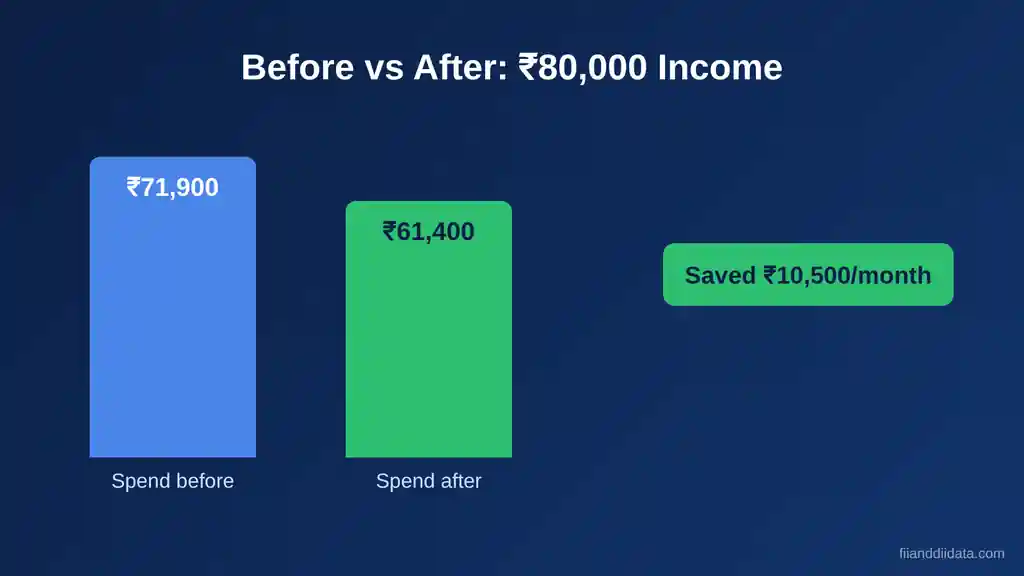
Take a family of four in a metro city with a take-home income of ₹80,000 a month. Before the audit, they spend ₹71,900 and save only ₹8,100, a savings rate of 10.1%. After applying the cuts above, their numbers look like this. These figures are illustrative, not a benchmark.
| Category | Before (₹/month) | After (₹/month) | Saved (₹) |
|---|---|---|---|
| Rent | 20,000 | 20,000 | 0 |
| Groceries | 12,000 | 10,200 | 1,800 |
| Eating out and delivery | 6,000 | 3,000 | 3,000 |
| Electricity | 2,800 | 2,300 | 500 |
| Mobile, broadband, OTT | 2,600 | 1,700 | 900 |
| Fuel and commute | 5,000 | 4,200 | 800 |
| Shopping and personal | 6,000 | 4,000 | 2,000 |
| Card interest and late fees | 1,500 | 0 | 1,500 |
| Loan EMI | 12,000 | 12,000 | 0 |
| Other | 4,000 | 4,000 | 0 |
| Total | 71,900 | 61,400 | 10,500 |
Total spending falls by ₹10,500 a month, or 14.6%. Monthly savings rise from ₹8,100 to ₹18,600, which lifts the savings rate from 10.1% to 23.2%. Over 12 months, that is ₹1,26,000 more set aside, without touching rent, the EMI or any insurance.
Notice that about 79% of the savings came from just four lines: eating out, shopping, groceries and card interest. That pattern is common, which is why the audit focuses on the top leaks. To build the new caps into a full plan, see our step-by-step guide on creating a monthly budget. Cutting the right things also means protecting a few that should never be cut.
Expenses You Should Not Cut to Reduce Monthly Expenses
Some costs look like easy savings but create much bigger bills later. Keep these protected while you trim everything else:
- Health insurance. A single hospital stay can cost more than years of premiums. Compare renewals, but do not let cover lapse.
- Term life insurance if anyone depends on your income.
- Your emergency fund contribution. Savings from cutting expenses should first build a buffer of several months of expenses.
- Long-term SIPs and retirement contributions. Pausing them to fund lifestyle spending breaks the habit that builds wealth.
- Basic health and safety: doctor visits, medicines, vehicle maintenance and your children’s education essentials.
Knowing what to protect helps you avoid the most common traps, covered next.
Common Mistakes When Cutting Expenses
- Cutting too much at once. A 50% cut across everything rarely lasts beyond a month. Start with the top three leaks.
- Ignoring small daily spends. A ₹150 coffee five days a week is more than ₹3,000 a month.
- Not moving the savings. If the money you save stays in your spending account, it usually gets spent.
- Buying in bulk without a plan. Bulk packs only save money if you use them before they expire.
- Chasing cashback. Spending ₹2,000 to earn ₹100 back is still spending ₹1,900.
- Skipping the review. Prices and habits change. Re-run the audit every quarter.
Once these traps are clear, a short monthly routine keeps you on track. If cutting costs feels like a sacrifice, our guide on living below your means covers the mindset side.
Monthly Expense-Cutting Checklist
Use this list on the first weekend of every month. It takes about 30 minutes.
- Download last month’s bank, card and UPI statements.
- Compare each variable category with its cap.
- Check for new subscriptions or auto-debits you did not plan.
- Confirm the credit card bill was paid in full, with no interest or late fee.
- Look at the electricity and mobile bills for any jump.
- Move the month’s savings into your savings account, emergency fund or SIP on salary day.
- Write down one cost to renegotiate this quarter.
For more ideas on turning these cuts into steady savings, read our guide to saving money every month, or browse all our personal finance guides on the FIIAndDIIData.com blog. If you also invest in shares, our FII and DII data page shows how big institutions move money in the Indian market every trading day.
FAQs
How to reduce monthly expenses quickly?
Start with a review of the last three months of bank, card and UPI statements. Find your top three variable categories, usually groceries, eating out and shopping, set caps 15% to 30% below your current average, cancel unused subscriptions, and move the money you save into a separate account on salary day.
What are the biggest monthly expenses to cut first?
Cut variable costs first because the results show up the same month. In September 2026, food prices rose 7.74% and restaurant prices 9.36% year on year, so groceries and eating out are usually the best starting points. Fixed costs such as rent and loan rates are best renegotiated once a year.
How much of my salary should go to expenses?
There is no single right number, but many planners use the 50-30-20 guide: about 50% for needs, 30% for wants and 20% for savings. If your savings are below 20%, cutting wants is usually the fastest way to close the gap.
How can I reduce expenses without lowering my lifestyle?
Focus on waste rather than comfort: unused subscriptions, credit card interest, late fees, delivery charges and standby electricity. Renegotiating insurance, rent or loan rates once a year also saves money without changing how you live day to day.
Should I stop my SIP to reduce monthly expenses?
Generally, no. A SIP is savings, not an expense. Stopping it to fund spending weakens your long-term plan. Cut variable costs first, and pause a SIP only in a genuine emergency when you have no emergency fund.
The Bottom Line
Reducing monthly expenses is less about willpower and more about method. With retail inflation at 5.54% and food inflation at 7.74% in September 2026, the same lifestyle now costs more, so the households that review their spending regularly are the ones that keep saving.
Cut the variable costs first, renegotiate the fixed ones once a year, and protect insurance, your emergency fund and SIPs. Your next step: download the last three months of statements this weekend and find your top three spending leaks.
Sources: PIB, MoSPI CPI press release for September 2026 (12 October 2026); Reserve Bank of India, Processing of e-mandate on cards for recurring transactions, circular dated 21 August 2019.
Disclaimer: This article is for educational purposes only and is not investment advice. Please consult a SEBI-registered advisor before making investment decisions.