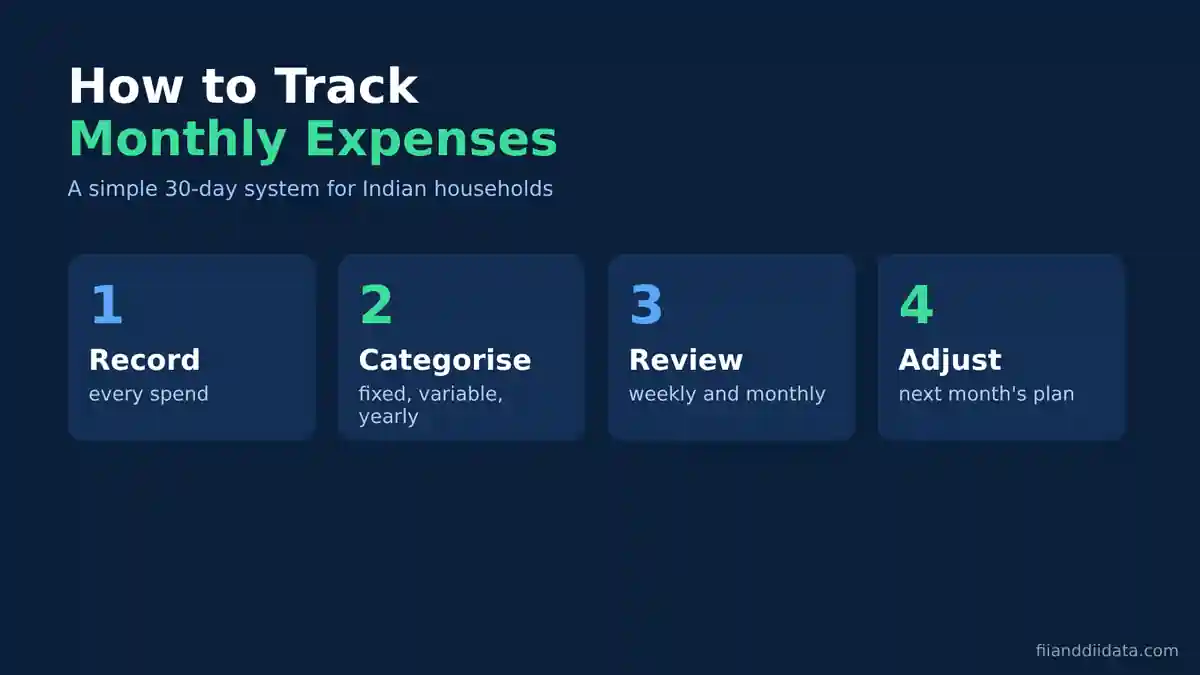
The simplest way to learn how to track monthly expenses is to record every rupee you spend for 30 days, group each payment into a few categories, and compare the total with your plan once a week. Most Indians now pay digitally, which makes this easier than it sounds. UPI handled 24.07 billion transactions worth ₹29.37 lakh crore in September 2026, as per NPCI data, and every one of those payments leaves a record you can use.
Key Takeaways
- Tracking means recording, categorising and reviewing every payment, including small UPI spends and cash.
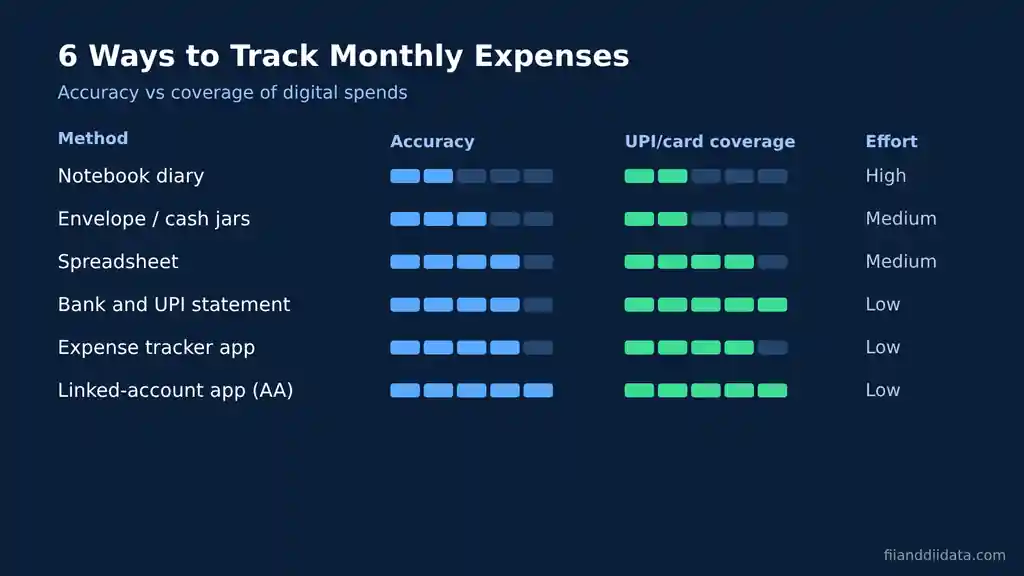
- Six methods work: a notebook, cash envelopes, a spreadsheet, your bank and UPI statements, an expense app, or a linked-account app.
- Your bank statement is the master record; any app or sheet should match it at month end.
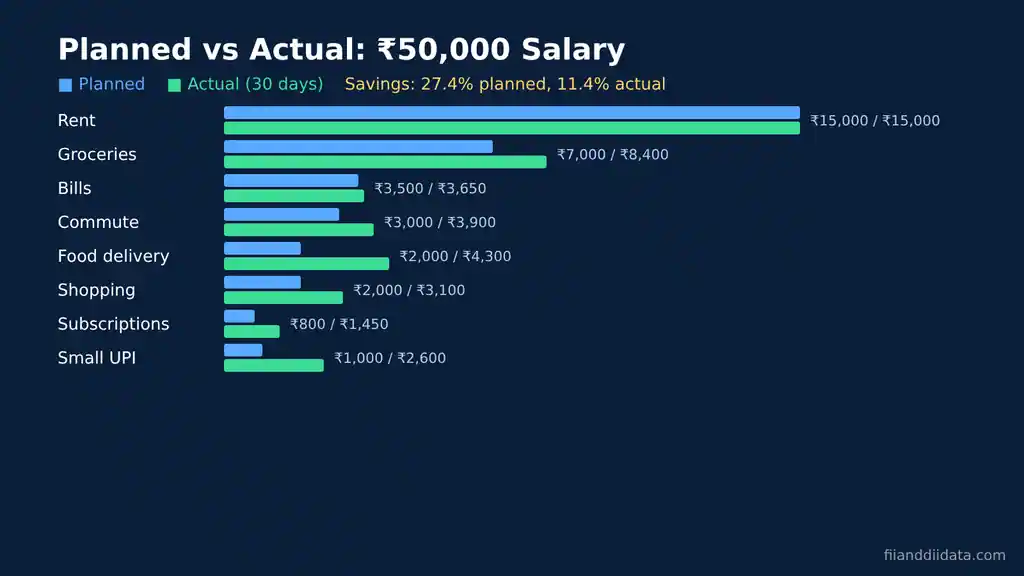
- In our ₹50,000 salary example, untracked spending cut savings from 27.4% of pay to 11.4% in one month.
- A 30-minute month-end review is enough to find the two or three leaks that matter.
Table of contents
- What expense tracking means and why it matters
- How to track monthly expenses: 6 methods compared
- A 7-step system to track monthly expenses
- Expense categories every Indian household should use
- Worked example: a ₹50,000 salary, tracked for 30 days
- How to track UPI, card and cash spending
- Common expense tracking mistakes
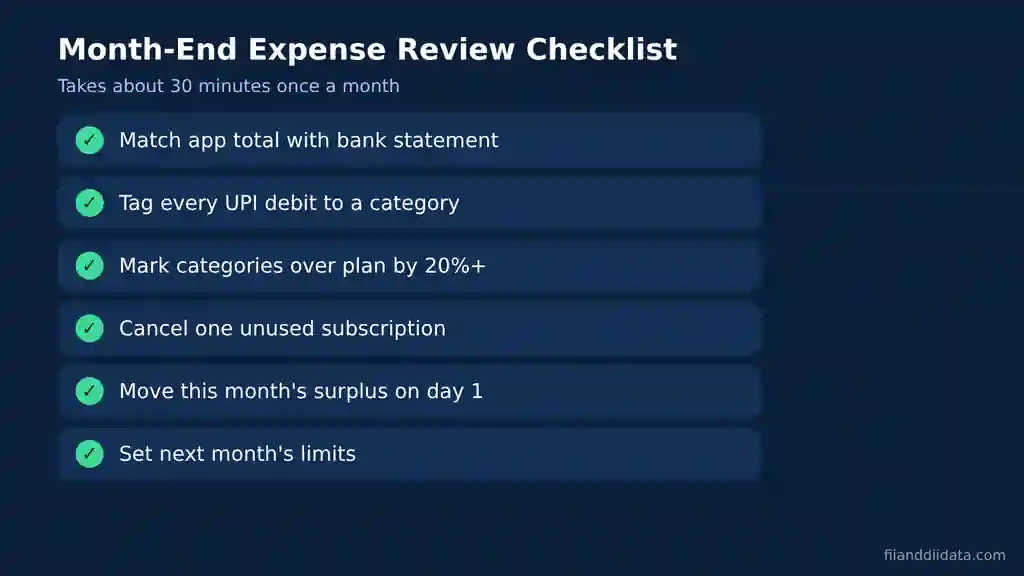
- Month-end review checklist
- Frequently asked questions
- The Bottom Line
What Expense Tracking Means and Why It Matters
Expense tracking is the habit of writing down what you spend, sorting it into categories and checking the totals at regular intervals. It is different from budgeting. A budget is the plan made before the month starts; tracking is the record of what really happened. You need both, because a plan without a record is a guess, and a record without a plan has nothing to compare against.
Most people underestimate small, frequent payments. A ₹40 tea, a ₹150 auto ride and a ₹299 delivery feel trivial one at a time, but they repeat 60 to 90 times a month. Tracking turns these into a single number you can see. That number is usually the first place where savings appear.
How Indian households spend: a benchmark
It helps to know what normal looks like. The government’s Household Consumption Expenditure Survey (HCES) 2023-24 measures monthly per capita consumption expenditure (MPCE), which is the average spending per person in a household each month. The results, released by MoSPI on 27 December 2024, are below.
| Measure (2023-24) | Rural India | Urban India |
|---|---|---|
| Average MPCE (without imputation) | ₹4,122 | ₹6,996 |
| Average MPCE (with imputed value of free items) | ₹4,247 | ₹7,078 |
| Share of spending on food | 47.04% | 39.68% |
| Share of spending on non-food items | 52.96% | 60.32% |
These are per-person averages, not household budgets, so treat them as a rough guide. Their main lesson is that non-food items such as conveyance, clothing, entertainment and durable goods now take the larger share of spending in both rural and urban India. Those are the categories that drift fastest when nobody is watching. The next section shows the tools you can use to watch them.
How to Track Monthly Expenses: 6 Methods Compared
There is no single best method. The right one is the one you will keep using for at least three months. Here is how the common options compare for an Indian earner who pays partly by UPI and card and partly in cash.
| Method | How it works | Best for | Main weakness |
|---|---|---|---|
| Notebook diary | Write each spend with date, amount and category | Cash-heavy households, beginners | Easy to forget entries; manual totals |
| Envelope or cash jars | Fix a cash limit per category at the start of the month | Controlling groceries and outings | Does not cover UPI or card payments well |
| Spreadsheet | Enter or paste transactions; formulas give category totals | People who like detail and charts | Needs 10 to 15 minutes a week |
| Bank and UPI statement review | Download the monthly statement and tag each debit | Mostly digital spenders | Merchant names can be unclear; cash is missing |
| Expense tracker app | Log spends by hand or from SMS alerts | Daily tracking on the phone | Privacy permissions; app may stop working |
| Linked-account app (Account Aggregator) | Pulls statements from several banks with your consent | People with more than one bank account | Categories still need checking by hand |
What the Account Aggregator option means
An Account Aggregator (AA) is a non-bank finance company regulated by the RBI that moves your financial data from one institution to another only on your instruction. The Department of Financial Services states that data is not shared “without the explicit consent of the customer” and that registering with an AA is fully voluntary. As of 30 September 2025, the department reported that 223.32 million users had linked accounts on the network. If you use an app built on this system, you can revoke consent at any time from the app.
Whichever method you pick, the process behind it is the same. The seven steps below work with a notebook, a sheet or an app.
A 7-Step System to Track Monthly Expenses
1. Find your real take-home pay
Start with the amount that reaches your bank account after tax, PF and other deductions. If your income varies, use the lowest month of the last six as your base.
2. List every account and payment channel
Write down each bank account, credit card, wallet and UPI app you use. Money that leaves through a channel you forgot is money you cannot track.
3. Pick 8 to 12 categories
Too few categories hide leaks; too many make tracking tiring. The list in the next section is a good starting set.
4. Record every spend within 24 hours
Log the amount, date and category the same day. For cash, note it before you sleep. Delays are the main reason tracking fails.
5. Do a 10-minute weekly check
Every Sunday, add up each category and compare it with one quarter of the monthly limit. A small correction in week two is easier than a big one in week four.
6. Reconcile with the bank statement at month end
Your tracked total plus your closing balance should explain your opening balance plus income. If there is a gap, look for missed UPI debits, auto-debits and cash withdrawals.
7. Adjust next month’s plan
Raise limits that were unrealistic and cut the ones that hid waste. Then move your savings on payday, before spending starts. Our guide on how to build a monthly budget covers the planning side in detail.
Expense Categories Every Indian Household Should Use
Group spending into three buckets. Fixed costs stay the same each month, variable costs change with your choices, and irregular costs come once or twice a year but still need monthly money set aside.
| Bucket | Categories to track | How often to check |
|---|---|---|
| Fixed | Rent or home loan EMI, other EMIs, school fees, insurance premiums paid monthly, SIPs and RDs | Once a month |
| Variable | Groceries, electricity, gas, mobile and internet, commute and fuel, food delivery and eating out, shopping, subscriptions, medicines, small UPI spends | Weekly |
| Irregular | Annual insurance premiums, festivals and gifts, travel, vehicle servicing, school admission, home repairs | Set aside monthly, review quarterly |
Keep a separate line called “small UPI spends” for payments under ₹200 that do not fit anywhere else. It sounds untidy, but it shows you exactly how much leaks through tiny payments. The example below shows why that matters.
Worked Example: A ₹50,000 Salary, Tracked for 30 Days
Rohit, 29, takes home ₹50,000 a month in Pune. He made a plan at the start of the month and then tracked every payment for 30 days. The figures are an illustration, computed on 30 October 2026.
| Category | Planned | Actual | Difference | Over plan |
|---|---|---|---|---|
| Rent | ₹15,000 | ₹15,000 | ₹0 | 0% |
| Groceries | ₹7,000 | ₹8,400 | ₹1,400 | 20% |
| Electricity, gas, mobile, internet | ₹3,500 | ₹3,650 | ₹150 | 4.3% |
| Commute and fuel | ₹3,000 | ₹3,900 | ₹900 | 30% |
| Food delivery and eating out | ₹2,000 | ₹4,300 | ₹2,300 | 115% |
| Shopping | ₹2,000 | ₹3,100 | ₹1,100 | 55% |
| Subscriptions | ₹800 | ₹1,450 | ₹650 | 81.2% |
| Small UPI spends | ₹1,000 | ₹2,600 | ₹1,600 | 160% |
| Medicines and health | ₹1,000 | ₹700 | -₹300 | -30% |
| Family and gifts | ₹1,000 | ₹1,200 | ₹200 | 20% |
| Total spending | ₹36,300 | ₹44,300 | ₹8,000 | 22% |
| Left to save | ₹13,700 (27.4%) | ₹5,700 (11.4%) |
What the tracking revealed
Rohit’s plan would have saved ₹13,700, or 27.4% of pay. Untracked, he saved only ₹5,700, or 11.4%. Three categories caused more than half of the ₹8,000 gap: food delivery, subscriptions and small UPI spends together went ₹4,550 over plan. None of them felt large while he was spending.
For the next month he set realistic limits: ₹2,500 for delivery, ₹800 for subscriptions after cancelling two unused services, and ₹1,500 for small UPI spends. Compared with his actual spending, that frees ₹3,550 a month, or ₹42,600 a year, without touching rent, groceries or bills. If you are on a tighter income, our guide on managing expenses on a low salary applies the same idea to a ₹20,000 budget.
How to Track UPI, Card and Cash Spending
Digital payments are now the bulk of daily spending. According to NPCI data reported by DD India on 1 October 2026, UPI averaged about 802 million transactions a day in September 2026, and total volume was 23% higher than a year earlier. Each channel needs a slightly different habit.
- UPI: Use one primary UPI app for daily spends so the history sits in one place. Every payment carries a 12-digit reference, explained in our guide to the UPI transaction ID, which helps you match app entries with the bank statement.
- Credit cards: Track the spend on the day you swipe, not when the bill arrives. Otherwise one month’s spending shows up in the next month’s record.
- Auto-debits: List every mandate, such as OTT plans, SIPs and insurance, and check them each quarter. Forgotten subscriptions are a common leak.
- Cash: Treat each ATM withdrawal as “cash spent” unless you note where it went. A weekly cash limit keeps this bucket small.
Choosing an app to track monthly expenses
We do not rank apps, because features and terms change often. Instead, check five things before installing one: whether it needs SMS or account access and why, whether it lets you export your data to a spreadsheet, whether it lets you edit categories, whether it supports cash entries, and what happens to your data if you delete the account. If an app asks for permissions it does not need, pick another.
Common Expense Tracking Mistakes
- Tracking only big payments. Rent and EMIs rarely surprise you. Small, frequent spends do.
- Ignoring cash. A digital-only record misses the vegetable vendor, the auto and the domestic help.
- Too many categories. Thirty categories turn a 10-minute task into an hour, and people quit.
- No monthly reconciliation. If your record never matches your bank statement, you cannot trust it.
- Forgetting irregular costs. Annual premiums and festival spending break budgets that only look at one month.
- Tracking without acting. A record is only useful if it changes next month’s limits.
Most of these are fixed by one short routine at the end of each month, set out below.
Month-End Review Checklist
Set aside 30 minutes on the last weekend of the month and go through this list.
- Download the statement for every bank account and credit card.
- Match your tracked total with the statements and fix any gaps.
- Tag every UPI debit to a category, including the small ones.
- Mark each category that went more than 20% over plan.
- Cancel at least one subscription or mandate you did not use.
- Move this month’s surplus to savings or investments on payday.
- Set next month’s limits, and add one-twelfth of yearly costs to a separate fund.
The money you free up should go somewhere with a purpose. Our guides on how to save money every month and on setting financial goals with a date and a price show where to direct it.
Frequently Asked Questions
How to track monthly expenses if most payments are made by UPI?
Use one main UPI app for daily spends, download your bank statement at month end, and tag each UPI debit to a category. Add cash spends by hand. The bank statement is the final record, so your app or sheet should match it.
What is the 50/30/20 rule for expenses?
It is a simple guideline that splits take-home pay into 50% for needs such as rent, groceries and bills, 30% for wants such as eating out and shopping, and 20% for savings and debt repayment. Tracking shows how close your real spending is to these shares.
How often should I track my expenses?
Record each spend within a day, check category totals once a week, and do a full review with your bank statement once a month. Review irregular yearly costs every quarter.
Is a spreadsheet better than an expense tracker app?
Neither is better for everyone. A spreadsheet gives full control and keeps data with you, but needs a few minutes of entry each week. An app is quicker on the phone but may ask for SMS or account access. Pick the one you will use for at least three months.
Is it safe to link my bank account to a budgeting app?
Check what the app needs access to and why. Apps that use the RBI-regulated Account Aggregator system can fetch data only with your explicit consent, which you can revoke. Never share your UPI PIN, OTP or net banking password with any app or person.
The Bottom Line
Tracking monthly expenses is less about the tool and more about the routine: record every payment, sort it into a few categories, check weekly and reconcile with your bank statement at month end. Because most payments are now digital, the data already exists; your job is to look at it.
Expect the first month to surprise you. In our example, three small categories explained more than half of the gap between planned and actual savings. Your next step: pick one method today, track every rupee until the end of November 2026, and then set new limits for December. For more practical money guides, visit our blog.
Sources: MoSPI, HCES 2023-24 press note (27 December 2024); PIB, factsheet on HCES 2023-24; DD India, UPI transactions in September 2026 based on NPCI data (1 October 2026); Department of Financial Services, Account Aggregator framework.
Disclaimer: This article is for educational purposes only and is not investment advice. Please consult a SEBI-registered advisor before making investment decisions.