
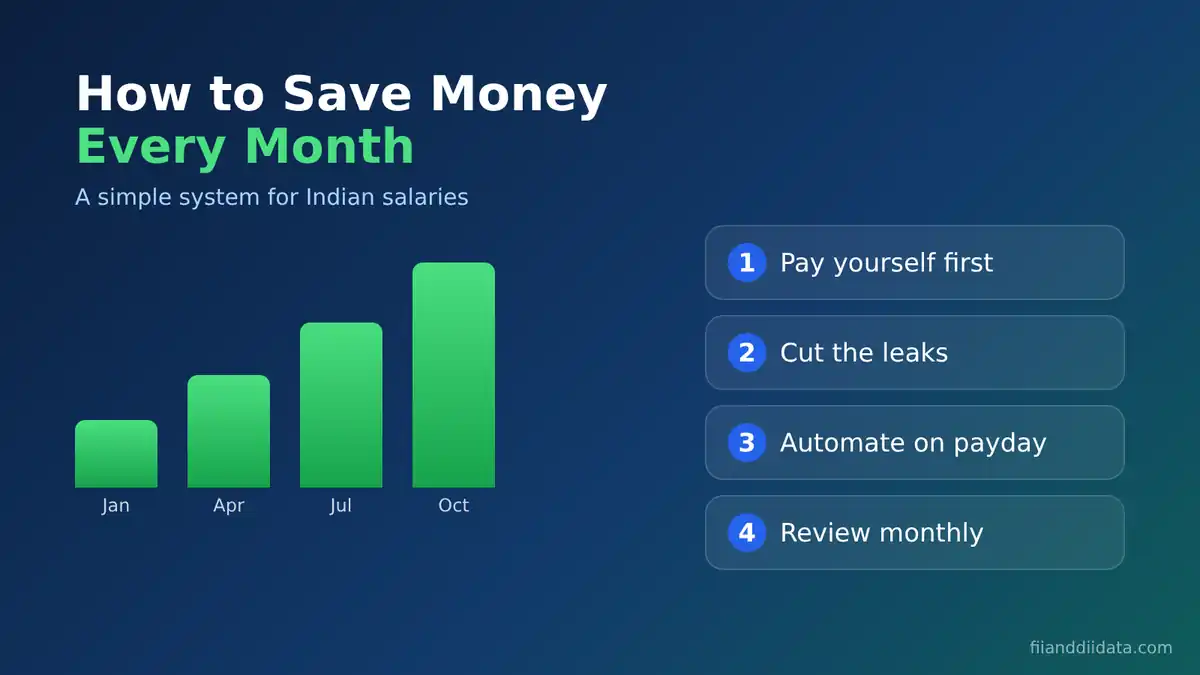
The simplest answer to how to save money every month is to move a fixed amount out of your salary account on payday, before you spend anything, and then cut the two or three expenses that quietly eat most of your income. It matters more than usual right now: retail inflation in India rose to 5.54% in September 2026 and food inflation to 7.74%, according to MoSPI data released on 12 October 2026. This guide shows a system that works on a normal Indian salary.
Key Takeaways
- Save first, spend later: set a standing instruction for the day after your salary credit.
- A 20% savings rate is a good target; on ₹50,000 take-home pay that is ₹10,000 a month.
- Most savings come from three areas: food delivery and eating out, shopping, and transport.
- A post office 5-year RD pays 6.7% for October to December 2026; ₹5,000 a month grows to about ₹3.57 lakh.
- Money in a 4% account loses value when inflation is 5.54%, so give every rupee saved a job.
Table of contents
- Why saving money every month feels harder in 2026
- How much money should you save every month?
- How to save money every month: 9 steps
- Worked example: ₹10,000 a month on a ₹50,000 salary
- Where to keep the money you save every month
- Monthly saving methods compared
- Common mistakes that stop monthly saving
- A month-end savings checklist
- Frequently asked questions
- The Bottom Line
Why Saving Money Every Month Feels Harder in 2026
Most people do not fail to save because they earn too little. They fail because saving is left for the end of the month, and by then the money is gone. Rent, EMIs and bills leave first, small daily payments through UPI follow, and whatever is left on the 30th is called “savings”.
Rising prices make this worse. The Consumer Price Index, which tracks the cost of a typical household basket, rose 5.54% year on year in September 2026, as per the MoSPI release on PIB. Food prices rose faster, at 7.74%. When groceries cost more each month, the leftover amount shrinks unless you plan for it.
What inflation does to idle savings
Inflation also eats money that sits still. Suppose you keep ₹10,000 in an account paying 4% a year. After a year you have ₹10,400. If prices rise 5.54% over the same year, that ₹10,400 buys only what about ₹9,854 buys today. The same ₹10,000 at 6.7% would be worth about ₹10,110 in today’s money. These are simple illustrations that ignore tax, but the lesson holds: saving is step one, and putting the money in the right place is step two. First, let us fix the right amount to save.
How Much Money Should You Save Every Month?
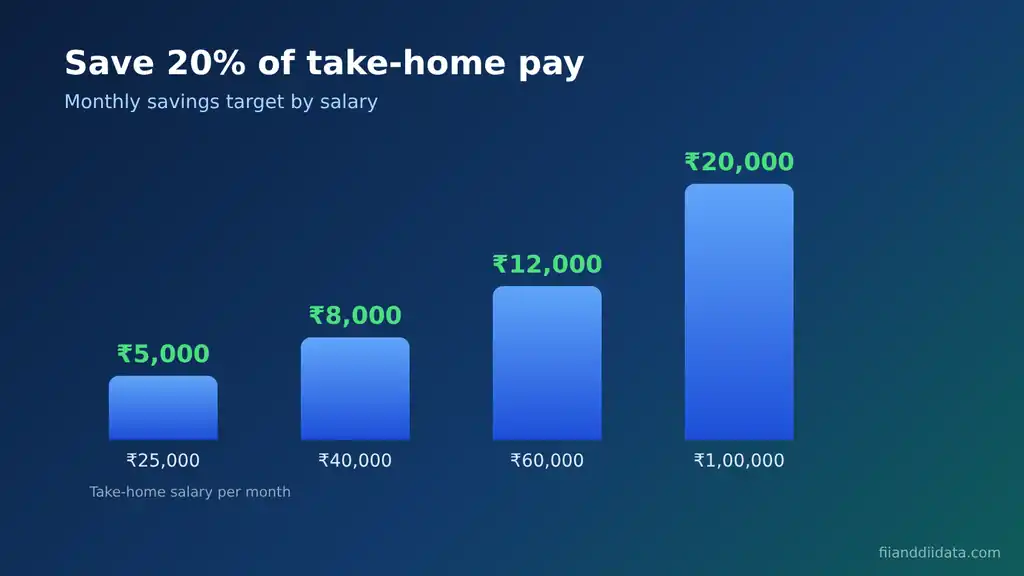
A widely used guide is the 50/30/20 rule: 50% of take-home pay for needs, 30% for wants and 20% for savings and investments. Twenty percent is a target, not a test. If you carry high rent or EMIs, start at 10% and add 1 to 2 percentage points every few months or with every increment.
| Monthly take-home salary | 10% savings | 20% savings | 30% savings | Yearly savings at 20% |
|---|---|---|---|---|
| ₹25,000 | ₹2,500 | ₹5,000 | ₹7,500 | ₹60,000 |
| ₹40,000 | ₹4,000 | ₹8,000 | ₹12,000 | ₹96,000 |
| ₹60,000 | ₹6,000 | ₹12,000 | ₹18,000 | ₹1,44,000 |
| ₹1,00,000 | ₹10,000 | ₹20,000 | ₹30,000 | ₹2,40,000 |
Your savings rate is simply the amount saved divided by take-home pay. If you save ₹6,000 out of ₹40,000, your rate is 15%. Track this one number every month. It tells you more than any app dashboard, and it is the number the nine steps below are designed to raise.
How to Save Money Every Month: 9 Steps
These steps follow a set order. The first three build the system, the next four free up money, and the last two keep it going.
1. Find your real monthly number
Download the last three months of bank and credit card statements. Add up every debit and divide by three. Most people find they spend more than they guessed, mainly through small UPI payments that do not feel like spending.
2. Pay yourself first with a standing instruction
Ask your bank for a standing instruction, or set up a recurring deposit or SIP, dated one or two days after your salary credit. The saved amount leaves before you can spend it. This single habit does more for monthly saving than any expense cut.
3. Split your money into separate accounts
Keep one account for bills and fixed costs, one for daily spending, and one for savings that has no debit card linked to your phone. When your spending account runs low, you know you have reached the month’s limit. Separation makes overspending visible.
4. Fix the big three: housing, transport and food
Rent, commuting and food are usually the largest items in a household budget. A shared flat, a metro pass instead of daily cabs, or cooking four more dinners a week at home can each save more than cutting a dozen small treats. Start here before you cancel the one subscription you enjoy.
5. Audit subscriptions and auto-debits
Check your UPI app and card statements for AutoPay mandates: OTT platforms, music, cloud storage, gym memberships and app trials that turned into paid plans. Cancel anything you have not used in the last 30 days. Review mobile and broadband plans too; many households pay for data they never use.
6. Use a 48-hour rule for wants
For any non-essential purchase above a set amount, say ₹2,000, wait 48 hours. Remove saved cards from shopping apps so that each purchase needs a deliberate step. Many “must-have” items lose their appeal within two days.
7. Plan groceries around a weekly list
With food inflation at 7.74% in September 2026, groceries deserve a plan. Write a weekly menu, buy staples in bulk once a month, and compare quick-commerce prices with your local store before you order. Avoid shopping when hungry; it is an old rule because it works.
8. Save half of every raise, bonus and refund
When your salary rises, increase your standing instruction by at least half of the raise on the same day. Do the same with bonuses, income tax refunds and cash gifts. This lets your lifestyle improve while your savings rate climbs.
9. Review on the last Sunday of the month
Spend 20 minutes comparing what you planned with what you spent. Note one leak to fix next month. Small monthly corrections compound into large yearly savings, as the worked example below shows.
Worked Example: ₹10,000 a Month on a ₹50,000 Salary
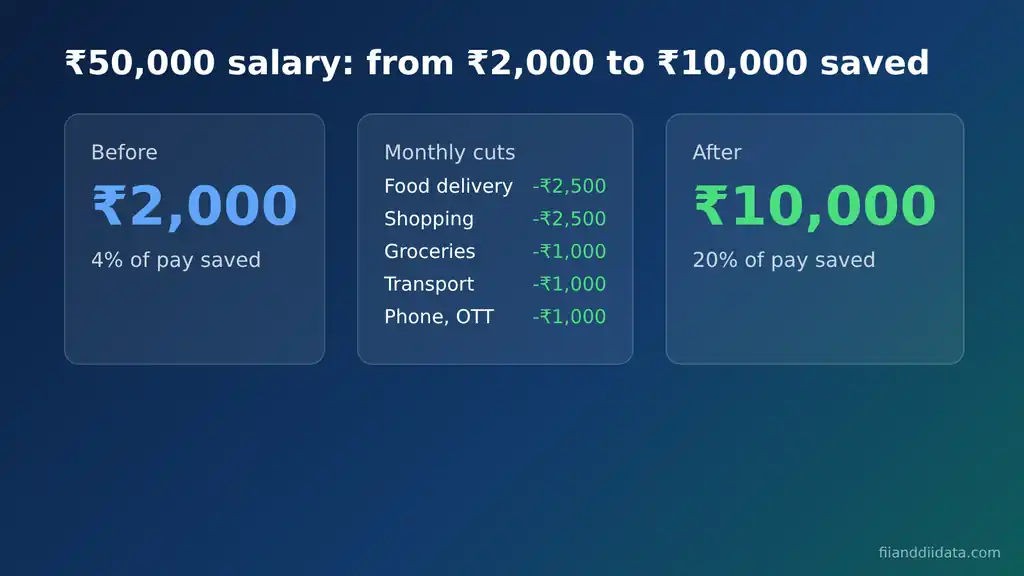
Take Priya, 27, who takes home ₹50,000 a month in Bengaluru. Before planning, she saved about ₹2,000 a month, or 4% of her pay. Here is her budget before and after applying the steps above. These figures are an illustration, not a recommendation.
| Expense | Before | After | Monthly saving |
|---|---|---|---|
| Rent (shared flat) | ₹15,000 | ₹15,000 | ₹0 |
| Groceries | ₹7,000 | ₹6,000 | ₹1,000 |
| Food delivery and eating out | ₹5,000 | ₹2,500 | ₹2,500 |
| Transport | ₹4,000 | ₹3,000 | ₹1,000 |
| Phone, internet and OTT | ₹2,200 | ₹1,200 | ₹1,000 |
| Electricity and utilities | ₹2,500 | ₹2,500 | ₹0 |
| Shopping | ₹6,000 | ₹3,500 | ₹2,500 |
| EMI | ₹4,000 | ₹4,000 | ₹0 |
| Miscellaneous | ₹2,300 | ₹2,300 | ₹0 |
| Total spending | ₹48,000 | ₹40,000 | ₹8,000 |
| Saved each month | ₹2,000 (4%) | ₹10,000 (20%) |
Notice that Priya did not touch rent, the EMI or utilities. Five changes in flexible spending moved her savings from ₹2,000 to ₹10,000 a month, or ₹1.2 lakh a year.
How Priya puts her monthly savings to work
- Emergency fund first: her essential costs (rent, groceries, transport, phone, utilities and EMI) come to ₹31,700. Three months of these is ₹95,100, which takes about 19 months at ₹5,000 a month. She then builds towards six months.
- Goal saving: ₹5,000 a month in a post office 5-year RD at 6.7%, compounded quarterly, would mature at about ₹3,56,829 on ₹3 lakh deposited, if the rate stayed unchanged for the full term.
- Long-term growth: once the emergency fund is ready, the first ₹5,000 can move into a diversified equity SIP for goals more than five years away.
The RD figure assumes the rate at the time of opening applies for the whole tenure. The next section shows where each part of your monthly savings should sit.
Where to Keep the Money You Save Every Month
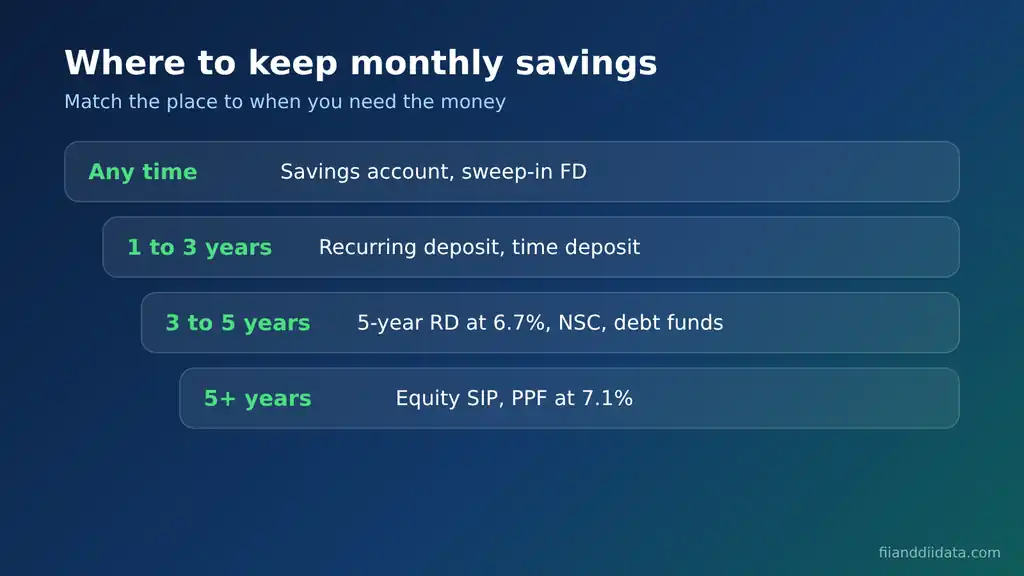
The right place depends on when you will need the money. Cash for emergencies must be easy to reach. Money for goals five or more years away can take some market risk for higher growth. The Finance Ministry kept small savings rates unchanged for October to December 2026, as reported on 30 September 2026; the rates below are listed on the India Post savings schemes page.
| When you need the money | Option | Rate (Oct to Dec 2026) | Good for |
|---|---|---|---|
| Any time | Post Office Savings Account | 4.0% | Day-to-day buffer |
| Any time | Bank savings account or sweep-in FD | Varies by bank | Emergency fund |
| 1 to 3 years | Post Office Time Deposit (1, 2, 3 years) | 6.9%, 7.0%, 7.1% | Known short-term goals |
| Up to 5 years | Post Office 5-year Recurring Deposit | 6.7% | Fixed monthly saving habit |
| 5 years | National Savings Certificate | 7.7% | Lump sums from bonuses |
| 15 years | Public Provident Fund | 7.1% | Long-term, low-risk saving |
| 5+ years | Equity mutual fund SIP | Market-linked | Wealth building |
Bank deposits are protected by the Deposit Insurance and Credit Guarantee Corporation up to ₹5 lakh per depositor per bank, covering principal and interest together, according to the DICGC guide to deposit insurance. Savings, fixed and recurring deposits are all covered.
Where SIPs fit when you save money every month
A monthly SIP is a natural partner to a monthly savings plan. AMFI’s monthly note for September 2026 shows a record ₹32,490 crore of SIP contributions from 10.06 crore accounts. We track how these domestic flows support the market in our SIP inflow September 2026 report. If you invest directly in shares, following FII and DII data helps you understand why prices move, but for most monthly savers a diversified fund is simpler.
Monthly Saving Methods Compared
No single budgeting method suits everyone. Pick the one you will actually follow for twelve months.
| Method | How it works | Best for | Watch out for |
|---|---|---|---|
| Pay yourself first | Fixed transfer on payday, spend the rest freely | Busy salaried earners | Amount may be set too low |
| 50/30/20 rule | Split pay into needs, wants and savings | Beginners | Needs often exceed 50% in metros |
| Zero-based budget | Every rupee gets a job before the month starts | Detail-minded people, irregular income | Takes time each month |
| Envelope or jar method | Separate pots for each spending category | People who overspend on wants | Harder with digital payments |
Many people combine two: pay yourself first for savings, and a simple envelope cap for food delivery and shopping. Whichever you choose, the mistakes in the next section can undo it.
Common Mistakes That Stop Monthly Saving
- Saving what is left over. Leftover money rarely exists. Save on payday.
- Setting an unrealistic target. Jumping from 4% to 30% in one month usually fails. Raise the rate in steps.
- Keeping savings in the spending account. Money you can see on your phone tends to get spent.
- Ignoring annual costs. Insurance premiums, school fees and festival spending break monthly plans. Save one-twelfth of each yearly cost every month.
- Breaking savings for wants. Withdraw only for true emergencies, and refill the amount first next month.
- Leaving all savings idle. A 4% return trails 5.54% inflation; match each rupee to a goal and a suitable product.
Avoiding these six errors keeps your plan alive past the first three months, which is where most attempts stop. A short routine helps.
A Month-End Savings Checklist
Use this list on the last Sunday of every month.
- Did the payday transfer, RD and SIP go through on time?
- What was this month’s savings rate (amount saved ÷ take-home pay)?
- Which category went over plan, and what is one fix for next month?
- Any new subscriptions or AutoPay mandates to cancel?
- Is the emergency fund at target, or does it need topping up?
- Are big yearly costs (insurance, fees, festivals) being set aside monthly?
- Did you get a raise, bonus or refund? Move at least half of it to savings.
For the wider plan, including insurance, debt and tax, read our guide to personal finance tips for Indian earners.
Frequently Asked Questions
How can I save money every month on a low salary?
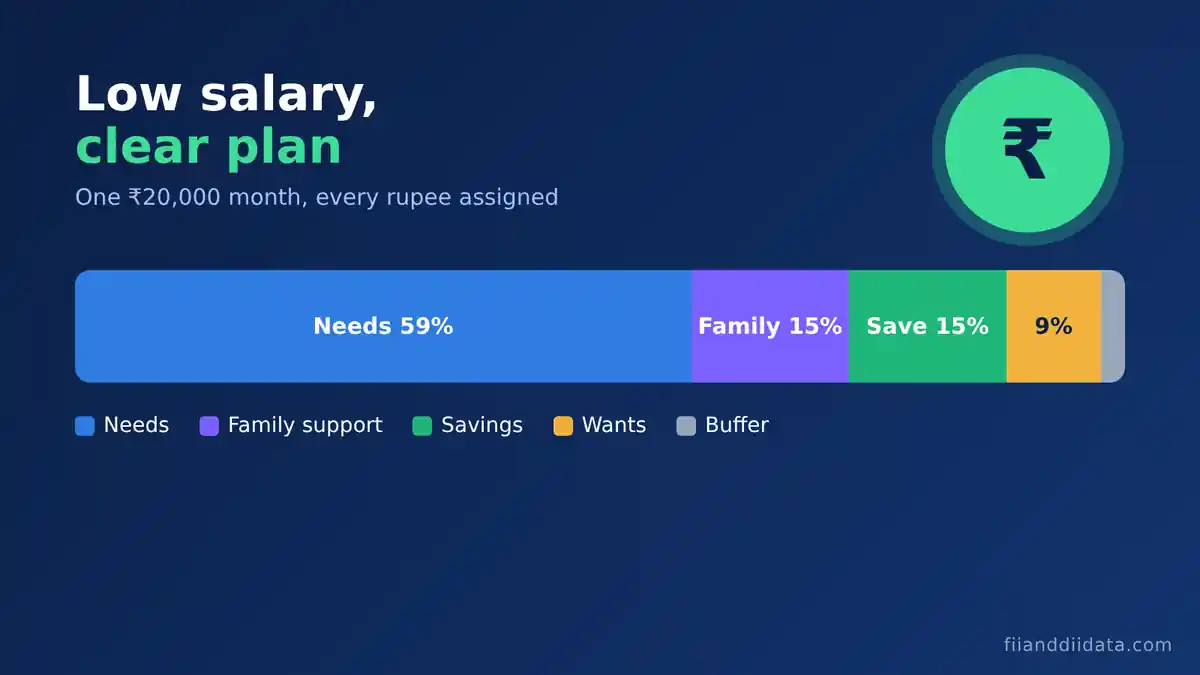
Start small and automate it. Save even 5% to 10% of take-home pay through a standing instruction on payday, cut food delivery and unused subscriptions first, and raise the amount with every increment or bonus.
How much money should I save every month?
A common target is 20% of take-home pay under the 50/30/20 rule. On a ₹50,000 salary that is ₹10,000 a month. If your rent or EMIs are high, begin at 10% and increase it step by step.
What is the best way to save money every month in India?
Pay yourself first. Set a recurring deposit, SIP or standing instruction one or two days after your salary credit, keep savings in a separate account, and review spending once a month.
Is a recurring deposit good for monthly saving?
Yes, for goals one to five years away. The post office 5-year RD pays 6.7% for October to December 2026, compounded quarterly. ₹5,000 a month for five years grows to about ₹3.57 lakh if the rate stays unchanged.
How can I stop spending my savings?
Keep savings in a different bank account with no card or UPI linked on your phone, set a 48-hour rule for non-essential purchases, and withdraw only for true emergencies.
The Bottom Line
Saving money every month is less about willpower and more about order. Move a fixed amount out on payday, cut the large flexible costs before the small ones, and give each rupee saved a place that matches when you will need it. With inflation at 5.54% in September 2026, leaving savings idle is a quiet loss.
Rates on deposits and small savings schemes change every quarter, so recheck them before you commit. Your next step: open your banking app today and schedule a standing instruction for the day after your next salary credit, even if it is only 5% of your pay. For more guides on money and markets, visit our blog.
Sources: PIB, CPI press release for September 2026 (12 October 2026); India Post, savings schemes interest rates; Business Today, small savings rates unchanged for Oct-Dec 2026 (30 September 2026); DICGC, guide to deposit insurance; AMFI monthly note, September 2026.
Disclaimer: This article is for educational purposes only and is not investment advice. Please consult a SEBI-registered advisor before making investment decisions.




1 thought on “How to Save Money Every Month: 9 Steps for Indian Salaries (2026)”