To learn how to create a monthly budget, start with your take-home pay, list what you actually spent in the last three months, and give every rupee a job before the month begins, with savings paid first. A written plan matters more now than a year ago: retail inflation rose to 5.54% in September 2026 and food inflation to 7.74%, as per MoSPI data released on 12 October 2026. This guide walks through seven steps and a worked ₹75,000 family budget.
Key Takeaways
- A monthly budget is a plan made before the month starts, not a record of what already happened.
- Use take-home pay, not CTC, and base the plan on three months of real bank and card statements.
- Divide yearly costs such as school fees and insurance by 12 and save that amount every month.
- In a metro city, needs often take 60% to 70% of pay, so the 50/30/20 rule may need adjusting.
- Review planned versus actual spending once a month and fix one category at a time.
Table of contents
- What a monthly budget is and why it matters
- What you need before you start
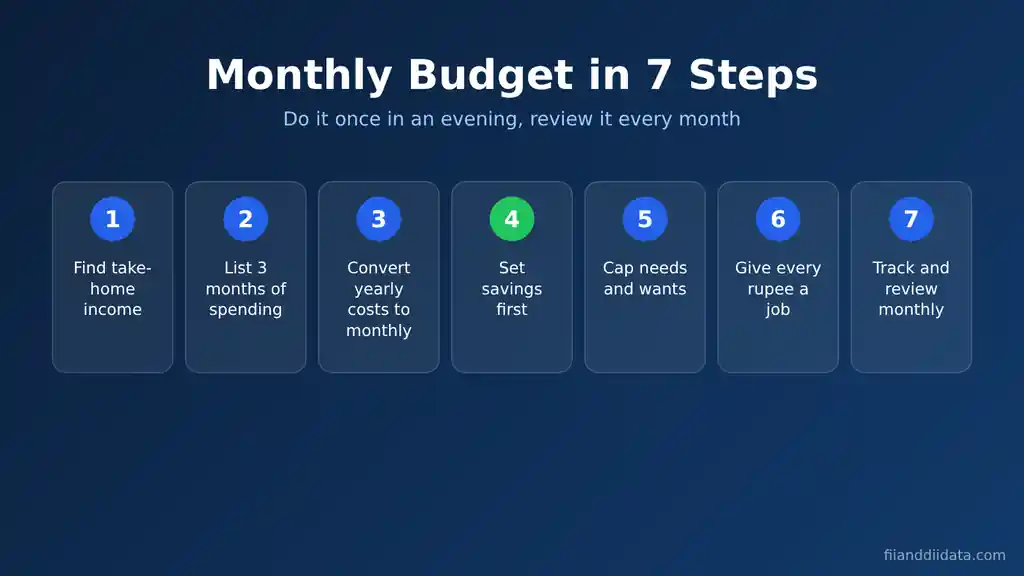
- How to create a monthly budget in 7 steps
- Worked example: a ₹75,000 family budget
- How to handle yearly and irregular costs
- Which budgeting method should you use?
- How to track and review your budget
- How to create a monthly budget without these 6 mistakes
- Frequently asked questions
- The Bottom Line
What a Monthly Budget Is and Why It Matters
A monthly budget is a written plan that decides, in advance, how much of your income goes to bills, daily spending, savings and debt. The key word is advance. Most people only look at money after it has gone. A budget reverses that order.
Rising prices make the plan more useful. In the CPI release for September 2026, headline inflation was 5.54%, urban inflation 4.88% and food inflation 7.74%. If your grocery bill is ₹11,000 today and food prices keep rising at 7.74%, the same basket would cost about ₹11,851 in a year. Without a budget, that extra ₹851 a month simply comes out of savings.
How Indian households spend, as a benchmark
The government’s Household Consumption Expenditure Survey 2023-24 (factsheet released 7 January 2025) found that food made up 39.68% of monthly spending in urban India and 47.04% in rural India. Average monthly spending per person was ₹6,996 in urban areas and ₹4,122 in rural areas. These are averages, not targets, but they show why food is usually the first category to plan.
What You Need Before You Start
Set aside one evening and collect these items. Having real numbers in front of you is what separates a working budget from a wish list.
- Salary slips for three months, to confirm take-home pay.
- Bank and credit card statements, including UPI history.
- Loan schedules showing each EMI and its end date.
- Yearly bills such as insurance premiums and school fees.
- A notebook or spreadsheet with four columns: category, planned, actual and difference.
With these in hand, you can follow the seven steps below in about two hours the first time and in 20 minutes each month after that.
How to Create a Monthly Budget in 7 Steps
Step 1: Find your real take-home income
Use the amount that actually lands in your bank account, not your CTC. Add regular side income, rent received or interest only if it arrives every month. If two partners earn, add both take-home amounts and plan as one household.
Step 2: List three months of actual spending
Go through your statements and tag every debit into a category: rent, groceries, utilities, transport, EMIs, eating out, shopping and so on. Add each category for three months and divide by three. This average is your starting point. Most people find two or three categories far higher than they guessed.
Step 3: Convert yearly costs into monthly amounts
Take every cost that comes once or twice a year and divide the yearly total by 12. A ₹36,000 yearly insurance premium becomes ₹3,000 a month. This single step stops “surprise” bills from breaking the plan, and we cover it in detail further below.
Step 4: Set savings first
Decide your savings amount before you set any spending limit. Treat it like a bill: an emergency fund contribution, a recurring deposit or a SIP that leaves the account a day or two after salary. If you cannot reach 20% yet, start at 10% and raise it with every increment.
Step 5: Separate needs from wants and cap each one
Needs are costs you must pay to live and work: housing, food at home, utilities, transport to work, EMIs, insurance and school fees. Wants are choices: eating out, shopping, entertainment and travel. Fixed costs stay the same each month, while variable costs move. Put a monthly cap on every variable category.
Step 6: Give every rupee a job
Income minus savings, needs and wants should equal zero. If something is left over, assign it to a goal. If the total is negative, cut wants first, then look at the large needs such as rent or transport. A plan that does not balance on paper will not balance in real life.
Step 7: Track and review once a month
At the end of the month, fill the “actual” column and compare it with “planned”. Fix one category at a time. The section on tracking below shows how a simple review looks with real numbers.
Worked Example: A ₹75,000 Family Budget
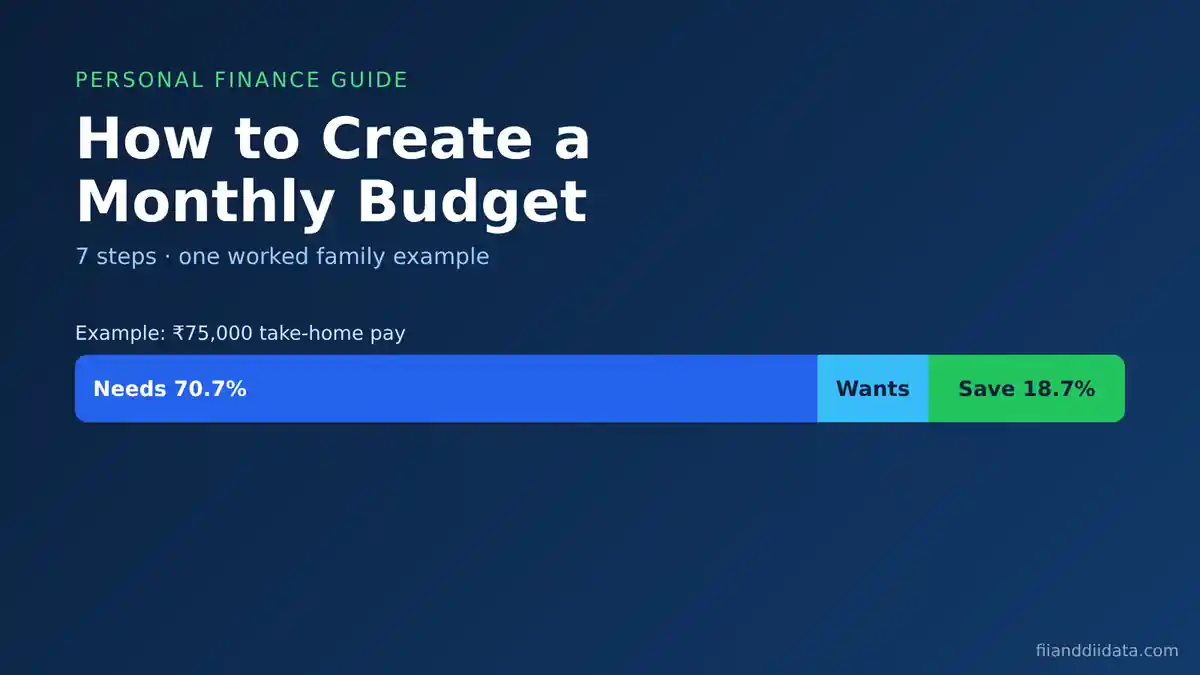
Take Rohan and Meera, who live in Pune with one school-going child. Their combined take-home pay is ₹75,000 a month. They have a car loan EMI, pay rent and want to build an emergency fund. Here is how their monthly budget looks after following the seven steps. The figures are an illustration, not a recommendation.
| Category | Type | Monthly amount | Share of pay |
|---|---|---|---|
| Rent | Need (fixed) | ₹18,000 | 24.0% |
| Groceries | Need (variable) | ₹11,000 | 14.7% |
| Car loan EMI | Need (fixed) | ₹6,000 | 8.0% |
| School fees (₹48,000 a year ÷ 12) | Need (yearly) | ₹4,000 | 5.3% |
| Transport and fuel | Need (variable) | ₹4,000 | 5.3% |
| Electricity, gas and water | Need (variable) | ₹3,500 | 4.7% |
| Insurance premiums (₹36,000 a year ÷ 12) | Need (yearly) | ₹3,000 | 4.0% |
| Phone and internet | Need (fixed) | ₹1,500 | 2.0% |
| Vehicle upkeep (₹12,000 a year ÷ 12) | Need (yearly) | ₹1,000 | 1.3% |
| Routine medical costs | Need (variable) | ₹1,000 | 1.3% |
| Eating out and entertainment | Want | ₹3,000 | 4.0% |
| Shopping and personal care | Want | ₹3,000 | 4.0% |
| Festivals and gifts (₹24,000 a year ÷ 12) | Want (yearly) | ₹2,000 | 2.7% |
| Emergency fund | Saving | ₹5,000 | 6.7% |
| Equity SIP | Saving | ₹6,000 | 8.0% |
| PPF | Saving | ₹3,000 | 4.0% |
| Total | ₹75,000 | 100% |
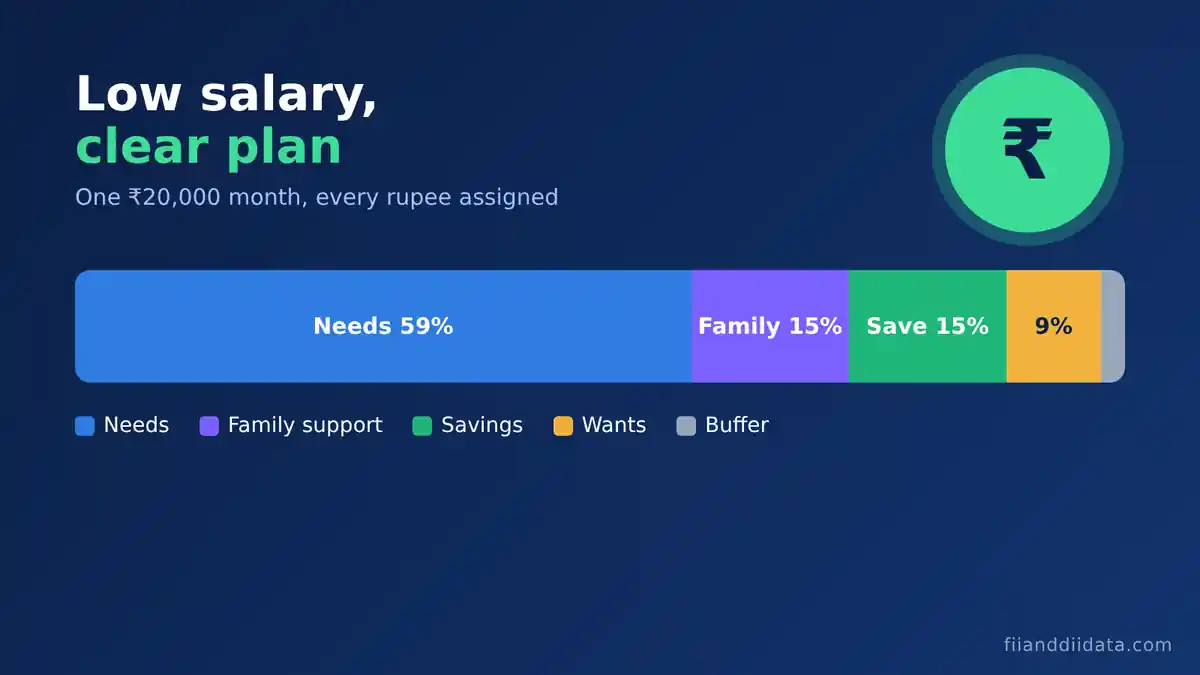
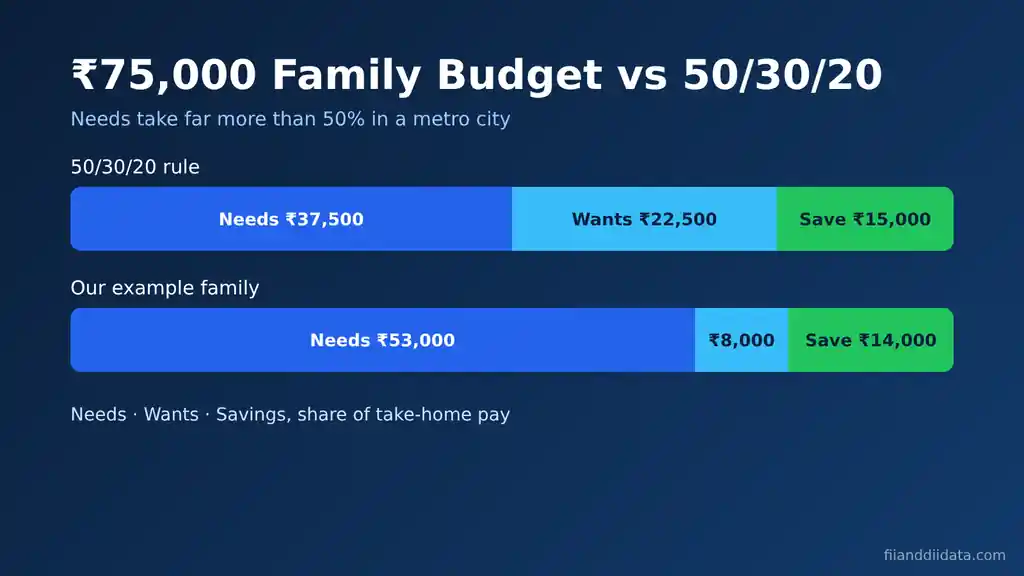
Added up, needs come to ₹53,000 (70.7%), wants to ₹8,000 (10.7%) and savings to ₹14,000 (18.7%). Under a strict 50/30/20 split the family would cap needs at ₹37,500, so the rule clearly does not fit a rent-paying metro household. That is fine. The plan still balances to zero, saves close to 20%, and leaves no yearly bill to chance.
Where the family keeps its savings
Their essential monthly costs are ₹53,000, so a three-month emergency fund is ₹1.59 lakh and a six-month fund is ₹3.18 lakh. At ₹5,000 a month in a savings account or sweep-in deposit, reaching three months takes about 32 months, a little less with interest. Bank deposits are insured by DICGC up to ₹5 lakh per depositor per bank, covering principal and interest, as per the DICGC guide to deposit insurance. For the PPF portion, the rate for October to December 2026 is 7.1%, unchanged from the previous quarter. We track how monthly SIPs like theirs add up across India in our SIP inflow September 2026 report.
How to Handle Yearly and Irregular Costs in a Monthly Budget
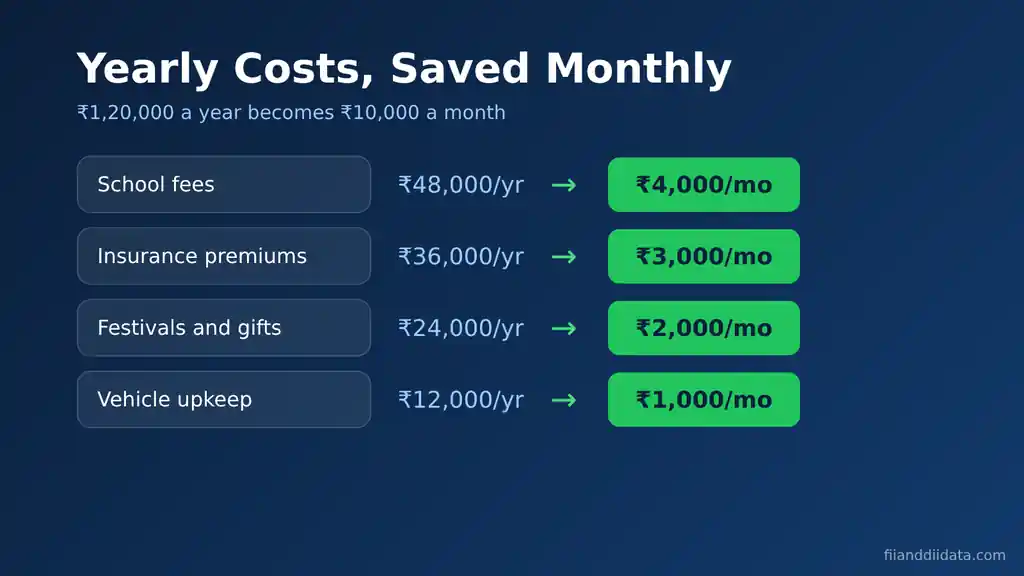
Most budgets fail in the month a large yearly bill arrives. The fix is a sinking fund: a separate pot where you save a fixed amount each month for a known future cost. In the example above, four yearly costs add up to ₹1,20,000. Divided by 12, that is ₹10,000 a month, set aside in a separate account or a short-term deposit.
| Yearly cost | Amount per year | Save each month | Where to park it |
|---|---|---|---|
| School fees | ₹48,000 | ₹4,000 | Recurring deposit or separate savings account |
| Health and term insurance | ₹36,000 | ₹3,000 | Separate savings account |
| Festivals and gifts | ₹24,000 | ₹2,000 | Separate savings account |
| Vehicle insurance and service | ₹12,000 | ₹1,000 | Separate savings account |
| Total | ₹1,20,000 | ₹10,000 |
How to create a monthly budget on an irregular income
Freelancers, commission earners and small business owners should plan on their lowest month, not their average. Suppose a freelancer earned between ₹48,000 and ₹95,000 a month over the last year, with an average of ₹70,000. Build the base budget on ₹48,000. In a month that brings ₹82,000, the extra ₹34,000 can be split: 50% (₹17,000) to an income buffer, 30% (₹10,200) to goals and 20% (₹6,800) to spending. Once the buffer holds three months of the base budget, or ₹1.44 lakh, you can pay yourself a steady “salary” from it.
Which Budgeting Method Should You Use?
Every method answers the same question: how much goes where. Pick the one you will follow for a full year.
| Method | How it works | Best for | Limitation |
|---|---|---|---|
| 50/30/20 rule | 50% needs, 30% wants, 20% savings | Beginners with moderate rent | Needs often exceed 50% in metro cities |
| Zero-based budget | Income minus all planned uses equals zero | Families and irregular earners | Takes more time each month |
| Pay yourself first | Fixed savings on payday, spend the rest | Busy salaried earners | Spending can drift without caps |
| Envelope method | Separate pots or wallets for each category | People who overspend on wants | Harder with UPI and cards unless you use separate accounts |
The worked example above is a zero-based budget with savings paid first, which suits most Indian salaried households. If you mainly want to build the saving habit, our guide on how to save money every month compares these methods with a single-earner example. Whichever method you pick, it only works if you track it.
How to Track and Review Your Budget
Tracking does not need an app. A spreadsheet with planned and actual columns is enough. Here is how Rohan and Meera’s first month compared with the plan in the five variable categories.
| Category | Planned | Actual | Difference |
|---|---|---|---|
| Groceries | ₹11,000 | ₹12,200 | ₹1,200 over |
| Eating out and entertainment | ₹3,000 | ₹4,100 | ₹1,100 over |
| Shopping and personal care | ₹3,000 | ₹2,400 | ₹600 under |
| Transport and fuel | ₹4,000 | ₹4,300 | ₹300 over |
| Electricity, gas and water | ₹3,500 | ₹3,200 | ₹300 under |
| Net | ₹1,700 over |
The family was ₹1,700 over plan. Rather than cutting savings, they took the shortfall from next month’s wants and made one change: a weekly grocery list. Over-spending in the first few months is normal; the review is where the budget improves.
A monthly budget review checklist
- Did savings, SIPs and sinking fund transfers go out on time?
- Which two categories went over plan, and by how much?
- Is there one change you can make next month, not five?
- Did any yearly bill come up that is not yet in the plan?
- Has income changed? If you got a raise, move at least half of it to savings.
- Is the emergency fund on track for three months of essential costs?
For goals beyond the monthly plan, such as insurance, debt and tax, see our personal finance tips for Indian earners. Next, the mistakes that most often undo a new budget.
How to Create a Monthly Budget Without These 6 Mistakes
- Planning on CTC or gross pay. Tax, PF and other deductions never reach your account. Plan on take-home pay only.
- Guessing instead of checking statements. Memory underestimates small UPI payments. Three months of data fixes this.
- Forgetting yearly costs. Insurance, school fees and festival spending break plans that only count monthly bills.
- No line for small leaks. A ₹150 coffee five days a week adds up to about ₹3,250 a month. Give such habits their own line.
- Making the budget too tight. A plan with no room for wants is usually abandoned within weeks. Keep a small, guilt-free spending line.
- Skipping the review. A budget written once and never checked is only a guess. Twenty minutes a month keeps it real.
Frequently Asked Questions
How do I create a monthly budget for the first time?
Note your take-home pay, list three months of actual spending from bank and card statements, divide yearly bills by 12, set savings first, cap each spending category, and make sure income minus all planned uses equals zero. Review it at the end of the month.
What is the 50/30/20 rule in budgeting?
It splits take-home pay into 50% for needs, 30% for wants and 20% for savings and investments. On ₹75,000 that means ₹37,500 for needs, ₹22,500 for wants and ₹15,000 for savings. Families paying metro rents often need to adjust the split.
What is the difference between fixed and variable expenses?
Fixed expenses stay the same each month, such as rent, EMIs and phone plans. Variable expenses change, such as groceries, fuel, electricity and eating out. Variable costs are where most monthly savings are found.
How much of my monthly budget should go to savings?
A common target is 20% of take-home pay. If rent or EMIs are high, start at 10% and raise it with every increment or bonus. Build an emergency fund of three to six months of essential costs before taking higher investment risk.
Do I need an app to make a monthly budget?
No. A notebook or spreadsheet with four columns, category, planned, actual and difference, is enough. What matters is reviewing it once a month and correcting one category at a time.
The Bottom Line
Creating a monthly budget comes down to order: real income, real spending, yearly costs divided by 12, savings first, then caps on needs and wants until the plan balances to zero. Do not force your numbers into a rule that does not fit your city or family. A plan that saves 15% to 20% and covers every yearly bill is a good plan.
With food prices rising faster than overall inflation in September 2026, the grocery line deserves the closest watch. Your next step: download the last three months of bank statements tonight and fill in the “actual” column for each category. Small savings rates change every quarter, so recheck them before you commit. For more guides on money and markets, visit our blog.
Sources: PIB, CPI press release for September 2026 (12 October 2026); PIB, Household Consumption Expenditure Survey 2023-24 factsheet (7 January 2025); DICGC, guide to deposit insurance; Business Today, small savings rates unchanged for Oct-Dec 2026 (30 September 2026); India Post, savings schemes interest rates.
Disclaimer: This article is for educational purposes only and is not investment advice. Please consult a SEBI-registered advisor before making investment decisions.