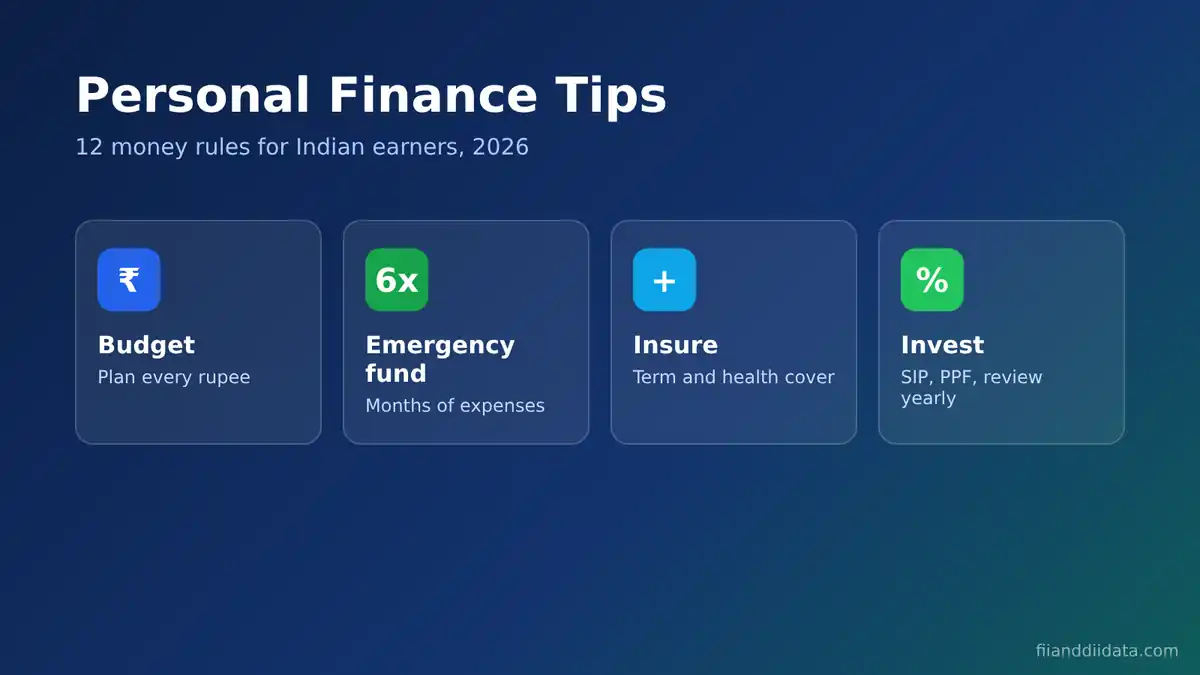
The best personal finance tips come down to a simple order: track what you spend, build a cash buffer, insure your income and health, clear costly debt, and only then invest for long-term goals. In September 2026, Indians put a record ₹32,490 crore into mutual fund SIPs, according to AMFI, yet many of those investors still have no emergency fund. This guide shows how to get the order right on a normal Indian salary.
Key Takeaways
- Follow a fixed order: budget, emergency fund, insurance, debt, investing, then a yearly review.
- On a ₹60,000 take-home salary, the 50/30/20 rule sets aside ₹12,000 a month for savings.
- Six months of essential expenses is a sensible emergency fund; for ₹30,000 of needs, that is ₹1.8 lakh.
- PPF earns 7.1% and SCSS 8.2% for October to December 2026, unchanged from the previous quarter.
- Report an unauthorised bank debit within 3 working days to keep your liability at zero under RBI rules.
Table of contents
- What personal finance means for an Indian household
- 12 personal finance tips that work on an Indian salary
- Worked example: a ₹60,000 salary plan
- Where to park safe money: latest small savings rates
- The personal finance tips priority ladder
- Protect your money from fraud
- Common money mistakes to avoid
- A monthly personal finance checklist
- Frequently asked questions
- The Bottom Line
What Personal Finance Means for an Indian Household
Personal finance is the way you earn, spend, save, protect and grow money across your life. For most Indian families it covers six areas: the monthly budget, a cash reserve for bad days, insurance, loans and credit cards, investments for goals such as a home or a child’s education, and tax.
These areas are linked. A family without health cover may break a fixed deposit or sell mutual fund units in a market fall to pay a hospital bill. A person who pays only the minimum due on a credit card can lose more in interest than a good fund earns. Getting the sequence right matters more than finding the “best” product, which is why the tips below follow a fixed order.
12 Personal Finance Tips That Work on an Indian Salary
These personal finance tips are written for salaried earners, but most apply to freelancers and small business owners too.
1. Track every rupee for 90 days
Before you set a budget, find out where your money actually goes. Download three months of bank and card statements and group each debit into needs (rent, groceries, EMIs, school fees, bills), wants (eating out, shopping, trips) and savings.
2. Use a simple budget rule such as 50/30/20
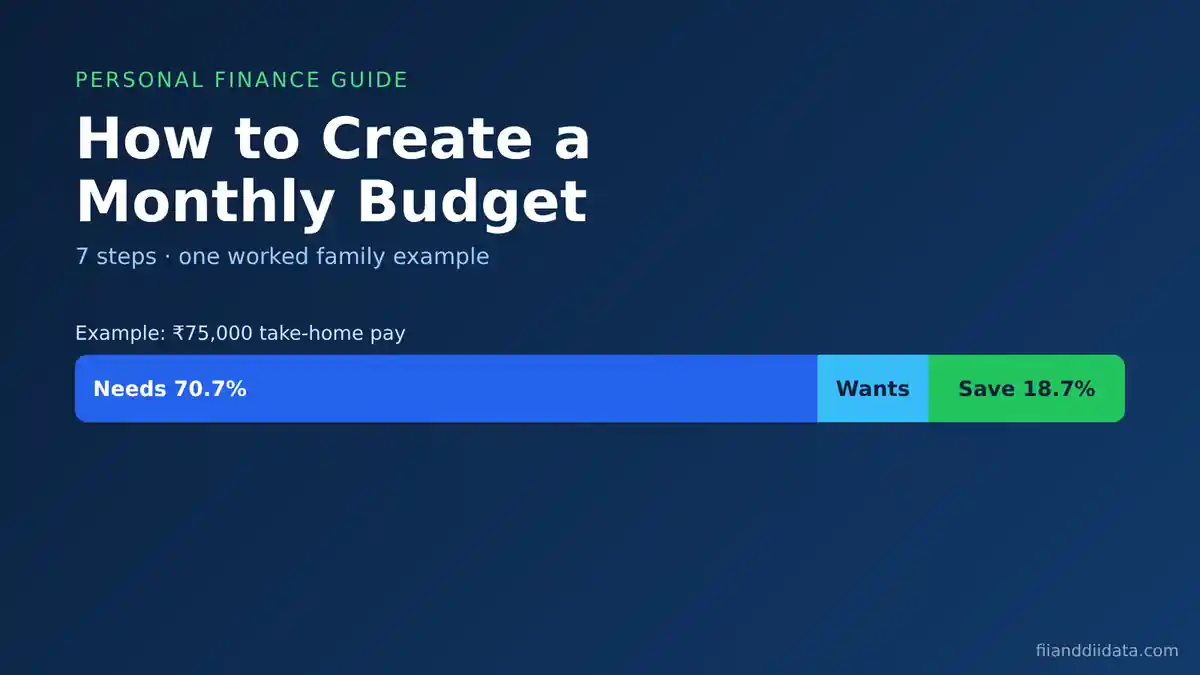
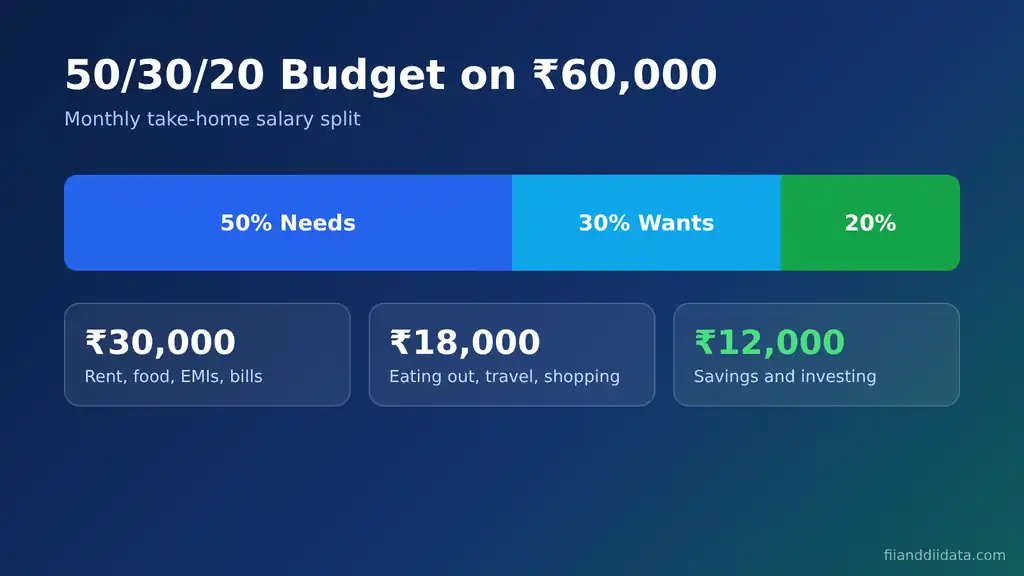
The 50/30/20 rule splits take-home pay into 50% for needs, 30% for wants and 20% for savings and investments. In a metro with high rent, needs may take 60%, so cut wants first rather than savings.
3. Pay yourself first on salary day
Set standing instructions so that your savings amount leaves your salary account within a day or two of payday. Money you never see is money you do not spend.
4. Build an emergency fund of six months of needs
An emergency fund covers job loss, medical bills not paid by insurance, or urgent home repairs. Three months of essential expenses is a minimum; six months suits single-income families and people in cyclical jobs. Keep it in a savings account, a sweep-in fixed deposit or a liquid fund, not in equity.
5. Buy pure term insurance if anyone depends on you
Term insurance pays your family a lump sum if you die during the policy term. It is far cheaper than endowment or money-back plans for the same cover. A common planner’s rule of thumb is cover of 10 to 15 times annual income, adjusted for loans and goals.
6. Hold your own health insurance, not just the office cover
Group cover from an employer ends when you leave the job, often when you need it most. A personal family floater policy, bought while you are young and healthy, avoids long waiting periods later. Read the room-rent limits, co-payment and waiting-period clauses before you buy.
7. Clear high-cost debt before you invest
Credit card dues and many personal loans cost far more than most investments earn. Paying them off is a guaranteed return. List your loans by interest rate and put any extra money into the costliest one first, while paying the minimum on the rest.
8. Use credit cards only as a payment tool
Pay the full statement balance every month, not the minimum due. Keep usage well below your limit and never withdraw cash on a card. Under an RBI directive of 1 September 2016, every credit bureau must give you one free full credit report, including your score, once a calendar year, so check it for errors.
9. Invest for goals, not for tips
Give every investment a job: retirement, a home down payment, a child’s education. Money needed within three years belongs in safer options such as fixed deposits or debt funds. Money for goals ten or more years away can go into diversified equity mutual funds through a monthly SIP.
10. Keep part of your money in government-backed schemes
PPF, NSC, SCSS and Sukanya Samriddhi offer fixed, government-set rates and are useful for the stable part of a portfolio. Rates are reviewed every quarter, so check them before you commit. The latest rates are in the table further down.
11. Choose your tax regime with a calculation, not a habit
Under the new tax regime announced in the Union Budget on 1 February 2025, there is no income tax payable up to ₹12 lakh of income, and ₹12.75 lakh for salaried taxpayers after the ₹75,000 standard deduction, according to PIB. If you have large deductions, such as a home loan, compare both regimes on the Income Tax Department’s calculator before you file.
12. Review once a year and after every life event
A pay rise, marriage, a child, a new loan or a job change should trigger a review of your budget, cover and nominees. Once a year, rebalance investments back to your planned mix of equity and debt. The worked example below shows how all twelve steps fit on one salary.
Worked Example: A ₹60,000 Salary Plan
Take Ravi, 29, who takes home ₹60,000 a month in Pune and supports his parents. Here is how the personal finance tips above turn into numbers. All figures are illustrations, not recommendations.
| Item | Calculation | Result |
|---|---|---|
| Needs (50%) | ₹60,000 × 50% | ₹30,000 a month |
| Wants (30%) | ₹60,000 × 30% | ₹18,000 a month |
| Savings (20%) | ₹60,000 × 20% | ₹12,000 a month |
| Emergency fund target | 6 × ₹30,000 of needs | ₹1,80,000 |
| Time to build it | ₹1,80,000 ÷ ₹12,000 | 15 months |
| Term cover range (rule of thumb) | 10 to 15 × ₹7.2 lakh annual pay | ₹72 lakh to ₹1.08 crore |
What Ravi does after the emergency fund is ready
From month 16, the full ₹12,000 can move to long-term goals. Suppose Ravi puts ₹1 lakh a year into PPF at the start of each year for 15 years. If the 7.1% rate stayed unchanged for the whole period, the account would grow to about ₹27.12 lakh on ₹15 lakh invested. The rate is revised quarterly, so the real outcome will differ.
For context, AMFI’s monthly note for September 2026 shows 10.06 crore SIP accounts contributing ₹32,490 crore, an average of about ₹3,230 per account. Even a small, regular SIP puts you in the same habit as millions of investors. You can read the full trend in our report on SIP inflow September 2026.
Where to Park Safe Money: Latest Small Savings Rates
The Finance Ministry kept small savings rates for October to December 2026 unchanged from the previous quarter, as stated in its office memorandum of 30 September 2026 and Department of Posts SB Order 12/2026. The rates below are from India Post.
| Scheme | Interest rate (per annum) | Best suited for |
|---|---|---|
| Post Office Savings Account | 4.0% | Day-to-day cash |
| Recurring Deposit | 6.7% | Disciplined monthly saving |
| Time Deposit | 6.9% to 7.5% | Short and medium-term goals |
| Monthly Income Account | 7.4% | Regular monthly income |
| Public Provident Fund | 7.1% | Long-term, tax-efficient saving |
| National Savings Certificate | 7.7% | Five-year fixed return |
| Kisan Vikas Patra | 7.5% | Doubling money in 115 months |
| Sukanya Samriddhi Account | 8.2% | A daughter’s education or marriage |
| Senior Citizens Savings Scheme | 8.2% | Retirees needing income |
Bank deposits are another safe option. The Deposit Insurance and Credit Guarantee Corporation (DICGC) insures each depositor up to ₹5 lakh per bank, covering principal and interest together. If your savings are larger, spreading them across banks keeps more of them insured. The next section puts every step in order.
The Personal Finance Tips Priority Ladder
Most money mistakes come from doing the right things in the wrong order. Investing in small-cap funds while carrying credit card debt, or buying a car before having health cover, are common examples. The ladder below fixes that.
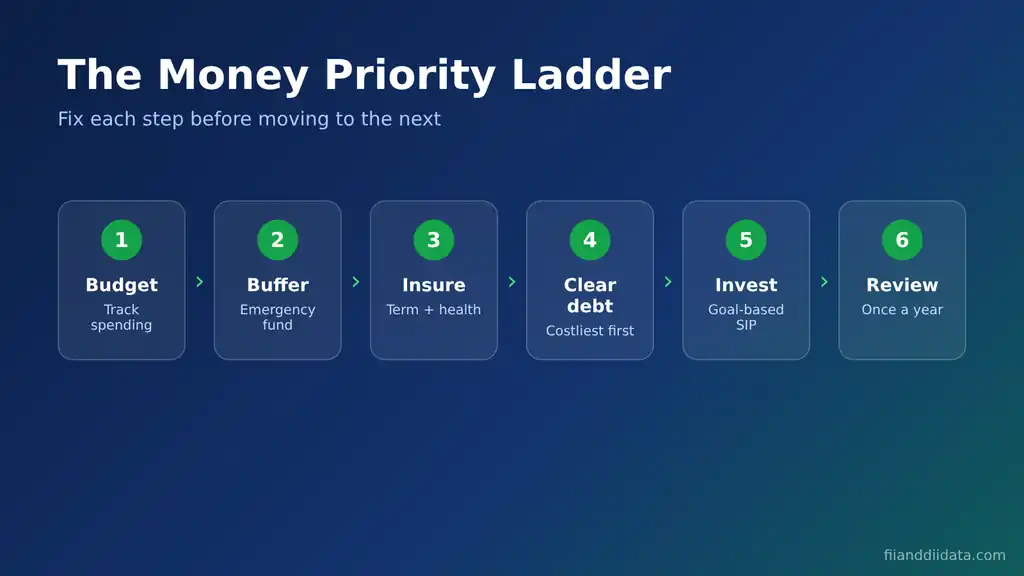
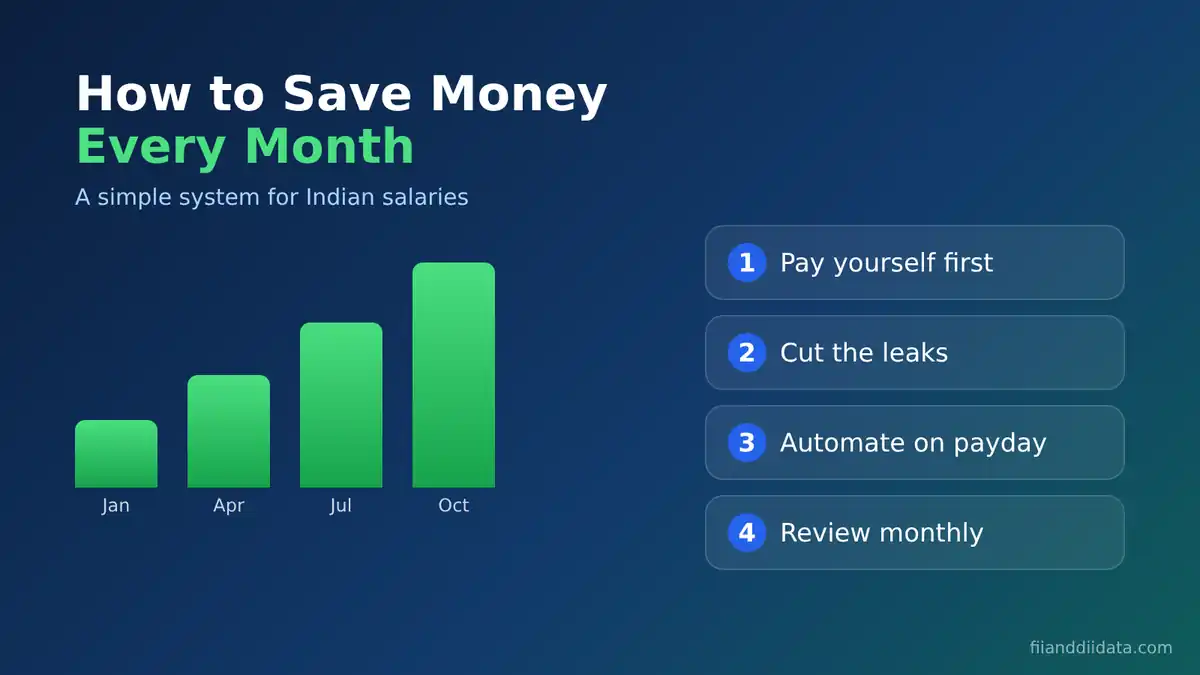
- Budget: know your fixed costs and your savings rate.
- Buffer: one to two months of needs first, then build to six.
- Insure: term cover for dependants and health cover for the family.
- Clear debt: start with the highest interest rate.
- Invest: goal-based SIPs plus safe schemes for the stable part.
- Review: once a year and after every major life event.
How the stock market fits into personal finance tips
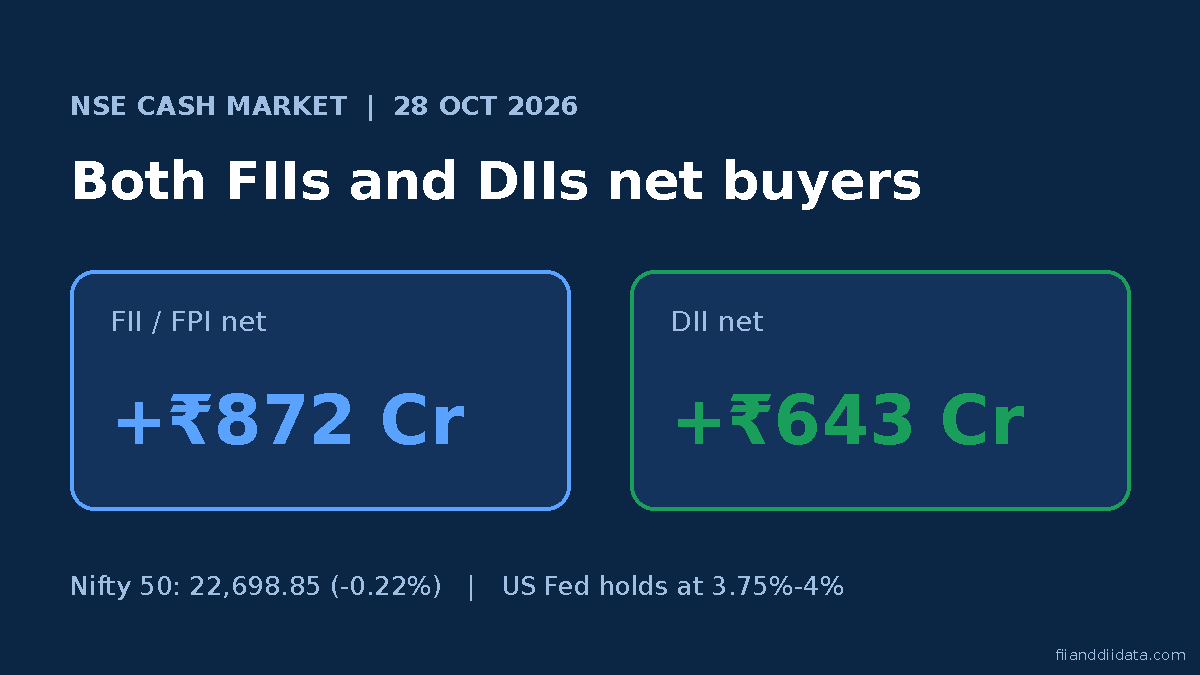
Equity is the growth engine of a long-term plan, but it also swings. In 2026, foreign investors have sold Indian shares heavily while domestic funds, fed by SIPs, kept buying, as we explain in how DIIs absorbed FII selling in 2026. If you invest directly in stocks, tracking FII and DII data helps you understand why markets move. For most beginners, a diversified fund is the simpler choice.
Protect Your Money From Fraud
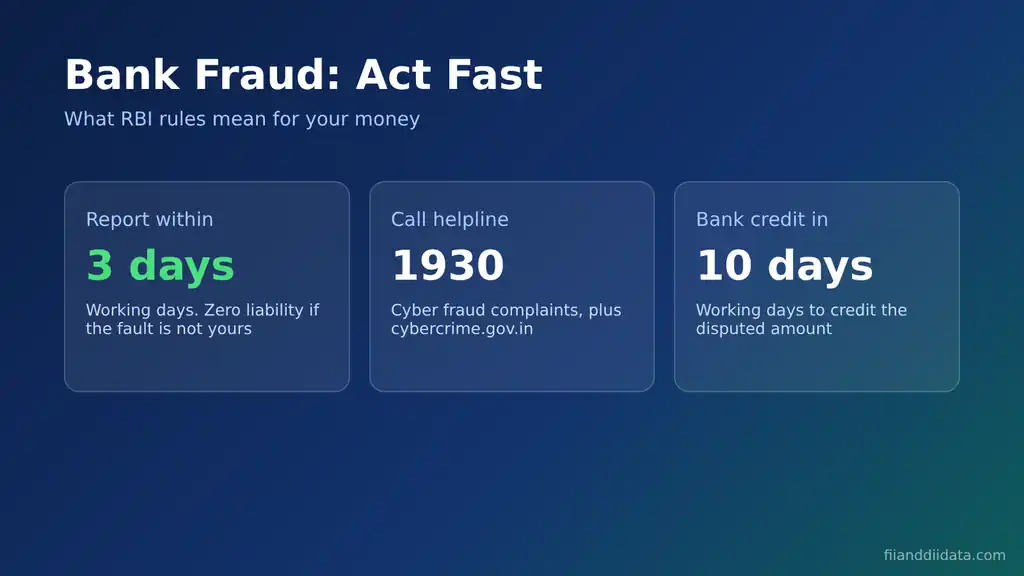
No savings plan survives a drained bank account. UPI, card and net banking fraud is now one of the biggest risks to household money, so speed matters. Under an RBI circular of 6 July 2017, your liability depends on how fast you report an unauthorised transaction caused by a third-party breach.
| When you report | Your maximum liability |
|---|---|
| Within 3 working days | Zero |
| 4 to 7 working days (Basic Savings Bank Deposit account) | ₹5,000 or the transaction value, whichever is lower |
| 4 to 7 working days (other savings accounts, cards with limit up to ₹5 lakh) | ₹10,000 or the transaction value, whichever is lower |
| Bank’s deadline to credit the disputed amount | 10 working days from your report |
Also report cyber fraud on the national helpline 1930 or at cybercrime.gov.in, which the government set up for online complaints. Never share an OTP, PIN or screen-sharing access, and never “receive” money by entering your UPI PIN.
Common Money Mistakes to Avoid
These are the errors we see most often.
| Mistake | Why it hurts | Better approach |
|---|---|---|
| Buying insurance as an investment | Low cover and low returns | Term plan plus separate investments |
| Paying only the card minimum due | Interest builds on the unpaid balance | Pay the full statement amount |
| No emergency fund | Forced to sell investments in a crisis | Six months of needs in liquid form |
| Stopping SIPs when markets fall | Misses buying at lower prices | Continue if the goal is still far away |
| Relying only on office health cover | Cover ends with the job | Personal family floater policy |
| Lifestyle creep after a raise | Savings rate stays flat | Save at least half of every raise |
Avoiding these six mistakes protects more wealth than picking the top fund of the year. The checklist below turns the advice into a routine.
A Monthly Personal Finance Checklist
Spend 30 minutes on these points at the start of every month.
- Did the savings transfer and SIPs go out on salary day?
- Was the credit card bill paid in full before the due date?
- Is the emergency fund still at its target after any withdrawals?
- Are insurance premiums and EMIs scheduled for the month?
- Any unknown debits, subscriptions or charges in bank statements?
- Are nominees updated on bank accounts, demat, mutual funds and insurance?
- Once a year: download your free credit report, compare tax regimes and rebalance investments.
Frequently Asked Questions
What are the most important personal finance tips for beginners?
Start with a budget, build an emergency fund of three to six months of needs, buy term and health insurance, clear high-interest debt, and then invest monthly for goals through SIPs and safe schemes such as PPF.
How much of my salary should I save each month?
A common guide is 20% of take-home pay under the 50/30/20 rule. On a ₹60,000 salary that is ₹12,000. If your needs are higher, start smaller and raise the amount with every increment.
Where should I keep my emergency fund?
Keep it in a savings account, a sweep-in fixed deposit or a liquid mutual fund, so that you can reach the money within a day or two without large losses. Do not keep it in equity.
What is the PPF interest rate for October to December 2026?
PPF earns 7.1% a year, compounded yearly, for the October to December 2026 quarter. The government kept small savings rates unchanged from the previous quarter.
What should I do if money is debited from my account without my permission?
Inform your bank immediately and report the fraud on helpline 1930 or cybercrime.gov.in. Under RBI rules, reporting a third-party fraud within 3 working days keeps your liability at zero, and the bank must credit the amount within 10 working days.
The Bottom Line
Good personal finance is less about clever products and more about order and habit. A budget, a six-month buffer, proper insurance and no costly debt create the base. Investing through SIPs and government schemes then does the slow work of building wealth.
Rates, tax rules and limits change, so recheck them each year from official sources. Your next step: download your last three months of statements this week and sort every debit into needs, wants and savings. For more guides on money and markets, visit our blog, or start with what FII and DII data shows if you want to understand the stock market side.
Sources: India Post, savings schemes interest rates; Department of Posts SB Order 12/2026 (30 September 2026); PIB, new tax regime release (1 February 2025); RBI, limiting customer liability (6 July 2017); RBI, free annual credit report directive (1 September 2016); DICGC, guide to deposit insurance; AMFI monthly note, September 2026; PIB, cyber crime helpline 1930 (6 August 2024).
Disclaimer: This article is for educational purposes only and is not investment advice. Please consult a SEBI-registered advisor before making investment decisions.