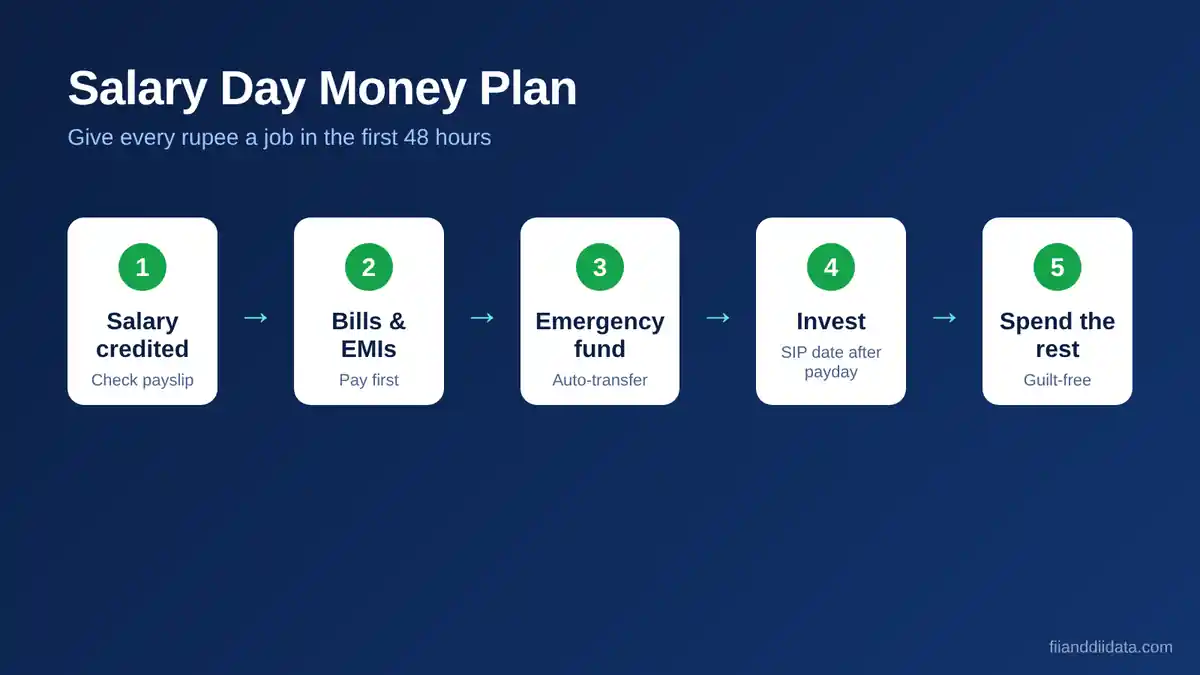
The simplest answer to how to manage money after getting a salary is to give every rupee a job within 48 hours of payday: pay fixed bills, move savings out, start investments, and only then spend. Most salaried Indians do the reverse and save whatever is left. In this guide we turn a ₹70,000 monthly CTC into a real FY 2026-27 payday plan, using the tax rules kept unchanged in the 1 February 2026 Budget.
Key Takeaways
- Plan with in-hand pay, not CTC. A ₹70,000 monthly CTC can become about ₹64,000 after provident fund deductions.
- Under the new tax regime for FY 2026-27, taxable income up to ₹12 lakh carries no tax because of the Section 87A rebate.
- Follow a fixed order on payday: bills, emergency fund, insurance, investments, then spending.
- Build an emergency fund of six months of essential costs before taking extra investment risk.
- Raise your SIP every time your salary rises, so lifestyle costs do not absorb the whole hike.
Table of contents
- What Managing Your Salary Really Means
- Know Your Real Salary: CTC to In-Hand
- How to Manage Money After Getting a Salary: The 7-Step Payday Sequence
- A Sample Budget for a ₹64,000 Salary
- Emergency Fund, Insurance and Bank Safety
- Common Mistakes in Managing Money After Getting a Salary
- Your Salary Day Checklist
- Frequently Asked Questions
- The Bottom Line
What Managing Your Salary Really Means
Managing a salary is not about cutting every expense. It is about deciding, before the money arrives, how much goes to needs, how much to future goals, and how much you can spend freely without guilt. When that decision is made once and automated, you stop renegotiating with yourself every weekend.
There are three jobs your salary must do each month. It must pay for the life you live today, protect you from shocks such as a job loss or hospital bill, and build wealth for goals that are years away. A plan that ignores any one of these breaks sooner or later, usually on a credit card statement.
If you are starting from zero, our guide on how to create a monthly budget covers the budgeting basics. This article focuses on what to do in the first two days after salary credit, which is where most money is won or lost. The first step is knowing the real number you will receive.
Know Your Real Salary: CTC to In-Hand
Your offer letter shows cost to company (CTC). Your bank account shows something smaller. The gap comes from the employer’s provident fund share, your own provident fund contribution, income tax deducted at source (TDS) and, in many states, professional tax. Budgeting on CTC is the most common first-job mistake because it overstates spending power every single month.
Worked example: ₹70,000 monthly CTC under the new regime
Take a salaried employee with a monthly CTC of ₹70,000 and a basic salary of ₹25,000. Under the Employees’ Provident Fund scheme, the employee contributes 12% of wages, and the employer contributes a matching amount that is usually shown inside CTC. We assume no bonus or gratuity component and leave out professional tax, which varies by state.
| Item | Monthly (₹) | Annual (₹) |
|---|---|---|
| CTC | 70,000 | 8,40,000 |
| Less: employer PF (12% of ₹25,000 basic) | 3,000 | 36,000 |
| Gross salary | 67,000 | 8,04,000 |
| Less: standard deduction (new regime) | n/a | 75,000 |
| Taxable income | n/a | 7,29,000 |
| Income tax after Section 87A rebate | 0 | 0 |
| Less: employee PF (12% of basic) | 3,000 | 36,000 |
| In-hand salary (before professional tax) | 64,000 | 7,68,000 |
The tax line is zero because the Income Tax Department’s new regime table allows a rebate of up to ₹60,000 for resident individuals whose taxable income does not exceed ₹12 lakh. The Union Budget presented on 1 February 2026 kept the slabs and the ₹75,000 standard deduction unchanged for FY 2026-27, as LiveLaw reported on Budget day. In simple terms, a salary of up to ₹12.75 lakh a year (₹12 lakh plus the ₹75,000 deduction) leaves no tax to pay under the new regime.

What changes at higher salaries
Above the rebate limit, tax becomes a real budget line. Using the same new regime slabs, a ₹15 lakh salary has taxable income of ₹14.25 lakh and tax of ₹93,750 before cess. A ₹20 lakh salary has taxable income of ₹19.25 lakh and tax of ₹1,85,000 before cess. Check your Form 16 and payslip TDS each month so the March deduction does not surprise you.
One more 2026 change matters for PF. EPFO raised the statutory wage ceiling from ₹15,000 to ₹25,000 a month through notification S.O. 5109(E), effective 17 September 2026, as StudyCafe reported on 26 September 2026. If your basic pay is above ₹15,000, check your October payslip, because PF deductions can rise and in-hand pay can fall slightly. With the real number in hand, you can now plan the payday sequence.
How to Manage Money After Getting a Salary: The 7-Step Payday Sequence
Order matters more than percentages. When saving comes last, it rarely happens. The sequence below puts the most important uses of money first and leaves spending money for the end, when the rest is already safe.
Step 1: Read your payslip on salary day
Match gross pay, PF, TDS and professional tax against last month. Any change in deductions changes your plan, so catch it on day one, not in March.
Step 2: Pay fixed bills and EMIs first
Rent, loan EMIs, school fees, utilities and the full credit card balance go out first. Set auto-debits a day or two after payday so no due date slips.
Step 3: Move emergency money to a separate account
Transfer a fixed amount to a separate savings account or a liquid option you do not use for daily spending. Out of sight keeps it out of reach.
Step 4: Pay insurance premiums
Keep a personal health policy and, if anyone depends on your income, a term life plan. Employer cover usually ends when the job ends.
Step 5: Start investments the same week
Set your SIP date two to five days after payday. Money invested before you start spending is money you will not miss.
Step 6: Fund sinking funds
Put small amounts aside each month for known yearly costs such as festivals, travel, gadget replacement and insurance renewals.
Step 7: Spend the rest without guilt
What remains is your spending money for the month. Once the first six steps are done, you can enjoy it without worry.
Automation is what makes this sequence stick. Standing instructions, auto-debits and SIP mandates do the work even in a busy month. For more ways to protect the savings line, see our guide on how to save money every month. Next, we put rupee figures on each step.
A Sample Budget for a ₹64,000 Salary
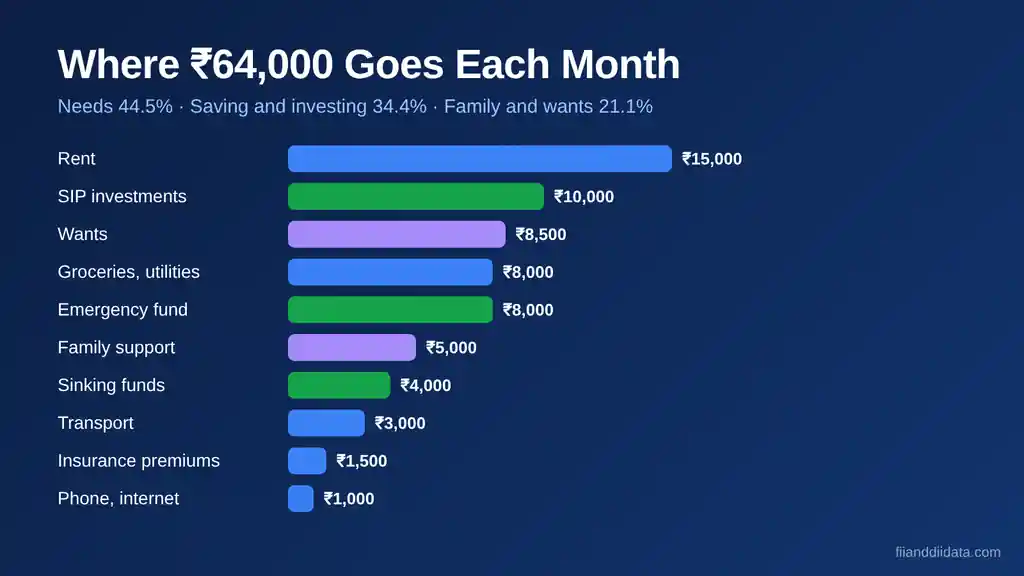
Here is how the ₹64,000 in-hand salary from our example could be split. It assumes a single earner renting in a mid-sized city with no loans. Your numbers will differ, but the structure travels well.
| Head | Monthly (₹) | Share of in-hand |
|---|---|---|
| Rent | 15,000 | 23.4% |
| Groceries and utilities | 8,000 | 12.5% |
| Transport | 3,000 | 4.7% |
| Phone and internet | 1,000 | 1.6% |
| Insurance premiums | 1,500 | 2.3% |
| Emergency fund | 8,000 | 12.5% |
| SIP investments | 10,000 | 15.6% |
| Sinking funds | 4,000 | 6.3% |
| Family support | 5,000 | 7.8% |
| Wants (eating out, shopping, outings) | 8,500 | 13.3% |
| Total | 64,000 | 100% |
In this plan, needs take 44.5% of in-hand pay, saving and investing take 34.4%, and family support plus wants take 21.1%. That is close to the popular 50/30/20 rule, with a bit more going to savings because a first-job budget usually has no EMIs yet. If rent in your city is higher, cut wants before you cut the SIP.
What the SIP line can grow into
A ₹10,000 monthly SIP for 10 years means ₹12 lakh invested. If returns average 10% a year, an assumption and not a promise, the corpus would be about ₹20.7 lakh. At an assumed 12%, it would be about ₹23.2 lakh. Equity returns are not guaranteed and can be negative over shorter periods, so treat these as illustrations of compounding, not forecasts.
Monthly SIP money from salaried Indians has also become a large source of domestic institutional buying in the stock market, which you can follow through our FII and DII data. To keep the budget honest, track where the money actually goes using the methods in our guide on how to track monthly expenses. The next priority is the safety net.
Emergency Fund, Insurance and Bank Safety
An emergency fund is money kept aside only for real shocks, such as a job loss, a medical bill not covered by insurance, or urgent family needs. A common target is six months of essential expenses. In our example, essentials (rent, groceries and utilities, transport, phone and insurance) add up to ₹28,500 a month, so the target is ₹1,71,000.
At ₹8,000 a month, that target takes about 22 months. You can get there faster by sending part of any joining bonus, annual bonus or tax refund straight to this fund. Once it is full, redirect the ₹8,000 to your SIP or to a specific goal.
Keep the money safe and easy to reach
Keep emergency money in a bank savings account, a sweep-in fixed deposit or another low-risk, easy-to-withdraw option, not in equity funds that can fall when you need cash. Bank deposits are insured by DICGC up to ₹5 lakh per depositor per bank, covering principal and interest together, according to the DICGC guide to deposit insurance. If your savings grow beyond that, consider spreading them across banks.
Insurance is the second half of the safety net. A personal health policy protects the emergency fund from being wiped out by one hospital stay, and a term plan protects anyone who depends on your income. Buy cover based on need, not on what a sales call suggests. With protection in place, the remaining risks are the habits that quietly undo good plans.
Common Mistakes in Managing Money After Getting a Salary

- Budgeting on CTC. CTC includes items you never receive as cash each month. Always plan on in-hand pay.
- Saving whatever is left. Leftover saving depends on willpower. Move savings out on payday instead.
- Gadget EMIs in month one. Fixed EMIs lock in future salary before you know your real costs.
- Paying only the minimum due. Credit card interest on an unpaid balance is far higher than most investment returns. Pay the full statement amount.
- Investing emergency money in equity. Markets can fall exactly when you need cash.
- Relying only on employer insurance. Group cover usually stops when you change or lose the job.
- Ignoring payslip changes. New PF rules or higher TDS can change in-hand pay without notice.
We cover more of these traps, with Indian examples, in our list of common money mistakes to avoid. The checklist below turns the full plan into a routine you can repeat every month.
Your Salary Day Checklist
Run through this list on the day your salary is credited. Most months it takes less than 20 minutes once the auto-debits are set.
- Payslip checked: gross pay, PF, TDS and professional tax match expectations.
- Rent, EMIs, utilities and full credit card balance paid or scheduled.
- Emergency fund transfer done to a separate account.
- Insurance premiums paid or set to auto-debit.
- SIP dates set within five days of payday.
- Sinking fund transfers done for known yearly costs.
- Spending money for the month moved to your main account or UPI-linked account.
- Any salary hike: raise the SIP by at least half of the increase.
Review the whole plan once a quarter and after any job change, appraisal or move to a new city. The questions below are the ones readers ask us most often.
Frequently Asked Questions
How to manage money after getting a salary for the first time?
Start with your in-hand pay, not CTC. On salary day, pay fixed bills, move a fixed amount to an emergency fund, pay insurance premiums, start a SIP, and spend only what is left. Automate each step so it happens every month.
How much of my salary should I save every month?
A common starting point is 20% to 30% of in-hand pay across the emergency fund and investments. In our ₹64,000 example, saving and investing take 34.4% because there are no loans. Increase the share with every salary hike.
What is the 50/30/20 rule for salary?
It suggests 50% of take-home pay for needs, 30% for wants and 20% for savings and investments. It is a guide, not a law. In high-rent cities needs may take more, so trim wants before you trim savings.
Do I need to pay income tax on a ₹12 lakh salary in FY 2026-27?
Under the new regime, a salaried person with a ₹12 lakh salary has taxable income of ₹11.25 lakh after the ₹75,000 standard deduction. That is within the ₹12 lakh limit for the Section 87A rebate, so the tax payable is nil, subject to the rules of the regime.
Should I build an emergency fund or start a SIP first?
You can do both, but give the emergency fund priority until it covers at least three months of essential costs. Then split new savings between the fund and your SIP until the fund reaches six months.
The Bottom Line
The method behind how to manage money after getting a salary is simple: know your in-hand number, follow a fixed payday order, and let automation do the hard part. Our ₹70,000 CTC example shows that a first-job salary can fund rent, family support, an emergency fund and a ₹10,000 SIP at the same time, as long as saving happens first.
No budget survives unchanged, and that is fine. Rents rise, family needs shift and tax rules can change in a future Budget. Review the plan every quarter and keep the order of priorities the same. For the next step, set your goals and timelines using our guide on financial goals for beginners, and browse more guides on the FIIAndDIIData.com blog.
Sources: Income Tax Department, new tax regime slabs and Section 87A rebate (AY 2026-27); LiveLaw, Budget 2026-27 keeps income tax slabs and standard deduction unchanged (1 February 2026); DICGC, A Guide to Deposit Insurance; StudyCafe, EPFO wage ceiling raised to ₹25,000 (26 September 2026); india.gov.in, Employees’ Provident Fund contribution rates. Figures checked on 2 November 2026.
Disclaimer: This article is for educational purposes only and is not investment advice. Please consult a SEBI-registered advisor before making investment decisions.