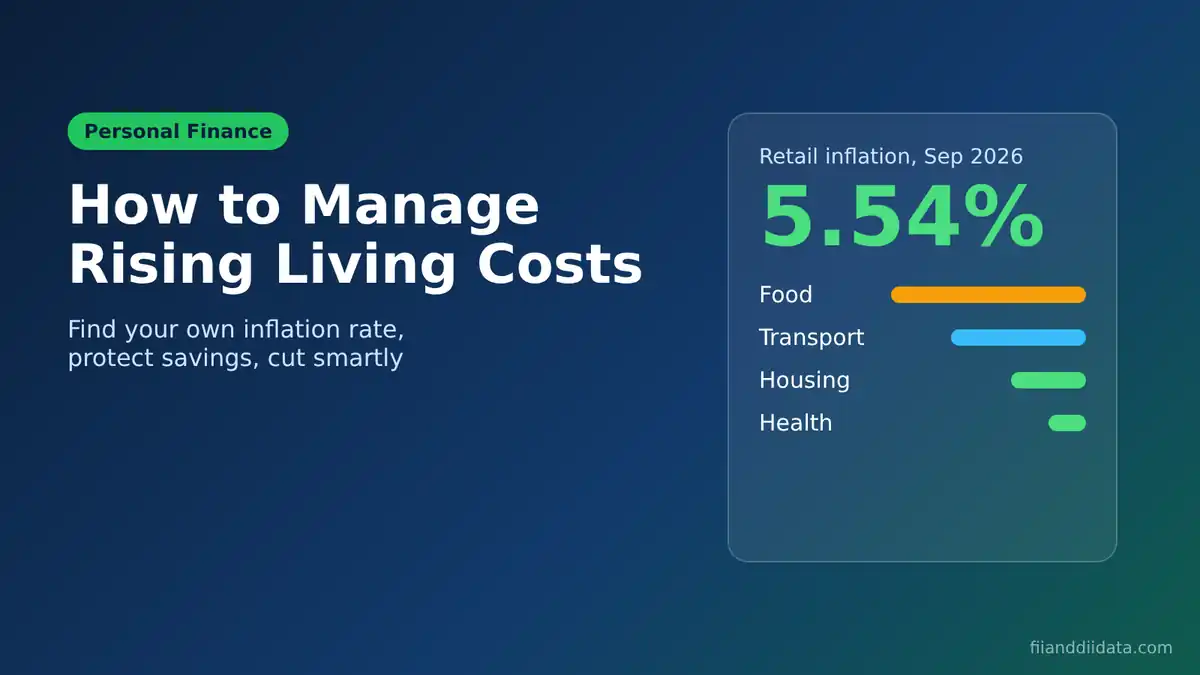
Learning how to manage rising living costs starts with one honest number: how much more your own household now spends for the same basket of goods. India’s retail inflation rose to 5.54% in September 2026, and food inflation hit 7.74%, so a family that does nothing will quietly lose ground every month. This guide shows you how to measure your personal inflation rate, protect your savings, and cut costs where prices are rising fastest.
Key Takeaways
- All-India CPI inflation was 5.54% in September 2026, up from 4.83% in August (MoSPI, 12 October 2026).
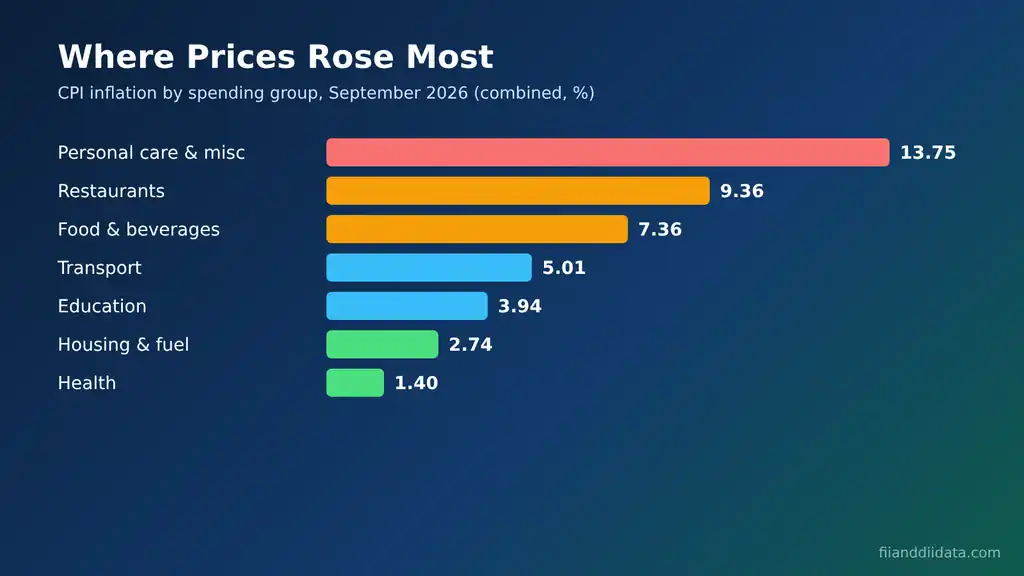
- Prices rose fastest in personal care (13.75%), restaurants (9.36%) and food (7.36%), while health (1.40%) and housing (2.74%) rose slowly.
- Your personal inflation rate can differ from the headline figure, so calculate it from your own spending.
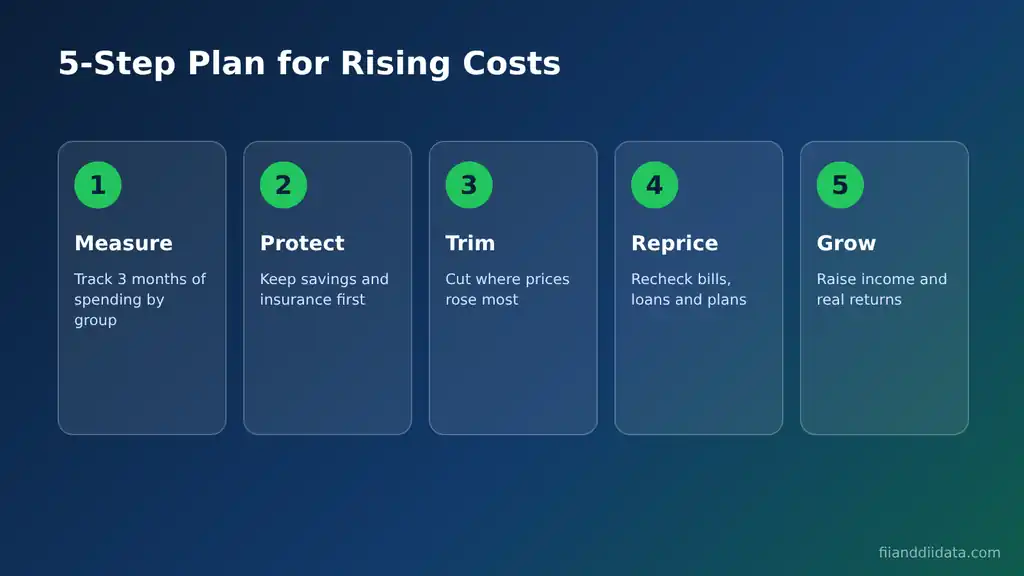
- Protect savings, insurance and your emergency fund first, then trim the categories where prices rose most.
- RBI projects CPI inflation of 5.2% for FY 2026-27 and raised the repo rate to 5.50% on 7 October 2026.
- Why living costs are rising in India right now
- Find your personal inflation rate (worked example)
- Protect savings and insurance before you cut
- How to manage rising living costs, category by category
- Reprice your fixed bills and loans
- Grow your income and real returns
- Common mistakes to avoid
- A monthly checklist for rising living costs
- FAQ
- The Bottom Line
Why Living Costs Are Rising in India Right Now
Inflation is the rate at which the general price level rises. In India, the official measure for households is the Consumer Price Index (CPI), published every month by the Ministry of Statistics and Programme Implementation (MoSPI). The series now uses 2024 as its base year.
According to MoSPI’s release of 12 October 2026, all-India CPI inflation was 5.54% in September 2026, against 4.83% in August. Rural inflation (6.08%) ran ahead of urban inflation (4.88%). The bigger story was food: the Consumer Food Price Index rose 7.74%, led by onion (108.09%), garlic (54.62%) and ginger (62.85%).
| Spending group | CPI inflation, Sep 2026 (combined) | What it means for your budget |
|---|---|---|
| Personal care, social protection and misc. | 13.75% | Review grooming, toiletries and jewellery-linked spends |
| Restaurants and accommodation | 9.36% | Eating out and travel stays cost noticeably more |
| Food and beverages | 7.36% | Biggest pressure for most families |
| Transport | 5.01% | Fuel, fares and vehicle running costs |
| Education services | 3.94% | Fee hikes usually come once a year |
| Housing, water, electricity, gas and fuels | 2.74% | Rising slowly on average, but rent renewals can jump |
| Health | 1.40% | Lowest rise among the main groups |
The Reserve Bank of India (RBI) responded on 7 October 2026 by raising the repo rate by 25 basis points to 5.50% and projecting CPI inflation of 5.2% for FY 2026-27, with 6.0% expected in the October to December quarter. In plain terms, the central bank expects prices to keep rising faster than earlier in the year. We explain the market side in our note on the RBI policy outlook for December 2026. The headline number is only an average, though, so the next step is to find your own.
Find Your Personal Inflation Rate (Worked Example)
Your personal inflation rate is the price rise on the things you actually buy. A family that eats out often feels 9.36% restaurant inflation far more than a family that cooks at home. To calculate it, list your monthly spending by group and apply the latest CPI rate for each group.
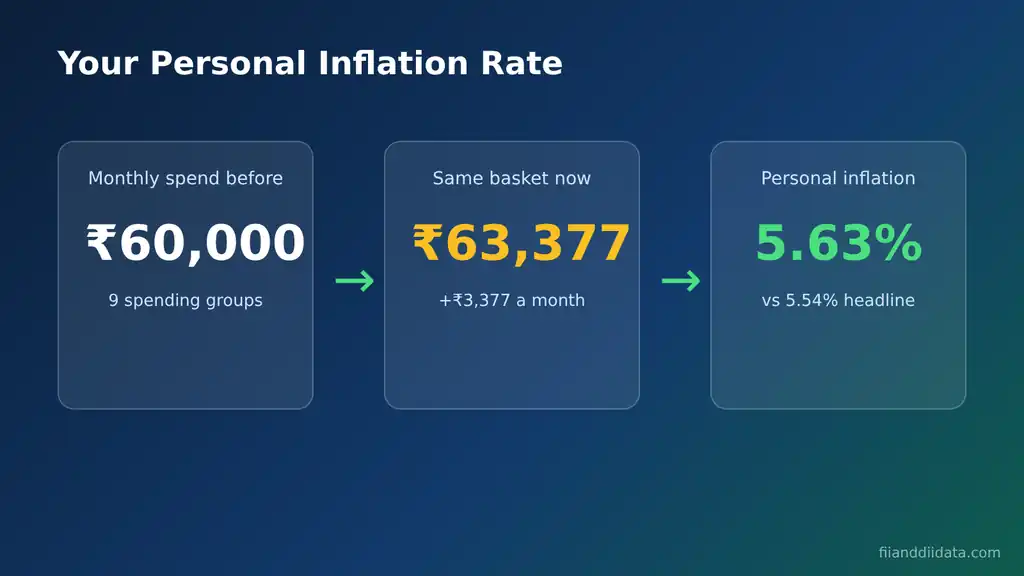
Take a sample household in a metro city that spends ₹60,000 a month. Applying the September 2026 group-wise rates gives this result:
| Spending group | Monthly spend before | CPI rate | Extra cost | Same basket now |
|---|---|---|---|---|
| Food and beverages | ₹22,000 | 7.36% | ₹1,619 | ₹23,619 |
| Housing, electricity and fuel | ₹15,000 | 2.74% | ₹411 | ₹15,411 |
| Transport | ₹6,000 | 5.01% | ₹301 | ₹6,301 |
| Education | ₹5,000 | 3.94% | ₹197 | ₹5,197 |
| Restaurants and eating out | ₹3,000 | 9.36% | ₹281 | ₹3,281 |
| Personal care and misc. | ₹3,000 | 13.75% | ₹412 | ₹3,412 |
| Health | ₹2,000 | 1.40% | ₹28 | ₹2,028 |
| Clothing and footwear | ₹2,000 | 3.93% | ₹79 | ₹2,079 |
| Communication | ₹2,000 | 2.44% | ₹49 | ₹2,049 |
| Total | ₹60,000 | 5.63% | ₹3,377 | ₹63,377 |
This family’s personal inflation rate is 5.63%, slightly above the 5.54% headline. The same basket costs ₹3,377 more each month, or ₹40,518 more over a year. If prices kept rising at RBI’s projected 5.2% a year, the ₹60,000 budget would need about ₹77,309 a month in five years.
Two notes on accuracy. Use three months of real bank and UPI statements, not guesses, and our guide on how to track monthly expenses shows a simple way to do it. Also, rent is the exception: CPI housing rose 2.74% on average, but a lease renewal can raise your rent by much more in a single month. Once you know your number, the first job is defence, not cutting.
Protect Savings and Insurance Before You Cut
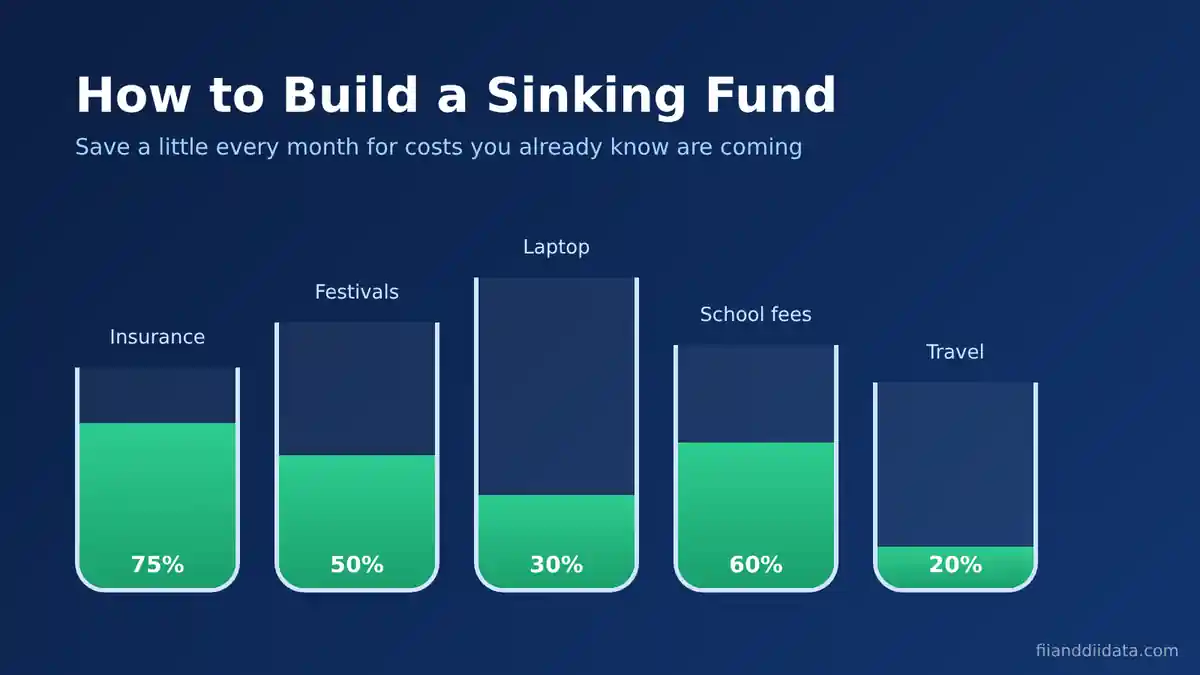
When the month gets tight, many families stop their SIP or skip an insurance premium first. That is the costliest place to save. A lapsed health or term policy can take years and a fresh medical check to restore, and a paused SIP loses months of compounding that never comes back.
- Keep paying insurance premiums. Health and term cover protect you from a single large bill that inflation makes even larger.
- Resize your emergency fund. Six months of expenses for our sample family was ₹3,60,000. At the new cost of ₹63,377 a month, it is ₹3,80,262, so the fund is now ₹20,262 short. Our guide on how to build an emergency fund explains where to keep it.
- Hold the savings rate, not just the amount. If you saved 20% of income before, aim to keep 20%. Raise the rupee amount when your salary rises.
- Pause wants before needs. Delay a gadget upgrade or a holiday booking before touching long-term goals.
With the base protected, you can now trim spending in a targeted way instead of cutting everything a little.
How to Manage Rising Living Costs, Category by Category
The smartest cuts follow the CPI data. Prices did not rise evenly in September 2026, so your effort should go where the increase is largest and where you have control.
Food: how to manage rising living costs at the grocery store
Food is the largest line for most Indian families and rose 7.36%. The jump came from a few items, not everything: onion prices more than doubled while potato (-11.50%) and tomato (-8.62%) were cheaper than a year earlier. Shift recipes towards items that fell in price, buy seasonal vegetables, plan a weekly menu, and buy staples such as rice, atta and dal in larger packs when the unit price is lower.
Eating out and personal care: the easiest wins
Restaurant prices rose 9.36% and personal care and miscellaneous items 13.75%, the fastest of all groups. These are also the most flexible. Halving eating out, ordering in less often, and switching to value packs for toiletries usually saves more than a painful cut to groceries.
Transport and utilities: small habits, steady savings
Transport costs rose 5.01%. Combine errands into one trip, use metro or bus passes where available, and keep tyres at the right pressure to save fuel. For electricity and gas, check appliance use and your tariff slab. Our guide to how to reduce monthly expenses lists more ideas by bill type.
For our sample family, three changes close the gap: halving eating out saves about ₹1,641, seasonal swaps and bulk staples cut the grocery bill by ₹1,200, and trimming personal care and miscellaneous spends saves ₹536. Together that is ₹3,377, which fully offsets the inflation increase without touching savings. Variable costs are only half the picture, though; fixed bills need a different approach.
Reprice Your Fixed Bills and Loans
Fixed costs feel permanent, but many can be renegotiated once a year. Inflation is the right moment to check each one, because providers rarely lower prices on their own.
- Subscriptions: list every OTT, app, gym and cloud plan in your bank and UPI mandates, then cancel the ones you have not used in 30 days.
- Mobile and broadband: compare your current plan with the provider’s newer plans. Family or annual plans often cost less per month.
- Rent: before renewal, compare listings nearby and negotiate. Offering a longer lock-in can win a smaller increase.
- Floating-rate loans: RBI’s repo rate rise to 5.50% on 7 October 2026 means EMIs on loans linked to an external benchmark may rise when your bank resets the rate. Ask your lender whether it will raise the EMI or extend the tenure, and prefer a higher EMI if you can afford it, since a longer tenure adds more total interest.
- High-cost debt: pay off credit card dues in full. Card interest is far above any inflation rate, so clearing it is the best guaranteed return you can get.
Cutting and repricing protect today’s budget. The longer fix is making your money grow faster than prices.
Grow Your Income and Real Returns
The real return is what your money earns after inflation. A simple way to estimate it is: (1 + interest rate) ÷ (1 + inflation rate) − 1. If idle cash sits in an account earning an assumed 2.7% a year while inflation is 5.54%, the real return is about −2.69%. Your money is shrinking in buying power even though the balance grows. An option paying an assumed 7.0% gives a real return of about +1.38%. These rates are only for illustration, so check your bank’s current published rates before you decide.
Put it another way: at 5.2% annual inflation, ₹1 lakh kept in cash for five years will buy only what about ₹77,611 buys today. That is why money you will not need for five years or more usually belongs in growth assets such as diversified equity mutual funds, chosen to suit your risk level. Equity prices swing in the short run, partly because of large institutional flows, which we track in our FII and DII data. Those swings matter less when your horizon is long.
Income is the other lever. Ask for a raise backed by your results and current market pay, add a skill that pays more, or take on small freelance work. Even a ₹3,500 monthly side income covers this sample family’s entire inflation gap. Next, let us look at the moves that make things worse.
How to Manage Rising Living Costs Without These Common Mistakes
- Using credit cards or Buy Now Pay Later to fill the gap. It hides the problem for a month and adds interest the next.
- Stopping SIPs and insurance first. These protect your future; trim discretionary spending before them.
- Cutting every category by the same percentage. Health costs rose 1.40% while eating out rose 9.36%; equal cuts waste effort.
- Panic buying in bulk. Stockpiling perishables leads to waste. Bulk buying works only for non-perishable staples you use regularly.
- Ignoring the emergency fund target. A fund sized for last year’s expenses will run out sooner than planned.
- Keeping large balances idle. Money in a low-interest account loses buying power every month inflation stays above its rate.
Avoiding these mistakes is half the work. The other half is a short routine you repeat each month.
A Monthly Checklist for Rising Living Costs
Use this checklist once a month, ideally a day or two after salary credit. It takes about 30 minutes and keeps your budget aligned with current prices.
- Check the latest MoSPI CPI release (published around the 12th of each month) and note food and transport inflation.
- Update your spending by group from bank and UPI statements and recalculate your personal inflation rate.
- Confirm that SIPs, insurance premiums and the emergency fund top-up went through.
- Compare actual spending with your monthly budget and move money between categories if needed.
- Cancel one unused subscription or renegotiate one bill.
- Plan next week’s meals around seasonal and cheaper items.
- Check whether your loan EMI or tenure changed after the latest RBI decision.
- Move any surplus cash above your emergency fund into your planned investments.
FAQ
How to manage rising living costs on a fixed salary?
Start by calculating your personal inflation rate from three months of statements. Keep savings and insurance untouched, then cut the categories where prices rose most, such as eating out and personal care. Reprice fixed bills and look for a small extra income to close the remaining gap.
What is the current inflation rate in India?
According to MoSPI’s release of 12 October 2026, all-India CPI inflation was 5.54% in September 2026, up from 4.83% in August. Food inflation was 7.74%. MoSPI publishes the next figure around the 12th of every month.
Should I stop my SIP when expenses rise?
It is usually better not to. Stopping a SIP gives up compounding that cannot be recovered. Trim discretionary spending first and pause wants before needs. If cash flow is very tight, reduce the SIP amount for a few months instead of stopping it completely.
How does inflation affect my savings?
Inflation reduces the buying power of money. If your savings earn less than the inflation rate, your real return is negative. For example, at 5.2% annual inflation, Rs 1 lakh held in cash for five years buys only what about Rs 77,611 buys today.
How much should my emergency fund be when prices rise?
Base it on your current monthly expenses, not last year’s. A family whose costs rose from Rs 60,000 to Rs 63,377 a month needs about Rs 3,80,262 for six months of cover, instead of Rs 3,60,000. Review the target every few months.
The Bottom Line
Rising prices are not felt equally. In September 2026, food, eating out and personal care rose far faster than health and housing, so the best response is targeted: measure your own inflation rate, protect savings and insurance, then cut where prices rose most.
Over the longer run, the answer is growth: an income that rises with prices and savings that earn more than inflation. Your practical next step is simple. Pull three months of statements this week and fill in the personal inflation table above. For more practical money guides, browse our blog.
Sources: MoSPI, Press Release of Consumer Price Index (base 2024=100) for September 2026, via PIB, 12 October 2026; Reserve Bank of India, Monetary Policy Statement 2026-27, Resolution of the MPC, 7 October 2026.
Disclaimer: This article is for educational purposes only and is not investment advice. Please consult a SEBI-registered advisor before making investment decisions.