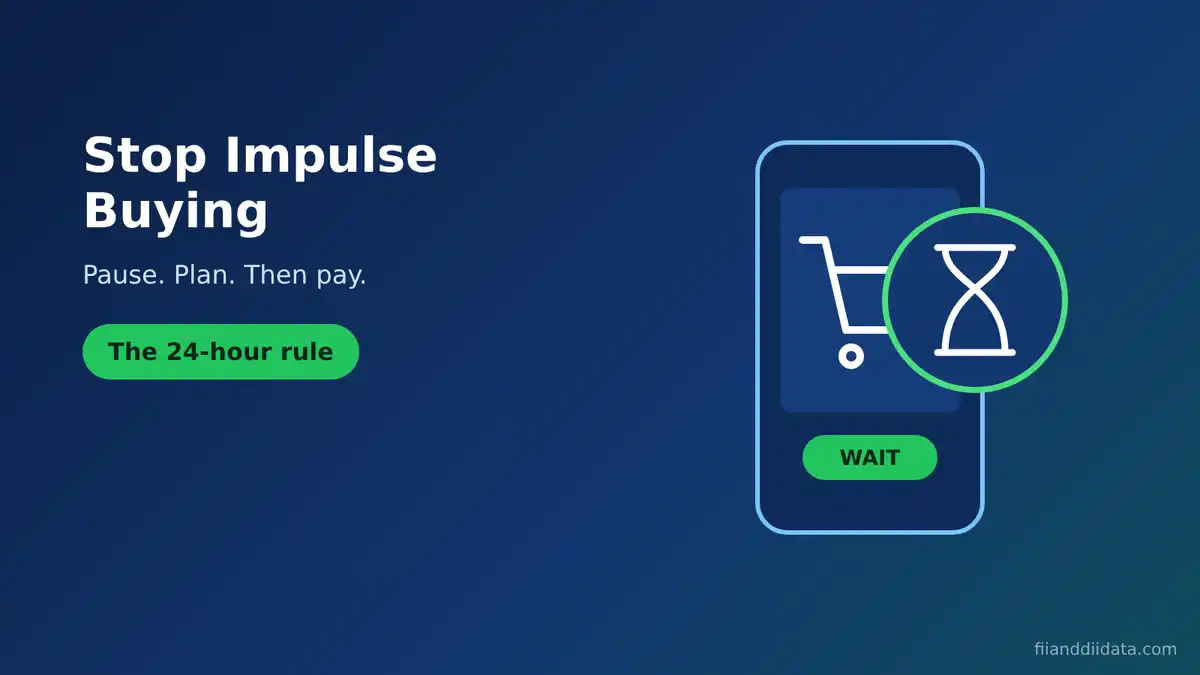
If you are wondering how to stop impulse buying, start by putting a gap between wanting something and paying for it, then make spending slightly harder and saving automatic. That gap matters more than ever: Indians made 25.47 billion UPI payments worth Rs 31.53 lakh crore in October 2026, according to NPCI data reported on 1 November 2026. When paying takes one tap, unplanned buying becomes the default.
Key Takeaways
- Impulse buying is an unplanned purchase driven by emotion, offers or convenience rather than need.
- A 24-hour wait for small items and a 30-day wait for big ones removes most regret purchases.
- Pricing a product in hours of work makes its real cost visible before you pay.
- Paying only the minimum due on a credit card suspends the interest-free period under RBI rules.
- Redirecting even Rs 2,000 a month from impulse buys to savings can build a meaningful corpus over 10 years.
In this article:
- What Is Impulse Buying and Why Does It Happen?
- Why Impulse Buying Is Easier in India Today
- What Impulse Buying Really Costs: A Worked Example
- How to Stop Impulse Buying: 10 Practical Steps
- Credit Cards and Pay Later: Rules You Should Know
- Where to Put the Money You Save
- Common Mistakes When You Try to Stop Impulse Buying
- Before-You-Pay Checklist
- Frequently Asked Questions
- The Bottom Line
What Is Impulse Buying and Why Does It Happen?
Impulse buying is any purchase you did not plan before you saw the product or the offer. It is usually small, fast and emotional: a second pair of sneakers in a flash sale, a food delivery order at midnight, or a gadget accessory added at checkout because it was “only Rs 499”.
Not every unplanned purchase is a problem. Buying an umbrella when it suddenly rains is sensible. The trouble starts when unplanned spending becomes a habit that eats into rent, EMIs or savings, or when you regret the purchase within a week.
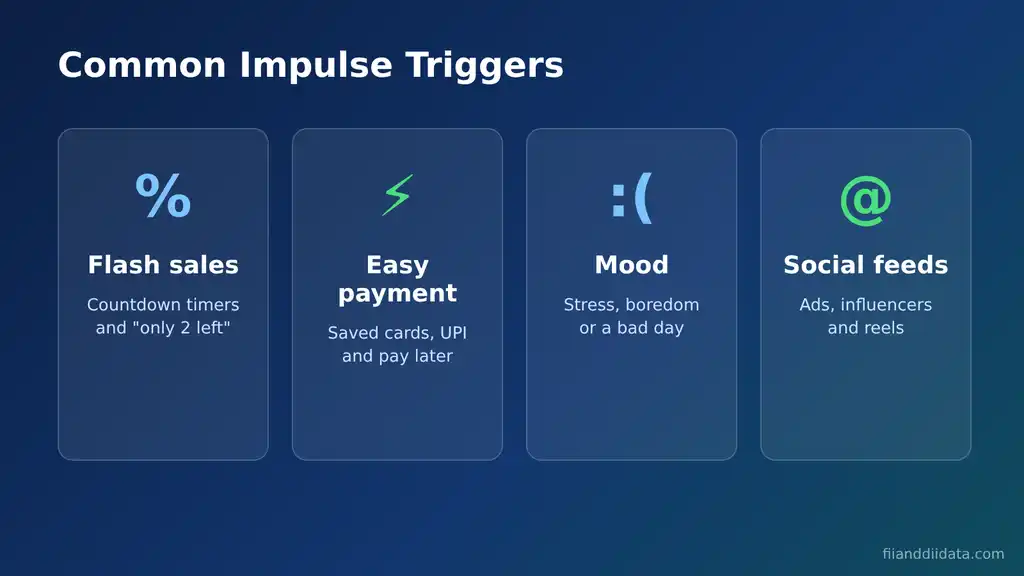
Most impulse purchases come from one of four triggers:
- Urgency: countdown timers, “only 2 left” badges and lightning deals push you to act before you think.
- Ease: saved cards, one-tap UPI and pay later options remove the small pause that used to exist at the cash counter.
- Mood: stress, boredom, loneliness or a bad day at work make shopping feel like a reward.
- Social pressure: influencer posts, reels and friends’ purchases create a sense that you are missing out.
Knowing your own trigger is the first step, because each one needs a different fix. Next, let us look at why these triggers are stronger in India now than they were a few years ago.
Why Impulse Buying Is Easier in India Today
Digital payments have made spending faster than ever. The table below shows how UPI usage grew in the festive month of October 2026. Growth in digital payments is good for the economy, but it also means the friction that once slowed down spending has almost disappeared.
| UPI metric | September 2026 | October 2026 |
|---|---|---|
| Monthly transactions | 24.07 billion | 25.47 billion |
| Monthly value | Rs 29.37 lakh crore | Rs 31.53 lakh crore |
| Daily average transactions | 802 million | 822 million |
| Daily average value | Rs 97,913 crore | Rs 1,01,707 crore |
Dividing the October value by the number of transactions gives an average payment of roughly Rs 1,238 (our calculation from the reported figures). Many of these are small, everyday payments, which is exactly the size range where impulse spending hides. A Rs 300 snack order does not feel like a decision, but twenty of them in a month add up to Rs 6,000.
The fix is not to stop using UPI. It is to add your own pause back into the process. Before that, it helps to see the real cost of the habit in numbers.
What Impulse Buying Really Costs: A Worked Example
Consider Riya, a salaried professional with a take-home pay of Rs 50,000 a month. She works about 22 days a month for 8 hours a day, which is 176 hours. Her earnings work out to about Rs 284 per hour.
Step 1: Price it in hours of work
A pair of wireless earbuds at Rs 3,999 costs Riya about 14 hours of work, almost two full working days. Framing the price this way often changes the answer from “why not” to “is it worth two days of my time?”
Step 2: Check the cost per use
A Rs 6,000 jacket worn three times costs Rs 2,000 per wear. A Rs 2,500 jacket worn fifty times costs Rs 50 per wear. The cheaper-looking item is not always the cheaper choice; the one you will use is.
Step 3: Add up the monthly leak
Riya tracks her spending for a month and finds Rs 4,000 of unplanned purchases. That is Rs 48,000 a year, almost one full month of her salary. If a simple waiting rule cuts this in half, she frees up Rs 2,000 every month without changing her lifestyle much.
The numbers show what is at stake. Now let us turn to the steps that actually reduce the leak.
How to Stop Impulse Buying: 10 Practical Steps
These steps work best together. Pick three to start with, then add the rest over a month.
- Use the 24-hour and 30-day rule. Wait one day before any unplanned purchase under Rs 5,000 and 30 days for anything bigger. Most urges fade within that time.
- Keep a written wish list. When you want something, add it to a list with the date and price. Review the list once a month and buy only what still matters.
- Set a fun-money budget. Give yourself a fixed monthly amount for guilt-free spending. Once it is gone, wait for next month. Our guide on how to create a monthly budget shows how to set this up.
- Remove saved cards. Delete stored card details from shopping and food apps. Typing a 16-digit number adds a useful pause.
- Turn off sale notifications. Unsubscribe from promotional emails and mute app alerts. You cannot be tempted by an offer you never see.
- Shop with a list, and only from it. This works for groceries, festive shopping and online carts alike.
- Track every rupee for 30 days. Seeing the total in one place is often enough to change behaviour. See our step-by-step guide to tracking monthly expenses.
- Use a separate spending account. Move only your monthly spending budget to the account linked to UPI and keep savings in a different bank account.
- Name your trigger and replace it. If boredom drives late-night shopping, replace scrolling with a walk, a call or a book.
- Pay yourself first. Set up an automatic transfer to savings on salary day, so impulse spending can only use what is left.
How to stop impulse buying online
Online shopping needs extra care because the store is open 24 hours a day and sits in your pocket. Leave items in the cart for a day instead of buying them immediately. Log out of shopping apps after each use, and move them off your home screen. During big sale events, decide your list and budget before the sale begins, not while browsing deals.
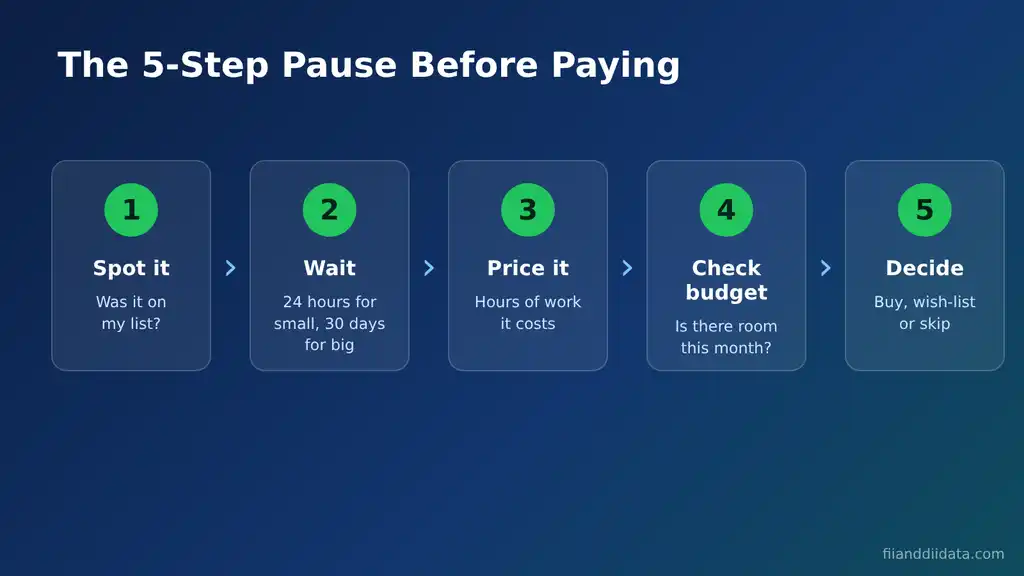
Habits are only half the story. The payment method you choose can make impulse buys much more expensive, as the next section shows.
Credit Cards and Pay Later: Rules You Should Know
Credit cards and pay later options make it easy to buy now and worry later. Under the RBI’s Master Direction on Credit Card and Debit Card (issued 21 April 2022, updated as on 7 March 2024), card issuers must explain that the interest-free credit period is suspended if any balance of the previous month’s bill is outstanding. Statements must also warn that making only the minimum payment every month stretches repayment over months or years.
Here is an illustration. Suppose you put Rs 30,000 of impulse purchases on a card that charges 3.5% a month (check your own card’s terms; rates vary by issuer) and repay a flat Rs 1,500 a month. It would take about 35 months to clear the balance, and you would pay roughly Rs 22,500 in interest before GST and any other charges. A Rs 30,000 shopping spree ends up costing about Rs 52,500.
- Pay the full statement amount, not the minimum due, every month.
- Do not use pay later or no-cost EMI offers for items you would not buy with cash today.
- Keep only one card for daily use and switch off online or international use on others through your bank app.
Once you stop the leak, the next question is what to do with the money you keep.
Where to Put the Money You Save
Money that is not given a job tends to get spent. Decide in advance where every rupee saved from impulse buys will go:
- Emergency fund first: build three to six months of essential expenses before anything else. Our guide on building an emergency fund explains the steps.
- Debt next: clear high-interest credit card balances before you invest.
- Long-term goals: once the basics are covered, a monthly SIP in a mutual fund suited to your risk profile can put the money to work.
Going back to Riya: if she invests the Rs 2,000 she saves every month for 10 years, she puts in Rs 2.4 lakh. At an assumed return of 10% a year, that could grow to about Rs 4.13 lakh. The 10% figure is only an illustration; market-linked returns are not guaranteed and can be lower or negative in some years.
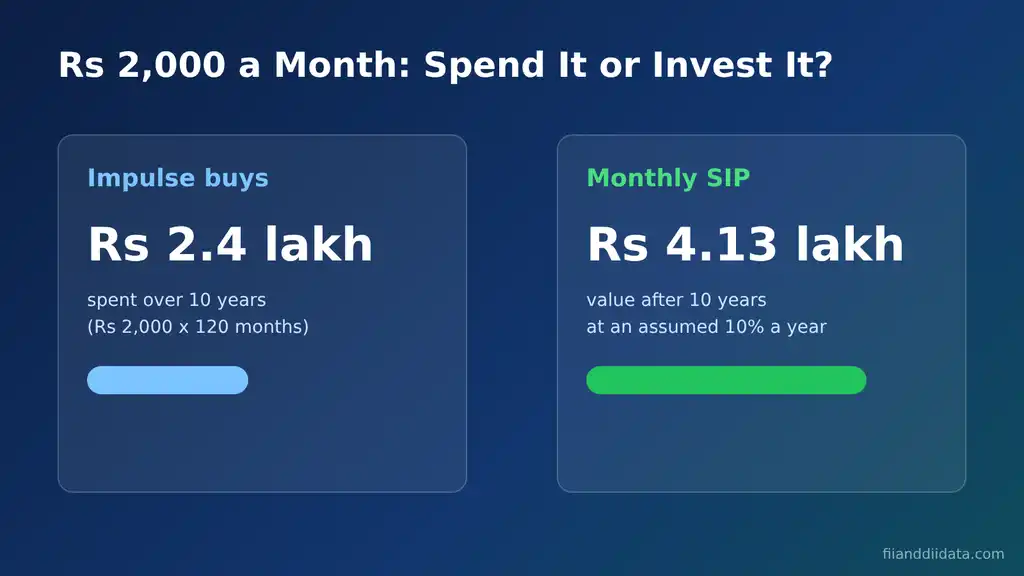
A simple rule such as the 50 30 20 budgeting rule can help you decide how much goes to needs, wants and savings. Even with a plan, a few common mistakes can undo your progress.
Common Mistakes When You Try to Stop Impulse Buying
- Banning all fun spending. A zero-fun budget usually ends in a bigger splurge. Keep a small, planned allowance.
- Counting discounts as savings. Saving Rs 1,000 on a Rs 4,000 item you did not need is still Rs 3,000 spent.
- Relying on willpower alone. Systems such as waiting rules and automatic transfers work better than trying harder.
- Ignoring small payments. Rs 150 here and Rs 200 there is where most of the leak sits.
- Quitting after one slip. One impulse buy does not cancel a month of progress. Note what triggered it and move on.
For a wider look at money habits that hold people back, read our list of common money mistakes to avoid. To make the habit stick, use the short checklist below every time you are about to pay.
Before-You-Pay Checklist
Ask yourself these six questions before any unplanned purchase. If the answer to two or more is “no”, wait.
| Question | Why it matters |
|---|---|
| Was this on my list or wish list? | Separates planned buys from urges |
| Would I buy it at full price? | Removes the pull of the discount |
| How many hours of work does it cost? | Shows the real price |
| Is there room in this month’s budget? | Protects bills and savings |
| Will I use it at least ten times? | Tests the cost per use |
| Am I paying in full, not on EMI or minimum due? | Avoids interest charges |
Frequently Asked Questions
How to stop impulse buying quickly?
The fastest method is a waiting rule: wait 24 hours before any unplanned purchase and 30 days before a big one. Pair it with deleting saved cards from shopping apps and turning off sale notifications.
What causes impulse buying?
Common causes are urgency created by sales and timers, very easy payment methods, emotions such as stress or boredom, and social pressure from friends, influencers and ads.
What is the 30-day rule for spending?
The 30-day rule means you wait 30 days before buying any non-essential item above a set amount. If you still want it after 30 days and it fits your budget, you can buy it.
Is impulse buying a bad habit?
An occasional unplanned purchase is normal. It becomes a problem when it affects bills, EMIs or savings, leads to credit card debt, or causes regular regret after buying.
How can I stop impulse buying online?
Leave items in the cart for a day, log out of shopping apps, remove saved cards, unsubscribe from promotional emails and fix your list and budget before any big sale starts.
The Bottom Line
Impulse buying is not a character flaw. It is the predictable result of fast payments, constant offers and normal human emotions. The way out is to rebuild the pause that one-tap payments removed, through waiting rules, a written wish list and a clear monthly budget.
Do not aim for zero spending. Aim for spending you planned and do not regret. As a practical next step, track every purchase for the next 30 days, mark the unplanned ones, and set up an automatic transfer of that amount to savings on your next salary day. You can find more guides like this on our blog.
Sources: Entrackr, UPI October 2026 data from NPCI (1 November 2026); Reserve Bank of India, Master Direction on Credit Card and Debit Card (updated 7 March 2024). Examples are illustrations computed by FIIAndDIIData.com.
Disclaimer: This article is for educational purposes only and is not investment advice. Please consult a SEBI-registered advisor before making investment decisions.