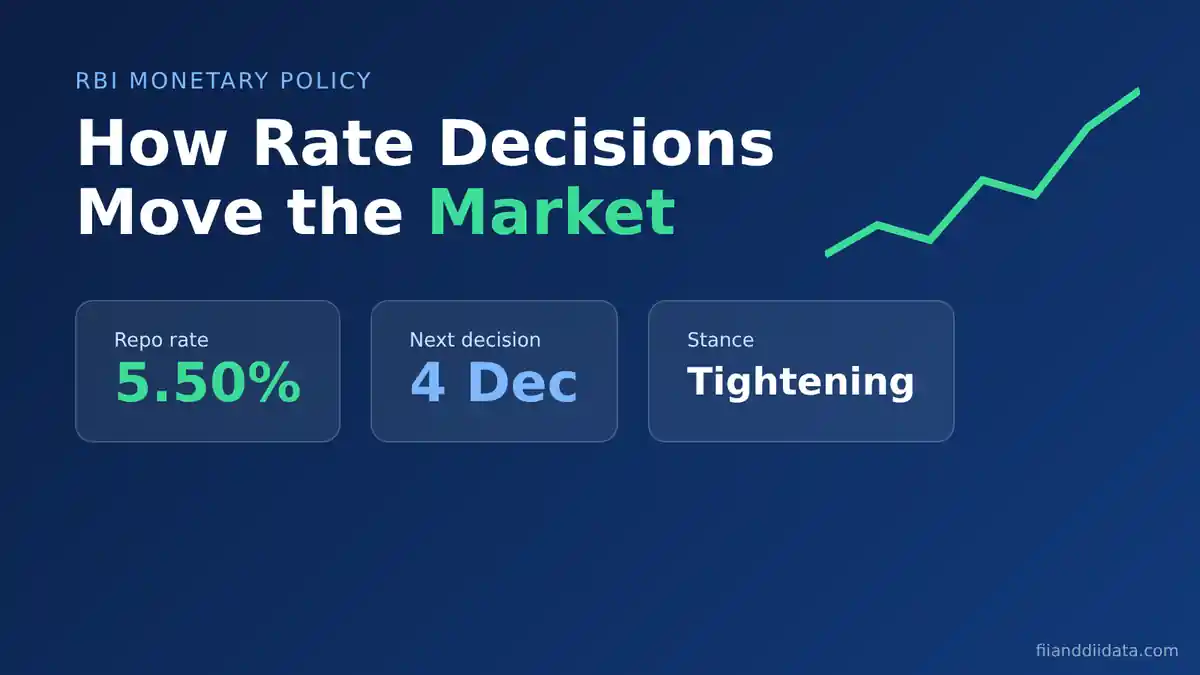
The RBI policy December 2026 impact on market will depend on one question: does the Reserve Bank stop at its October hike or keep tightening? On 7 October 2026 the RBI raised the repo rate by 25 basis points to 5.50%, and the Nifty closed 0.76% lower that day. The next decision is due on 4 December 2026. This guide explains how rate moves reach stock prices, what past policy days show, and what to track before December.
Key Takeaways
- The RBI Monetary Policy Committee (MPC) meets on 2, 3 and 4 December 2026; the decision comes on Friday, 4 December.
- The repo rate is 5.50% after the 7 October hike, the first increase since February 2023, with the stance changed to “calibrated tightening”.
- CPI inflation rose to 5.54% in September 2026 from 4.83% in August, which keeps pressure on the RBI.
- On recent policy days the Nifty fell when rates went up and rose when rates were cut, but the tone of the statement often matters as much as the rate.
- FII flows, the rupee and bond yields carry the policy signal into equities, so read them together with the rate decision.
In this article
- What the RBI policy decides
- How RBI policy moves the stock market
- Where things stand before December
- What past RBI policy days did to the Nifty
- Sector-wise impact
- The FII, rupee and bond yield link
- How traders and investors can prepare
- Common mistakes on RBI policy day
- FAQ
- The Bottom Line
What the RBI Policy Decides
The RBI’s six-member Monetary Policy Committee meets six times a year to set the repo rate. The repo rate is the interest rate at which banks borrow short-term money from the RBI. When it changes, the cost of money changes for the whole economy, from home loans to corporate bonds.
Markets read four parts of each announcement:
- The repo rate: the headline number, now 5.50%.
- The corridor: the Standing Deposit Facility (SDF) at 5.25% sets the floor and the Marginal Standing Facility (MSF) at 5.75% sets the ceiling for overnight rates.
- The stance: a one or two word signal of where rates may go next. “Neutral” keeps all options open; “calibrated tightening” tells markets that cuts are off the table for now and further hikes are possible.
- The projections: the RBI’s forecasts for inflation and GDP growth, which show how worried it is.
Under its mandate, the RBI aims to keep CPI inflation at 4%, within a band of 2% to 6%. When inflation moves towards the top of that band, the bias shifts towards higher rates. Next, we look at how these decisions reach share prices.
How RBI Policy Moves the Stock Market
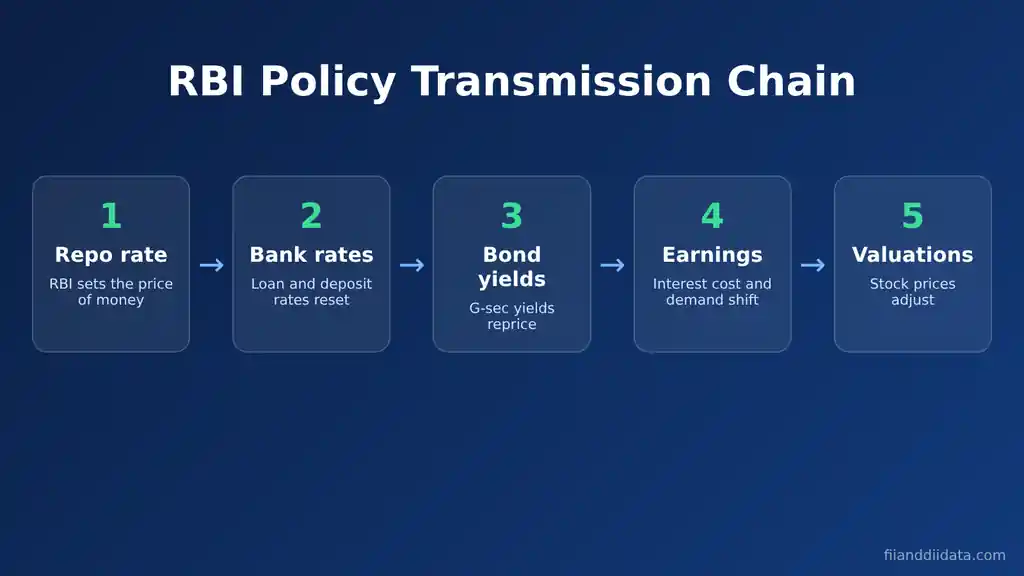
A rate decision reaches stock prices through a chain of five links.
- Bank rates reset. Loan rates linked to the repo (most new retail loans) move quickly. Deposit rates follow with a lag.
- Bond yields reprice. Government bond yields adjust to the new expected path of rates. Higher yields make safe bonds more attractive compared with equities.
- Company earnings shift. Firms with floating-rate debt pay more interest, and demand for rate-sensitive purchases such as homes and cars can soften.
- Valuations adjust. Analysts discount future earnings at a higher rate, which lowers the fair value of growth stocks the most.
- Foreign flows react. Rate moves change the rupee outlook and the return gap between India and other markets, which affects FII buying and selling.
Transmission is real but partial. According to RBI data cited in a smallcase analysis, the 250 bps of repo hikes that began in May 2022 lifted the weighted average lending rate on fresh rupee loans by 170 bps by September 2024, not the full 250 bps.
Worked example: RBI policy December 2026 impact on market math
Take a simple, hypothetical company with ₹2,000 crore of floating-rate debt and a pre-tax profit of ₹250 crore. If a 25 bps hike passes through fully, its annual interest bill rises by ₹5 crore (₹2,000 crore x 0.25%). That cuts pre-tax profit by 2%, before any change in demand. For a debt-free IT company, the direct hit is close to zero.
The same logic works for households. On a ₹50 lakh home loan over 20 years, a rate rise from 8.50% to 8.75% lifts the EMI from about ₹43,391 to ₹44,186. That is roughly ₹795 more every month and about ₹1.91 lakh of extra interest over the loan’s life. Across millions of borrowers, that is why housing and auto stocks track the repo rate.
RBI Policy December 2026 Impact on Market: Where Things Stand
The October policy changed the direction of travel. After a cutting cycle that took the repo rate to 5.25% in December 2025, the RBI held it there in April 2026 and then raised it to 5.50% on 7 October 2026. The MPC cited rising inflation, signs that price increases are spreading across the CPI basket, and the second-round effects of the food, fuel and crude oil shock.
| Indicator | Latest reading | Date |
|---|---|---|
| Repo rate | 5.50% (up 25 bps) | 7 Oct 2026 |
| SDF / MSF | 5.25% / 5.75% | 7 Oct 2026 |
| Policy stance | Calibrated tightening | 7 Oct 2026 |
| CPI inflation | 5.54% (August: 4.83%) | September 2026 |
| Food inflation | 7.74% (August: 5.97%) | September 2026 |
| RBI FY27 CPI forecast | 5.2%, with Q3 at 6.0% | October 2026 policy |
| RBI FY27 GDP forecast | 7.1% (up from 6.7%) | October 2026 policy |
| 10-year G-sec yield | 7.34% | 2 Nov 2026 |
| FPI equity outflow, October | ₹48,056 crore (as of 25 Oct) | October 2026 |
Two numbers stand out. First, September CPI at 5.54% is already above the RBI’s own Q2 projection of 4.9%. Second, the RBI expects inflation to peak near 6% in the October to December quarter, which is the top of its tolerance band. Strong growth gives the MPC room to stay tight.
We are not predicting the December outcome. Instead, history shows how markets have read each type of decision.
What Past RBI Policy Days Did to the Nifty
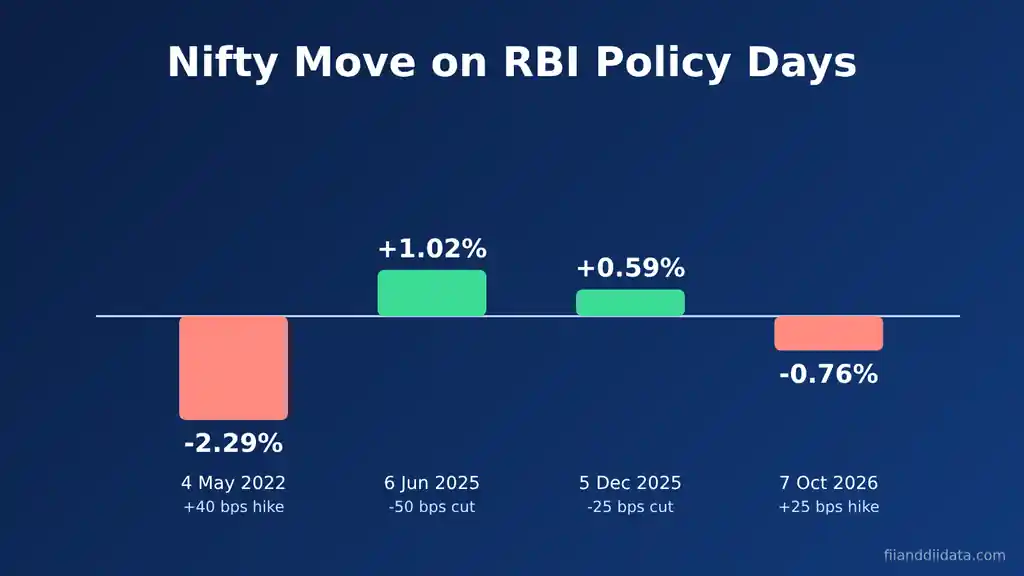
Four recent decisions and the same-day index close show a clear pattern on direction. The size of each move depended on surprise.
| Date | RBI decision | Sensex close | Nifty close |
|---|---|---|---|
| 4 May 2022 | Surprise 40 bps hike to 4.40%, CRR raised | 55,669 (down 1,307 pts, 2.3%) | 16,677 (down 391 pts, 2.3%) |
| 6 Jun 2025 | 50 bps cut to 5.50%, CRR cut by 100 bps | 82,188.99 (up 746.95 pts, 0.92%) | 25,003.05 (up 252.15 pts, 1.02%) |
| 5 Dec 2025 | 25 bps cut to 5.25% | 85,712.37 (up 447.05 pts, 0.52%) | 26,186.45 (up 152.7 pts, 0.59%) |
| 7 Oct 2026 | 25 bps hike to 5.50%, stance to calibrated tightening | 72,638.70 (down 429.11 pts, 0.59%) | 22,603.05 (down 173.05 pts, 0.76%) |
The May 2022 hike came between scheduled meetings, so nobody had priced it in. The fall was 2.3% in a day, and the 10-year bond yield jumped to 7.37%. The October 2026 hike came at a scheduled meeting after two months of rising CPI, and the drop was smaller at 0.76%. The lesson: markets react to the gap between what the RBI does and what traders expected, not to the decision alone.
Three possible December outcomes
| Scenario | What it would signal | How markets have tended to react |
|---|---|---|
| Hold at 5.50%, hawkish tone | RBI waits to see the effect of October’s hike | Mixed; banks steady, rate-sensitive sectors stay under pressure |
| Another 25 bps hike | Inflation worry has deepened | Negative if not priced in; bond yields rise, realty and autos lag |
| Hold with a softer tone | RBI sees inflation peaking | Relief rally in rate-sensitive stocks; bond yields ease |
Sectors do not move together on these outcomes, as the next section shows.
Sector-Wise RBI Policy December 2026 Impact on Market
The October hike gave a live example of sector rotation. On 7 October 2026 the Nifty PSU Bank index rose 1% while the Nifty Metal index fell 2.33%, according to Kotak Neo’s closing report. Realty, auto, IT and consumer stocks also ended lower.
- Banks: often hold up after a hike because loan rates reprice faster than deposit rates, which can widen net interest margins in the short run.
- NBFCs: usually hurt, because they borrow from banks and markets and their funding costs rise.
- Real estate and autos: sensitive to EMIs; higher rates can slow bookings and vehicle loans.
- Consumer durables: many purchases are financed, so demand can soften.
- IT and pharma: less tied to domestic rates; they track global demand and the rupee more closely.
Foreign money adds another layer, reacting to rates, the rupee and global yields together.
The FII, Rupee and Bond Yield Link
Foreign investors care about returns in dollars, so the RBI’s decision matters to them mainly through the rupee. A hike can support the currency by raising the return on rupee assets. But in 2026 that support has been weak against bigger forces. On the day of the October hike, the rupee traded near a record low of 96.84 per dollar, and Brent crude was back above $101 a barrel.
FPIs pulled ₹48,056 crore out of Indian equities in October up to 25 October, as per NSDL data reported by AIR News. By 12 October, net outflows for 2026 had reached about ₹3.04 lakh crore, well above the ₹1.66 lakh crore for all of 2025. You can follow how this selling interacts with rupee weakness in our guide on rupee vs dollar and FII outflows, and the oil angle in how crude prices drain foreign flows.
Bond yields tie it together. India’s 10-year yield touched about 7.46% to 7.47% in late October, near its highest since March 2023, before easing to 7.34% on 2 November 2026. That puts the 10-year bond 1.84 percentage points above the 5.50% repo rate. When safe government bonds pay over 7%, equities need stronger earnings to stay attractive. Global yields matter too, as we explain in US bond yield impact on the Indian market.
Tracking both sides daily through our FII and DII data page shows whether a policy-day move has real money behind it.
How Traders and Investors Can Prepare
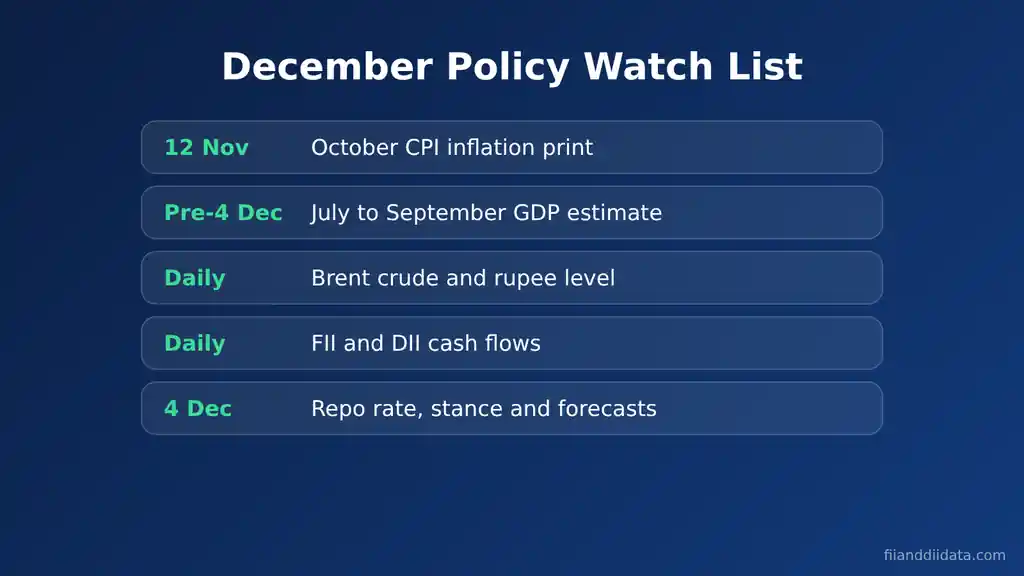
A policy day is scheduled, so you can plan for it. Use this checklist before 4 December 2026.
- Read the October CPI on 12 November. A print above 6% would raise the odds of another hike; a drop would ease pressure.
- Watch the July to September GDP estimate. Strong growth gives the RBI more room to stay tight.
- Track Brent crude and the rupee daily. Both feed directly into imported inflation.
- Follow institutional flows. Check FII DII data today after market close to see whether FIIs are selling ahead of the event or covering positions.
- Note the 10-year yield. A rising yield before the meeting often means the bond market expects a tighter RBI.
- Read the stance and forecasts, not just the rate. A hold with a hawkish tone can hit stocks as hard as a small hike.
- Size positions for volatility. Option premiums usually rise into policy day; avoid large bets with borrowed money on a single outcome.
Our Nifty outlook for November 2026 lists the index levels to watch. Even with a plan, a few habits trip up traders on policy day.
Common Mistakes on RBI Policy Day
- Trading the headline only. The first move after 10 AM often reverses once the governor’s press conference adds detail on the stance.
- Ignoring what was priced in. A widely expected hike can lead to a rally if the tone is softer than feared.
- Treating all banks the same. PSU banks, private banks and NBFCs can move in different directions on the same decision.
- Forgetting global cues. A Fed decision, US yields or an oil spike can swamp the RBI effect within days. In 2026, foreign selling has moved the Nifty more than any single rate decision, as we show in how FII activity affects the stock market.
- Reading one day as a trend. Rate cycles play out over quarters, not sessions.
FAQ
When is the RBI policy in December 2026?
The RBI Monetary Policy Committee meets on 2, 3 and 4 December 2026. The decision is announced on Friday, 4 December 2026, as per the meeting schedule the RBI released on 23 March 2026.
What is the RBI policy December 2026 impact on market likely to be?
It depends on the decision and the tone compared with expectations. On recent policy days, the Nifty fell 0.76% after the October 2026 hike and rose 0.59% after the December 2025 cut. A hold with a softer tone would likely help rate-sensitive stocks, while a surprise hike would likely weigh on them.
Does a repo rate hike always make the stock market fall?
No. Markets react to surprises. A hike that is fully expected can lead to a flat or even positive day if the RBI signals that it is near the end of tightening. The May 2022 hike caused a 2.3% fall because it came without warning.
Which sectors gain when RBI raises interest rates?
Banks, especially PSU banks, often hold up because loan rates reset faster than deposit rates. On 7 October 2026, the Nifty PSU Bank index rose 1% while the broader Nifty fell. Realty, autos, NBFCs and consumer durables usually come under pressure.
How do RBI rate decisions affect FII flows?
Higher rates can support the rupee and make Indian debt more attractive, but equity flows also depend on global yields, crude oil and valuations. In 2026, FPIs kept selling Indian equities even after the October hike, with outflows of Rs 48,056 crore in October up to the 25th.
The Bottom Line
The December 2026 policy arrives with the repo rate at 5.50%, CPI inflation at 5.54% and a stance that leans towards tighter money. History shows that hikes tend to pull the Nifty down and cuts lift it, but the size of the move depends on surprise and tone. In a year of heavy foreign selling, a weak rupee and high oil, the RBI is one important driver, not the only one.
A practical next step: mark 12 November (October CPI) and 4 December (policy day) on your calendar, and check institutional flows each evening in between. More explainers on flows and macro drivers are on our blog.
Sources: RBI, MPC meeting schedule 2026-27; Infomerics, RBI Monetary Policy Review (October 2026); DD News, September 2026 CPI; Business Today, market close 7 October 2026; Business Standard, 4 May 2022 market reaction; Free Press Journal (6 June 2025, 5 December 2025); Kotak Neo (7 October 2026); AIR News and The Hans India (NSDL data, October 2026); Trading Economics (2 November 2026); smallcase.
Disclaimer: This article is for educational purposes only and is not investment advice. Please consult a SEBI-registered advisor before making investment decisions.