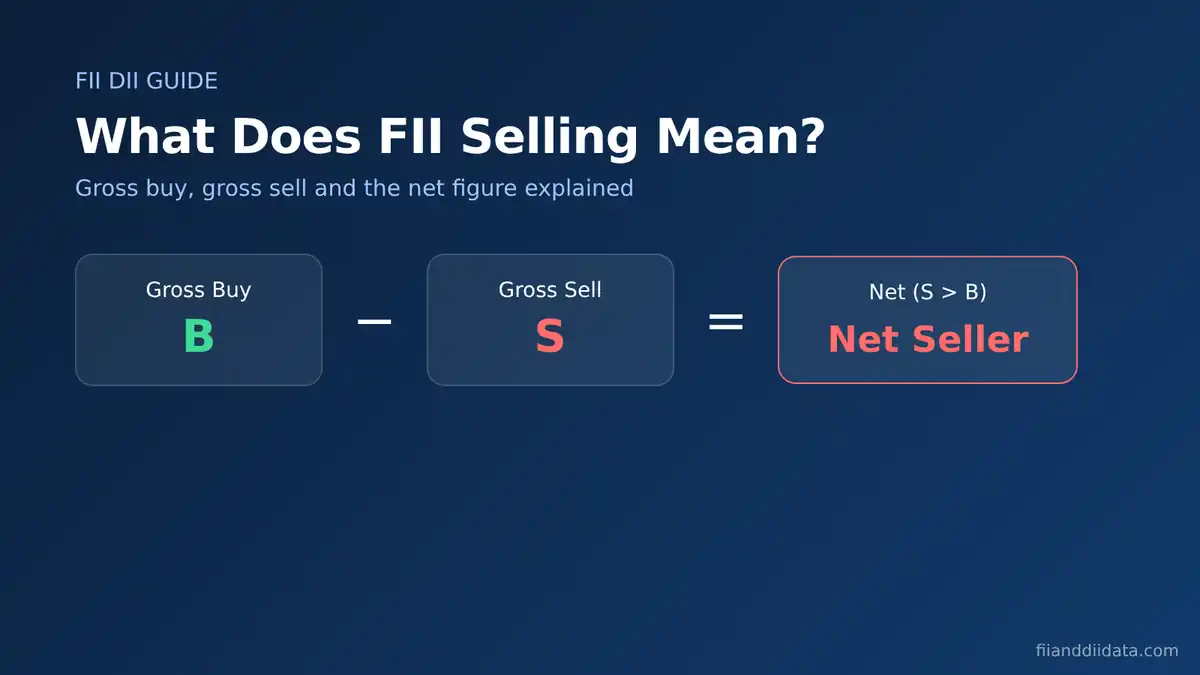
What does FII selling mean? It means foreign institutional investors sold more Indian shares than they bought on a given day, week or month, so their net figure is negative. On 8 October 2026, for example, FIIs bought ₹15,725 crore of shares but sold ₹28,669 crore, leaving a net sale of ₹12,944 crore in exchange provisional data. This guide explains how that number is built, who takes the other side, and how to read it without overreacting.
Key Takeaways
- FII selling means gross sales by foreign institutions were larger than their gross purchases, so the net figure is negative.
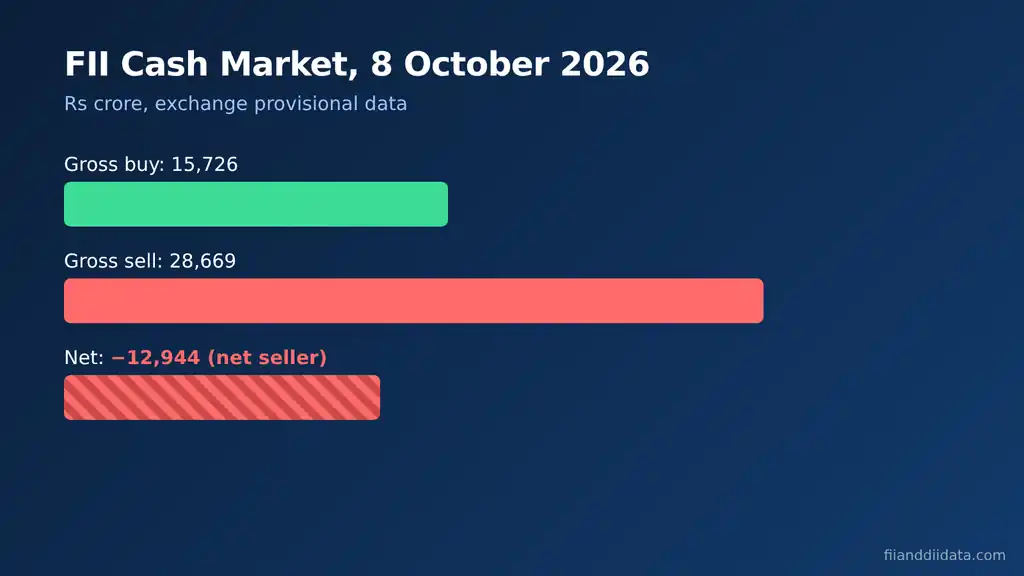
- FIIs both buy and sell every day. On 8 October 2026 they bought ₹15,725 crore and sold ₹28,669 crore, a net sale of ₹12,944 crore.
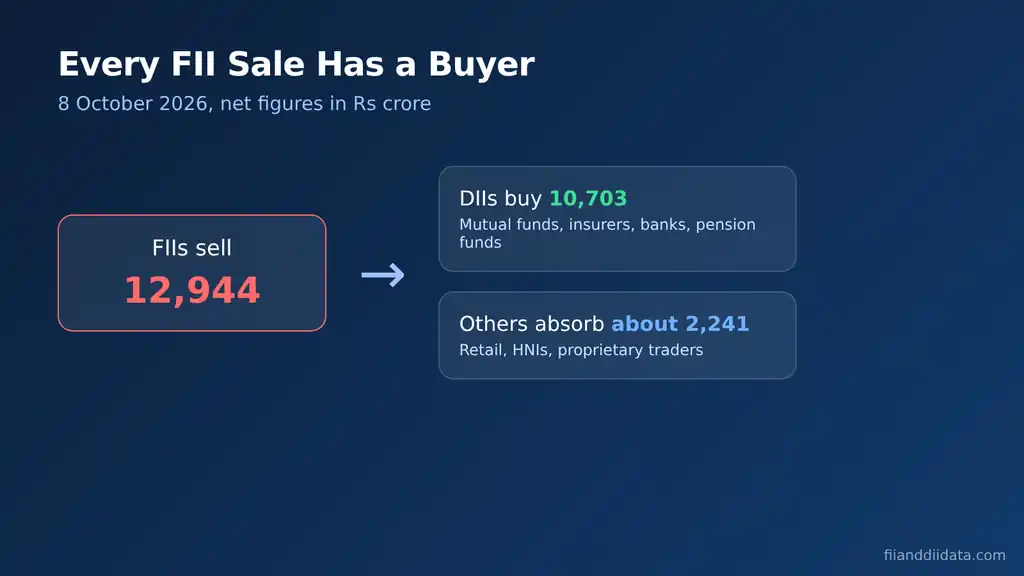
- Every share an FII sells is bought by someone else. That day, DIIs bought a net ₹10,703 crore.
- FIIs were net sellers of ₹45,162 crore in October 2026 (exchange data), then net buyers of ₹45,960 crore in just five sessions from 2 to 6 November.
- Read FII selling with DII flows, the size of the move, the streak and F&O positions, not as a stand-alone sell signal.
Table of contents
- What does FII selling mean? The short answer
- Gross buy, gross sell and net: how FII selling is calculated
- Cash market selling vs F&O selling
- If FIIs sell, who buys?
- Why FIIs sell and what FII selling means for the market
- What does FII selling mean in real numbers? October vs November 2026
- How to read FII selling data: a 6-point checklist
- Common mistakes investors make
- FAQs
- The Bottom Line
What Does FII Selling Mean? The Short Answer
A foreign institutional investor (FII) is a fund based outside India that invests in Indian shares and bonds. Pension funds, sovereign wealth funds, hedge funds and global mutual funds all fall in this group. SEBI now registers them as foreign portfolio investors (FPIs), but market reports still use both names for the same set of investors.
What does FII selling mean in plain words?
When a news headline says “FIIs sold ₹5,000 crore today”, it does not mean foreign funds only sold. It means that, after adding up every purchase and every sale they made that day, sales were ₹5,000 crore higher. FIIs are then called net sellers. If purchases are higher, they are net buyers.
Three points follow from this. First, FII selling is always a net number. Second, it can cover a day, a week, a month or a year. Third, it usually refers to the cash market (actual shares changing hands), unless the report says futures or options. We look at each of these below, starting with the arithmetic.
Gross Buy, Gross Sell and Net: How FII Selling Is Calculated
Every evening, the exchanges publish three numbers for FIIs: gross purchase, gross sale and net value. The formula is simple:
Net FII flow = Gross buy value – Gross sell value
A worked example
Imagine a single global fund on one trading day. It buys ₹900 crore of bank shares because it likes their valuations. On the same day it sells ₹1,500 crore of IT shares to cut its exposure to that sector. Its net figure is ₹900 crore minus ₹1,500 crore, which is -₹600 crore. In the data, this fund counts as a net seller of ₹600 crore, even though it bought heavily in banks.
Now scale that up to hundreds of foreign funds, each with its own reasons. The daily FII number is the sum of all those decisions. Here is what it looked like on the heaviest selling day of October 2026.
| 8 October 2026 | Gross buy (₹ crore) | Gross sell (₹ crore) | Net (₹ crore) |
|---|---|---|---|
| FII / FPI | 15,725.45 | 28,669.03 | -12,943.58 |
| DII | 22,987.97 | 12,284.86 | +10,703.11 |
Two things stand out. FIIs still bought over ₹15,700 crore of shares that day, so plenty of foreign money was coming in even as more went out. And their sales were about 1.8 times their purchases. Of the ₹44,394 crore they traded in total, the net sale was about 29%. That ratio is a quick way to judge how one-sided a selling day really was.
That table covers shares bought and sold for delivery. Foreign funds also trade derivatives, and selling there means something different.
Cash Market Selling vs F&O Selling
The headline FII number almost always refers to the cash market, where shares actually change owners. When FIIs are net sellers here, foreign funds have reduced their holdings of Indian stocks. Money tends to leave the country once they convert the rupees into dollars.
Selling in futures and options (F&O) works differently. If an FII sells Nifty futures, it may be betting on a fall, or it may be hedging shares it already owns. No shares change hands, and the position can be closed within days. A fund can even be a net buyer in cash while selling index futures to protect that purchase.
| Point | Cash market selling | F&O selling |
|---|---|---|
| What changes | Ownership of shares | A contract position (long or short) |
| Money leaves India? | Often, once converted to dollars | Not necessarily |
| Typical purpose | Reduce exposure, rebalance, book profit | Hedge, bet on direction, roll over |
| Where to track | Daily cash FII/DII figures | Participant wise open interest |
We track both sides each evening. The cash numbers are on our FII DII data today page, and futures and options positions are on the FII DII F&O data page. With that distinction clear, the next question is the one most beginners ask: if foreigners are selling, who is buying?
If FIIs Sell, Who Buys?
A stock exchange only matches trades. For every share sold, there is exactly one share bought. So when FIIs are net sellers of ₹12,944 crore, other investors must be net buyers of the same ₹12,944 crore. The question is who, and at what price.
On 8 October 2026, domestic institutional investors (DIIs) such as mutual funds, insurance companies, banks and pension funds bought a net ₹10,703 crore. The remaining gap of about ₹2,241 crore was absorbed by retail investors, wealthy individuals (HNIs), proprietary traders of brokers and other participants.
The price matters more than the volume. If buyers are willing at current prices, heavy FII selling can pass with little damage. If they are not, prices must fall until enough buyers appear. This is why the same ₹10,000 crore sale can move the Nifty sharply one day and barely at all on another. Steady monthly SIP money gives mutual funds cash to deploy, which is one reason DIIs so often buy on the days FIIs sell.
Knowing who absorbs the selling explains the price reaction. The next step is to understand why foreign funds sell in the first place.
Why FIIs Sell and What FII Selling Means for the Market
Foreign funds manage money across many countries, so their reasons are often global rather than Indian. Common triggers include:
- Higher US bond yields: safer dollar returns pull money out of emerging markets.
- A weaker rupee: it cuts the dollar value of Indian returns.
- High crude oil prices: India imports most of its oil, so costly crude hurts inflation and company margins.
- Valuations and earnings: expensive stocks or weak quarterly results prompt profit booking.
- Better opportunities elsewhere: money shifts to markets that look cheaper or have a stronger theme.
For October 2026, analysts quoted by PTI on 1 November pointed to high crude oil prices, attractive US yields and concerns about the corporate earnings outlook. Geojit’s VK Vijayakumar noted that FPIs kept selling large-cap financials while buying pharma, healthcare and select digital platforms. Our longer piece on why FIIs have been selling Indian stocks covers these drivers in detail.
What does it mean for the market? Sustained FII selling usually adds pressure on large caps, especially banks and IT, because foreign funds own large stakes in them. It can also weaken the rupee as dollars leave. But it does not automatically mean a crash. Our guide to how FII flows move the stock market explains the six channels through which this money works. The real numbers from the last six weeks show how quickly the picture can change.
What Does FII Selling Mean in Real Numbers? October vs November 2026
October 2026 was a clear selling month. Exchange provisional data shows FIIs were net sellers of ₹45,162 crore across 20 sessions, an average of about ₹2,258 crore a day. DIIs bought ₹62,220 crore over the same period, about ₹17,058 crore more than FIIs sold.
Then the direction flipped. In the first week of November, FIIs were net buyers on all five sessions.
| Date (2026) | FII gross buy | FII gross sell | FII net | DII net |
|---|---|---|---|---|
| Mon, 2 Nov | 16,499 | 13,385 | +3,115 | -392 |
| Tue, 3 Nov | 20,971 | 14,134 | +6,837 | -3,679 |
| Wed, 4 Nov | 21,607 | 14,323 | +7,284 | -3,712 |
| Thu, 5 Nov | 31,798 | 16,823 | +14,975 | -10,445 |
| Fri, 6 Nov | 30,456 | 16,706 | +13,750 | -5,969 |
| Week | 1,21,331 | 75,371 | +45,960 | -24,197 |
Depository figures, which include primary market deals, tell a similar story with different numbers. PTI reported on 1 November 2026 that FPIs pulled out a net ₹34,843 crore from equities in October, after ₹35,861 crore in September, taking 2026 outflows to about ₹2.95 lakh crore. ANI reported on 8 November that FPIs then put in ₹38,971 crore during the first week of November (NSDL data), as a global sell-off in AI-linked stocks pushed money back towards India. If you are unsure why the two sources differ, read our explainer on why NSE and NSDL FII figures differ.
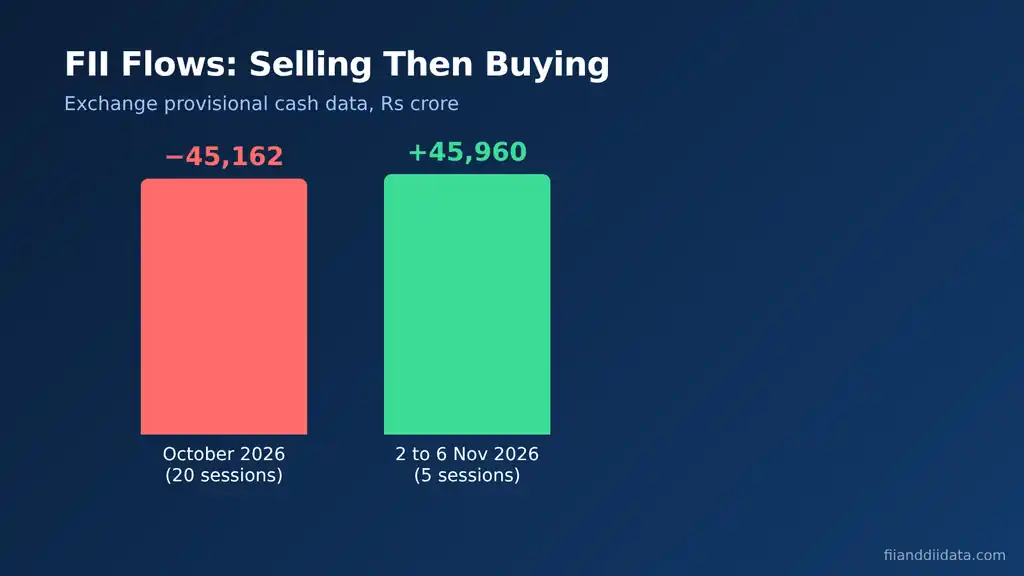
The lesson: a month of heavy selling was almost fully reversed in one week. That is why a single number should never drive a decision. The checklist below gives you a routine to read it properly.
How to Read FII Selling Data: A 6-Point Checklist
NSE publishes provisional FII and DII cash figures after market close, usually around 6 PM IST on trading days. NSDL publishes final FPI data the next working day. You can see the official release on the NSE FII/DII reports page, or follow the daily and historical tables on our FII and DII data home page. Each evening, run through these six checks:
- Net plus DII: add FII net and DII net. A combined positive figure means institutions as a group still added money.
- Size versus normal: compare the day with the month’s average. In October 2026 the average FII net sale was about ₹2,258 crore, so a ₹12,944 crore day was more than five times normal.
- Net as a share of gross: divide the net by total turnover. On 8 October it was about 29%, a strongly one-sided day.
- Streak: five or more sessions in one direction say more than one big day, which may be a block deal or index rebalancing.
- F&O positions: check whether FIIs are adding shorts or covering them in index futures.
- Price and rupee: if FIIs sell but the Nifty holds, domestic demand is strong. If the index and rupee both fall, the selling is biting.
For the monthly view, our FII DII monthly data page shows how each month adds up. Even with this routine, a few habits trip up investors again and again.
Common Mistakes Investors Make
- Thinking FIIs only sold. Net selling hides large gross buying. On 8 October FIIs still bought ₹15,725 crore.
- Treating FII selling as a sell signal for every stock. Foreign funds may sell banks while buying pharma on the same day.
- Ignoring DII flows. In October 2026, DIIs bought more than FIIs sold. Looking at FIIs alone gives half the picture.
- Mixing provisional and final data. Exchange figures and NSDL figures measure different things and can differ by thousands of crores in a month.
- Reading one week as a new trend. October’s selling reversed within days, and early November’s buying can reverse too.
- Confusing F&O shorts with cash selling. Selling index futures can be a hedge, not an exit.
Avoiding these mistakes turns the daily FII number from a source of worry into useful context. The questions below cover what readers ask most.
FAQs
What does FII selling mean in the share market?
It means foreign institutional investors sold more Indian shares than they bought over a period, so their net figure is negative. For example, on 8 October 2026 FIIs bought ₹15,725 crore and sold ₹28,669 crore of shares, making them net sellers of ₹12,944 crore.
Is FII selling bad for the market?
Not always. Heavy and sustained FII selling can pull down large caps and weaken the rupee, but the impact depends on who buys. In October 2026, DIIs bought ₹62,220 crore while FIIs sold ₹45,162 crore in exchange data, which cushioned the fall.
What happens when FIIs sell and DIIs buy?
The shares move from foreign to domestic owners. If DII buying is equal to or larger than FII selling, prices may hold steady. If DII buying is smaller, retail and other investors must absorb the rest, and prices often fall until they do.
What does FII net seller mean?
A net seller is an investor group whose total sales are larger than its total purchases in a period. FIIs can buy thousands of crores of shares on a day and still be net sellers if they sell even more.
When is FII selling data released?
NSE releases provisional FII and DII cash market data after market close, usually around 6 PM IST on trading days. NSDL publishes final FPI figures, which also include primary market deals, on the next working day.
The Bottom Line
FII selling means foreign funds sold more Indian shares than they bought over a period. It is a net figure built from large two-way trading, and every rupee of it is matched by a buyer, most often DIIs. October 2026 showed heavy selling of ₹45,162 crore in exchange data, and the first week of November showed it can reverse just as fast.
The practical step is to check FII net, DII net, the size versus normal and F&O positions together each evening, and to act on streaks, not single days. You can find more plain-English explainers on our FII DII blog.
Sources: Business Standard (PTI), 1 November 2026; Tapetide, FII and DII flows in October 2026; StockPil, FII vs DII this week (2 to 6 November 2026); Kotak Neo, 8 November 2026; ANI, 8 November 2026; NSE provisional FII/DII data.
Disclaimer: This article is for educational purposes only and is not investment advice. Please consult a SEBI-registered advisor before making investment decisions.