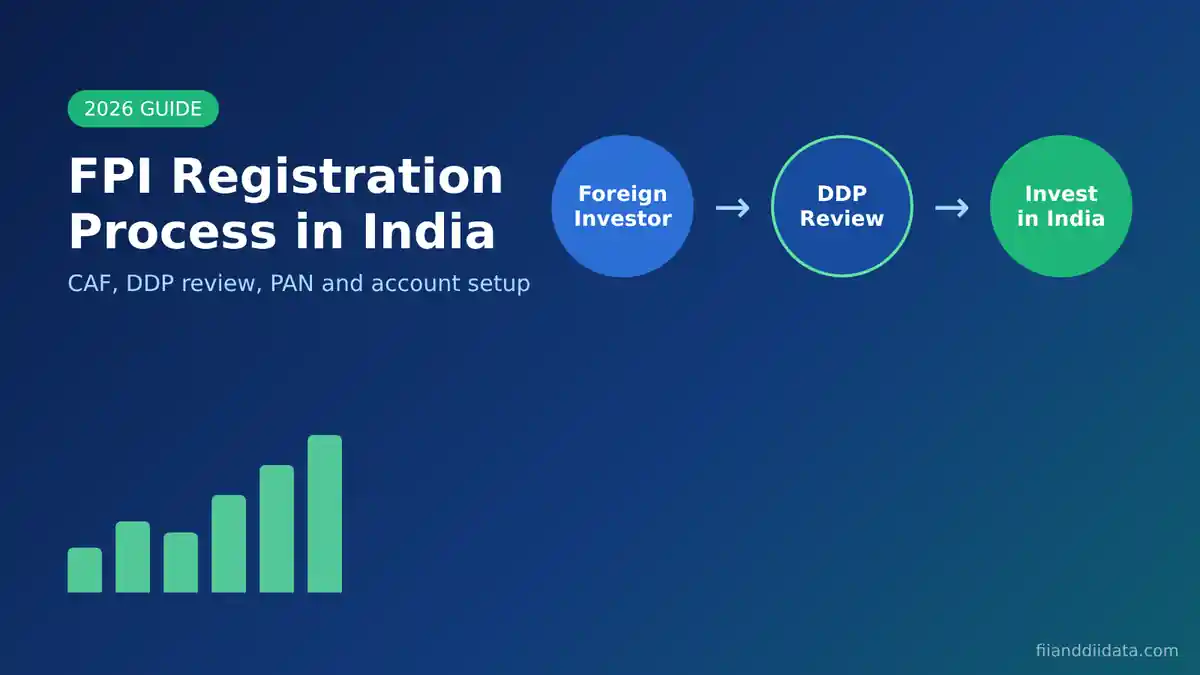
The FPI registration process India uses is a single-window route: a foreign investor files one Common Application Form (CAF) through a Designated Depository Participant (DDP), which grants registration, sets up the PAN request and hands over to a custodian. With 12,260 FPIs registered as of September 2026 and two big rule changes this year, here is exactly how the process works now.
Key Takeaways
- Every foreign portfolio investor registers through a SEBI-approved DDP, not directly with SEBI.
- One CAF covers registration, PAN allotment and KYC; the DDP must decide within 30 days of a complete file.
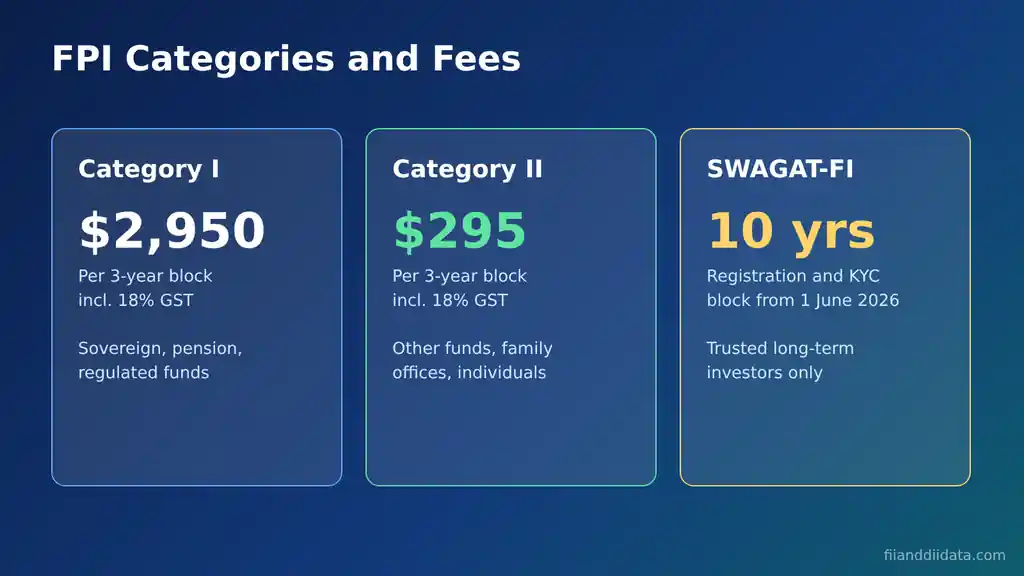
- The fee is USD 2,950 for Category I and USD 295 for Category II, per three-year block, including 18% GST.
- From 1 June 2026, trusted investors under SWAGAT-FI get a 10-year registration and KYC block.
- Since 20 August 2026, SEBI accepts a digitally signed Power of Attorney, which cuts notarisation delays.
Table of contents
- What Is FPI Registration?
- Who Can Register as an FPI?
- FPI Registration Process India: 6 Steps
- Documents, Fees and FPI Categories
- Timelines and 2026 Rule Changes
- Worked Example: The NRI and Resident Limit Test
- After Registration: Accounts, Renewal and Data
- Common Mistakes That Delay Approval
- Frequently Asked Questions
- The Bottom Line
What Is FPI Registration and Why Does It Matter?
A foreign portfolio investor (FPI) is a foreign entity or individual that buys Indian shares, bonds, derivatives or fund units without taking control of the company. Before it can place a single order on NSE or BSE, it needs a certificate of registration under the SEBI (Foreign Portfolio Investors) Regulations, 2019. The older term FII still appears in market reports, and we explain how the two labels relate in our guide on FPI categories and SEBI rules.
Registration decides the investor’s category and paperwork, and every rupee in the NSE “FII/FPI” column or NSDL’s FPI Monitor comes from a registered FPI. So the route matters to foreign funds and to Indian readers who track their money.
If one foreign investor group crosses 10% of a listed company’s equity, the holding is treated as foreign direct investment instead, as our FII vs FDI comparison explains. Next, who is allowed to apply?
Who Can Register as an FPI in India?
Eligibility is about the applicant’s home country, its regulator and who owns it. Based on the SEBI master circular of 30 May 2024 and the DDP operating procedures published by custodian banks, an applicant must clear these tests:
- Regulator test: the home-country securities regulator must sign the IOSCO multilateral MoU or have a bilateral MoU with SEBI.
- FATF test: the applicant and its beneficial owners must not come from a jurisdiction named in a FATF public statement, and must not appear on the UN Security Council sanctions list.
- Residency test: the applicant cannot be a resident Indian. NRIs, OCIs and resident Indians can contribute to an FPI’s corpus only within limits, covered in the worked example below.
- Ownership test: beneficial owners are traced through look-through thresholds, such as 10% for a company and 15% for an unincorporated body.
Category I or Category II in the FPI registration process
Once eligible, the applicant is placed in one of two risk-based categories. Category I covers governments, central banks, sovereign funds, pension and university funds, and appropriately regulated entities such as banks, insurers and asset managers. Category II covers everything else: unregulated funds, endowments, family offices, corporate bodies and individuals. Individuals can register only in Category II. The category sets the fee and the depth of KYC, which shapes every step that follows.
FPI Registration Process India: 6 Steps From Application to First Trade
The sequence below follows the NSE FPI FAQ brochure and the procedure DDPs use for fresh registrations. A global custodian often runs it for the investor.
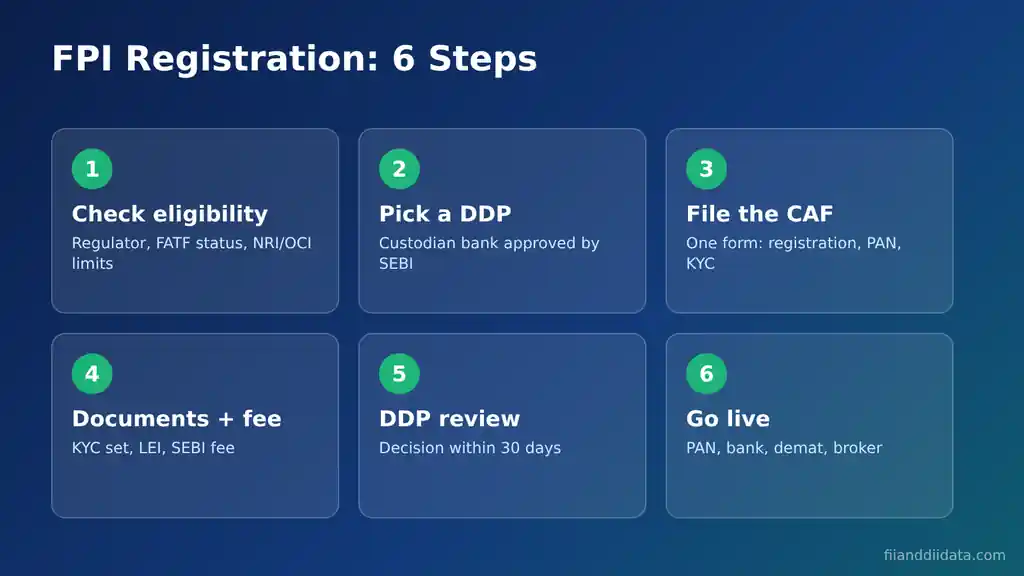
- Check eligibility and pick the category. Confirm the regulator, FATF and residency tests, and decide between Category I and Category II.
- Appoint a DDP. A DDP is a SEBI-approved custodian bank that does due diligence and grants registration on SEBI’s behalf. The same bank usually becomes the local custodian.
- Fill the Common Application Form. The CAF and its annexure are filled on the depository portal. One form covers FPI registration, PAN allotment and KYC. The portal generates a barcoded CAF that must be signed on every page, in wet ink or with an IT Act compliant digital signature.
- Submit documents and pay the fee. Send the signed CAF, KYC documents, Legal Entity Identifier (LEI) details, beneficial owner declarations and the SEBI fee to the DDP.
- DDP review and grant. The DDP checks the file, raises queries if needed, completes KYC and updates the depository system. Once satisfied, it grants the registration certificate and forwards the PAN application to the Income Tax Department.
- Go live. With PAN in hand, the investor opens its bank and demat accounts, gets a Custodial Participant (CP) code, and appoints a broker and clearing member before placing trades.
A gap in step 4 stalls everything after it, so the document list deserves a closer look.
Documents, Fees and FPI Categories
Category I faces lighter paperwork because its investors are already supervised at home. The table compares both categories.
| Item | Category I | Category II |
|---|---|---|
| Who qualifies | Governments, sovereign funds, pension funds, regulated banks, insurers and asset managers | Other funds, family offices, corporates, individuals |
| Core KYC set | Constitutive documents, proof of address, PAN, FATCA/CRS form, signatory list | Same set plus board resolution and proof of identity of beneficial owners |
| Beneficial owner details | Required (not for government-related entities) | Required |
| LEI and granular disclosure | Required | Required |
| SEBI fee per 3-year block | USD 2,500 + 18% GST = USD 2,950 | USD 250 + 18% GST = USD 295 |
| Can issue offshore derivative instruments | Yes | No |
How documents are verified
KYC documents must be certified or notarised, or backed by a SWIFT MT 599 message from the investor’s global custodian. Documents signed within the last six months are accepted as they are; older ones need a “no change” confirmation. A wrong name, jurisdiction or category in the CAF means a fresh, re-signed form, and that delay costs more than the fee.
FPI Registration Process Timelines and 2026 Rule Changes
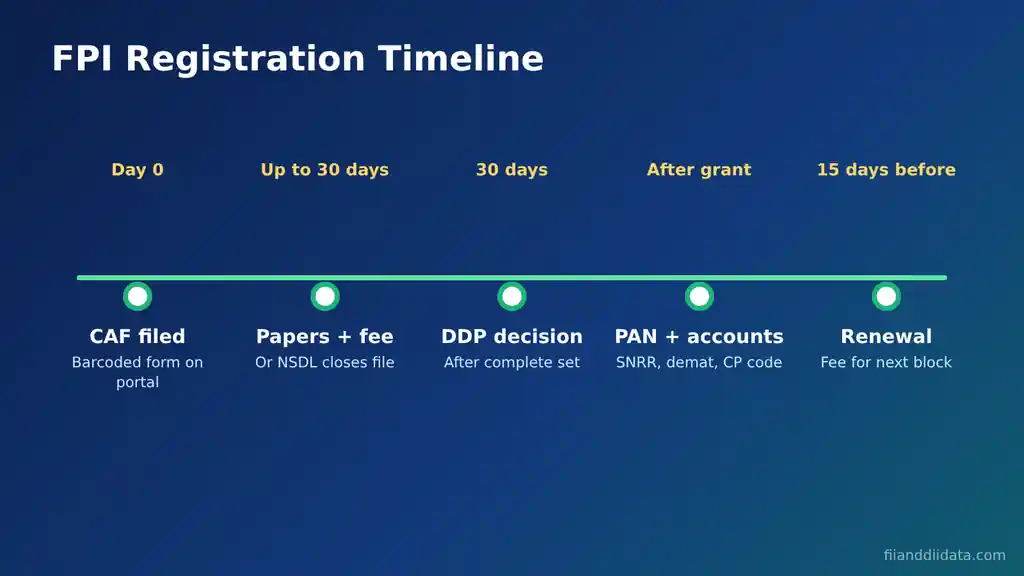
Under Regulation 7(2), the DDP must decide an application as soon as possible and no later than 30 days after it receives complete documents or the further information it asked for, whichever is later. Incomplete files take longer.
Two 2026 changes have shortened the path for many investors. First, SEBI’s circular of 16 January 2026 set out SWAGAT-FI (Single Window Automatic and Generalised Access for Trusted Foreign Investors), effective 1 June 2026. Government-related investors, regulated public retail funds, regulated insurers investing their own money and regulated pension funds can now hold registration for a 10-year block instead of three years, with KYC reviewed every 10 years. Second, SEBI’s circular of 20 August 2026 allows the Power of Attorney given to the custodian to be digitally signed, removing the need to notarise, apostille or consularise it.
| Measure | Value | Date or effective from |
|---|---|---|
| Registered FPIs | 12,260 | September 2026 |
| FPI assets under custody | US$767+ billion | September 2026 |
| DDP decision deadline | 30 days after complete documents | Regulation 7(2), FPI Regulations 2019 |
| Renewal information and fee due | At least 15 days before validity ends | SEBI master circular, 30 May 2024 |
| SWAGAT-FI registration block | 10 years | 1 June 2026 |
| Digitally signed Power of Attorney | Accepted | 20 August 2026 |
The test that trips up many fund structures is the limit on Indian money inside the fund, so let us work through it.
Worked Example: The NRI and Resident Limit Test
The SEBI master circular says a single NRI, OCI or resident Indian must contribute below 25% of the applicant’s corpus, and all of them together must stay below 50%. Resident Indian money must also come through the Liberalised Remittance Scheme into a global fund with Indian exposure below 50%.
Take a hypothetical Singapore fund with a corpus of US$200 million:
| Contributor | Amount (US$ million) | Share of corpus | Below 25%? |
|---|---|---|---|
| NRI investor A | 45 | 22.5% | Yes |
| OCI investor B | 30 | 15.0% | Yes |
| Resident Indian C (via LRS) | 35 | 17.5% | Yes |
| Total NRI, OCI and resident | 110 | 55.0% | Aggregate limit is below 50% |
Each person passes the single-investor test, but together they hold 55%, so the fund fails the aggregate test. The 50% mark here is US$100 million, so the fund must bring Indian-linked money down by more than US$10 million. If investor C cuts the commitment to US$24 million, the total drops to US$99 million, or 49.5%, and the fund qualifies.
Fee cost over nine years in the FPI registration process
Fees are paid per three-year block. Over nine years, a Category I investor pays 3 x USD 2,950 = USD 8,850, while a Category II investor pays 3 x USD 295 = USD 885, a gap of USD 7,965. Category choice should follow eligibility, not price. Once the certificate arrives, the work shifts to accounts.
After Registration: Accounts, Renewal and Where FPI Flows Show Up
A registration certificate alone does not let an FPI trade. According to the NSE FPI FAQ brochure, it must also:
- Open a Special Non-Resident Rupee (SNRR) account with an Authorised Dealer bank. All trades settle in rupees through this account.
- Appoint a local custodian and open a demat account in the FPI’s own name. Omnibus accounts are not allowed.
- Get a CP code, then appoint a trading member, a clearing member and a tax consultant.
Registration has no fixed end date as long as fees are paid for each block. But if the renewal fee is not paid within 30 days of the end of the previous block, the registration ceases, and an expired one cannot be revived. A fresh application is then needed.
Once trading starts, the FPI’s activity flows into public data. NSE publishes provisional FII/FPI cash figures around 6 PM IST on trading days, which we track as FII DII data today. NSDL publishes final FPI figures the next working day, and our NSE vs NSDL FII data guide explains why the two rarely match. For the bigger picture of how registered FPIs have pulled money out this year, see our FPI outflow 2026 breakdown. Back to the application itself: these are the errors that slow most files.
Common Mistakes That Delay FPI Approval
- Choosing the wrong category. An unregulated fund applying as Category I will be rejected or asked to re-file with a new CAF.
- Ignoring the 25% and 50% limits. Funds with large NRI or resident Indian backing must check the corpus test before applying, not after.
- Stale or uncertified documents. Papers older than six months without a “no change” note, or copies without certification, restart the review.
- Missing the CAF window. If documents and fees do not reach the DDP within 30 days of the barcoded CAF, the depository can close the application.
- Late renewal. Missing the renewal fee deadline ends the registration, and it cannot be continued.
A pre-filing checklist
- Home regulator signs the IOSCO MMoU or has a SEBI MoU.
- No FATF public statement or UN sanctions issue for the applicant or its owners.
- NRI, OCI and resident Indian money below 25% each and 50% in total.
- Category decided and supporting proof ready.
- KYC set certified or backed by a SWIFT message, signed within six months.
- Valid LEI, FATCA/CRS form and beneficial owner details in hand.
- Fee arranged in US dollars for the first three-year block (or 10-year block under SWAGAT-FI).
Tick every box and most files clear the DDP without back-and-forth.
Frequently Asked Questions
What is the FPI registration process in India?
A foreign investor appoints a SEBI-approved Designated Depository Participant (DDP), files one Common Application Form covering registration, PAN and KYC, submits documents and the fee, and receives a registration certificate after the DDP review. It then opens bank, demat and broker accounts before trading.
How long does FPI registration take?
Under Regulation 7(2) of the SEBI FPI Regulations, 2019, the DDP must decide within 30 days of receiving complete documents or any further information it asked for. Incomplete files take longer, because the clock starts only when the file is complete.
What is the FPI registration fee in India?
The SEBI fee is USD 2,950 for Category I (USD 2,500 plus 18% GST) and USD 295 for Category II (USD 250 plus 18% GST) for each three-year block. PAN fees are extra where a PAN is needed.
Can an NRI register as an FPI?
Generally no. Resident Indians cannot be FPIs, and NRIs and OCIs usually cannot register individually. They can contribute to a foreign fund that registers as an FPI, but each must stay below 25% of the corpus and all of them together below 50%.
How long is FPI registration valid?
Registration continues as long as fees are paid for each three-year block, with information updated at least 15 days before validity ends. Under SWAGAT-FI, effective 1 June 2026, eligible trusted investors get a 10-year block. If renewal fees are not paid within 30 days of the previous block ending, registration ceases.
The Bottom Line
The FPI registration process in India is built around one form and one gatekeeper. A foreign investor proves eligibility, picks Category I or II, files the CAF through a DDP, pays a modest fee and waits up to 30 days from a complete file for a decision. The real work is in the details: clean KYC, a valid LEI and Indian-linked money within the 25% and 50% limits.
2026 has made the route easier for long-term money, with 10-year SWAGAT-FI registration from June and digitally signed Powers of Attorney from August. As a next step, follow how registered FPIs are actually trading on our FII and DII data home page, and find more explainers on the FIIAndDIIData.com blog.
Sources: NSE FPI FAQs brochure; India Market Access (SEBI and MIIs), FPI statistics, September 2026; NSDL circular of 24 Aug 2026 on SEBI’s digitally signed PoA rule; SEBI circular on SWAGAT-FI, 16 January 2026; SEBI Master Circular for FPIs, DDPs and EFIs, 30 May 2024; J.P. Morgan DDP SOP for FPI registration, 2 August 2024.
Disclaimer: This article is for educational purposes only and is not investment advice. Please consult a SEBI-registered advisor before making investment decisions.