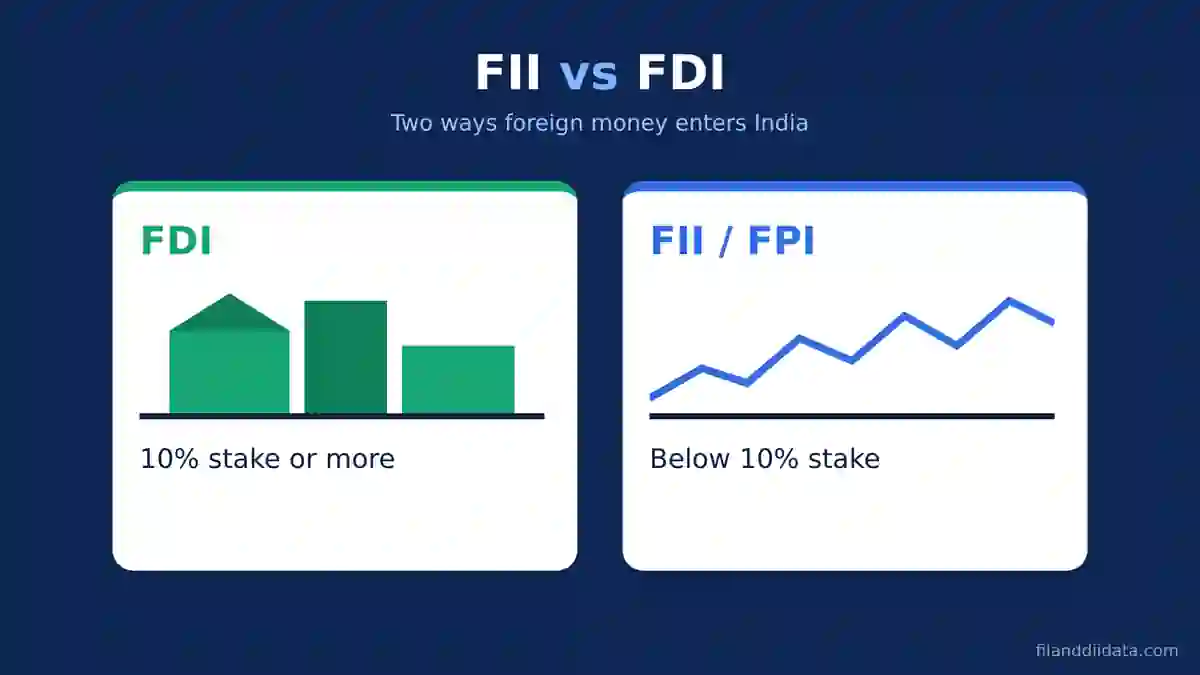
The FII vs FDI difference is about control and time: FDI (foreign direct investment) buys a lasting stake of 10% or more in an Indian business, while an FII (foreign institutional investor, now called an FPI) buys smaller, tradable holdings that can be sold within days. India’s FY26 numbers show why the gap matters. Gross FDI reached US$94.5 billion, yet foreign portfolio investors pulled out a net US$16.5 billion in the same year, according to RBI data.
Key Takeaways
- FDI is a long-term stake with a say in management; FII or FPI money is a financial holding that can exit quickly.
- The dividing line for a listed company is 10% of paid-up equity held by one foreign investor group.
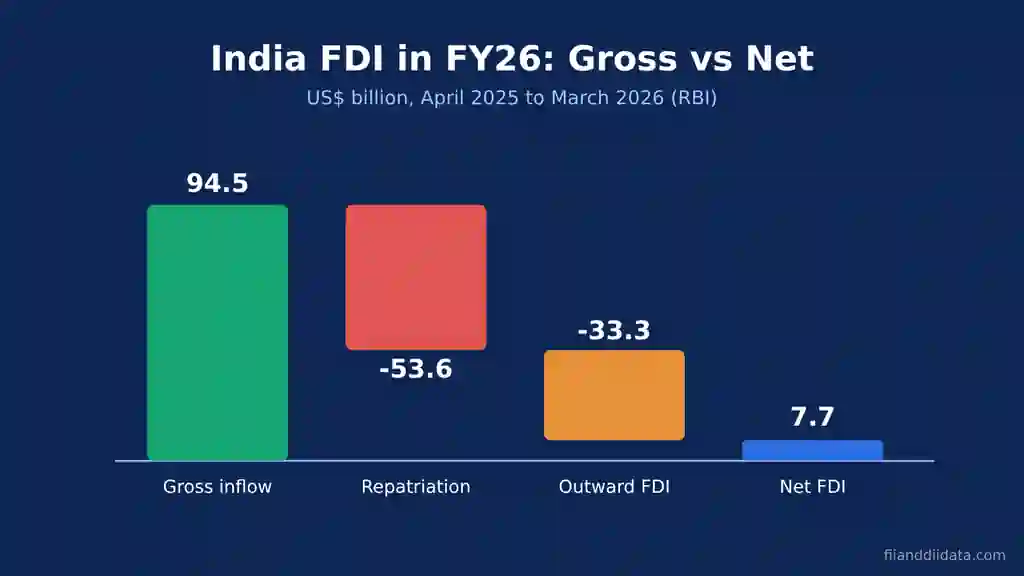
- In FY26, India’s gross FDI was US$94.5 billion, but net FDI was only US$7.7 billion after repatriation and outward investment.
- FPIs sold a record of about ₹3.08 lakh crore of Indian equities in 2026 up to late October, per depository data.
- Traders watch daily FII data; long-term investors and economists watch FDI trends.
- What is FII vs FDI?
- FII vs FDI comparison table: 7 key differences
- The 10% rule that separates FPI from FDI
- FDI and FII in India: the latest data
- Why FII vs FDI matters for the market and the rupee
- How to track FII and FDI data: a checklist
- Common mistakes when comparing FII and FDI
- FAQs
- The Bottom Line
What Is FII vs FDI?
Both terms describe foreign money coming into India. The difference lies in what the investor wants from that money and how long it plans to stay.
FDI: Foreign Direct Investment
FDI is investment made to own and help run a business. A global carmaker building a plant in Tamil Nadu, a foreign parent putting capital into its Indian subsidiary, or a strategic investor buying a large stake in a listed company are all FDI. The investor usually stays for years, brings technology or management skills, and often gets board seats.
FII: Foreign Institutional Investor (Now FPI)
An FII is a foreign fund, such as a pension fund, sovereign fund, mutual fund or hedge fund, that buys Indian shares, bonds or derivatives as a financial investment. SEBI now registers these investors as foreign portfolio investors (FPIs), so FII and FPI describe the same group. Our guide on FII vs FPI explains why both names are still used.
A simple way to remember it: FDI buys a part of the business, while an FII buys a part of the share register. The table below sets out every practical difference.
FII vs FDI Comparison Table: 7 Key Differences
| Factor | FDI | FII / FPI |
|---|---|---|
| Size of stake | 10% or more of a listed company’s equity, or a controlling or strategic stake | Below 10% per investor group in a listed company |
| Goal | Build, own or run a business | Earn returns from price moves, dividends and interest |
| Time horizon | Long term, often many years | Days to years; positions can change daily |
| Control | Often board seats and a say in strategy | No management role |
| Ease of exit | Slow; needs a buyer for a large stake | Fast; shares sold on the exchange |
| What it brings | Capital, technology, jobs, factories | Liquidity and price discovery in markets |
| Main data source | RBI (monthly) and DPIIT (quarterly) | NSE provisional data (daily) and NSDL (next working day) |
The first row decides everything else. Once a foreign investor crosses the 10% line in a listed Indian company, it moves from the FPI world into the FDI world. Here is how that rule works in practice.
The 10% Rule That Separates FPI From FDI
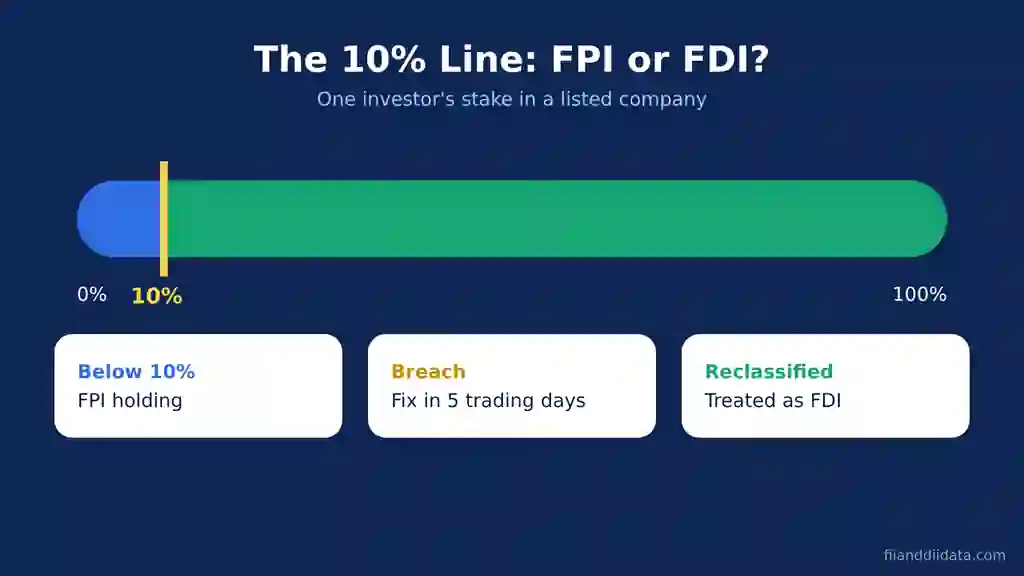
Under the SEBI FPI Regulations, 2019, a single FPI, together with its investor group, must keep its holding below 10% of a listed company’s total paid-up equity on a fully diluted basis. On 11 November 2024, the RBI and SEBI issued a framework for what happens when an FPI crosses that limit, as Business Standard reported that day. The key points:
- The FPI has five trading days from the settlement of the trades that caused the breach to either sell the excess or reclassify the holding as FDI.
- Reclassification needs any required government approval and the investee company’s concurrence, and it must meet FDI rules such as entry route, sectoral caps and pricing.
- It is not allowed in sectors where FDI is prohibited.
- Once reclassified, the entire holding is treated as FDI and stays FDI even if the stake later falls below 10%.
FII vs FDI Worked Example: When FII Money Becomes FDI
Take a listed company with a market value of ₹50,000 crore. A foreign fund owns 6% of it, worth ₹3,000 crore. That is a portfolio holding, so the fund counts as an FPI and its trades show up in daily FII data.
Now the fund buys more and reaches 11%, worth ₹5,500 crore. It has crossed the limit by more than 1 percentage point, or over ₹500 crore. Within five trading days of settlement it must choose:
- Sell the excess: trim a little over ₹500 crore of shares to get back below 10% and stay an FPI.
- Reclassify: treat the full ₹5,500 crore stake as FDI, subject to approvals and FDI conditions.
If it reclassifies, the stake leaves the FPI category for good. That is why the same foreign fund can appear in FII data one month and in FDI statistics the next.
The rule explains the definitions. The numbers explain why investors care, so let us look at what each flow did in the latest year.
FDI and FII in India: The Latest Data
| Measure | Value | Period |
|---|---|---|
| Gross inward FDI | US$94.5 billion (FY25: US$80.6 billion) | FY26 |
| Repatriation and disinvestment by foreign investors | US$53.6 billion | FY26 |
| Outward FDI by Indian companies | US$33.3 billion | FY26 |
| Net FDI | US$7.7 billion (FY25: US$1 billion) | FY26 |
| FDI equity inflows (DPIIT) | US$58.84 billion, up 18% | FY26 |
| Net FPI flows | Outflow of US$16.5 billion | FY26 |
| FPI net equity selling | About ₹3.08 lakh crore | 2026, up to late October |
| FPI net equity selling | ₹1.66 lakh crore | Calendar 2025 |
Reading the FDI Numbers: Gross vs Net
The headline FDI figure can mislead if you stop at the gross number. Start with gross inflow of US$94.5 billion, subtract US$53.6 billion that foreign investors took home through repatriation and stake sales, then subtract US$33.3 billion that Indian companies invested abroad. That leaves about US$7.6 billion by simple arithmetic, close to the US$7.7 billion net FDI the RBI reported in its annual report, as covered by Outlook Business on 29 May 2026. The small gap likely reflects rounding.
On the equity side, DPIIT data showed FDI equity inflows of US$58.84 billion in FY26, up 18%, with Singapore the largest source at US$19.8 billion, according to Outlook Money on 5 June 2026. US investment more than doubled to US$11.17 billion.
Reading the FII Numbers in 2026
Portfolio money has moved the other way. NSDL data showed FPIs sold ₹1.66 lakh crore of Indian equities in all of 2025, as Free Press Journal reported on 11 October 2026. By late October 2026, depository data put 2026 selling at about ₹3.08 lakh crore, roughly 1.9 times the full 2025 figure, with about ₹48,056 crore sold in October alone. We break the monthly pattern down in our report on FPI outflow in 2026.
The selling has also shrunk the foreign share of Indian companies. The NSE India Ownership Report for June 2026 put FPI ownership of NSE-listed companies at 15.1%, the lowest in 69 quarters. So two kinds of foreign money behaved very differently in the same period. Next, we look at why that split matters.
To follow the portfolio side month by month, use our FII DII monthly data table, and check how foreign funds are positioned in futures and options on the FII DII F&O data page.
Why FII vs FDI Matters for the Market and the Rupee
Stock Market Impact
FII flows hit the market directly because they are trades on the exchange. Heavy FII selling can push Nifty lower within days, especially when domestic buying does not fully absorb it. FDI rarely moves the index on a given day, because most of it goes into unlisted businesses, new projects or negotiated stake purchases.
Rupee and Balance of Payments
Both flows bring dollars into India, and both can take them out. FDI is often called stable money and FII money is often called hot money, because portfolio investors can leave fast when US yields rise or the dollar strengthens. In FY26, the RBI noted that net FPI outflows, including US$13.1 billion in March 2026 alone, which it linked to the West Asia conflict, left portfolio flows short of financing the current account deficit. Our analysis of the rupee and FII outflows covers this link in more detail.
What Each Flow Tells You
- Rising FDI: global companies see India as a long-term place to build and sell.
- Rising repatriation: foreign owners are cashing in, often through IPOs and stake sales in a strong market.
- FII buying: global funds like Indian valuations, earnings or the rupee outlook right now.
- FII selling: money is moving to cheaper markets, higher US yields or safer assets.
Knowing what each flow signals is only useful if you can find the data at the right time. The next section shows where and when.
How to Track FII and FDI Data: A Checklist
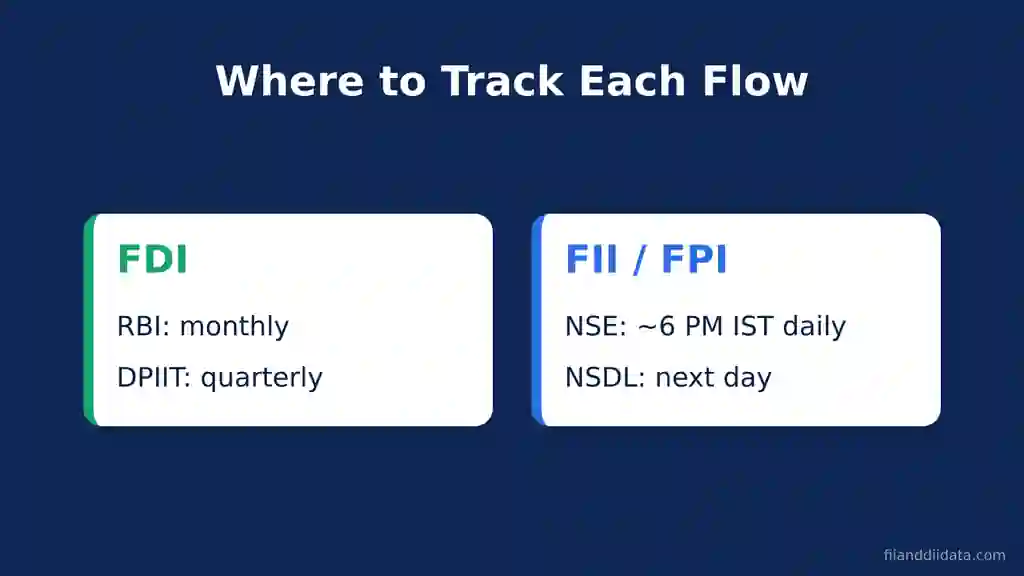
FII data is fast and FDI data is slow, so they need different routines. NSE releases provisional FII and DII cash market figures around 6 PM IST on trading days, and NSDL publishes final FPI figures the next working day. FDI data arrives monthly in the RBI Bulletin and quarterly in DPIIT factsheets, usually with a lag of several weeks.
- Daily: check the FII net figure after 6 PM on our FII DII data today page and note whether DIIs absorbed the selling.
- Next morning: compare with NSDL’s final FPI number, which also includes IPO and primary market money. Our guide explains why NSE and NSDL FII numbers differ.
- Weekly: keep a running total of FII flows rather than reacting to one day.
- Monthly: read the RBI Bulletin for gross FDI, repatriation and net FDI.
- Quarterly: check DPIIT factsheets for FDI by country, sector and state, and company shareholding patterns for FPI stake changes.
- Always: note the period and unit. FII data is usually in ₹ crore, while FDI is usually in US$ billion.
For daily flows, charts and free tools in one place, see our FII and DII data home page. Even with good data, a few common errors can lead you to the wrong conclusion.
Common Mistakes When Comparing FII and FDI
- Adding them together without care. FII figures are often in rupees and by calendar month, while FDI is in dollars and by financial year.
- Quoting gross FDI as if it were net. In FY26, US$94.5 billion gross became US$7.7 billion net.
- Calling all FII money short term. Many pension and sovereign funds hold Indian shares for years; they are FPIs because of stake size, not holding period.
- Assuming FDI cannot leave. Repatriation of US$53.6 billion in FY26 shows that direct investors do exit, just more slowly.
- Confusing FDI with DII. DIIs are Indian institutions. See our explainer on the difference between FII and DII.
Frequently Asked Questions
FII vs FDI: what is the difference?
FDI (foreign direct investment) is a long-term investment to own or run a business, usually a stake of 10% or more in a listed company. An FII (foreign institutional investor, now called an FPI) buys smaller holdings of shares or bonds as a financial investment, with no management role, and can sell quickly on the exchange.
Which is better for India, FDI or FII?
Both help. FDI brings long-term capital, technology and jobs, and is harder to withdraw. FII money adds liquidity to stock and bond markets but can leave fast. In FY26, India received gross FDI of US$94.5 billion while net FPI flows were an outflow of US$16.5 billion, according to RBI data.
Is FPI the same as FDI?
No. FPI (foreign portfolio investment) is the current name for FII investment. It covers holdings below 10% per investor group in a listed company. Holdings above that limit must be cut back or reclassified as FDI within five trading days of settlement.
What is the 10% rule for FDI and FPI?
A single FPI and its investor group must hold below 10% of a listed Indian company’s paid-up equity on a fully diluted basis. Under the RBI and SEBI framework of November 2024, a breach must be fixed by selling the excess or reclassifying the whole holding as FDI, which then stays FDI.
Why is FII money called hot money?
FII money is called hot money because portfolio investors can sell shares and take funds out of India within days, often in response to US bond yields, the dollar or global risk. FDI is harder to exit because it is tied to factories, businesses or large strategic stakes.
The Bottom Line
FII vs FDI comes down to stake size, control and speed. FDI buys a lasting role in Indian businesses and moves slowly. FII or FPI money buys tradable holdings below the 10% line and can change direction in a single session.
FY26 showed both sides clearly: strong gross FDI, thin net FDI after repatriation, and record portfolio selling. Neither flow tells the full story on its own. Your next step: track daily FII figures for two weeks alongside the next RBI Bulletin, and browse more explainers on our blog.
Sources: Outlook Business, RBI Annual Report data (29 May 2026); Outlook Money, DPIIT FDI data (5 June 2026); Business Standard, RBI-SEBI FPI to FDI framework (11 November 2024); Free Press Journal, NSDL FPI data (11 October 2026); Multibagg, CDSL FPI data (30 October 2026); NSE India Ownership Report, June 2026. Data as of 30 October 2026.
Disclaimer: This article is for educational purposes only and is not investment advice. Please consult a SEBI-registered advisor before making investment decisions.