When people track FII flows, they usually look at the daily number on the exchange and stop there. That number only tells part of the story. A large share of foreign money enters India through FII primary market investment, meaning IPOs, anchor books and QIPs, and much of it never shows up in the daily cash market figure. This guide explains how that money moves, how to read it, and what it means for the market.
Key Takeaways
- FII primary market investment means foreign portfolio investors buying new shares directly from the issuer, through IPOs, anchor allocations and QIPs.
- Daily NSE provisional data covers secondary market trades only. NSDL data, published the next working day, also captures primary market allotments.
- Anchor investors face a lock-in: half of the shares unlock after 30 days and the rest after 90 days.
- Heavy primary market buying can sit alongside heavy secondary market selling, so the two numbers should never be read in isolation.
What Is FII Primary Market Investment?
The primary market is where a company sells shares for the first time, or issues fresh shares to raise money. The company receives the cash directly. In the secondary market, shares simply change hands between investors on the exchange, and the company gets nothing new.
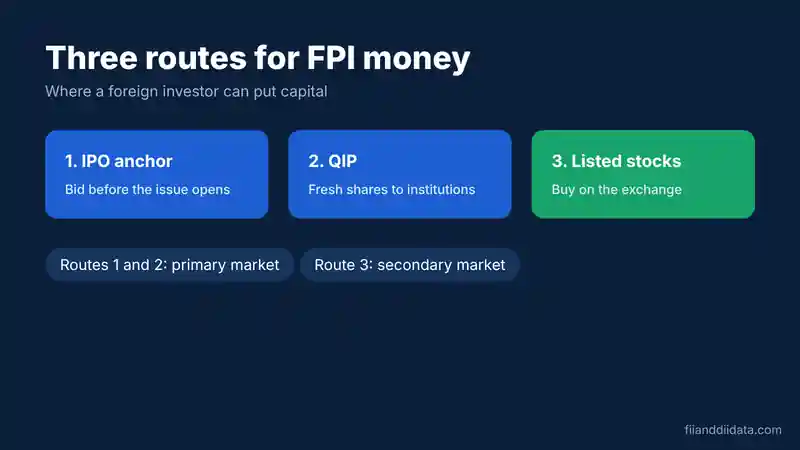
FII primary market investment is therefore money that goes straight into a company’s treasury. Foreign portfolio investors, often still called FIIs in everyday market talk, take part in three main ways: the anchor book of an IPO, the regular QIB (qualified institutional buyer) quota of an IPO, and a QIP, which is a qualified institutions placement by an already listed company.
The distinction sounds technical, but it changes how you read every flow headline. A foreign fund that sells a million shares of a bank on the exchange and a foreign fund that subscribes to a new issue are doing opposite things for the economy, even if both are counted as “FII activity” in casual conversation.
Primary vs Secondary Market: Why the Difference Matters
An FPI that buys shares on the exchange is a buyer facing a seller. Prices move, but no new capital reaches the company. An FPI that subscribes to an IPO or QIP adds fresh capital to the economy, which is why policymakers care about primary market flows. They fund expansion, debt repayment and new projects.
| Feature | Primary market | Secondary market |
|---|---|---|
| Who receives the money | The issuing company | The selling investor |
| How FPIs participate | IPO, anchor book, QIP | Buying and selling listed shares |
| Impact on market liquidity | Adds new shares to the market | No new shares created |
| Shows in NSE daily data | No | Yes |
| Shows in NSDL data | Yes | Yes |
The Three Routes FPI Money Takes
1. IPO anchor book
Before an IPO opens to the public, the company can allot a portion of the QIB quota to anchor investors. These are large institutions, including many FPIs, that commit a day ahead. Their participation signals confidence and helps price discovery. In return, they accept a lock-in on the shares, explained below.
2. QIB quota in the IPO
Outside the anchor book, a further portion of the IPO is reserved for qualified institutional buyers, which includes FPIs, mutual funds and insurers. These bids are placed during the open subscription window, and shares carry no special lock-in beyond the standard listing rules.
3. QIP by listed companies
A listed company can raise money quickly by issuing shares to qualified institutions through a QIP. It is faster and cheaper than a public issue, so banks and large companies use it often. FPIs are frequent buyers because the shares are already trading, which makes pricing easier to judge.
Why Companies and Foreign Funds Both Like This Route
For the issuer, institutional buyers bring size and speed. A company that needs a large sum for a new plant or to cut debt can close a QIP in a matter of days, without the long process of a public offer. An anchor book also helps a first-time issuer set a sensible price, because large investors scrutinise the numbers before committing.
For the foreign fund, the primary market offers access to businesses it cannot buy in size on the exchange. A mid-sized company may have limited free float, so a fund wanting a meaningful position can find it difficult to build one quietly in the open market. An allotment solves that problem in one step. Funds also like that the price is fixed in advance for everyone in the book, which removes the risk of moving the market against themselves while buying.
There are limits, though. Under Indian rules, a single FPI generally cannot hold 10 percent or more of the paid-up capital of one company, and all foreign holdings together must stay within the aggregate and sectoral limits. These caps shape how much any one fund can take in an issue.
Why NSE and NSDL Numbers Tell Different Stories
This is the point most readers miss. The provisional figure the exchange publishes in the evening, usually around 6 PM IST, records only trades done on the exchange. An IPO allotment is not an exchange trade, so it is absent. The final FPI numbers from NSDL arrive the next working day and include allotments in IPOs and QIPs.
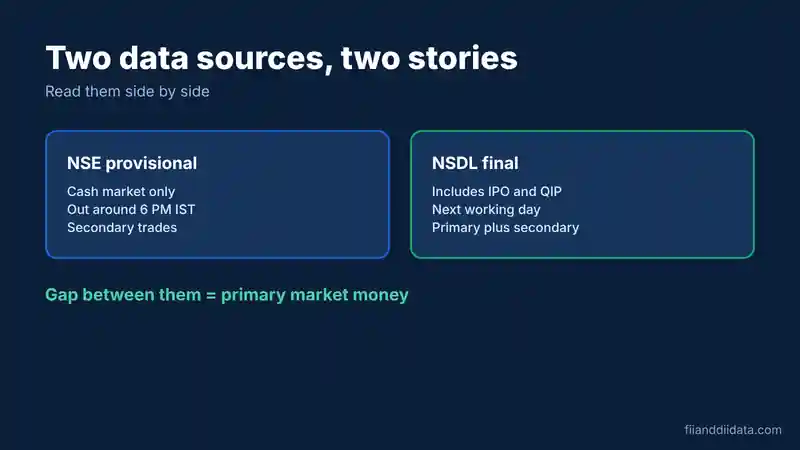
The practical result is that a day showing net FII selling on the exchange can later look milder, or even positive, once NSDL data adds a large IPO or QIP allotment. For a daily view of exchange activity, our FII cash market data page is the right starting point, while monthly and yearly totals are better judged from NSDL figures. You can follow both on FII and DII data.
A Simple Example of the Gap
Imagine a week in which foreign funds sell listed shares worth a net 3,000 crore rupees on the exchange. The evening headlines say FIIs were heavy sellers. During the same week, a large IPO allots foreign funds shares worth 2,000 crore rupees through its anchor and QIB books. The exchange data never sees that 2,000 crore. When NSDL numbers are published, the net foreign position for the week looks like 1,000 crore of selling rather than 3,000 crore.
These figures are illustrative, not actual data, but the logic is exactly how the gap appears in real weeks. It is also why a reader who only follows the evening number can feel more pessimistic about foreign sentiment than the full data justifies.
Anchor Lock-In: What Happens After Listing
Under SEBI rules, half of the shares allotted to anchor investors are locked in for 30 days from the date of allotment. The remaining half is locked in for 90 days. Once a lock-in ends, those shares can be sold on the exchange.
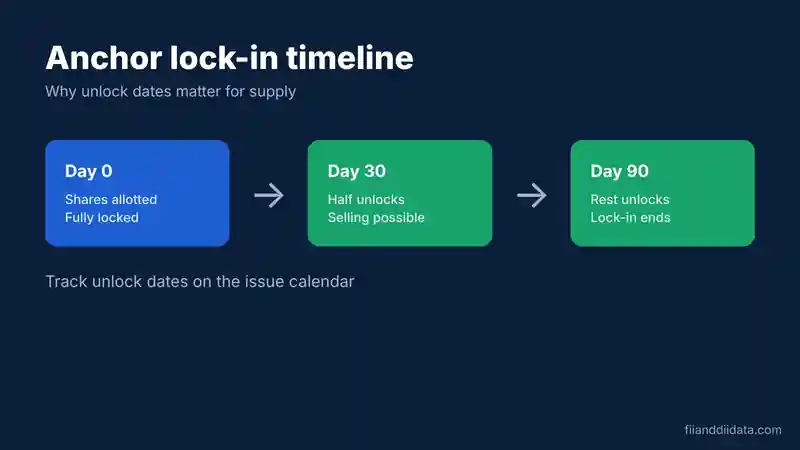
Traders watch these dates closely. When a large block unlocks, some holders sell, which can pressure the stock for a few sessions. This is called unlock overhang. It does not always lead to a fall, but a stock that has run up strongly since listing is more exposed. Those sales then appear in secondary market FII data, which is one reason primary buying today can turn into secondary selling a month or three later.
How to Read FII Primary Market Investment Like an Analyst
- Compare both data sources. Check the exchange figure for the day, then the NSDL figure when it arrives. A large gap points to primary market activity.
- Check the IPO and QIP calendar. Big issues in a week often explain why FPI totals diverge from exchange totals.
- Separate fresh capital from churn. Primary buying brings new money in. Secondary buying is a transfer between investors.
- Mark unlock dates. Day 30 and Day 90 after a large anchor allotment are the likely points of added supply.
- Look at the wider trend. One IPO does not change the picture. Our guides on FPI investment in India and FPI outflow in 2026 show the larger pattern.
What Primary Flows Mean for the Market and the Rupee
Secondary market flows move prices day to day. Primary flows work differently. Because the money goes to the company, it supports investment and balance sheets rather than index levels. Still, strong foreign demand for new issues usually reflects healthy confidence, and the dollars brought in add to currency inflows, which can ease pressure on the rupee.
There is a flip side. A wave of new issues absorbs liquidity. When many companies raise money in the same weeks, funds may sell some existing holdings to make room, so secondary selling and primary buying can happen together. That pattern has appeared in several recent phases, and our report on FPI inflows and the AI sell-off shows how mixed signals like this can confuse the headline picture.
Why It Matters for Retail Investors
Foreign participation in an IPO is a useful signal, but not a guarantee. A strong anchor book shows that large institutions did their homework and accepted a price, yet listing gains and later performance still depend on the business and market conditions. Domestic institutions also play a major role, and our explainer on FII delivery buying shows how to separate real accumulation from short term trading.
Remember too that FPI data in the primary market is reported in aggregate. You cannot see which institution bought which stock from daily flow data alone. For that detail, read the allotment lists in the offer documents published by the company.
Common Mistakes When Reading These Flows
- Treating the evening exchange number as the complete FII picture.
- Assuming net selling always means foreign money is leaving India, when primary buying may be offsetting it.
- Ignoring lock-in expiry dates after a hot IPO.
- Comparing a single day of exchange data with a month of NSDL data.
- Reading a strong anchor book as a promise of listing gains.
A Practical Checklist Before You Act on Any Flow Number
Before you build a view on foreign sentiment from a single headline, run through a short check. First, note whether the number is a provisional exchange figure or a final NSDL figure. Second, look at the issue calendar for that week and see whether large IPOs or QIPs closed. Third, check whether any anchor lock-ins are expiring soon in stocks you follow. Fourth, compare the figure with the trailing month, not just the day. Finally, remember that DII buying often fills the gap when foreign funds step back, so read both sides together.
This habit takes a few minutes and avoids the most common misreading: assuming the evening number is the final word on what foreign investors did.
Frequently Asked Questions
What is FII primary market investment?
It is money foreign portfolio investors put directly into a company through an IPO, anchor book or QIP. The company receives the cash, unlike secondary market trades where shares only change hands.
Does daily NSE FII data include IPO investment?
No. The provisional exchange figure covers secondary market trades only. IPO and QIP allotments appear later in NSDL data, which is published the next working day.
What is the anchor investor lock-in period?
Half of the shares allotted to anchor investors are locked in for 30 days and the other half for 90 days from the date of allotment, as per SEBI rules.
Can FIIs invest in a QIP?
Yes. Qualified institutional buyers, including registered foreign portfolio investors, can subscribe to a QIP, subject to the rules on foreign ownership limits.
Why does FII selling sometimes coincide with a strong IPO market?
Foreign investors can sell listed shares in the secondary market while buying new shares in IPOs and QIPs. The two flows are separate, so one can be negative while the other is positive.
Conclusion
FII primary market investment is the part of foreign flows that daily exchange numbers miss. Read the NSE provisional figure for the day, confirm with NSDL data, and keep an eye on IPO calendars and lock-in dates. Doing so gives a far more accurate view of how much foreign capital is truly entering or leaving India. For regular updates, keep following FII and DII data on this site.
Disclaimer: This article is for education only and is not investment advice. Please consult a SEBI registered adviser before investing.