The Budget 2027 expectations stock market investors are watching come down to one question: will the government cut the taxes it raised on equity investors, or protect revenue at a time of heavy foreign selling? The Finance Ministry began pre-budget meetings on 12 October 2026, and on 13 October Finance Minister Nirmala Sitharaman said discussions on capital gains tax and STT were underway. With the Nifty down 12.98% in 2026 as of 27 October, the stakes for the next Budget are high.
Key Takeaways
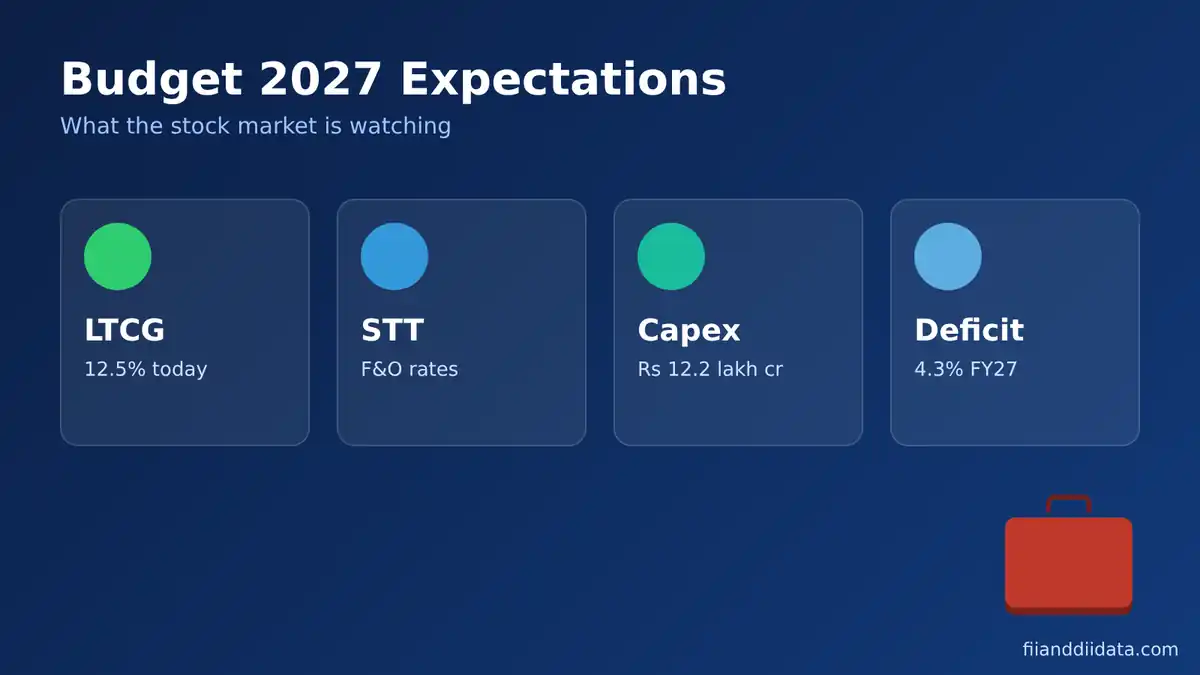
- The market’s top asks are a lower LTCG rate (now 12.5% above ₹1.25 lakh) and a review of STT on F&O, which Budget 2026 raised.
- The Centre has started consultations on LTCG and STT, but no change has been announced as of 3 November 2026.
- FPIs sold a net ₹3.04 lakh crore of Indian equities in 2026 up to 11 October, which is why tax relief is being debated.
- Nifty rose on only 4 of the last 12 Budget days; the 2026 Budget day fall was 495 points.
- Revenue pressure from the West Asia conflict and the Eighth Pay Commission limits how much relief the government can give.
Table of contents
- Budget 2027 timeline: what is known so far
- Why Budget 2027 matters for the stock market
- Top Budget 2027 expectations for the stock market
- How Nifty reacts on Budget day: 12-year record
- Worked example: what STT and LTCG changes mean in rupees
- FII flows and the Budget: what to watch
- Pre-Budget checklist for investors and traders
- Common mistakes investors make around the Budget
- FAQs
- The Bottom Line
Budget 2027 Timeline: What Is Known So Far
The Union Budget for 2027-28 is the government’s spending and tax plan for the year starting 1 April 2027. A Finance Ministry circular, reported by Business Today on 29 August 2026, asked ministries to submit data by 6 October 2026, with pre-budget meetings chaired by the Secretary (Expenditure) starting on 12 October 2026. It will be Nirmala Sitharaman’s 10th consecutive Budget.
The presentation date has not been officially notified as of 3 November 2026. Since 2017 the Budget has been presented on 1 February, and in 2026 it was presented on a Sunday so that the date did not change. Investors should treat 1 February 2027 as the likely date until Parliament confirms it.
| Date | Event | Status |
|---|---|---|
| By 6 Oct 2026 | Ministries submit budget data on UBIS | Done |
| 12 Oct 2026 | Pre-budget meetings begin | Underway |
| 13 Oct 2026 | FM says LTCG and STT debate is underway | Done |
| Late Oct 2026 | Centre seeks views on LTCG and STT (media reports) | Underway |
| Likely 1 Feb 2027 | Budget 2027-28 presentation | Not yet notified |
Knowing the calendar helps, but the bigger question is why this Budget carries more weight for equities than usual. That comes from the flow data.
Why Budget 2027 Matters for the Stock Market
Indian equities have had a difficult 2026. Outlook Money reported on 27 October 2026 that the Nifty was down 12.98% for the year, and Kotak Neo noted that Indian stocks had lost $924 billion in market value since the September 2024 peak. Foreign selling is the main driver.
According to NSDL data reported by the Free Press Journal, FPIs (foreign portfolio investors) were net sellers of ₹3.04 lakh crore of Indian equities in 2026 up to 11 October, against ₹1.66 lakh crore for the whole of 2025. We track the month-by-month picture in our FPI outflow 2026 breakdown. Domestic institutions have absorbed much of this selling, which you can follow in the daily FII and DII data.
When foreign money leaves, policy makers look at what makes India less attractive than other markets. Tax on returns is one of the few levers the government controls directly, and the Budget is where it uses that lever.
The revenue problem behind Budget 2027 expectations
Tax relief has a cost. Kotak Neo reported that LTCG (long-term capital gains) tax collections rose to ₹1.29 lakh crore in FY25 from ₹72,249 crore in FY24, and STT (securities transaction tax) brought in ₹57,522 crore in FY26. Business Today also noted pressure from the West Asia conflict, higher fertiliser subsidies and the Eighth Pay Commission. Any cut has to fit inside these limits, which brings us to what the market is actually asking for.
Top Budget 2027 Expectations for the Stock Market
Based on investor demands reported by Business Today on 15 October 2026 and the consultations reported on 27 October 2026, these are the main asks. None of them is confirmed.
1. A lower LTCG tax rate on equity
Long-term gains on listed shares held over 12 months are taxed at 12.5% on gains above ₹1.25 lakh a year, after the July 2024 Budget raised the rate from 10%. Investors want the rate cut or the old 10% restored. SBI Research has gone further and recommended abolishing equity LTCG while extending the holding period to two or three years, as Business Today reported.
2. A review of STT, especially on F&O
Budget 2026 raised STT on futures from 0.02% to 0.05% and on options premium from 0.1% to 0.15%, according to Business Standard. Traders call the combination of STT and capital gains tax “double taxation.” Our guide to SEBI’s F&O rules in 2026 explains how these costs add to the new contract rules.
3. Tax relief aimed at FPIs
One idea in the consultation, reported by Outlook Money, is to exempt FPIs from capital gains tax and slightly raise STT so that revenue stays neutral. This would directly target the outflow problem.
4. Fiscal discipline and capex
Markets also want the government to keep its borrowing in check. Budget 2026-27 set a fiscal deficit target of 4.3% of GDP for FY27 and capital expenditure of ₹12.2 lakh crore, with gross market borrowing of ₹17.2 lakh crore. A slip in the deficit path could push bond yields up, which tends to hurt equity valuations.
5. Equal treatment across asset classes
Investors point out that the ₹1.25 lakh exemption applies to Indian listed equity but not to foreign stocks, gold or property, and that debt fund gains are taxed at slab rates. These are smaller asks, but they shape how household savings flow into equities.
Expectations are one thing; reactions are another. History shows that the market rarely celebrates on Budget day itself.
How Nifty Reacts on Budget Day: 12-Year Record
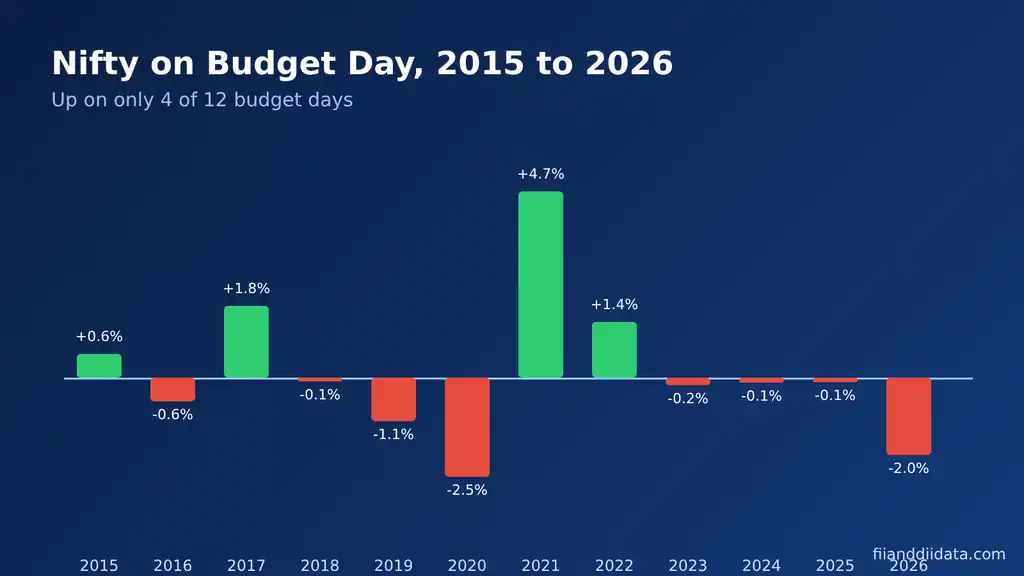
Looking at Budget-day moves from 2015 to 2026, the Nifty closed higher on only 4 of 12 occasions. The biggest gain was 4.7% in 2021. The biggest fall was 2.5% in 2020.
| Budget year | Nifty change on Budget day | Note |
|---|---|---|
| 2015 | +0.6% | |
| 2016 | -0.6% | |
| 2017 | +1.8% | First 1 February Budget |
| 2018 | -0.1% | |
| 2019 (July) | -1.1% | Full Budget after election |
| 2020 | -2.5% | |
| 2021 | +4.7% | Best Budget day in the period |
| 2022 | +1.4% | |
| 2023 | -0.2% | |
| 2024 (July) | -0.13% | LTCG raised to 12.5% |
| 2025 | -0.11% | Closed at 23,482.15 |
| 2026 | -495 points (about -2.0%) | STT hike on F&O; closed at 24,826 |
The 2026 reaction is the most relevant lesson. On 1 February 2026 the Sensex fell 1,547 points (1.8%) to 80,723 and the Nifty fell 495 points to 24,826, mainly because of the STT increase and the change in buyback taxation. FPIs sold a net ₹588 crore and DIIs sold ₹683 crore in that special session, per Business Standard.
The pre-Budget month has also been weak. Business Standard reported on 8 January 2026 that the Nifty fell in January in each of 2021 to 2025, with losses ranging from 0.03% to 2.48%. So both the run-up and the day itself have leaned negative. To see why tax details matter so much to traders, it helps to put them in rupee terms.
Worked Example: What STT and LTCG Changes Mean in Rupees
Here is how the current rules affect two common investors. The numbers are illustrative and ignore cess and surcharge.
Example 1: An F&O trader
Suppose a trader sells futures worth ₹10 lakh. At the old STT rate of 0.02%, the tax was ₹200. At the current 0.05%, it is ₹500, an extra ₹300 per trade. A trader who does 20 such trades a month pays ₹6,000 more each month, or ₹72,000 more a year, before any profit or loss. For options, selling ₹1 lakh of premium now costs ₹150 in STT instead of ₹100.
Example 2: A long-term investor
Suppose an investor books ₹5 lakh of long-term gains on shares in a year. Taxable gain is ₹5 lakh minus the ₹1.25 lakh exemption, or ₹3.75 lakh. At 12.5%, the tax is ₹46,875. If the rate went back to 10% with the same exemption, the tax would be ₹37,500, a saving of ₹9,375. If LTCG were abolished, the full ₹46,875 would stay with the investor.
| Scenario | Tax on ₹5 lakh LTCG | Change vs today |
|---|---|---|
| Current (12.5%, ₹1.25 lakh exempt) | ₹46,875 | None |
| Rate back to 10% | ₹37,500 | ₹9,375 lower |
| LTCG abolished | ₹0 | ₹46,875 lower |

These amounts explain why the STT and LTCG debate gets so much attention. The next question is whether relief would actually bring foreign money back.
FII Flows and the Budget: What to Watch
Foreign investors respond to after-tax returns, the rupee, and global interest rates. A tax cut helps the first, but it cannot fix a weak rupee or high US yields on its own. We discuss these drivers in detail in will FIIs come back to India.
Flows have not been one-way in 2026. NSDL data show FPIs bought ₹20,200 crore in July and ₹29,631 crore in August before selling ₹35,861 crore in September. This shows that foreign money can return quickly when conditions change, and a credible Budget could be one such trigger.
- Before the Budget: watch whether FPI selling slows in December and January. Our daily FII DII data today page shows provisional NSE figures after market close, around 6 PM IST.
- On Budget day: check the net FII and DII figures released that evening, not intraday commentary.
- After the Budget: track the next two to four weeks in the monthly FII DII data. A sustained change in flows matters more than a one-day reaction.
Flow data also tie in with interest rates. If you want the near-term view first, read our Nifty outlook for November 2026 before planning for February.
Pre-Budget Checklist for Investors and Traders
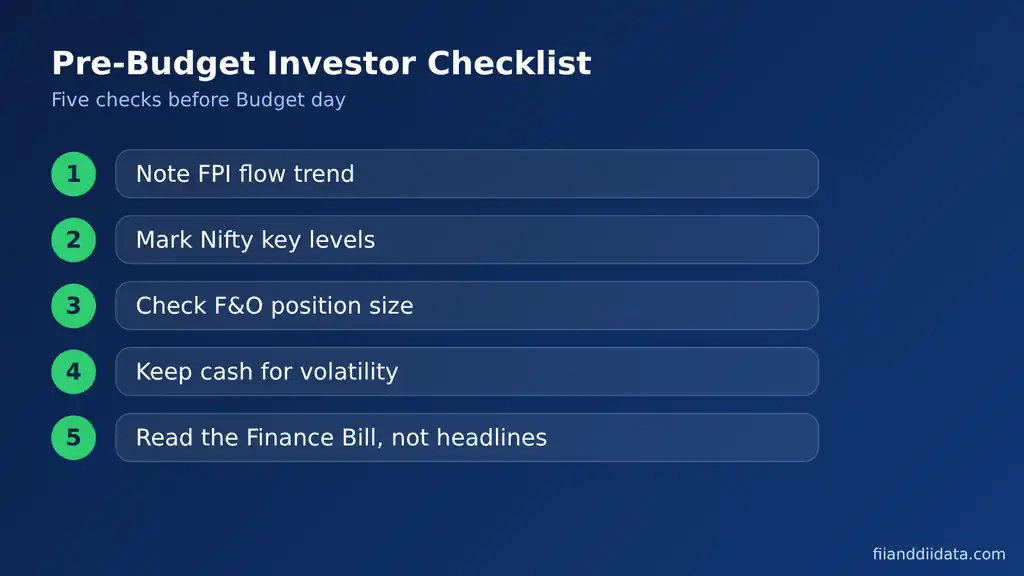
A Budget is a known event with an uncertain outcome. Use this checklist in the weeks before it.
- Track FPI flows weekly. Note whether selling is slowing or speeding up into January.
- Mark key Nifty levels. Know your support and resistance zones before volatility rises.
- Check F&O position size. Budget days can move the Nifty 2% or more, as in 2020 and 2026. Cut position size if a gap would hurt you.
- Keep some cash ready. Cash lets long-term investors act if prices fall sharply, as they did on Budget day in 2020 and 2026.
- Read the Finance Bill, not headlines. Tax changes are in the Finance Bill and memorandum. Effective dates matter as much as rates.
Even with a checklist, investors repeat a few errors around every Budget. Here are the ones we see most.
Common Mistakes Investors Make Around the Budget
- Trading on expectations as if they are facts. Media reports of consultations are not announcements. In 2026, investors hoping for tax relief got an STT increase instead.
- Selling long-term holdings to avoid a possible tax change. Booking gains early can trigger tax today for a change that may never happen.
- Reading the first hour of trade. Indices often swing both ways during the speech. The closing level and evening FII DII data give a clearer signal.
- Ignoring the fiscal numbers. The deficit, borrowing and capex figures affect bond yields and sector earnings for the whole year.
- Taking oversized option positions. Implied volatility rises before the Budget and falls after it, which can hurt option buyers even when they guess the direction right.
With the main risks covered, here are answers to the questions readers ask most often.
FAQs
When will Budget 2027 be presented?
The date for Budget 2027-28 has not been officially notified as of 3 November 2026. The Budget has been presented on 1 February every year since 2017, including on a Sunday in 2026, so 1 February 2027 is the likely date.
What are the Budget 2027 expectations for the stock market?
The main expectations are a cut in the 12.5% LTCG rate on equity, a review of STT on F&O after the 2026 increase, possible capital gains relief for FPIs, and continued fiscal discipline with steady capital expenditure. None of these has been confirmed.
Will LTCG tax be removed in Budget 2027?
There is no official decision. The Centre has sought views on LTCG and STT, and SBI Research has recommended abolishing equity LTCG, but revenue needs make a full removal uncertain. A rate cut or a longer holding period are also possible outcomes.
How does the stock market usually react on Budget day?
Between 2015 and 2026 the Nifty closed higher on only 4 of 12 Budget days. Moves ranged from a 4.7% gain in 2021 to a 2.5% fall in 2020, and the 2026 Budget day saw a 495-point fall after the STT increase.
Should I sell stocks before the Budget?
Selling only because of the Budget is rarely a good plan for long-term investors, since tax changes may not happen and selling can create a tax bill now. Traders should instead manage position size and margin around the event.
The Bottom Line
Budget 2027 arrives after a year of heavy foreign selling, and the government has openly started discussing LTCG and STT. That raises the chance of tax relief for equity investors, but it is far from certain, and the 2026 Budget showed that the market can be surprised in the other direction.
The practical step is to prepare rather than predict. Track FPI flows into January, keep F&O exposure in check around 1 February, and judge the Budget by the Finance Bill and the flows that follow. You can find all our coverage on the FIIAndDIIData.com blog.
Sources: Business Standard (1 Feb 2026), Business Today (15 Oct 2026), Outlook Money (27 Oct 2026), Free Press Journal, NSDL data (Oct 2026), Kotak Neo (27 Oct 2026), Business Today (29 Aug 2026), Republic World, Angel One (Feb 2025), DT Next (1 Feb 2026).
Disclaimer: This article is for educational purposes only and is not investment advice. Please consult a SEBI-registered advisor before making investment decisions.