The SEBI new F&O rules 2026 are a set of changes that make index derivatives bigger, costlier and more closely watched, with one more shift due on 7 December 2026. On 15 October 2026, SEBI reversed its closing auction plan and said expiring contracts will again settle on the volume weighted average price (VWAP) of the last 30 minutes. Here is every rule in force, what it costs a trader, and what to do now.
Key Takeaways
- Index F&O contracts now start at about ₹15 lakh, and the Nifty lot is 65 units.
- STT on futures rose from 0.02% to 0.05% and on options premium from 0.1% to 0.15% from 1 April 2026.
- Each exchange keeps one weekly expiry: Nifty on Tuesday (NSE) and Sensex on Thursday (BSE).
- From 7 December 2026, F&O expiry prices return to a 30-minute VWAP, and expiring index contracts stop at 3:30 PM.
- Open interest for ban and position limits is now measured on a delta (future equivalent) basis.
In this article
- What are the SEBI new F&O rules 2026?
- 9 key changes traders must know
- Timeline and key numbers
- What the new rules cost: a worked example
- How the rules change FII and DII F&O data
- Checklist: how traders should adjust
- Common mistakes to avoid
- Frequently asked questions
- The bottom line
What Are the SEBI New F&O Rules 2026?
“SEBI new F&O rules 2026” is the name traders use for a package of derivatives reforms that rolled out in stages from November 2024 to the end of 2026. Some came from SEBI circulars. One, the higher securities transaction tax (STT), came from the Union Budget 2026-27, not from SEBI. Together they decide how much capital you need, what each trade costs and how expiry day works.
The reason is simple. SEBI’s own study, reported by Business Standard on 7 July 2025, found that more than 91% of individual F&O traders lost money in FY25. Their combined net loss was ₹1,05,603 crore, up 41% from ₹74,812 crore in FY24. The regulator’s answer was to make small, frequent, highly geared bets harder to place.
It also changes the numbers we track every day, such as FII positions in index futures. So the rules matter even if you never trade options yourself. The next section lists each change in plain terms.
9 Key Changes in the SEBI New F&O Rules
1. Bigger contracts and new lot sizes
From 20 November 2024, new index derivative contracts must be worth at least ₹15 lakh when introduced, and exchanges set lot sizes so the value stays between ₹15 lakh and ₹20 lakh. Before this, the minimum was ₹5 lakh. After the latest NSE review, January 2026 and later contracts use these lots: Nifty 65 (was 75), Bank Nifty 30 (was 35), Fin Nifty 60 (was 65), Midcap Nifty 120 (was 140) and Nifty Next 50 unchanged at 25.
2. One weekly expiry per exchange
Each exchange may offer weekly contracts on only one benchmark index. NSE kept Nifty and BSE kept Sensex. Since 1 September 2025, Nifty weekly contracts expire on Tuesday and Sensex contracts on Thursday. Bank Nifty and the other indices now have monthly expiries only.
3. Upfront premium and higher expiry-day margins
Brokers must collect the full option premium from buyers before the order goes through (from 1 February 2025). Option sellers pay an extra 2% extreme loss margin (ELM) on short positions expiring that day (from 20 November 2024). The margin benefit for calendar spreads is also removed on expiry day.
4. Intraday position limits for index derivatives
Exchanges now check position limits during the day, not only at the close. Under SEBI’s September 2025 measures, an entity’s intraday net position in index options is capped at ₹5,000 crore, against the end-of-day net cap of ₹1,500 crore. Gross long and gross short positions are each capped at ₹10,000 crore. Exchanges take at least four random snapshots a day, one of them between 2:45 PM and 3:30 PM.
5. Delta-based open interest and a new MWPL formula
Open interest (OI) is the number of contracts still open. For ban and limit purposes, SEBI now measures it as future equivalent OI, which weights each option by its delta, that is, how much its price moves for a ₹1 move in the stock. A deep out-of-the-money option now counts for far less than a future. The market-wide position limit (MWPL) for a stock is the lower of 15% of free float or 65 times average daily delivery value, with a floor of 10% of free float.
6. A pre-open session in futures
Like the cash market, the derivatives segment now has a pre-open call auction for current-month futures. During the rollover week it extends to next-month contracts. The aim is a cleaner opening price and fewer wild ticks at 9:15 AM.
7. Higher STT from 1 April 2026
The Budget raised STT on futures from 0.02% to 0.05%, on the sell-side options premium from 0.1% to 0.15%, and on exercised options from 0.125% to 0.15%. STT is charged on turnover, so you pay it whether the trade makes or loses money.
8. Retail algo trading framework
From 1 April 2026, retail traders using APIs must place orders through a registered app mapped to a whitelisted static IP address. Brokers have also set order-rate caps; Fyers, for example, limits API orders to 10 a second. Third-party algo platforms must be empanelled with exchanges.
9. How SEBI new F&O rules 2026 change expiry settlement
This is the change most traders have not caught up with. A SEBI circular of 16 January 2026 brought in a closing auction session (CAS) for F&O stocks from 3 August 2026, and CAS prices also set expiry values. After industry pushback, SEBI’s circular of 15 October 2026 decoupled the two. From 7 December 2026, expiring stock and index derivatives will settle on the VWAP of the last 30 minutes of continuous trading. Expiring index contracts will stop trading at 3:30 PM on expiry day, CAS will run from 3:30 PM to 3:40 PM, and stock derivatives will trade until 3:45 PM.
SEBI New F&O Rules 2026: Timeline and Key Numbers
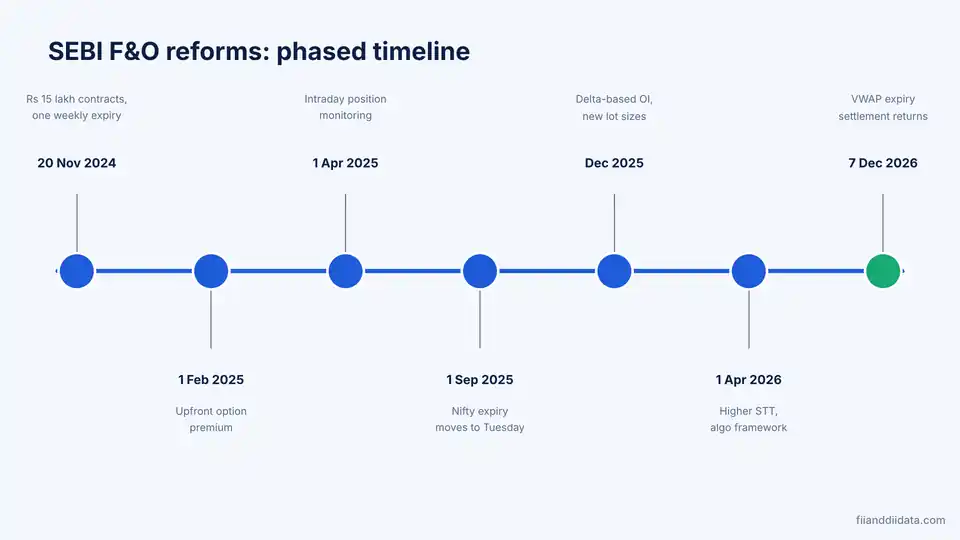
The rules did not arrive on one date, which is why so many traders are confused about what applies today. The chart and table below put each change in order.
| Change | Key number | Effective from |
|---|---|---|
| Minimum index contract value | ₹15 lakh (band ₹15 to 20 lakh) | 20 Nov 2024 |
| Extra ELM on expiring short options | 2% | 20 Nov 2024 |
| Upfront option premium | 100% of premium | 1 Feb 2025 |
| Weekly expiry days | Nifty Tuesday, Sensex Thursday | 1 Sep 2025 |
| Index options intraday net limit | ₹5,000 crore per entity | 1 Oct 2025 |
| Nifty / Bank Nifty lot size | 65 / 30 | January 2026 contracts |
| STT on futures / options premium | 0.05% / 0.15% | 1 Apr 2026 |
| Retail algo trading | Registered app and static IP | 1 Apr 2026 |
| Expiry settlement | Last 30-minute VWAP | 7 Dec 2026 |
Knowing the dates is only half the job. The bigger question for most readers is what all this does to the cost of a single trade.
What the New Rules Cost: A Worked Example
Assume Nifty is at 25,000. This is a round number for illustration, not a forecast. With a lot size of 65, one Nifty futures lot is worth 25,000 × 65 = ₹16.25 lakh, inside the ₹15 to 20 lakh band.
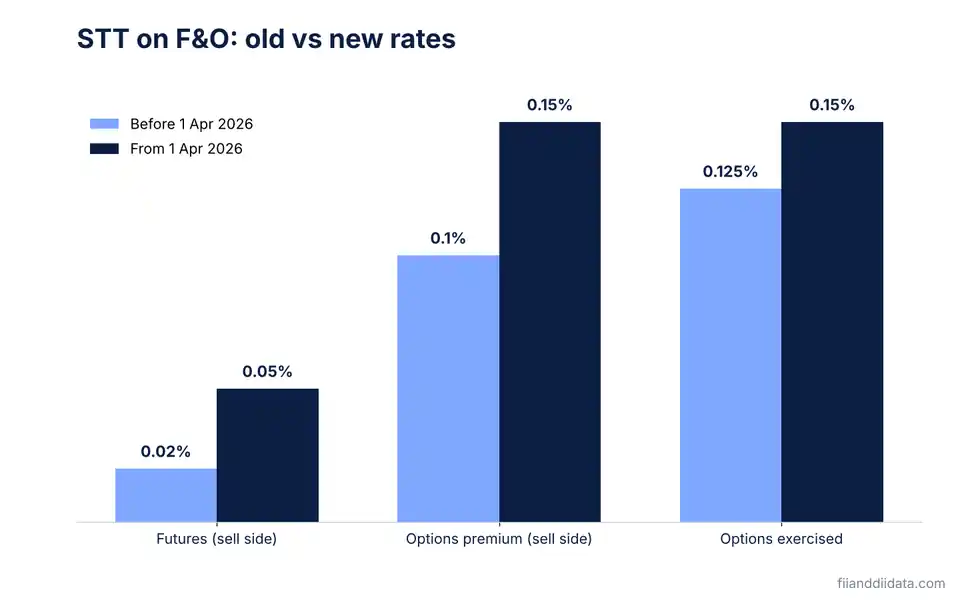
- Futures: STT is charged on the sell side. At 0.05%, one round trip costs ₹16,25,000 × 0.05% = ₹812.50. At the old 0.02% it was ₹325. That is ₹487.50 more per lot.
- Active futures trader: someone doing 200 lot round trips a year now pays about ₹1,62,500 in STT, against ₹65,000 before. The extra ₹97,500 has to come out of profits.
- Options seller: selling one lot at a premium of ₹120 means turnover of 120 × 65 = ₹7,800. STT at 0.15% is ₹11.70, up from ₹7.80.
- Options buyer: buying two lots at ₹120 needs the full ₹15,600 in your account before the order is accepted, because of the upfront premium rule.
The lesson is that cost now depends more on how often you trade than on what you trade. Brokerage, exchange charges and GST come on top of these figures. Next, let us see how the rules show up in the data FIIs leave behind.
How the Rules Change FII and DII F&O Data
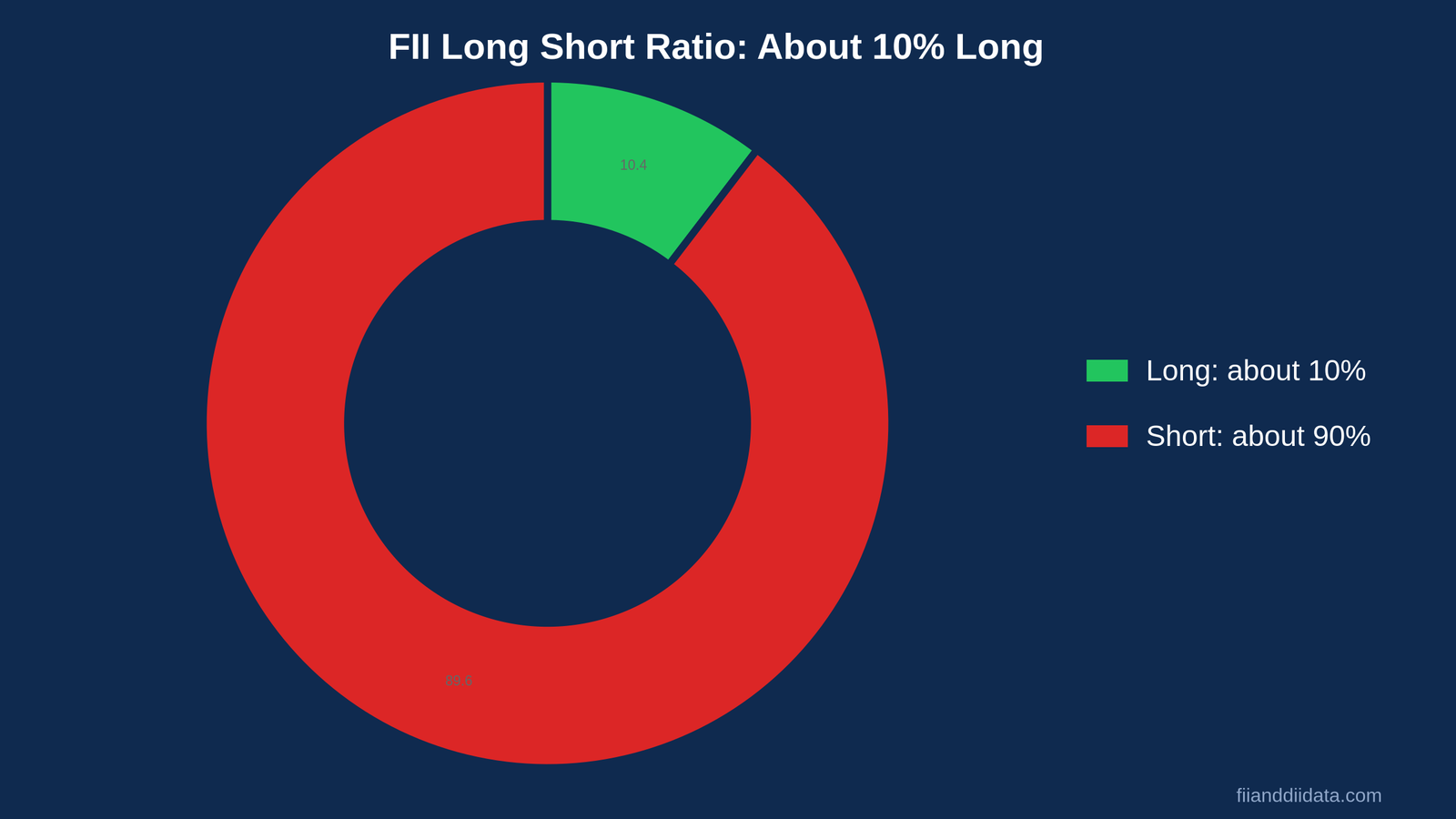
Larger lots mean the same rupee position shows up as fewer contracts. When you compare FII index futures contracts from 2024 with today, a fall in contract count does not always mean FIIs cut exposure. Always compare positions in value terms or as a ratio. This is why our FII long short ratio uses percentages rather than raw contract counts.
The weekly expiry shift also moves the noise. Big swings in client and pro option positions now cluster around Tuesday for Nifty. When you read the participant wise open interest data on a Tuesday evening, remember that expiring contracts drop out of the totals.
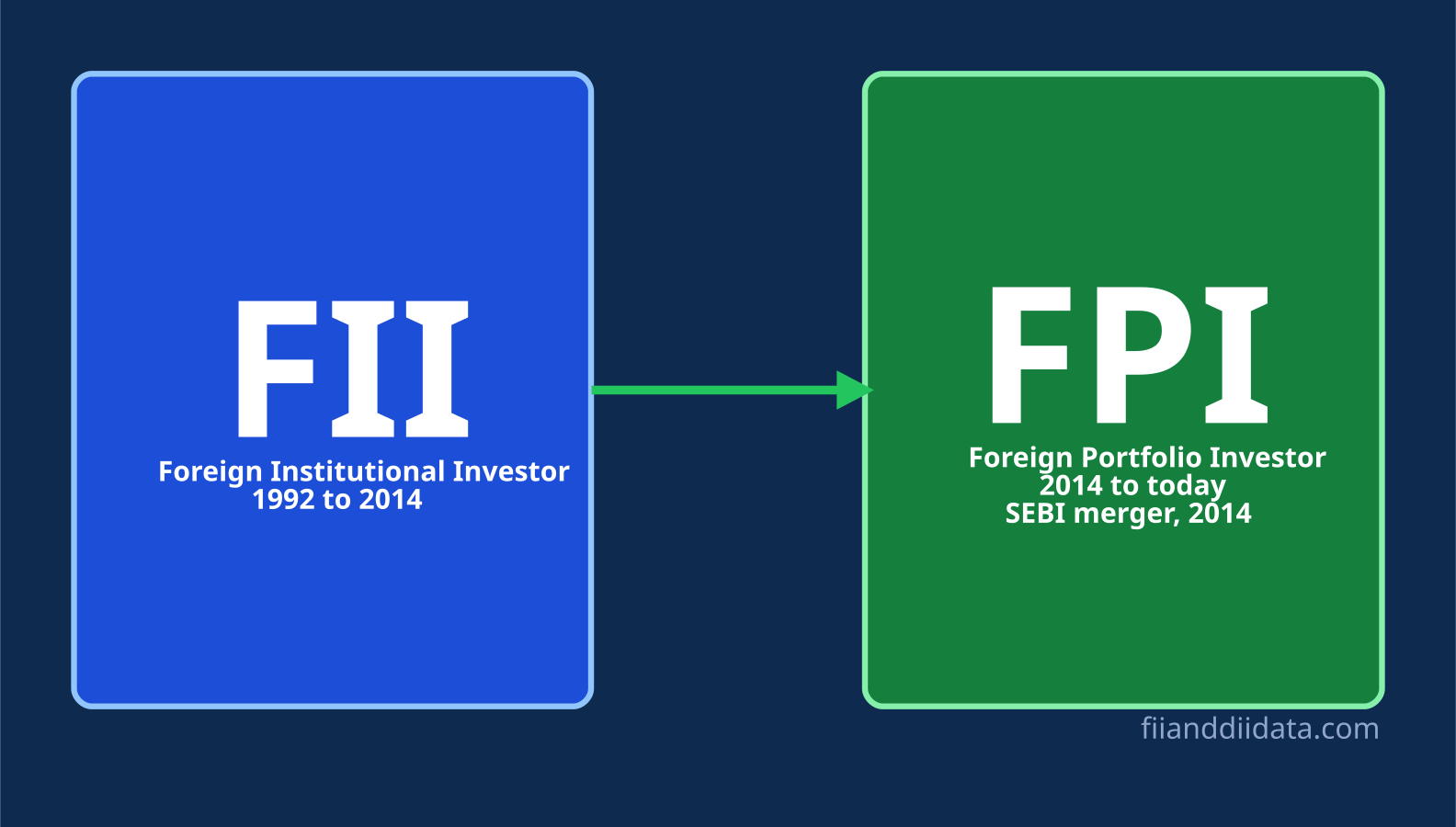
Intraday limits matter for large FPIs most of all. Category I foreign investors, explained in our FII vs FPI guide, can no longer build very large intraday option books and square them off before the close. For a daily view of how foreign money is positioned, track the FII DII F&O data under the SEBI new F&O rules and the FII options activity tracker side by side.
Checklist: How Traders Should Adjust
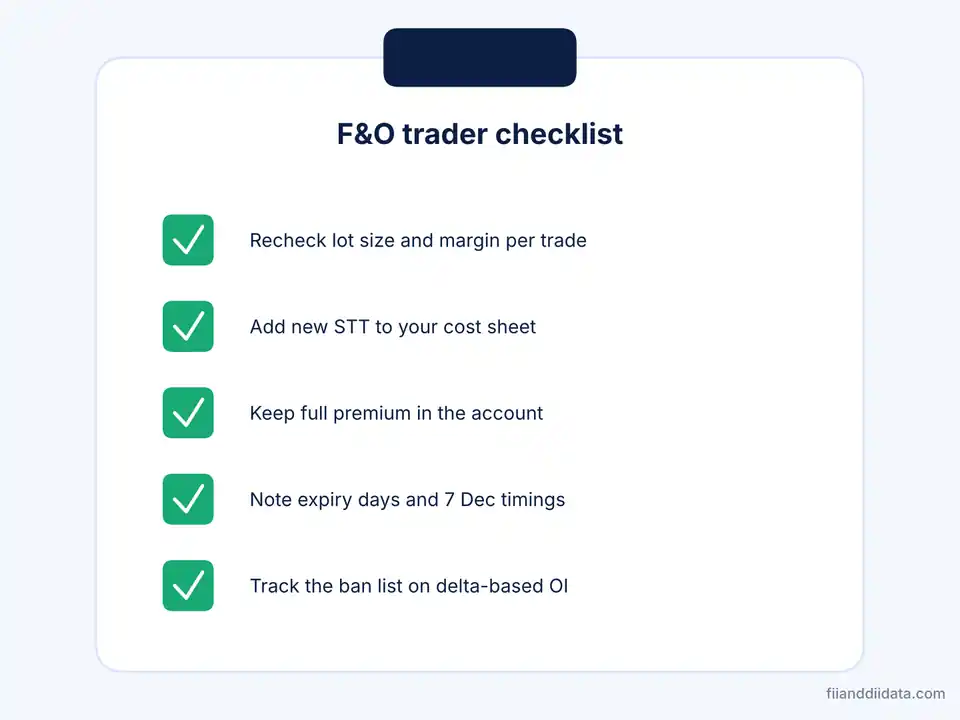
- Recalculate position size using the new lot (Nifty 65, Bank Nifty 30) and the margin your broker shows today, not last year’s numbers.
- Add the new STT rates to your trading cost sheet and check whether your average profit per trade still covers all charges.
- Keep the full option premium in your account before you place a buy order.
- Mark Tuesday (Nifty) and Thursday (Sensex) as expiry days, and note that from 7 December 2026 expiring index contracts stop at 3:30 PM.
- If you sell options on expiry day, budget for the extra 2% ELM and no calendar spread benefit.
- Track the F&O ban list using delta-based OI, since a stock can now enter or leave the ban differently than it used to.
- If you run an algo through an API, confirm your static IP and app registration with your broker.
Most of these take ten minutes. Skipping them is where the real cost lies, as the next section shows.
Common Mistakes Traders Make With the New Rules
Assuming the closing auction sets expiry prices. Many explainers written in August 2026 say CAS decides settlement. From 7 December 2026 that is no longer true. Expiry settles on the 30-minute VWAP, while CAS only sets the daily closing price of the underlying stocks.
Comparing old and new contract counts. A Nifty lot was 25 units before November 2024, then 75, and is now 65. Comparing raw lot counts across these periods gives a false picture of open interest trends.
Ignoring STT on losing trades. Because STT is on turnover, a trader who churns many small losing trades pays more tax than one who trades less and holds longer.
Thinking weekly options have gone. They have not. Only one index per exchange keeps them. Nifty and Sensex weekly contracts still trade every week.
Frequently Asked Questions
What are the SEBI new F&O rules 2026 in simple terms?
They are a set of derivatives reforms rolled out between November 2024 and December 2026. Contracts are bigger (about ₹15 lakh minimum), each exchange has one weekly expiry, premiums are collected upfront, positions are monitored intraday, open interest is measured on a delta basis, STT is higher from 1 April 2026, and expiry settlement returns to a 30-minute VWAP from 7 December 2026.
What is the Nifty lot size now?
The Nifty lot size is 65 units for January 2026 and later contracts, down from 75. Bank Nifty is 30, Fin Nifty 60, Midcap Nifty 120 and Nifty Next 50 is 25, as reported by Business Standard on 31 December 2025.
How much STT is charged on F&O from April 2026?
From 1 April 2026, STT is 0.05% on the sell side of futures (was 0.02%), 0.15% on the sell-side options premium (was 0.1%) and 0.15% on exercised options (was 0.125%). It applies to turnover, so it is charged on losing trades too.
When will the new F&O expiry settlement method start?
Under SEBI’s circular of 15 October 2026, expiring stock and index derivatives will settle on the volume weighted average price of the last 30 minutes of continuous trading from 7 December 2026. Expiring index contracts will stop trading at 3:30 PM on expiry day.
Is weekly expiry still allowed in India?
Yes, but only on one benchmark index per exchange. Nifty weekly contracts expire on Tuesday on NSE and Sensex weekly contracts expire on Thursday on BSE, a schedule in place since 1 September 2025. Other indices such as Bank Nifty have monthly expiries only.
The Bottom Line
The SEBI new F&O rules 2026 do not ban anything. They raise the ticket size, the tax and the paperwork, so that frequent small bets cost more and expiry day is harder to game. For a disciplined trader with proper position sizing, the changes are manageable. For someone running dozens of trades a day on thin margins, the maths has turned sharply against them.
Our practical next step: before 7 December 2026, rework your trading cost sheet with the new STT and lot sizes, then compare it with your last three months of results. Keep an eye on the daily FII DII cash market summary and our blog for updates as the settlement change takes effect.
Sources: Business Standard, SEBI’s six F&O measures (1 October 2024); Business Standard, intraday position limits (3 September 2025); Outlook Money, STT hike (31 March 2026); Outlook Money, SEBI restores VWAP settlement (16 October 2026). Also Business Standard reports of 30 May 2025, 7 July 2025 and 31 December 2025, the Fyers notice board on F&O and algo rules, and News On AIR (1 September 2025).
Disclaimer: This article is for educational purposes only and is not investment advice. Please consult a SEBI-registered advisor before making investment decisions.