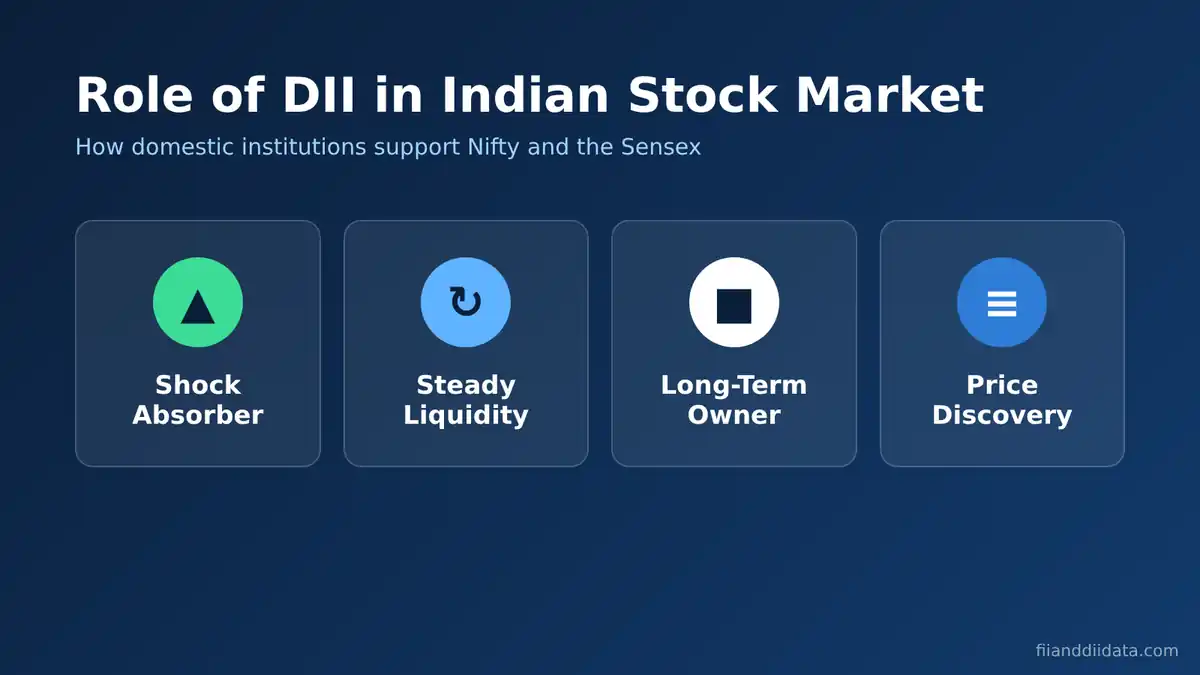
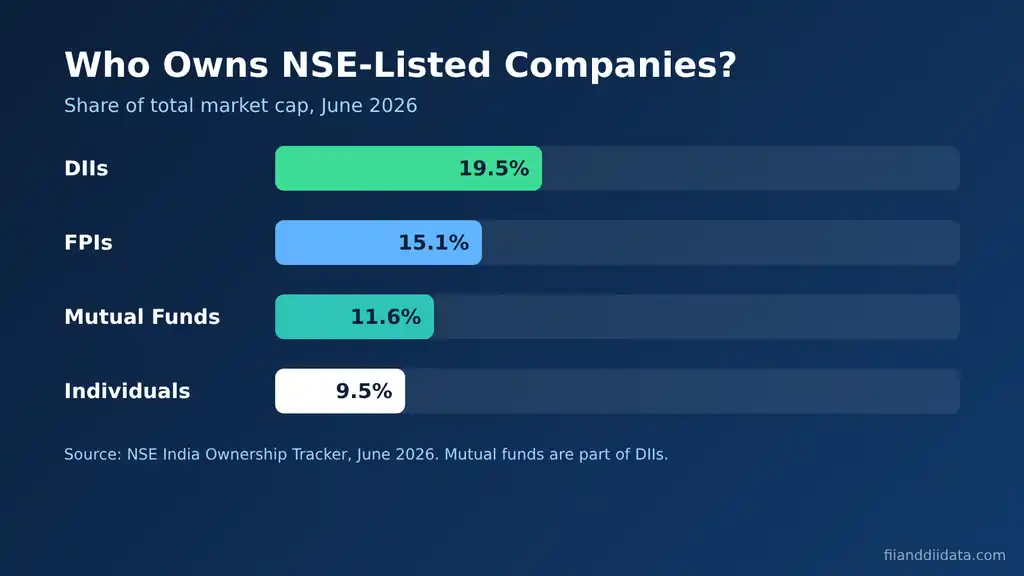
The role of DII in Indian stock market is to act as the steady domestic buyer that absorbs foreign selling, supplies liquidity and holds Indian companies for the long term. That role is now bigger than ever: in June 2026, domestic institutions owned 19.5% of NSE-listed companies against just 15.1% for foreign portfolio investors, the widest gap since 2001, according to NSE. Here is what DIIs do, where their money comes from, and how to read their data.
Key Takeaways
- DIIs are Indian institutions such as mutual funds, insurers, banks and pension funds that invest pooled domestic savings.
- Their five main jobs: absorb FII selling, supply liquidity, own companies long term, support price discovery and channel household savings into equities.
- DIIs held 19.5% of NSE-listed companies in June 2026, ahead of FPIs (15.1%) for a seventh straight quarter.
- Monthly SIP inflows hit a record ₹32,490 crore in September 2026, which keeps the DII buying engine running.
- DIIs are not one-way buyers: in the week of 2 to 6 November 2026 they sold a net ₹24,197 crore while FIIs bought.
Table of contents
- What Is a DII?
- Who Are the DIIs? The Main Types
- Role of DII in Indian Stock Market: 5 Key Functions
- Latest Data: DII Ownership and Flows in 2026
- How DIIs Absorb FII Selling: A Worked Example
- When DIIs Turn Sellers
- Using the Role of DII in Indian Stock Market: A Checklist
- Common Mistakes When Reading DII Data
- Frequently Asked Questions
- The Bottom Line
What Is a DII?
DII stands for Domestic Institutional Investor. It is an institution registered in India that invests money pooled from Indian savers, policyholders or depositors into Indian financial markets. A retail investor buys shares with personal savings. A DII buys with money that millions of people have handed to it, which is why its trades are large enough to move prices.
DIIs sit on the opposite side of Foreign Institutional Investors (FIIs), now formally called Foreign Portfolio Investors (FPIs). If you want the full definition and a side-by-side comparison, read our guide on DII meaning and the difference between FII and DII. In this article we focus on what DIIs actually do for the market.
Exchanges publish DII buying and selling every trading day after market close. NSE releases provisional cash-market figures around 6 PM IST, and you can follow them on our FII and DII data dashboard. Before reading those numbers, it helps to know who sits inside the DII bucket.
Who Are the DIIs? The Main Types
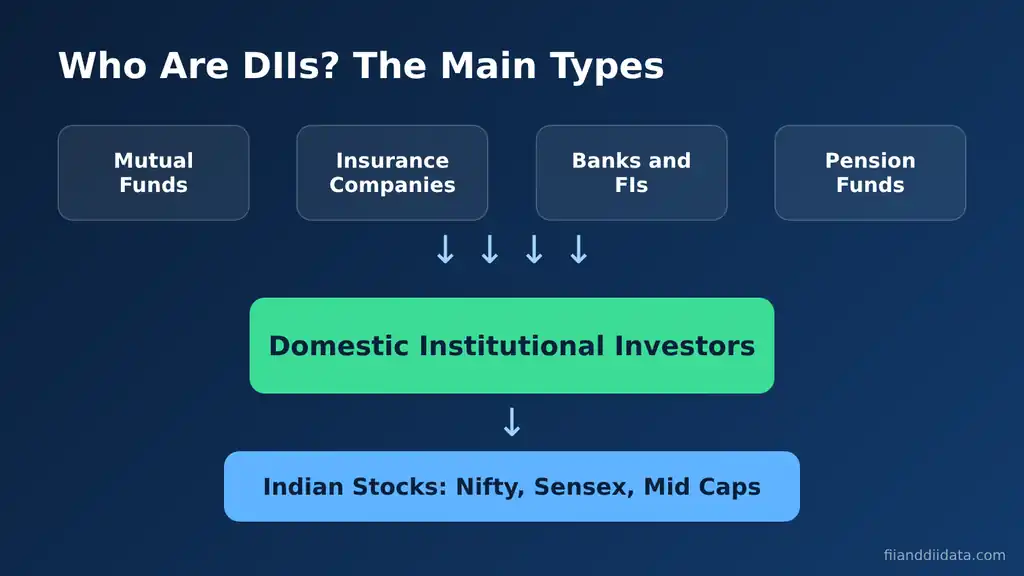
The DII category is not one investor. It is a group of institutions with very different reasons for buying stocks. The four main types are listed below.
| DII type | Where the money comes from | Typical behaviour |
|---|---|---|
| Mutual funds | SIPs and lump-sum investments by individuals | Must deploy fresh inflows; the most active daily buyers |
| Insurance companies (including LIC) | Life and general insurance premiums | Very long horizon; favour large, liquid stocks |
| Banks and financial institutions | Deposits and own balance sheet | Invest part of their funds in shares alongside bonds |
| Pension and provident funds | Retirement contributions (NPS, EPFO) | Steady, rule-based allocation to equity |
Mutual funds dominate this group. NSE data shows domestic mutual funds alone held a record 11.6% of NSE-listed market capitalisation in June 2026, out of the 19.5% held by all DIIs. Insurers such as LIC form much of the rest; we track LIC portfolio moves separately in LIC buying stocks 2026.
Each of these institutions buys for its own reasons, but together they perform five clear functions in the market.
Role of DII in Indian Stock Market: 5 Key Functions
1. Shock absorber when FIIs sell
This is the role most traders notice. Foreign funds sell India for global reasons: a rising US dollar, higher US bond yields, or better value in other emerging markets. When that happens, someone has to take the other side of the trade. In the June 2026 quarter, FPIs pulled out US$15.1 billion, their largest quarterly outflow on record, while DIIs bought a net US$23.2 billion, NSE data shows. Without that domestic bid, the fall in Nifty would have been far sharper. Our tracker of FII selling vs DII buying in 2026 shows this pattern month by month.
2. Steady source of liquidity
Liquidity means you can buy or sell a stock quickly without moving its price much. Mutual funds receive SIP money every month whether markets rise or fall, so they buy on most trading days. That regular flow narrows spreads and keeps large-cap and mid-cap counters tradable, even on days when foreign desks are absent.
3. Long-term owner of Indian companies
Insurers and pension funds plan for liabilities that are 10 to 30 years away. They do not need to sell when a quarter disappoints. This patient capital gives companies a stable shareholder base and reduces the share of free float that can be dumped in a panic.
4. Price discovery and corporate governance
DIIs employ research teams that value businesses and vote at shareholder meetings. Their buying and selling helps push prices toward fair value, and their votes can block resolutions that hurt minority shareholders. As their stake grows, so does their voice in boardrooms.
5. Channel for household savings
DIIs turn small monthly savings into equity ownership. NSE estimates that individuals, including holdings through mutual funds, owned a record 19.3% of NSE-listed companies in June 2026, ahead of FPIs for seven straight quarters. That shift began in 2024, after nearly two decades of foreign dominance. Next, let us look at the numbers behind these roles.
Latest Data: DII Ownership and Flows in 2026
The table below collects the most recent verified figures on DII ownership and flows. Each row carries its own date, because ownership data is quarterly while flow data is monthly or daily.
| Metric | Value | Period |
|---|---|---|
| DII ownership, NSE-listed companies | 19.5% | June 2026 |
| FPI ownership, NSE-listed companies | 15.1% (lowest in 69 quarters) | June 2026 |
| Domestic mutual fund ownership | 11.6% (record high) | June 2026 |
| DII net purchases | US$23.2 billion | April to June 2026 |
| Mutual fund net equity investment | ₹1.42 lakh crore (21st straight quarter of inflows) | April to June 2026 |
| DII vs FII share of Nifty 50 | 25.8% vs 22.1% | September 2026 quarter |
| Monthly SIP inflow | ₹32,490 crore (record) | September 2026 |
| Equity mutual fund net inflow | ₹38,306.55 crore | September 2026 |
Two points stand out. First, the DII-FPI ownership gap of 4.4 percentage points in June 2026 is the widest since NSE began this analysis in March 2001. Second, the trend continued into the September 2026 quarter: Elara Securities data reported by CNBC-TV18 shows DIIs owned 25.8% of the Nifty 50 against 22.1% for FIIs, a 16-quarter low for foreign investors.
The fuel behind this is retail money. Monthly SIP inflows rose to a record ₹32,490 crore in September 2026 from ₹32,297 crore in August, as AMFI data reported by Kotak Neo shows. Our SIP inflow September 2026 report covers the full breakdown.
Ownership numbers tell you who holds the market. To see how DIIs cushion a bad day, it helps to work through the arithmetic.
How DIIs Absorb FII Selling: A Worked Example
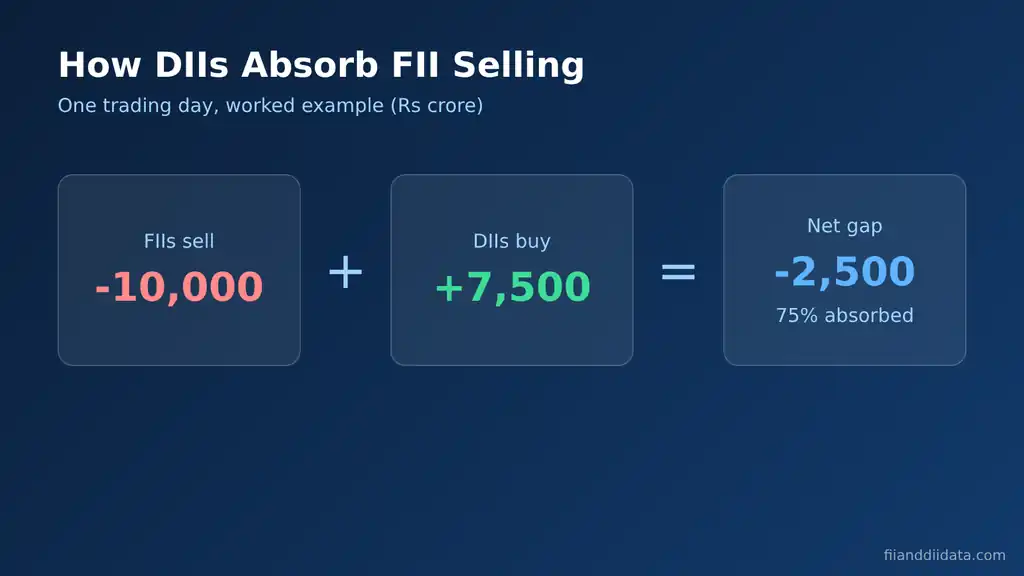
Suppose on one trading day FIIs are net sellers of ₹10,000 crore in the cash market and DIIs are net buyers of ₹7,500 crore. Here is how to read it.
- Net institutional flow: -₹10,000 crore + ₹7,500 crore = -₹2,500 crore.
- Absorption ratio: ₹7,500 crore / ₹10,000 crore = 75%. DIIs took up three-quarters of the foreign supply.
- Who covers the gap: the remaining ₹2,500 crore has to be bought by retail investors, HNIs or proprietary traders, usually at lower prices.
- Likely market effect: a mild decline rather than a sharp fall. If DIIs had bought only ₹2,000 crore, the gap would be ₹8,000 crore and the pressure much heavier.
Real data follows the same logic. On 9 October 2026, FIIs sold ₹3,568.90 crore while DIIs bought ₹4,743.26 crore, so domestic buying covered about 133% of foreign selling and the institutional net was positive. A ratio above 100% usually signals that domestic money is fully in control of that session.
The example assumes DIIs are buyers. That is common, but not guaranteed, as the latest week shows.
When DIIs Turn Sellers
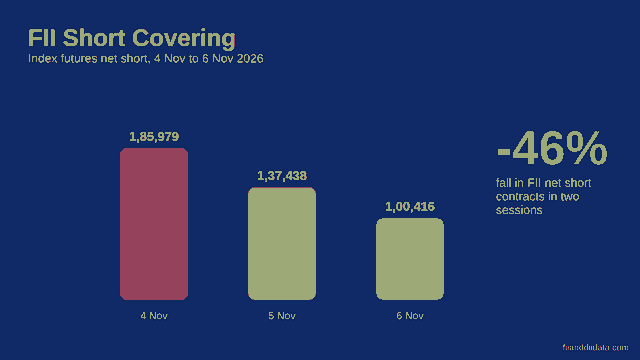
DIIs also sell, usually when markets rally and foreign money returns. In the first week of November 2026, the roles reversed. According to NSE provisional figures compiled by StockPil, FIIs bought a net ₹45,960 crore between 2 and 6 November 2026, while DIIs sold a net ₹24,197 crore. The biggest day was 5 November, when FIIs bought ₹14,975 crore and DIIs sold ₹10,445 crore.
Why would a long-term investor sell into strength? There are three common reasons:
- Profit booking and rebalancing: fund managers trim stocks that have run up to bring weights back to target.
- Redemptions: when investors withdraw money from equity funds, the fund has to sell shares to pay them.
- Supplying stock to buyers: large FII buying needs a seller on the other side, and DIIs with big inventories are natural suppliers.
So the role of DIIs is better described as a balancing force than a permanent buyer. They lean against extreme moves in both directions. The next section turns this into a practical checklist.
Using the Role of DII in Indian Stock Market: A Checklist
Daily DII figures are useful only when read in context. Use this checklist before you act on them:
- Read DII and FII together. A DII buy of ₹3,000 crore means little on its own. Compare it with FII selling the same day on our FII DII data today page.
- Calculate the absorption ratio. Divide DII net buying by FII net selling. Above 100% is supportive; below 50% means retail is taking most of the hit.
- Look at the five-day and monthly trend. Single days are noisy. Our FII DII monthly data page shows whether DII support is building or fading.
- Check the SIP pipeline. Rising monthly SIP inflows suggest DIIs will keep having cash to deploy.
- Watch the price reaction. If DIIs buy heavily but Nifty still falls, selling pressure is stronger than the support.
- Confirm with final data. NSE numbers are provisional. NSDL publishes final FPI figures on the next working day.
Even with a checklist, a few errors come up again and again.
Common Mistakes When Reading DII Data
- Assuming DIIs set a floor under Nifty. DIIs slow declines; they do not stop them. If redemptions rise in a deep correction, mutual funds may have less cash, not more.
- Treating DII selling as bearish by default. As November 2026 showed, DII selling often means profit booking into foreign buying, not a vote against India.
- Ignoring the stock-level picture. Aggregate DII flows hide sector rotation. A DII net buy can include heavy selling in one sector.
- Mixing up ownership and flows. Ownership (19.5%) is a stock figure that changes slowly. Daily flows are small slices that swing every session.
- Calling the data live. FII and DII figures are published after market close, around 6 PM IST, not in real time.
Below are short answers to the questions investors ask most often about DIIs.
Frequently Asked Questions
What is the role of DII in Indian stock market?
DIIs absorb foreign selling, provide daily liquidity, hold companies for the long term, support price discovery and channel household savings into equities. In June 2026 they owned 19.5% of NSE-listed companies, more than FPIs at 15.1%.
Who are the biggest DIIs in India?
Domestic mutual funds as a group are the largest DII category, holding 11.6% of NSE-listed market capitalisation in June 2026 out of 19.5% for all DIIs. Insurance companies such as LIC, banks, financial institutions and pension funds make up the rest.
Can DIIs stop the market from falling?
No. DII buying can slow a fall by absorbing part of the foreign selling, but if selling is heavier than domestic buying, prices still drop. DIIs act as a cushion, not a floor.
Why do DIIs buy when FIIs sell?
Mutual funds receive SIP money every month and must invest it, and insurers and pension funds follow long-term allocation rules. When FIIs sell, prices fall and DIIs get the chance to buy at lower valuations.
Where can I check daily DII data?
NSE publishes provisional FII and DII cash market data around 6 PM IST on trading days. FIIAndDIIData.com summarises the daily, weekly and monthly figures in one place.
The Bottom Line
DIIs have moved from supporting actors to the largest institutional owners of Indian equities. Their steady SIP-funded buying absorbed record foreign outflows in 2026 and kept market falls orderly. That is a structural change, not a one-quarter story.
Still, DIIs are not a guarantee. They sell into rallies, they depend on retail inflows staying strong, and they cannot stop a fall driven by heavy global selling. Treat DII data as one input alongside price, earnings and FII positioning.
A practical next step: for the next 10 trading days, note FII and DII net figures each evening and calculate the absorption ratio. You will quickly see how much domestic support the market really has. For more explainers, browse the FIIAndDIIData.com blog.
Sources: NSE India Ownership Tracker, June 2026; CNBC-TV18 (Elara Securities data), 5 November 2026; Kotak Neo (AMFI data), 12 October 2026; StockPil (NSE provisional data), 6 November 2026; 5paisa (NSE provisional data for 9 October 2026).
Disclaimer: This article is for educational purposes only and is not investment advice. Please consult a SEBI-registered advisor before making investment decisions.