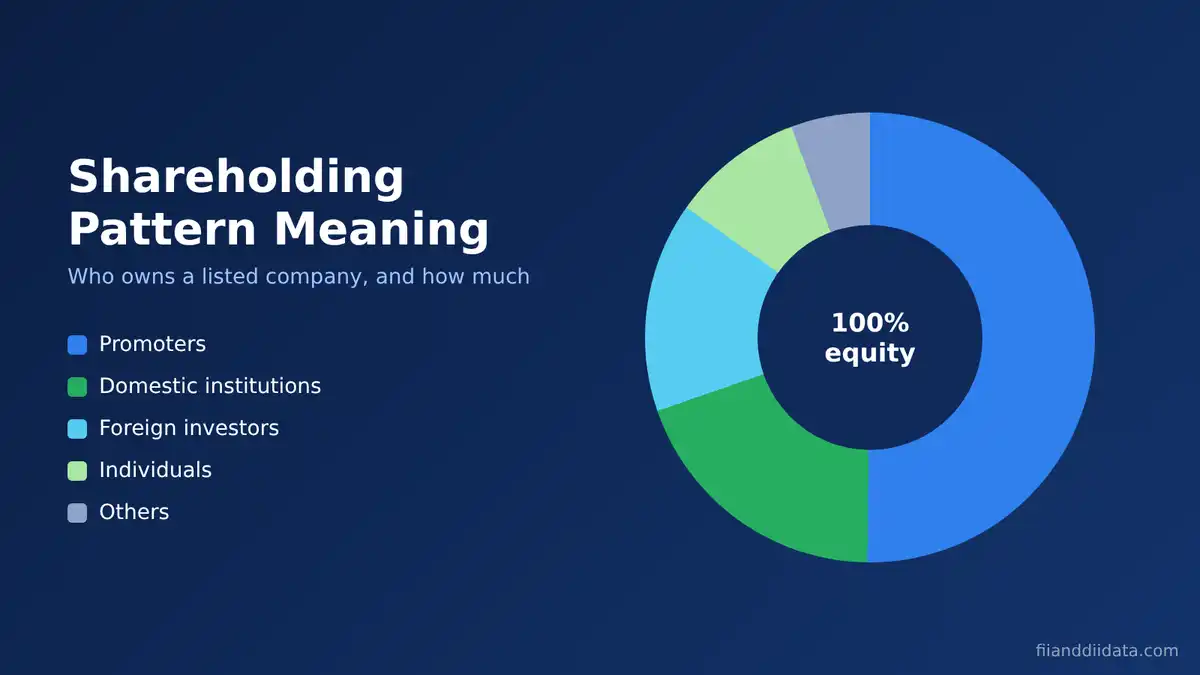
FII buying banking stocks is the single flow that moves Bank Nifty and Nifty the most, because financials make up nearly 40% of the Nifty. In 2026, though, foreign investors have mostly been sellers of Indian banks: they sold Rs 1,26,089 crore of financial stocks in the first 110 sessions of the year, and their stake in HDFC Bank fell to 39.39% by 30 September 2026. Here is how to read the data and spot when the buying returns.
Key Takeaways
- FPIs sold Rs 1,26,089 crore of financial stocks in the first 110 trading sessions of 2026, about 44% of all their equity selling in that period.
- The one strong buying burst came in 16-30 June 2026, when FPIs bought Rs 14,634 crore of financials, the highest fortnightly figure in 14 months.
- Selling slowed sharply in late October: Financial Services outflow fell to Rs 883 crore in 16-31 October from Rs 8,634 crore in 1-15 October.
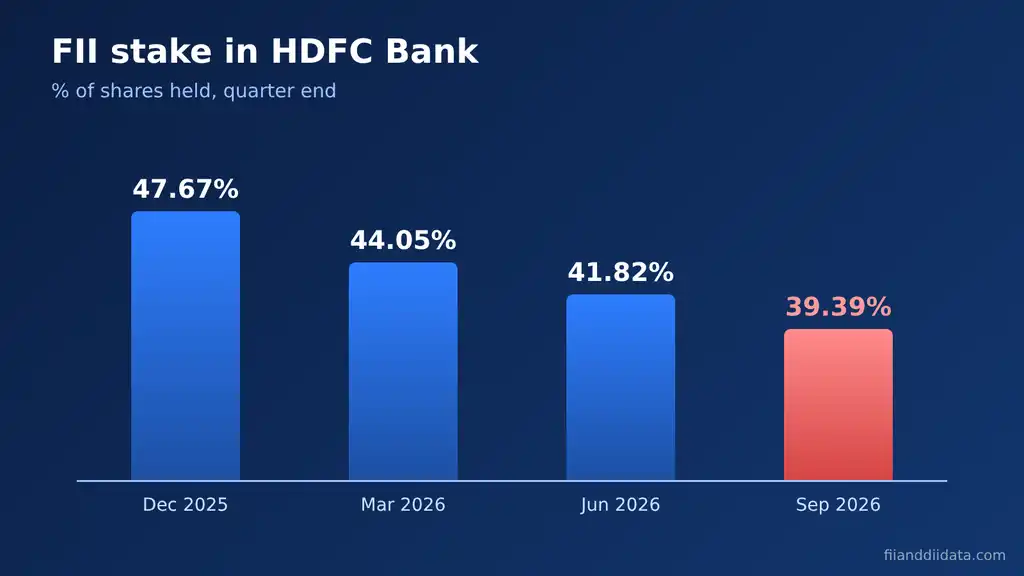
- FII stake in HDFC Bank dropped from 47.67% in December 2025 to 39.39% in September 2026, while mutual funds raised theirs.
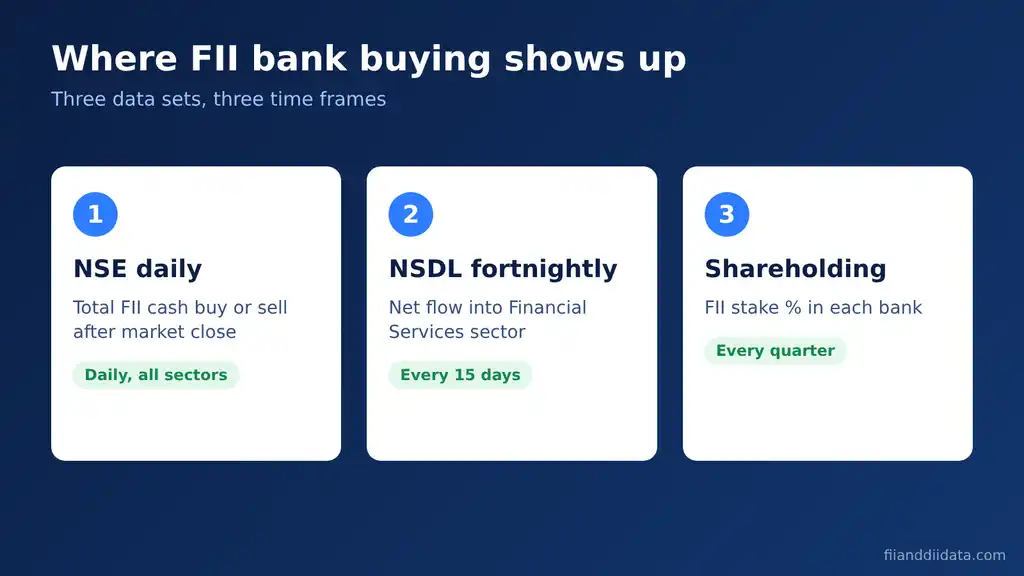
- Track three data sets together: NSE daily cash data, NSDL fortnightly sector data and quarterly shareholding.
In this article
- What FII Buying Banking Stocks Means
- Why Foreign Investors Care So Much About Indian Banks
- How to Track FII Buying Banking Stocks: Three Data Sets
- FPI Flows Into Financial Services in 2026
- Bank by Bank: Where FII Stakes Moved
- What Could Bring FIIs Back to Bank Stocks
- Checklist and Common Mistakes
- FAQs
- The Bottom Line
What FII Buying Banking Stocks Means
Foreign institutional investors (FIIs), now officially called foreign portfolio investors (FPIs) by SEBI, are overseas funds that buy listed Indian shares. When we say FIIs are buying banking stocks, we mean their net purchases (buys minus sells) in bank and financial shares are positive over a given period. A single day of buying means little. A run of fortnights or a rising stake over quarters means a lot more.
In practice, “banking” in flow data usually sits inside a wider bucket. NSDL reports a sector called Financial Services, which includes private banks, PSU banks, NBFCs, insurers and capital market companies. Banks are the largest part of that bucket, so it is the best public proxy for foreign money moving in or out of Indian banks.
You can see the overall daily picture on our FII and DII data dashboard. To understand why banks matter so much, start with how big they are in the index.
Why Foreign Investors Care So Much About Indian Banks
Banks are the easiest way for a global fund to own the India growth story. They are large, liquid and heavily weighted. Financials account for nearly 40% of the Nifty, according to a Kotak Neo report dated 7 July 2026. When a fund wants to add or cut India exposure quickly, banks are usually the first stocks it trades.
That same liquidity cuts both ways. An Outlook Business report dated 24 June 2026 noted that banks became the easiest exit when foreign money rotated towards AI-linked markets such as the US, Taiwan and South Korea. Financials made up about 44% of the Rs 2.88 lakh crore FPI outflow across sectors in that phase.
- Index weight: big bank moves shift Nifty and Bank Nifty directly.
- Liquidity: large orders can be filled without moving prices too much.
- Macro link: banks track credit growth, interest rates and the rupee, which FIIs watch closely.
- Ownership limits: foreign holding caps in banks mean flows can hit a ceiling in some stocks.
Our post on the sectors FIIs sold in 2026 shows how financials compared with IT, oil and FMCG. Next, let us look at where bank-specific buying actually shows up.
How to Track FII Buying Banking Stocks: Three Data Sets
No single report tells you everything. Each source answers a different question, at a different speed.
1. NSE daily provisional cash data
NSE publishes provisional FII and DII cash market figures around 6 PM IST on each trading day. It shows the total net buy or sell, not the sector split. Use it to judge the overall mood, then check FII DII data today for the latest figure.
2. NSDL fortnightly sector-wise data
NSDL publishes sector-wise FPI investment every fortnight, for the 1st to 15th and the 16th to month end. This is the only regular public source that shows net flows into Financial Services. It arrives a few days after each fortnight ends, so it confirms a trend rather than predicting it.
3. Quarterly shareholding pattern
Every listed bank discloses who owns its shares at the end of each quarter. This tells you which individual banks FIIs added or trimmed. Our guide to the FII shareholding pattern explains how to read the filing on NSE or BSE.
Traders also watch FII positions in Bank Nifty futures for a short-term read. You can follow that on our FII index futures data page. With these sources in mind, here is what the 2026 numbers actually say.
FPI Flows Into Financial Services in 2026: The Latest Data
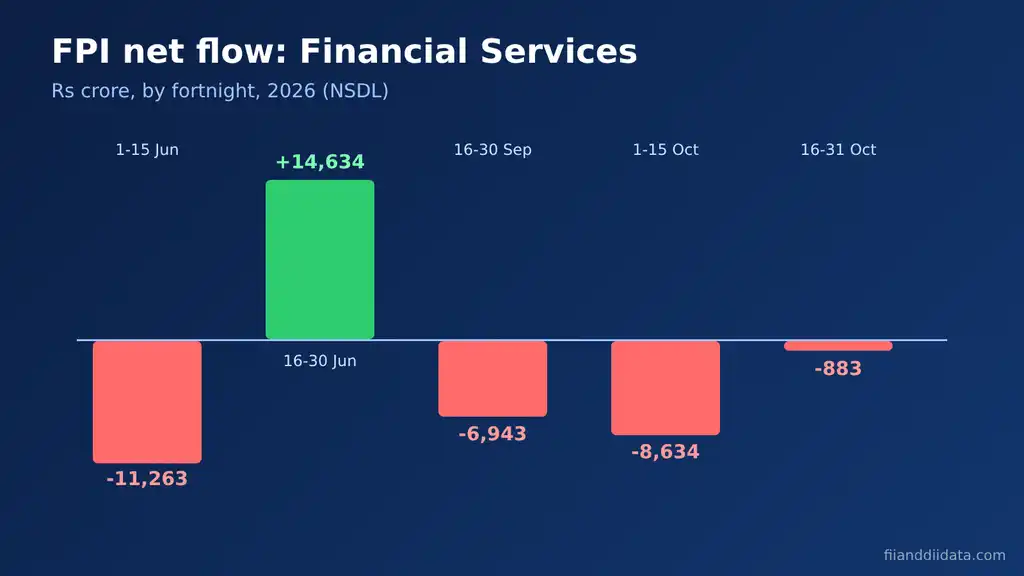
The table below collects the fortnightly Financial Services figures we could verify from published reports of NSDL data. Negative numbers mean net selling.
| Period (2026) | FPI net flow in Financial Services | Context |
|---|---|---|
| 1-15 June | -Rs 11,263 crore | Selling continued |
| 16-30 June | +Rs 14,634 crore | Highest fortnightly buying in 14 months |
| 16-30 September | -Rs 6,943 crore | Selling resumed |
| 1-15 October | -Rs 8,634 crore | Total FPI equity selling of Rs 47,955 crore |
| 16-31 October | -Rs 883 crore | Overall FPIs net bought Rs 13,112 crore |
Two things stand out. First, the June burst proves FIIs can turn into large buyers of banks quickly when conditions change. Second, the late-October number shows selling in financials almost stopped while foreign money poured into IT (Rs 10,915 crore) and telecom (Rs 11,065 crore) in the same fortnight. Banks were no longer the main exit, but they were not yet the main destination either.
Worked example: sizing FII buying banking stocks in rupees
Raw crore figures are hard to judge without a base. FPI holdings in Financial Services were about Rs 19.62 lakh crore at the end of October 2026, per NSDL data compiled by Craytheon. Compare each flow with that base:
- June second-half buying: 14,634 / 19,62,000 = about 0.75% of holdings in one fortnight.
- Late-October selling: 883 / 19,62,000 = about 0.05%, close to neutral.
- Net for June as a whole: 14,634 – 11,263 = Rs 3,371 crore of buying.
- September second half plus all of October: -6,943 – 8,634 – 883 = -Rs 16,460 crore.
So a fortnight of Rs 10,000 crore or more of buying is a meaningful shift, while a few hundred crore either way is noise. Now let us see how this showed up in individual banks.
Bank by Bank: Where FII Stakes Moved
Sector flows hide big differences between banks. In 2026, FIIs cut the large private lenders and added some smaller ones.
HDFC Bank: three straight quarters of cuts
FII holding in HDFC Bank was 47.67% in December 2025, 44.05% in March 2026, 41.82% in June 2026 and 39.39% in September 2026, according to Kotak Neo (8 October 2026). Over the same September quarter, mutual fund holding rose to 31.88% from 30.62%. The number of FIIs holding the stock fell to 3,465 from 3,560. The shares were down about 29% in 2026 at the time of that report.
Axis, ICICI and the smaller banks
In the June 2026 quarter (Q1 FY27), FII stake in Axis Bank fell 2.09 percentage points to 42.05% and in ICICI Bank by 0.69 points to 33.79%, per data reported by NiftyTrader on 14 August 2026. Federal Bank went the other way, with FII stake up 1.66 points to 27.71%. FIIs trimmed 17 banks in that quarter but raised stakes in 11 mid-sized and small private banks, including Karnataka Bank, South Indian Bank and DCB Bank.
This is why “FIIs are selling banks” can be true at the sector level while some bank stocks still see FII buying. Our list of stocks with the highest FII holding shows which large banks carry the most foreign ownership and so the most flow risk.
A falling stake does not always mean selling
Stake percentages can drop without a single FII share being sold. Suppose FIIs hold 40 crore shares of a bank that has 100 crore shares in total, a 40% stake. If the bank issues 5 crore new shares to domestic funds through a QIP, FIIs still own 40 crore shares, but their stake becomes 40 / 105 = 38.10%, a drop of 1.9 points. Always check the share count, not just the percentage.
So what could turn the large-bank selling into buying again?
What Could Bring FIIs Back to Bank Stocks
The June 2026 reversal gives a useful template. Reports at the time linked it to several factors working together:
- RBI measures: an extended forex swap facility for banks and permission to lend to non-residents against foreign currency deposits.
- Lower risk-off pressure: easing West Asia tensions from mid-June.
- Index rebalancing: part of the inflow came from the FTSE June review.
- Valuations: value buying after a sharp de-rating of the sector.
One policy item to watch now is foreign ownership limits. In a December 2025 Lok Sabha reply, the Finance Ministry said FDI limits were unchanged: 20% for public sector banks, and 49% through the automatic route for private banks, extendable to 74% with government approval. On 21 October 2026, the Free Press Journal reported that the Finance Ministry had drafted a Cabinet note to raise the PSU bank cap to 49%. That proposal had not been approved as of that report, so treat it as a possible trigger, not a done deal.
Global factors still matter most. Business Standard reported on 13 October 2026 that record FPI outflows of Rs 3.08 trillion in CY26 were driven by US 10-year yields above 5.2%, the AI trade abroad, Brent crude near $100 and a weak rupee. Banks will likely see sustained FII buying only when some of these pressures ease. Our running coverage of FII buying in November 2026 tracks whether the late-October turn is holding.
A Checklist for Reading FII Bank Flows, Plus Common Mistakes
Use this short routine before you act on any headline about FII buying banking stocks or selling them:
- Check the NSE daily cash figure for the overall direction over the last 5 to 10 sessions.
- Open the latest NSDL fortnightly report and find the Financial Services row.
- Compare that flow with total FPI holdings in the sector, as in the worked example above.
- Look at FII positions in Bank Nifty futures for short-term positioning.
- At quarter end, check the shareholding pattern of the specific bank you own or trade.
- Note what DIIs did in the same period, since mutual funds have absorbed much of the FII selling in 2026.
Common mistakes
- Treating one day as a trend. A single big buy day can come from a block deal or index event.
- Reading Financial Services as banks only. The NSDL bucket also covers NBFCs, insurers and brokers.
- Ignoring the base. Rs 2,000 crore sounds large but is a small share of nearly Rs 20 lakh crore in holdings.
- Missing dilution. A lower stake percentage may come from new share issues, not selling.
- Mixing up sources. NSE provisional and NSDL figures differ in timing and coverage, so do not compare them line by line.
The questions below are the ones readers ask most often about this topic.
FAQs
Is FII buying banking stocks a bullish sign for Bank Nifty?
Usually yes, if it lasts. Banks carry a large weight in Bank Nifty and Nifty, so sustained net buying over several fortnights tends to support prices. A single day or a single fortnight can reverse quickly, so look for repeat buying in NSDL data and rising FII stakes in shareholding filings.
Why did FIIs sell Indian bank stocks in 2026?
Reports linked the selling to high US bond yields, global money moving to AI-linked markets such as the US, Taiwan and South Korea, high crude prices, a weak rupee and rich valuations. Banks are large and liquid, so they were the easiest way for funds to cut India exposure.
How can I check FII holding in a bank stock?
Open the bank’s quarterly shareholding pattern on the NSE or BSE website, or on the bank’s investor relations page. The foreign portfolio investor line shows the FII stake. Compare it with the previous quarter and check the total share count for any dilution.
What is the foreign investment limit in Indian banks?
As per the Finance Ministry’s December 2025 reply in the Lok Sabha, the limit is 20% for public sector banks and 49% through the automatic route for private banks, which can go up to 74% with government approval. A proposal to raise the PSU bank cap to 49% was reported in October 2026 but was not yet approved.
How often does NSDL publish sector-wise FPI data?
NSDL publishes sector-wise FPI investment data every fortnight, covering the 1st to the 15th and the 16th to the end of each month. It usually appears a few days after the fortnight ends.
The Bottom Line
Foreign investors spent most of 2026 selling Indian banks, and the large private lenders took the biggest hit. The June burst of Rs 14,634 crore and the near-zero financials outflow in late October show that the selling is not one-way, but one good fortnight does not make a trend.
The practical step is simple: watch the next two NSDL fortnightly reports for the Financial Services row. If both show net buying, and the December quarter shareholding shows FII stakes rising in the big banks, the case for a real return gets much stronger. For more data-led explainers, browse the FIIAndDIIData.com blog.
Sources: NSDL FPI Monitor; Angel One, 6 November 2026; Kotak Neo, 8 October 2026; Business Standard, 13 October 2026; Kotak Neo (7 July 2026); Outlook Business (24 June 2026); NiftyTrader (14 August 2026); Craytheon sector flows; Free Press Journal (21 October 2026); Angel One (3 December 2025).
Disclaimer: This article is for educational purposes only and is not investment advice. Please consult a SEBI-registered advisor before making investment decisions.