The list of stocks FII exited 2026 is longer than most investors realise: foreign investors cut their holding in 21 of the 50 Nifty companies in every one of the March, June and September 2026 quarters, according to an Economic Times analysis published on 2 November 2026. HDFC Bank, Max Healthcare, HDFC Life, InterGlobe Aviation and Kotak Mahindra Bank saw some of the deepest cuts. This guide shows the data, explains the difference between a full exit and a trim, and gives you a checklist to use before you react.
Key Takeaways
- FIIs reduced their stake in 21 Nifty 50 stocks in all three quarters of 2026 reported so far (March, June and September).
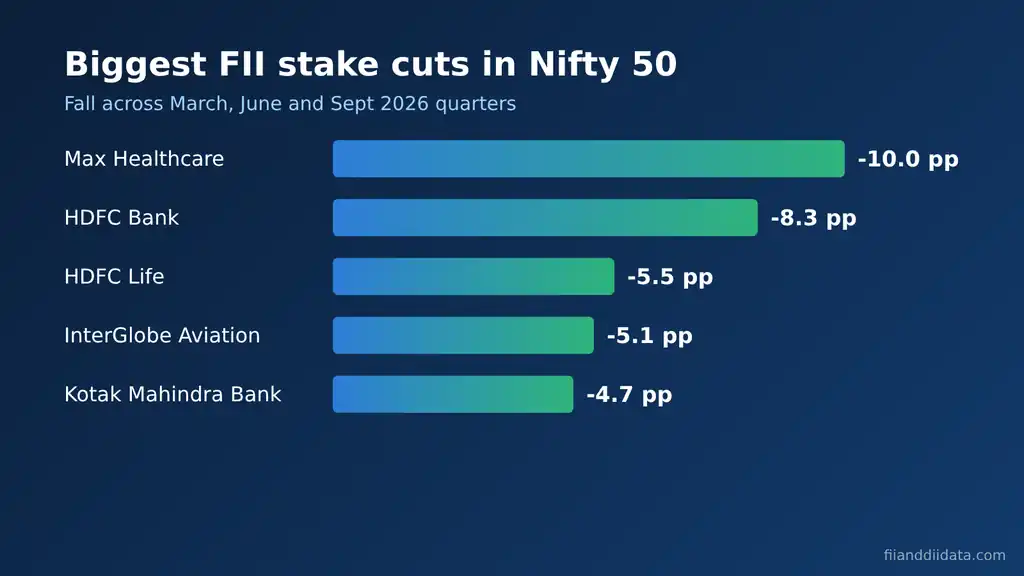
- Max Healthcare (-10.0 points), HDFC Bank (-8.3), HDFC Life (-5.5), InterGlobe Aviation (-5.1) and Kotak Mahindra Bank (-4.7) saw the largest declines.
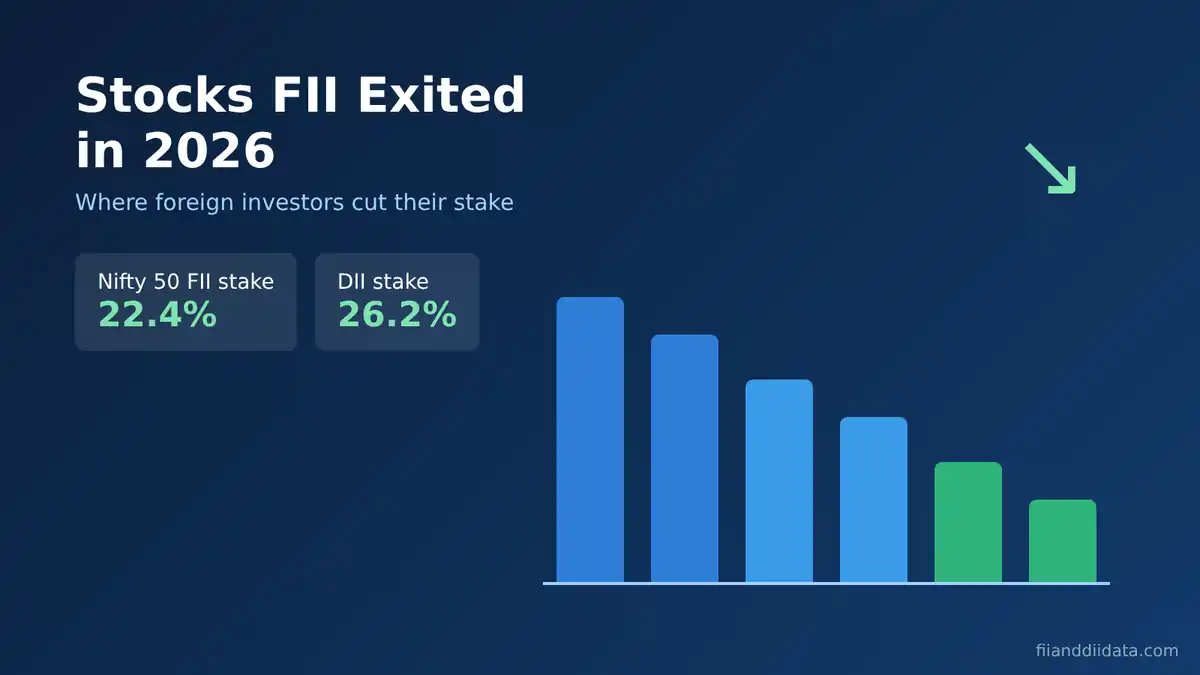
- FII ownership of the Nifty 50 fell to 22.4% in the September 2026 quarter, while DII ownership hit a record 26.2%.
- Most of these moves are trims, not full exits. True exits, where FII holding falls close to zero, are mostly found in small caps.
- A falling FII stake is a signal to investigate, not an automatic sell signal. Check share count, buyers and results first.
In this article
- What “FII exited” means in a shareholding pattern
- Stocks FII exited 2026: the Nifty 50 data
- HDFC Bank and ITC: two large-cap case studies
- Midcap and smallcap stocks FIIs left in 2026
- Why FIIs exited these stocks in 2026
- Exit, trim or dilution: a worked example
- How to use stocks FII exited 2026 data: a checklist
- Common mistakes when reading FII stake cuts
- Frequently asked questions
- The Bottom Line
What “FII Exited” Means in a Shareholding Pattern
Every listed company files a shareholding pattern with the stock exchanges at the end of each quarter. It splits ownership into promoters, foreign institutional investors (FIIs, officially called foreign portfolio investors or FPIs), domestic institutional investors (DIIs such as mutual funds and insurers) and the public. Our guide to the FII shareholding pattern explains each line of this filing.
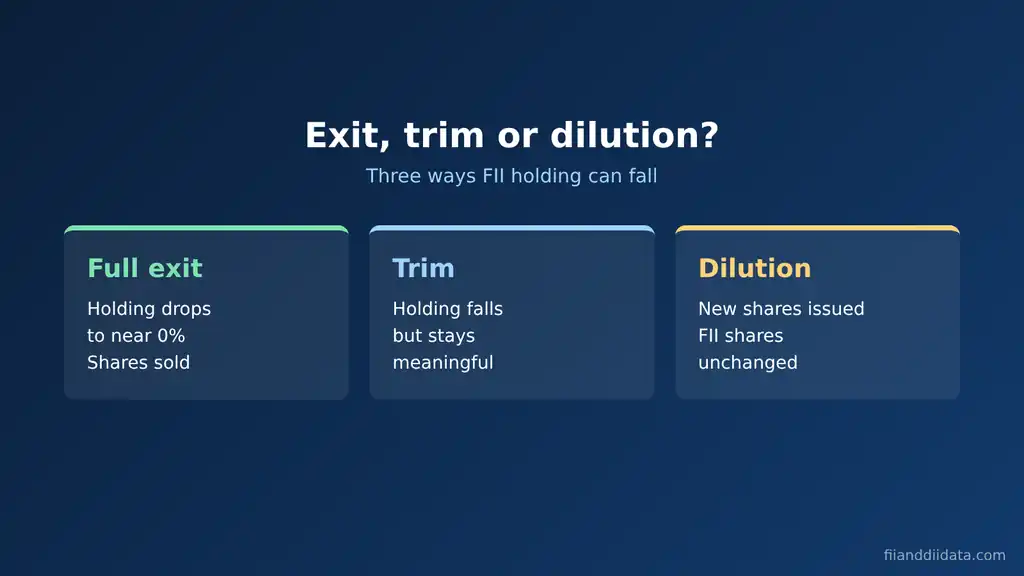
When people search for stocks FIIs “exited”, they usually mean stocks where the FII holding fell. In practice, that covers three different situations. A full exit means FII holding drops to near zero. A trim means FIIs sold part of their stake but still hold a meaningful share. Dilution means the company issued new shares, so the FII percentage fell even though FIIs did not sell.
Changes are measured in percentage points (pp). If FII holding moves from 20% to 18%, that is a 2 pp fall, or a 10% relative cut. Keep both numbers in mind, because the next section shows how large some of the 2026 cuts were.
Stocks FII Exited 2026: The Nifty 50 Data
The Economic Times, using shareholding data for the March, June and September 2026 quarters, found that 21 Nifty 50 companies saw FII holding fall in each of those quarters. Eighteen of those 21 stocks also fell in price during 2026. The table shows the five largest declines it reported.
| Stock | Fall in FII holding in 2026 (pp) | Sector |
|---|---|---|
| Max Healthcare | -10.0 | Hospitals |
| HDFC Bank | -8.3 | Private bank |
| HDFC Life | -5.5 | Life insurance |
| InterGlobe Aviation | -5.1 | Aviation |
| Kotak Mahindra Bank | -4.7 | Private bank |
Stocks FII exited 2026: the wider Nifty picture
The same analysis found that FIIs held less of 70% of Nifty 50 companies in September 2026 than a year earlier. FII ownership of the index fell to 22.4%, down 230 basis points year on year and 40 basis points from the June quarter. DII ownership rose 150 basis points to a record 26.2%. The cuts spread across banks, insurers, autos, consumer companies, telecom, IT, aviation, pharma, cement and conglomerates.
ITC, Maruti Suzuki, HDFC Life, HDFC Bank and Tata Motors Passenger Vehicles were named among the weakest Nifty performers of 2026. For a sector view of the same trend, see our report on the sectors FIIs sold in 2026. Two of these names deserve a closer look.
HDFC Bank and ITC: Two Large-Cap Case Studies
HDFC Bank
HDFC Bank’s filing for the September 2026 quarter showed FII holding at 39.40%, down from 41.83% in June, a fall of 2.43 points, Upstox reported on 8 October 2026. In relative terms, FIIs held about 5.8% fewer shares than three months earlier. DII holding rose from 41.92% to 43.63%, so domestic institutions picked up most of what foreign funds sold.
The stock closed at ₹702.75 on 7 October 2026, down 29% in 2026, with a market value of over ₹10.83 lakh crore. At that value, a 2.43 point stake is worth roughly ₹26,300 crore of shares. That gives a sense of how much foreign money left a single stock in one quarter.
ITC
ITC is a slower, longer exit. Business Today reported on 3 November 2026 that FII holding fell to 33.2% in the September 2026 quarter, a nine-quarter low, from 40.5% in September 2024. That is a 7.3 point drop, or about 18% of the FII position, over two years. The stock traded near ₹268, about 49% below its record high of ₹528.50 from September 2024, after a cigarette tax increase that took effect on 1 February 2026.
Both stocks show the same pattern: steady FII selling, steady DII buying and a falling share price. The story is different further down the market, as the next section shows.
Midcap and Smallcap Stocks FIIs Left in 2026
Full or near-full exits are more common in smaller companies, where a few foreign funds can own most of the FII stake. NiftyTrader reported on 18 July 2026, using ACE Equity data, that FIIs cut holdings in 268 of the 522 smallcaps that had filed June 2026 quarter data at that point.
| Stock | FII holding before | FII holding after | Change (pp) | Period |
|---|---|---|---|---|
| Ugro Capital | 22.34% | 5.45% | -16.89 | Mar 2026 to Jun 2026 |
| ITC Hotels | 25.49% | 14.58% | -10.91 | Sep 2025 to Mar 2026 |
| Hexaware Technologies | 8.31% | 4.20% | -4.11 | Sep 2025 to Mar 2026 |
| Rama Steel Tubes | 5.71% | 2.70% | -3.01 | Mar 2026 to Jun 2026 |
| Dixon Technologies | 20.69% | 18.30% | -2.39 | Sep 2025 to Mar 2026 |
| NIIT Learning Systems | 16.75% | 14.44% | -2.31 | Mar 2026 to Jun 2026 |
| KPIT Technologies | 14.31% | 13.25% | -1.06 | Sep 2025 to Mar 2026 |
Ugro Capital is the clearest example of a near exit: FIIs gave up about 76% of their position in a single quarter. In Oswal Agro Mills, FII holding went from 0.03% to 0.00%, a complete exit, though from a very small base. Sahi’s 18 May 2026 report counted about 53 midcaps where FIIs reduced holdings across the December 2025 and March 2026 quarters, with KPIT Technologies down 42% in price over six months.
For context on the reverse trend, read our list of stocks where FIIs raised their stake in Q2 FY27. Next, let us look at why the selling happened.
Why FIIs Exited These Stocks in 2026
Stock-level exits sit inside a much larger outflow. FPIs sold a net ₹3.04 lakh crore of Indian equities in 2026 up to 12 October, according to NSDL data reported by The Hans India, far above the ₹1.66 lakh crore sold in all of 2025. You can follow the month-wise trail in our FPI outflow 2026 report.
- Global factors. High crude oil prices, a firm US dollar and high US bond yields made Indian equities less attractive in dollar terms.
- Better options elsewhere. An AI-led rally in North Asian markets such as Korea and Taiwan drew foreign money away from India.
- Large, liquid stocks are sold first. When a global fund cuts its India weight, it sells the stocks it can exit quickly, which is why HDFC Bank and other index heavyweights show up repeatedly.
- Company-specific pressure. ITC faced a cigarette tax hike, and several stocks on the list had weak earnings or rich valuations.
- Domestic buyers absorbed the supply. Strong mutual fund and insurance inflows meant FIIs could sell large blocks without a collapse in prices.
Knowing why a stake fell is only half the job. You also need to know how it fell, which is where most readers make errors.
Exit, Trim or Dilution: A Worked Example
Take a company with 100 crore shares, where FIIs own 20 crore shares (20%). Here are three ways the FII number can fall.
- Full exit: FIIs sell 19.9 crore shares. Their holding becomes 0.1 crore out of 100 crore, or 0.1%. This is a true exit.
- Trim: FIIs sell 2 crore shares. Holding becomes 18%, a 2 pp fall and a 10% relative cut. FIIs are still large owners.
- Dilution: The company issues 25 crore new shares through a QIP to domestic funds. FIIs still own 20 crore shares, but out of 125 crore. Their holding falls to 16% without a single share sold.
All three cases would appear in a “FII holding decreased” screen, yet they mean very different things. Applied to the real data, HDFC Bank’s 2.43 point fall is a trim, while Ugro Capital’s drop from 22.34% to 5.45% is close to an exit. With this lens, you are ready for a practical routine.
How to Use Stocks FII Exited 2026 Data: A Checklist
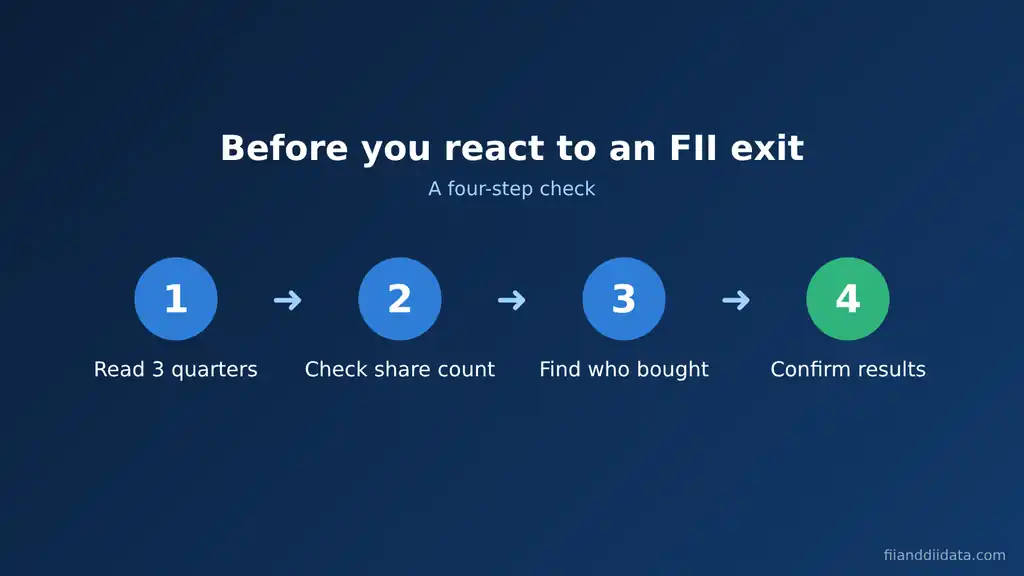
We run four checks before treating any FII stake cut as meaningful:
- Read three quarters, not one. Open the shareholding pattern on the NSE or BSE website. A single-quarter dip can be noise; three falling quarters, like the 21 Nifty stocks above, show a trend.
- Check the share count. Compare total shares outstanding. If the count rose because of a QIP, rights issue or merger, the fall may be dilution.
- Find who bought. If DII holding rose by a similar amount, as in HDFC Bank, the supply found a home. If retail holding jumped instead, be more careful.
- Confirm with results and price. Look at the latest quarterly results, valuation and price trend before you decide to hold, add or sell.
It also helps to compare stock-level data with daily flows. Our FII DII data today page shows whether foreign selling is continuing after the quarter ended, and the FII DII monthly data page shows the bigger trend. Even with these tools, a few mistakes come up often.
Common Mistakes When Reading FII Stake Cuts
- Calling every cut an exit. HDFC Bank still had 39.40% FII ownership after its cut. That is a trim, not a departure.
- Selling late. Shareholding data is a snapshot on the last day of the quarter and is published weeks later. Much of the price fall may already have happened.
- Ignoring who bought. When DIIs absorb the selling, prices often stabilise sooner than headlines suggest.
- Mixing periods. Some lists compare with the last quarter, others with a year or two ago. ITC’s 7.3 point fall covers two years, not one quarter.
- Assuming FIIs are always right. Foreign funds sell for currency, benchmark and global reasons that may have nothing to do with the company’s business.
Avoiding these errors turns a scary headline into useful research. For daily figures, charts and free tools, visit our FII and DII data home page. The questions below cover what readers ask most.
Frequently Asked Questions
Which are the stocks FII exited in 2026?
Among Nifty 50 companies, FIIs cut their stake in 21 stocks in each of the March, June and September 2026 quarters, led by Max Healthcare (-10.0 points), HDFC Bank (-8.3), HDFC Life (-5.5), InterGlobe Aviation (-5.1) and Kotak Mahindra Bank (-4.7), according to The Economic Times on 2 November 2026. Near-full exits were more common in small caps such as Ugro Capital.
How do I check if FIIs are selling a stock?
Open the company page on the NSE or BSE website and go to the shareholding pattern. Compare the FPI or FII figure for the last three quarters. A steady fall across quarters, with no rise in total shares, shows FII selling.
Should I sell a stock if FIIs reduce their stake?
Not automatically. Check whether the fall is a trim, a full exit or dilution from new shares, see who bought the shares, and review results and valuation. FIIs often sell for global or currency reasons that do not reflect the company’s business.
Why are FIIs selling Indian stocks in 2026?
High crude oil prices, a firm US dollar, high US bond yields and an AI-led rally in North Asian markets pulled money away from India. FPIs sold a net Rs 3.04 lakh crore of Indian equities in 2026 up to 12 October, according to NSDL data.
Who is buying when FIIs sell?
Mostly domestic institutions. DII ownership of the Nifty 50 reached a record 26.2% in the September 2026 quarter. In HDFC Bank, DII holding rose from 41.92% to 43.63% in the same quarter that FII holding fell 2.43 points.
The Bottom Line
2026 has been a year of steady FII retreat from India’s largest companies. Twenty-one Nifty 50 stocks saw FII holding fall in three straight quarters, and FII ownership of the index slipped to 22.4% while domestic institutions climbed to a record 26.2%. Most of these moves are trims by global funds cutting their India weight, while true exits are concentrated in smaller companies.
A falling FII stake tells you where to look, not what to do. As a next step, pick one stock you own from the lists above, run it through the four-step checklist, and note whether the cut is an exit, a trim or dilution. You can find more data-led guides on our blog.
Sources: The Economic Times, FII stake cuts across Nifty 50 stocks in 2026 (2 November 2026); Upstox, HDFC Bank FII stake cut in September quarter (8 October 2026); Business Today, ITC FII stake at nine-quarter low (3 November 2026); NiftyTrader, FII smallcap stake cuts (18 July 2026); Sahi, FIIs cut stakes in 10 midcap stocks (18 May 2026); The Hans India, FPI outflows cross Rs 3 lakh crore in 2026 (12 October 2026).
Disclaimer: This article is for educational purposes only and is not investment advice. Please consult a SEBI-registered advisor before making investment decisions.