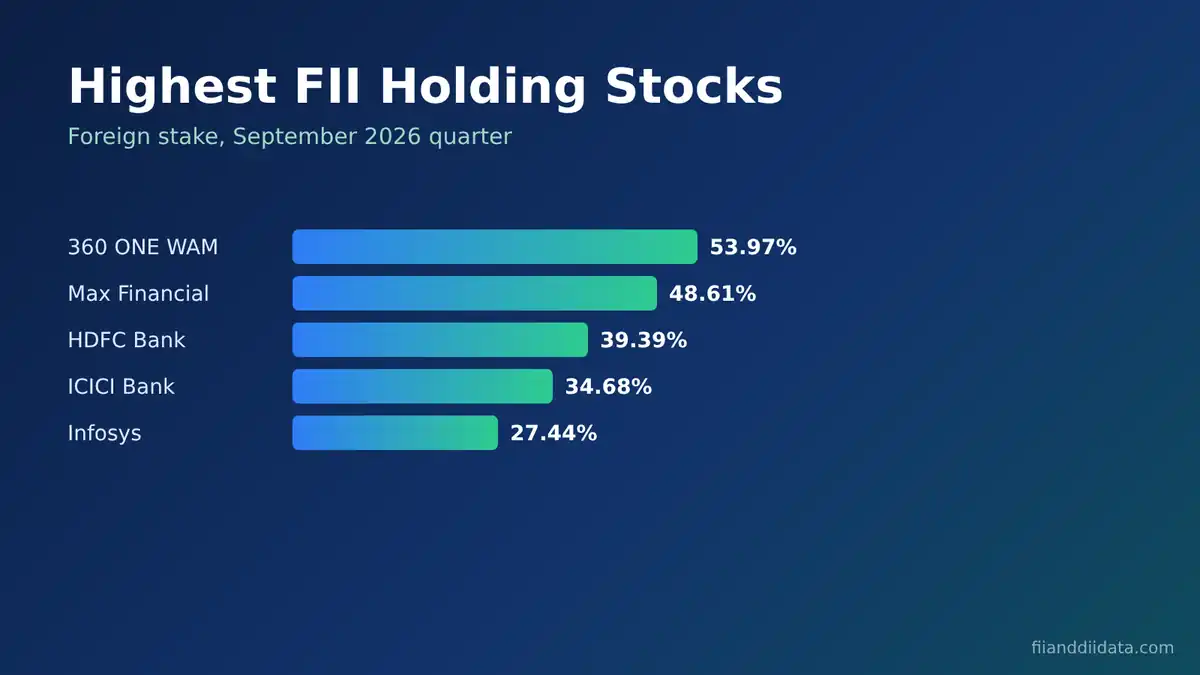
The highest FII holding stocks India offers today are mostly mid-sized financial, travel-tech and distribution names, not the Nifty heavyweights most people expect. At the end of September 2026, foreign investors owned 53.97% of 360 ONE WAM and 48.61% of Max Financial Services, while their stake in HDFC Bank fell to 39.39%. That shift matters, because foreign ownership of Indian companies has just dropped to its lowest level since December 2011.
Key Takeaways
- FPIs held 14.02% of BSE-listed companies at end-September 2026, the lowest since December 2011.
- Among Sep 2026 filings we checked, 360 ONE WAM (53.97%) and Max Financial (48.61%) had the highest foreign stakes.
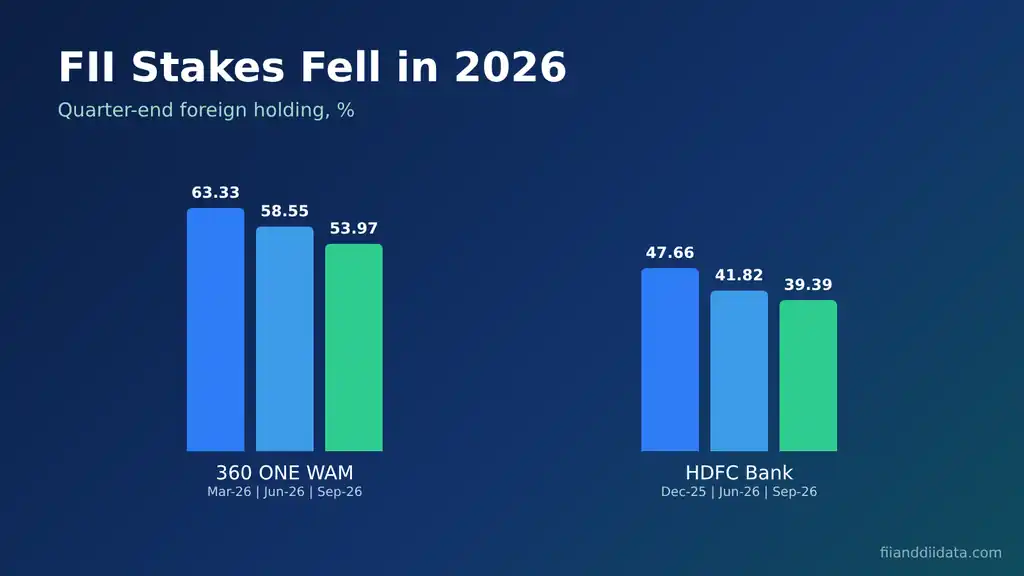
- Very high FII holding can turn into heavy selling: 360 ONE’s foreign stake fell 9.36 points in two quarters.
- Always separate FPI from FDI and ADR lines, or the “FII holding” figure can mislead you.
- Use FII holding as one input with earnings, valuation and liquidity, never as a buy signal by itself.
Table of contents
- What highest FII holding stocks India means
- Latest data: highest FII holding stocks in India (Sep 2026)
- The Q4 FY26 top 10 list by FII share
- Why FIIs own so much of these companies
- How to read FII holding: a worked example
- Three classification traps that distort the numbers
- How to use highest FII holding stocks data: a 5-step checklist
- Common mistakes investors make
- Frequently asked questions
- The Bottom Line
What Highest FII Holding Stocks India Means
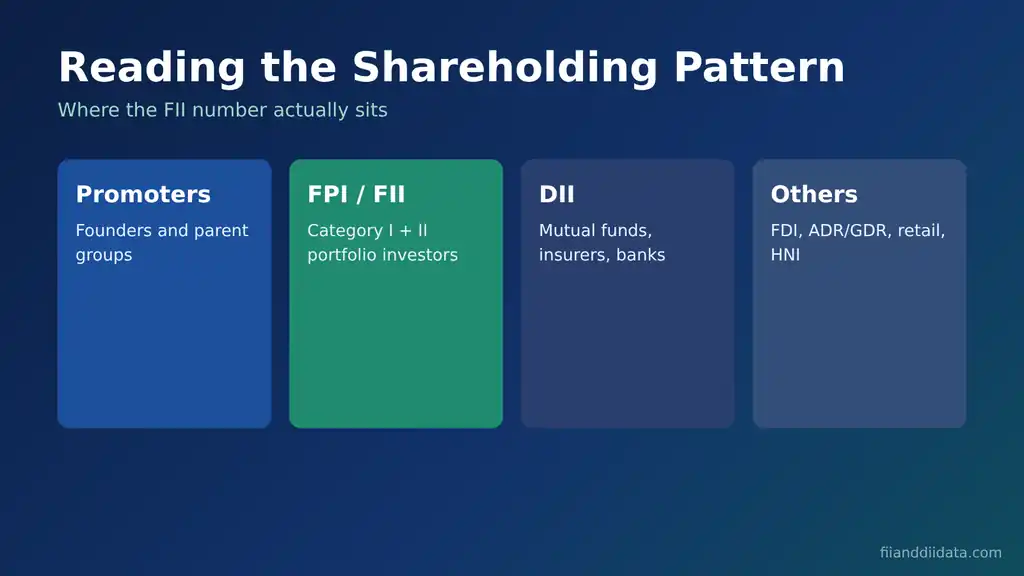
FII stands for foreign institutional investor. Since 2014, SEBI calls this group foreign portfolio investors, or FPIs, and the two terms now refer to the same investors: global pension funds, mutual funds, sovereign funds, insurers and hedge funds that buy listed Indian shares. “FII holding” is the share of a company’s total equity that these investors own at the end of a quarter.
The number comes from the shareholding pattern that every listed company files with the exchanges. Under Regulation 31 of SEBI’s listing rules, a main-board company must file it within 21 days of each quarter end. That is why September-quarter figures appear through October, and why any list of the highest FII holding stocks is always a snapshot of a past date, not a live reading.
If you are new to this filing, our guide to the FII shareholding pattern explains each category line by line. The short version is simple: a high FII figure tells you foreign funds own a large slice of the company. It does not tell you whether they are adding or leaving. For that you need the trend, which is where most of the useful information sits.
Latest Data: Highest FII Holding Stocks in India (Sep 2026)
The table below lists the latest quarter-end foreign stake for widely tracked high-FII companies. Where a September 2026 filing was not available from the source we used, we show the most recent quarter and label it. Stakes refer to FII or FPI holding as a share of total equity.
| Company | FII / FPI holding | Quarter end | Change vs earlier quarter |
|---|---|---|---|
| 360 ONE WAM | 53.97% | Sep 2026 | Down from 58.55% (Jun 2026) |
| Max Financial Services | 48.61% | Sep 2026 | Up from 48.06% (Jun 2026) |
| HDFC Bank | 39.39% | Sep 2026 | Down from 41.82% (Jun 2026) |
| ICICI Bank | 34.68% | Sep 2026 | Up from 33.79% (Jun 2026) |
| Infosys | 27.44% | Sep 2026 | Up from 27.09% (Jun 2026) |
| One 97 Communications (Paytm) | 25.09% (FPI only) | Sep 2026 | FDI of 18.43% shown separately |
| Redington | 61.96% | Jun 2026 | Up from 61.49% (Mar 2026) |
| Bharti Airtel | 26.48% | Jun 2026 | Down from 28.75% (Dec 2025) |
Two patterns stand out. First, the very top of the list is made up of companies where foreign funds own close to or above half of the equity, and several of them, such as Redington and 360 ONE WAM, have little or no promoter holding. Second, the large private banks that FPIs once crowded into now sit well below those levels. HDFC Bank’s foreign stake was 47.66% at the end of December 2025, according to Business Today, so it has lost 8.27 percentage points in nine months.
The wider backdrop explains why. A Mint analysis of CMIE data, reported by The Wire on 3 November 2026, puts the FPI share of 5,638 BSE-listed firms at 14.02% at end-September 2026. That is 6.07 points below the December 2020 peak of 20.09%, while the domestic mutual fund stake rose to a record 11.59%. Our FPI outflow in 2026 tracker shows the month-wise selling behind that drop.
The Q4 FY26 Top 10 List by FII Share
The most complete ranked list we found is for the March 2026 quarter. NiftyTrader published it on 15 May 2026, using Economic Times figures based on primeinfobase.com data. It is a useful baseline, because it shows where foreign money sat just before the heavy selling of mid-2026.
| Rank | Company | FII holding (31 Mar 2026) |
|---|---|---|
| 1 | Le Travenues Technology (ixigo) | 64.19% |
| 2 | 360 ONE WAM | 63.33% |
| 3 | Redington | 61.49% |
| 4 | CarTrade Tech | 60.15% |
| 5 | Dr Agarwal’s Health Care | 57.94% |
| 6 | Urban Company | 55.77% |
| 7 | One 97 Communications (Paytm) | 49.40% |
| 8 | Home First Finance | 49.16% |
| 9 | Five-Star Business Finance | 48.48% |
| 10 | Delhivery | 48.22% |
Compare this with the September numbers and the picture changes quickly. 360 ONE WAM went from 63.33% to 53.97%. Paytm’s 49.40% in March was a combined foreign figure; its September filing splits out 25.09% FPI and 18.43% FDI, as Business Standard reported on 14 October 2026. Rankings move every quarter, so treat any “top 10” as a dated list, not a permanent one.
Why FIIs Own So Much of These Companies
Most stocks with very high foreign ownership share a few traits. Knowing them helps you understand why the list looks the way it does.
- No dominant promoter. Redington shows 0.00% promoter holding, and 360 ONE’s promoters held 6.18% in September 2026. When there is no large founder block, institutions end up owning most of the free float.
- Private equity and pre-IPO investors. New-age listings such as ixigo, Urban Company and Delhivery raised money from global funds before listing. Those funds often appear in the FPI category after the IPO.
- Index weight. Large banks and IT firms carry big weights in MSCI and FTSE indices, so passive global funds must hold them.
- Sector preference. Business Standard reported in August 2026 that financials made up 39.9% of FPI allocation in India, 288 basis points above their index weight.
Exit risk in highest FII holding stocks India
The same traits create a risk. When one group owns more than half of a company, its decisions move the price. If global funds cut India exposure, as they did through 2026, the stocks where they own the most have the largest pool of shares that could be sold. Domestic mutual funds have been the main buyers on the other side. In 360 ONE WAM, mutual fund holding rose from 10.00% to 18.41% over the same two quarters in which foreign holding fell.
How to Read FII Holding: A Worked Example
A percentage on its own hides the money involved. Converting it into rupees, and then into trading days, gives a clearer sense of the pressure a change can create. Here is a simple example using round, hypothetical numbers.
- Company XYZ has a market value of ₹30,000 crore and FIIs own 60%. Their stake is worth ₹18,000 crore.
- In one quarter, the FII holding falls from 60% to 55%. Five percentage points of ₹30,000 crore is ₹1,500 crore of shares sold.
- Suppose the stock trades ₹150 crore a day. If sellers keep to about 20% of daily volume to avoid crashing the price, they can sell about ₹30 crore a day.
- ₹1,500 crore divided by ₹30 crore is 50 trading days, close to a full quarter of steady supply.
Now apply the same logic to a real case. 360 ONE WAM’s foreign stake fell 9.36 percentage points between March and September 2026. HDFC Bank’s fell 2.43 points in the September quarter alone. For a bank of HDFC Bank’s size, even a small move in percentage terms is a large rupee amount, and it helps explain why the stock stayed under pressure while FPIs sold.
Three Classification Traps That Distort the Numbers
Many free screeners show one “FII” column. Behind it, the filing may contain several foreign lines, and mixing them up leads to wrong conclusions. These are the three traps we see most often.
1. FDI counted as FII
Foreign direct investment is a strategic stake, usually from an early backer, and it is not portfolio money. Paytm’s September 2026 filing shows 25.09% FPI and 18.43% FDI. Adding the two gives 43.52%, which overstates what portfolio funds actually own. Our explainer on FII vs FDI covers why the two behave so differently.
2. ADR and GDR shares on a separate line
Some companies have shares listed abroad as depositary receipts. In Equitymaster’s ICICI Bank data, the FII line drops from 43.87% in December 2025 to 34.48% in March 2026, the same quarter in which an 18.00% ADR/GDR line appears. Part of that “fall” is a change in how holdings are shown, not only selling. Check the depositary line before you draw a conclusion.
3. Category I and II rolled together
FPIs are registered as Category I (regulated funds, sovereign wealth funds) or Category II (other investors). Paytm’s 25.09% FPI stake was made up of 24.36% Category I and 0.73% Category II. Most of the time this split does not change the story, but in smaller companies a large Category II holder can behave more like a trader than a long-term fund.
How to Use Highest FII Holding Stocks Data: A 5-Step Checklist
Here is the routine we use before reading anything into a high foreign stake. It takes about ten minutes per stock with the company’s filing open on the NSE or BSE website.
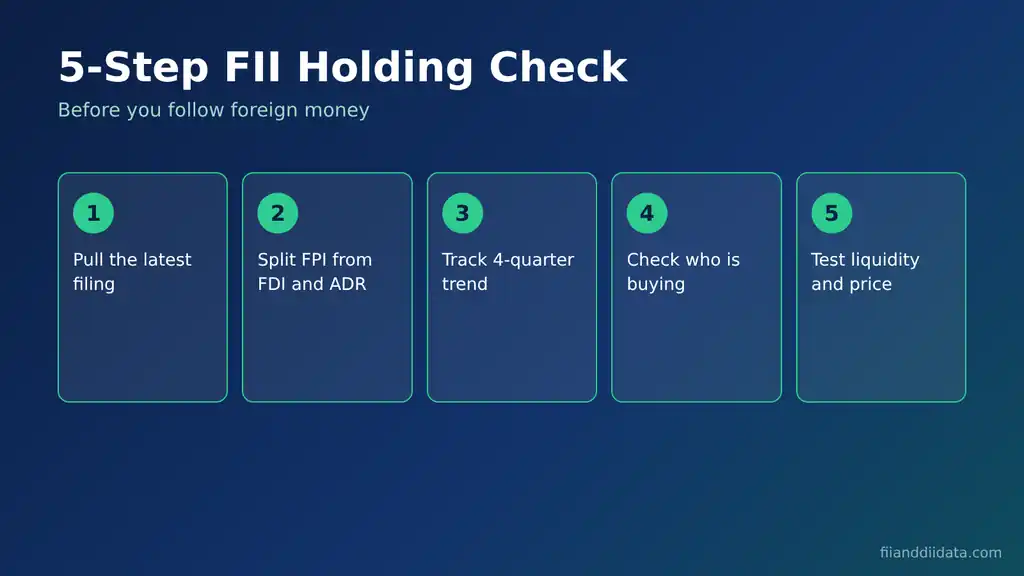
- Pull the latest filing. Open the shareholding pattern on the exchange site and note the quarter end. Do not rely on a screener that may still show an older quarter.
- Split FPI from FDI and ADR. Add only the FPI Category I and II lines. Treat FDI and depositary shares as separate groups.
- Track the four-quarter trend. Write down the FPI share for the last four quarters. A steady fall of two points or more per quarter is a warning sign; a steady rise shows conviction.
- Check who is buying on the other side. If mutual funds and insurers are absorbing the selling, the price impact is usually smaller. Our guide to the difference between FII and DII explains why domestic buyers behave differently.
- Test liquidity and valuation. Compare the rupee value of any change with average daily traded value, as in the worked example above, and then check earnings and valuation before acting.
To see which names moved the other way last quarter, read our list of stocks where FIIs raised their holding in Q2 FY27. For the daily market-wide flows that sit behind these quarterly numbers, track our FII and DII data page after each trading session.
Common Mistakes Investors Make
- Treating high FII holding as a quality stamp. Foreign funds held large stakes in several stocks that fell sharply in 2026. Business Today noted on 30 September 2026 that none of the FPIs’ ten largest Indian holdings by value had a positive return this year.
- Ignoring the date. A list built on March data can be badly out of date by November. Always check the quarter end.
- Comparing different filings. One source may include FDI or ADR lines and another may not. Compare like with like.
- Buying because FIIs “must come back”. They may, but timing is uncertain. A high foreign stake also means a large pool of potential sellers.
Frequently Asked Questions
Which are the highest FII holding stocks in India right now?
Among September 2026 filings we checked, 360 ONE WAM (53.97%) and Max Financial Services (48.61%) had some of the highest foreign stakes. Redington held 61.96% FII ownership in June 2026, and ixigo topped the March 2026 list at 64.19%. Rankings change every quarter, so check the latest filing.
Is high FII holding good for a stock?
Not by itself. High FII holding shows that global funds have done their research, but it also means a large group could sell at the same time. Look at the trend over four quarters, earnings, valuation and liquidity before deciding.
How can I check FII holding in a stock?
Open the company’s shareholding pattern on the NSE or BSE website. Companies file it within 21 days of each quarter end. Add the FPI Category I and Category II lines, and keep FDI and ADR or GDR holdings separate.
Why did FII holding in HDFC Bank fall in 2026?
FPIs cut India exposure through 2026 amid record outflows, and large, liquid banks were easy to sell. HDFC Bank’s foreign stake fell from 47.66% in December 2025 to 41.82% in June 2026 and 39.39% in September 2026, while mutual fund holding rose.
What is the difference between FII holding and DII holding?
FII holding is the share owned by foreign portfolio investors. DII holding is the share owned by domestic institutions such as mutual funds, insurers, banks and pension funds. In 2026, DIIs have been buying many of the shares that FIIs sold.
The Bottom Line
The highest FII holding stocks in India are a moving list. In September 2026, the top foreign stakes sat in companies like 360 ONE WAM and Max Financial, while big banks such as HDFC Bank kept losing foreign ownership. With the overall FPI share at a 15-year low, high foreign ownership now carries more exit risk than it did a few years ago.
That does not make these stocks bad investments. It means the trend, the classification and the liquidity matter more than the headline number. As a practical next step, pick one stock you own, open its last four shareholding filings and run the five-step checklist above. You can find more guides like this on our blog.
Sources: Business Standard, Paytm shareholding (14 Oct 2026); The Wire, citing Mint and CMIE (3 Nov 2026); NiftyTrader, Q4 FY26 FII list (15 May 2026); Equitymaster shareholding data for ICICI Bank, Infosys, 360 ONE WAM and Redington; Upstox (29 Oct 2026); Kotak Neo (8 Oct 2026); Business Today (30 Sep 2026); Business Standard (17 Aug 2026); SEBI LODR Regulation 31.
Disclaimer: This article is for educational purposes only and is not investment advice. Please consult a SEBI-registered advisor before making investment decisions.