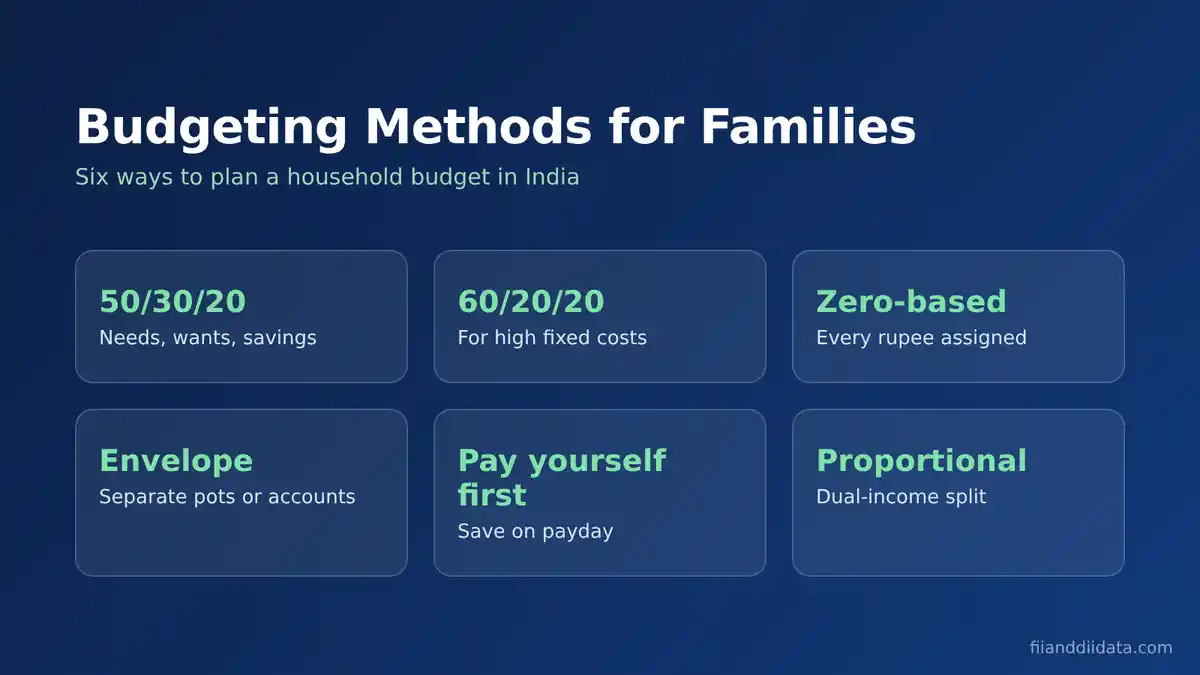
The best budgeting methods for families are the 50/30/20 rule, a 60/20/20 variant, zero-based budgeting, the envelope system, pay-yourself-first and a proportional split for dual-income homes. The right one depends on how fixed your costs are and how many people earn. This matters more now: retail inflation in India rose to 5.54% in September 2026, with food prices up 7.74%, according to MoSPI data released on 12 October 2026.
Key Takeaways
- A budgeting method is a rule for splitting take-home pay before the month starts, not a record of what was spent.
- The 50/30/20 rule suits families with moderate fixed costs; a 60/20/20 split is more realistic for high-rent city households.
- Zero-based and envelope methods give the most control and work best when spending keeps slipping.
- Pay-yourself-first protects savings with almost no tracking, which suits busy parents.
- Dual-income couples can share common costs in proportion to income so that both partners keep some personal money.
Table of contents
- What Are the Best Budgeting Methods for Families?
- Why Indian Families Need a Budgeting Method in 2026
- 6 Best Budgeting Methods for Families Explained
- Budgeting Methods for Families Compared Side by Side
- Worked Example: One ₹90,000 Family, Four Plans
- How to Choose and Start: A 7-Step Checklist
- Common Family Budgeting Mistakes to Avoid
- Frequently Asked Questions
- The Bottom Line
What Are the Best Budgeting Methods for Families?
A budgeting method is a fixed rule that tells you how to divide take-home income between essential bills, lifestyle spending and savings. It is decided before the salary arrives. Tracking, by contrast, records where money already went. Families need both, but the method comes first because it sets the targets that tracking measures against.
For a single person, almost any method works. Families are different. There are more fixed costs (school fees, rent or EMI, insurance premiums), more people making small spending decisions, and often more than one income. A method that ignores these realities usually fails by the third month.
What makes a budgeting method family-friendly
- Simple enough to explain to a spouse or teenager in two minutes.
- Room for large yearly costs such as school admission fees, festivals and insurance renewals.
- A clear savings target that is paid before discretionary spending.
- Low tracking effort, because a budget that takes hours each week gets abandoned.
With that test in mind, the next section looks at why a written method matters more for Indian households right now.
Why Indian Families Need a Budgeting Method in 2026
Two official data sets explain the pressure on household budgets. The first is price inflation. MoSPI’s Consumer Price Index release for September 2026 (base year 2024) put all-India headline inflation at 5.54%, rural inflation at 6.08% and urban inflation at 4.88%. Food inflation, measured by the Consumer Food Price Index, was 7.74%. When food costs rise faster than overall prices, families with children feel it first, because groceries are their largest variable expense.
The second is spending structure. MoSPI’s Household Consumption Expenditure Survey 2023-24, released on 27 December 2024, found average monthly per capita consumption expenditure of ₹4,122 in rural India and ₹6,996 in urban India (current prices, without imputed values). Food made up roughly 47% of rural spending and about 40% of urban spending.
| Indicator | Rural | Urban | Period |
|---|---|---|---|
| Average monthly spending per person | ₹4,122 | ₹6,996 | 2023-24 |
| Same figure for a family of four (our calculation) | ₹16,488 | ₹27,984 | 2023-24 |
| Approximate food share of spending | About 47% | About 40% | 2023-24 |
| CPI inflation, year on year | 6.08% | 4.88% | September 2026 |
| Consumer Food Price Index inflation (combined) | 7.74% | September 2026 |
What does this mean in practice? Suppose a family spends ₹15,000 a month on groceries. If food prices kept rising at 7.74% for a full year, the same basket would cost about ₹16,161 a month. That is ₹1,161 more every month without anyone buying anything extra. A budgeting method forces that increase to come out of a planned category rather than quietly from savings. You can read the official figures in the MoSPI CPI release for September 2026 and the MoSPI HCES 2023-24 press note.
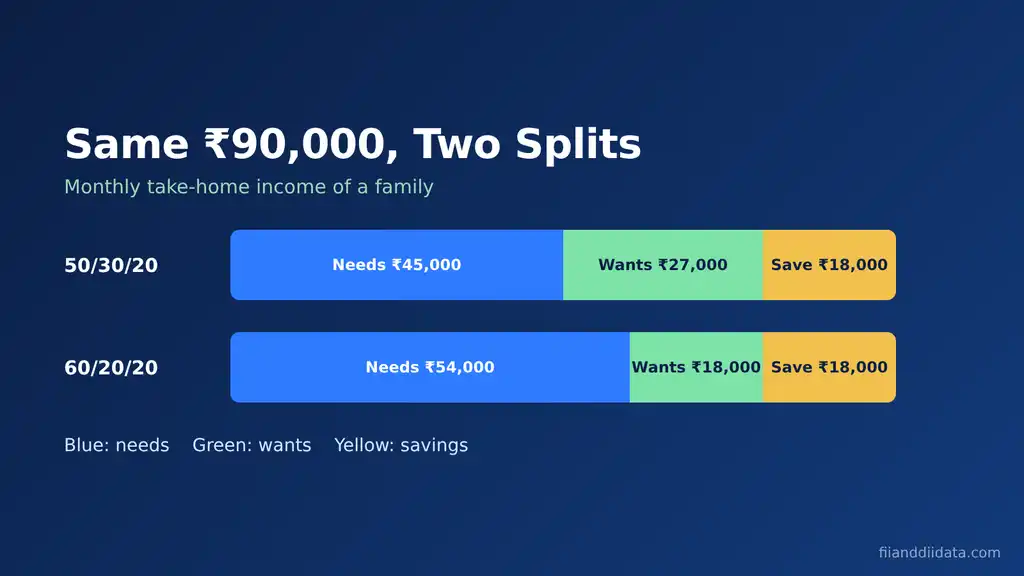
The image above shows how the two most common percentage rules divide the same income. Here is how each of the six methods works.
6 Best Budgeting Methods for Families Explained
Each method below is described with how it works, who it suits and its main weakness. None of them is perfect, and many families end up combining two.
1. The 50/30/20 rule
Split take-home pay into 50% for needs (rent or EMI, groceries, utilities, school fees, insurance), 30% for wants (eating out, shopping, subscriptions, trips) and 20% for savings and debt prepayment. It is easy to remember and needs only three buckets. Our detailed guide to the 50/30/20 budgeting rule covers category definitions. The weakness: in metros, rent and school fees alone can cross 50% of a single income.
2. The 60/20/20 variant
This keeps the 20% savings target but moves 10 percentage points from wants to needs. It is a practical adjustment for families in high-rent cities or with two children in private schools. The trade-off is less money for lifestyle spending, so the family must agree on what counts as a need.
3. Zero-based budgeting
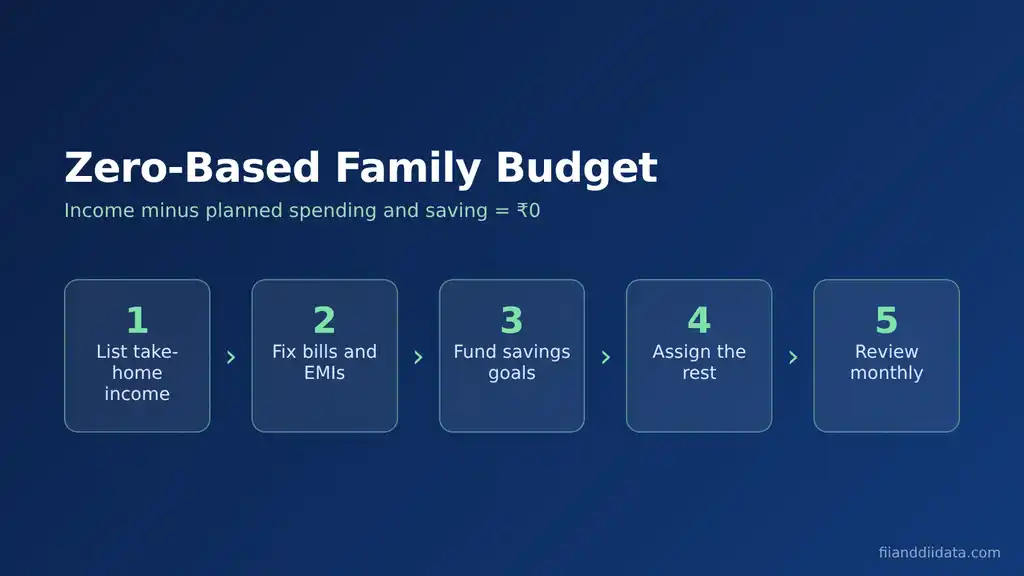
Every rupee of income is assigned a job until income minus planned spending and saving equals zero. Nothing is left unallocated, so there is no unplanned surplus to leak away. It gives the most control and suits families whose spending keeps overshooting. It also takes the most effort, because each month starts from a blank sheet. Our step-by-step guide to zero-based budgeting explains the setup.
4. The envelope (multi-account) system
Traditionally, cash was placed in labelled envelopes for groceries, transport and so on. When an envelope was empty, spending in that category stopped. Most Indian families now do this digitally, using separate savings accounts or wallet balances for each category, funded on salary day. It works well for households where small daily spends add up. The weakness is managing several accounts and keeping their minimum balance rules in mind.
5. Pay yourself first (reverse budgeting)
On salary day, a fixed amount moves automatically to savings and investments through standing instructions, recurring deposits or SIPs. The family spends whatever is left without detailed category tracking. It suits busy parents who dislike spreadsheets. Its weakness: if fixed costs are too high, the remaining money runs out before month-end, so it works only when needs are under control.
6. Proportional split for dual-income families
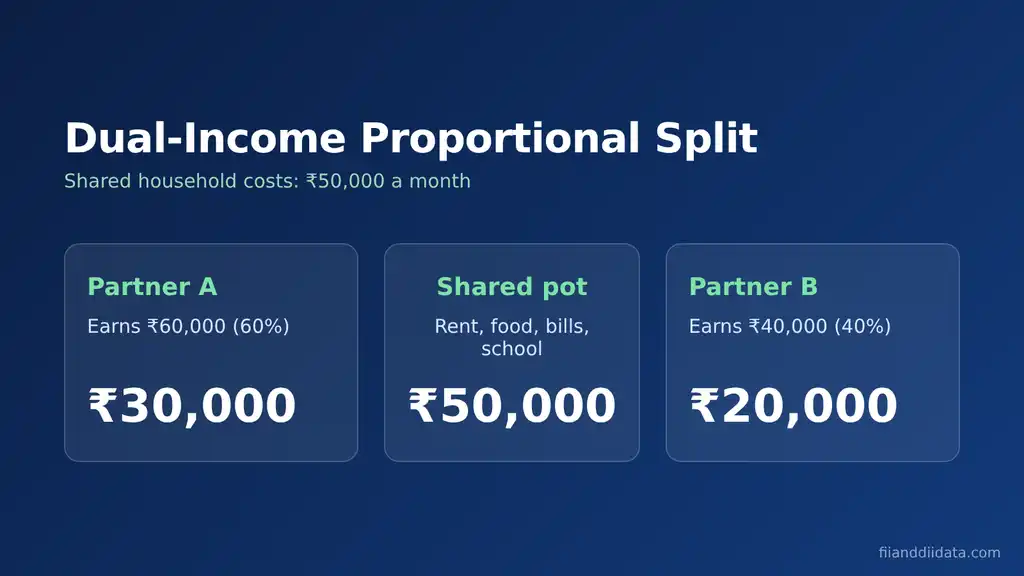
Each partner contributes to a shared household pot in proportion to income, and keeps the rest for personal spending and individual savings. If one partner earns 60% of the household income, that partner pays 60% of shared costs. It reduces arguments about fairness. On its own it does not set a savings target, so pair it with pay-yourself-first or a percentage rule.
With six options on the table, a side-by-side view makes the choice easier.
Budgeting Methods for Families Compared Side by Side
| Method | Best for | Effort | Main risk |
|---|---|---|---|
| 50/30/20 | Moderate fixed costs, one or two earners | Low | Needs exceed 50% in big cities |
| 60/20/20 | High rent or school fees | Low | Wants budget feels tight |
| Zero-based | Overspending families, irregular bills | High | Fatigue after a few months |
| Envelope / multi-account | Many small daily spends | Medium | Too many accounts to manage |
| Pay yourself first | Busy parents, stable salary | Very low | Month-end shortfall if needs are high |
| Proportional split | Dual-income couples | Low | No savings target unless combined |
Which budgeting methods for families work best together
Combinations often work better than a single rule. A common pairing is pay-yourself-first for savings plus the envelope system for groceries and household spending. Dual-income couples often use a proportional split for shared costs and the 50/30/20 rule inside each partner’s personal share. Families recovering from overspending can run zero-based budgeting for three months, then move to a simpler percentage rule once habits settle.
Numbers make the differences clearer, so the next section runs one family through four plans.
Worked Example: One ₹90,000 Family, Four Plans
Consider a family of four in a tier-2 city with a combined take-home income of ₹90,000 a month. Here is how the same income looks under different methods. All figures are illustrative and rounded to the nearest rupee.
Under 50/30/20 and 60/20/20
- 50/30/20: needs ₹45,000, wants ₹27,000, savings ₹18,000.
- 60/20/20: needs ₹54,000, wants ₹18,000, savings ₹18,000.
- Pay yourself first at 20%: ₹18,000 moves to savings on salary day, leaving ₹72,000 for everything else.
Notice that savings stay at ₹18,000 in all three. The methods differ in how strictly they control the remaining ₹72,000.
Under zero-based budgeting
| Category | Monthly amount |
|---|---|
| Rent | ₹22,000 |
| Groceries | ₹15,000 |
| School fees (monthly equivalent) | ₹8,000 |
| Transport and fuel | ₹6,000 |
| Electricity, water, phone and internet | ₹5,000 |
| Insurance premiums (monthly equivalent) | ₹4,000 |
| SIP and investments | ₹12,000 |
| Emergency fund top-up | ₹6,000 |
| Festival and gifts fund | ₹4,000 |
| Eating out and entertainment | ₹5,000 |
| Personal spending | ₹3,000 |
| Total allocated | ₹90,000 |
Every rupee has a purpose, and income minus allocations equals zero. The festival fund of ₹4,000 a month builds ₹48,000 over a year, so Diwali or a wedding gift no longer breaks the budget. Savings here total ₹22,000 (SIP, emergency fund and festival fund), higher than the 20% rules, because the family chose to give up some lifestyle spending.
Under a proportional split
Now take a dual-income couple earning ₹60,000 and ₹40,000. Shared costs come to ₹50,000. Partner A earns 60% of household income and pays ₹30,000; Partner B earns 40% and pays ₹20,000. Each keeps the same share of income, ₹30,000 and ₹20,000, for personal spending and individual savings.
Seeing the plans in numbers usually makes the choice obvious. The checklist below turns that choice into action.
How to Choose and Start: A 7-Step Checklist
- Find your real take-home income. Use the amount credited after tax and deductions, not the CTC figure.
- List fixed costs for the past three months. Use bank and UPI statements; our guide on tracking monthly expenses shows a simple way.
- Calculate your needs ratio. Divide fixed costs by take-home income. Under 50% points to 50/30/20; 50% to 60% points to 60/20/20; above 60% calls for zero-based budgeting until costs come down.
- Decide your savings figure first. Set up automatic transfers on salary day so savings never depend on willpower.
- Add yearly costs as monthly amounts. Divide school fees, insurance renewals and festival spending by 12.
- Protect the base. Build an emergency fund before raising investment amounts; see our guide to building an emergency fund.
- Review together once a month. A 20-minute family check after salary day keeps the plan realistic.
For a full walk-through of drafting the numbers, read how to create a monthly budget, and for wider household money roles, see how to manage household finances. Even with the right method, a few habits can still derail a family plan.
Common Family Budgeting Mistakes to Avoid
- Budgeting on gross salary. PF, tax and other deductions shrink the real amount; plan only with what reaches the bank.
- Ignoring irregular expenses. School admissions, vehicle insurance and festivals arrive every year and should not be treated as surprises.
- One person runs the whole budget. If the spouse and older children do not know the limits, the plan breaks at the shop counter.
- Copying percentages blindly. A rule designed for one city or income level may not fit yours; adjust the needs share to reality.
- No buffer category. Keep a small miscellaneous line, around 2% to 3% of income, so one unplanned bill does not wreck the month.
- Never revisiting the plan. Prices change. With food inflation at 7.74% in September 2026, a grocery limit set last year is probably too low.
Below are answers to the questions families ask most often about choosing a method.
Frequently Asked Questions
Which of the best budgeting methods for families should we start with?
Most families should start with the 50/30/20 rule or, if fixed costs are high, the 60/20/20 variant. Both need only three categories. If spending keeps overshooting after two or three months, switch to zero-based budgeting for tighter control.
Is the 50/30/20 rule realistic for Indian families?
It works for many families with moderate rent and school costs. In large cities, needs often exceed 50% of take-home pay, so a 60/20/20 split is more practical while keeping the same 20% savings target.
How much should a family save every month?
There is no official rule. A common planning guideline is at least 20% of take-home income, which is the savings share in both the 50/30/20 and 60/20/20 rules. Build an emergency fund first, then raise long-term investments.
How should couples split household expenses fairly?
A proportional split is the most common fair approach. Each partner pays shared costs in proportion to income, so a partner earning 60% of household income pays 60% of rent, groceries and bills, and both keep money for personal use.
How often should a family review its budget?
Do a short review every month after salary day and a full reset once a year, or whenever income, rent, school fees or family size change. Rising prices are another reason to update category limits.
The Bottom Line
No single method is best for every household. Families with stable salaries and moderate costs do well with 50/30/20 or pay-yourself-first. High-cost city households usually need the 60/20/20 variant, and families who keep overspending benefit from a few months of zero-based budgeting. Dual-income couples gain clarity from a proportional split.
What matters most is that savings are decided first, yearly costs are spread across months, and the plan is reviewed as prices change. Start this month: calculate your needs ratio from the last three bank statements, pick the method that fits it, and set up one automatic transfer on salary day. For more practical money guides, visit our blog.
Sources: MoSPI, Consumer Price Index press release for September 2026 (12 October 2026); MoSPI, Household Consumption Expenditure Survey 2023-24 press note (27 December 2024). Rates and data change over time; check the latest official releases.
Disclaimer: This article is for educational purposes only and is not investment advice. Please consult a SEBI-registered advisor before making investment decisions.