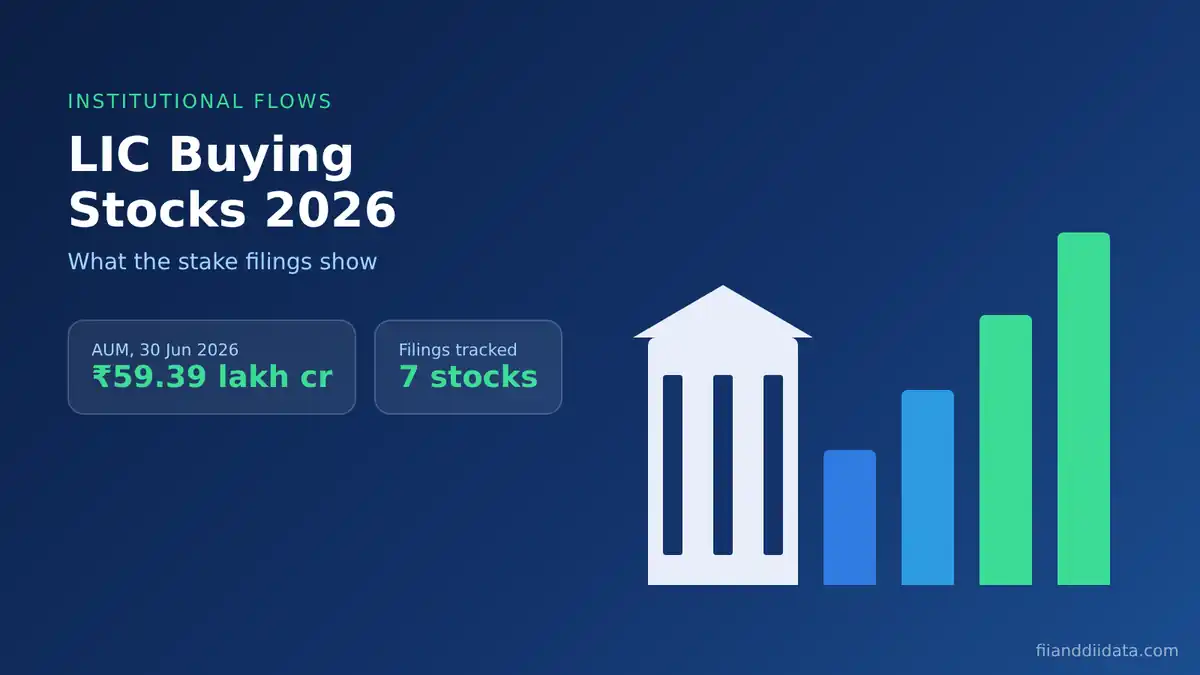
LIC buying stocks 2026 is easiest to follow through stake filings, and they show Life Insurance Corporation of India adding to state-owned power and banking names plus two consumer leaders. Between May and October 2026, LIC’s market purchases triggered disclosures in at least seven listed companies, from Central Bank of India to Britannia. Here is what each filing says, how to read one, and what it does and does not mean for your portfolio.
Key Takeaways
- LIC managed assets of ₹59.39 lakh crore on 30 June 2026, which makes every stake change worth watching.
- Seven 2026 filings show buying in Central Bank of India, NTPC, NHPC, REC, Power Grid, Maruti Suzuki and Britannia.
- Five of the seven are government-owned companies, a familiar LIC pattern.
- Most filings were triggered by tiny purchases that pushed LIC just past 5%, not by big new bets.
- LIC’s Q2 FY27 results are due from a board meeting on 5 November 2026; the September shareholding data will fill in the rest.
Table of contents
- What LIC buying stocks 2026 really means
- Why LIC’s buying matters for the market
- How to track LIC buying stocks in 2026
- LIC buying stocks 2026: the filings so far
- How to read an LIC stake filing
- What the 2026 pattern tells us
- A 5-step checklist before you follow LIC
- Common mistakes to avoid
- FAQs
- The Bottom Line
What LIC Buying Stocks 2026 Really Means
LIC is a domestic institutional investor, or DII. That puts it in the same group as mutual funds, banks, pension funds and other insurers, as we explain in our guide on the difference between FIIs and DIIs. It collects premiums from policyholders and invests a large part of that money in government bonds, corporate debt and listed shares.
Its size is the reason markets watch it. LIC reported assets under management of ₹59.39 lakh crore as of 30 June 2026, up 4.10% from ₹57.05 lakh crore a year earlier, according to its Q1 FY27 results released on 6 August 2026. Even a small shift in that book can move a mid-sized stock.
One point often gets mixed up. “LIC buying stocks” is about LIC investing in other companies. It is not the same as investors buying LIC’s own shares. In August 2026 the government sold a 6.5% stake in LIC through an offer for sale that raised ₹31,514.89 crore, and in the September quarter SBI group and ICICI group funds picked up stakes in LIC. Those are trades in LIC stock, not LIC’s own investments.
With that cleared up, the next question is why one investor’s trades deserve this much attention.
Why LIC’s Buying Matters for the Market
2026 has been a year of heavy foreign selling and steady domestic buying. DIIs as a group bought a net ₹5.13 trillion of Indian equities in calendar 2026 up to 7 August, compared with ₹4.48 trillion in the same period of 2025, according to data compiled by 5paisa. We track the full gap in our analysis of FII selling versus DII buying in 2026.
Daily exchange data shows DII buying only as one total. LIC is one of the largest names inside that total, but its trades are not reported separately each day. Stake filings and quarterly shareholding data are the only public way to see where LIC itself is putting money. That is why each filing gets reported and discussed.
LIC also has a long record of buying when others sell, and of supporting government share sales. That can steady a stock in a weak market. It does not guarantee that the stock will rise. The next section shows where these trades actually appear.
How to Track LIC Buying Stocks in 2026
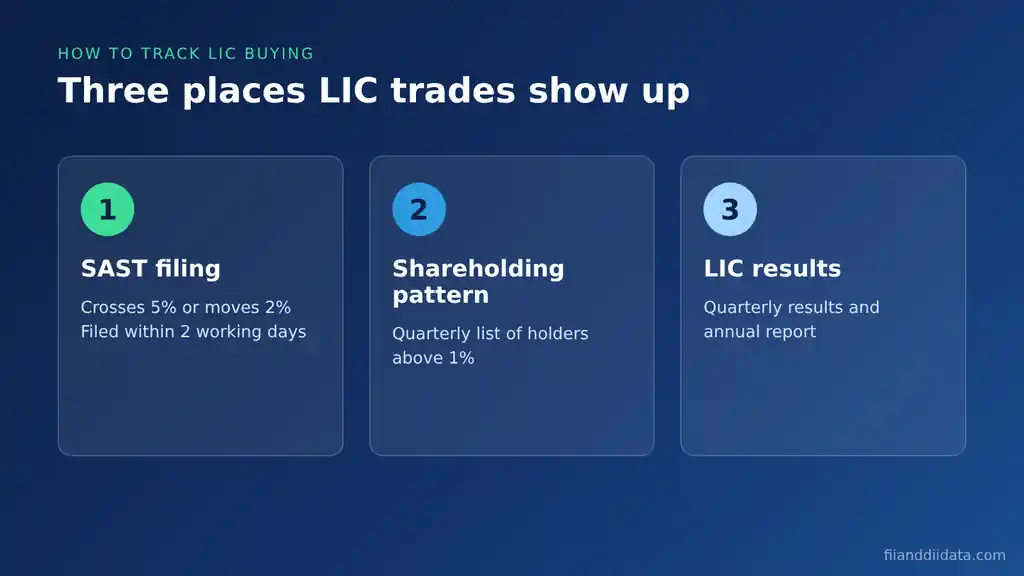
There are three public sources. Each one shows a different slice, and none of them shows everything.
1. SAST disclosures under Regulation 29
Under SEBI’s Substantial Acquisition of Shares and Takeovers (SAST) Regulations, 2011, an investor must disclose when its holding reaches 5% of a company. After that, it must disclose every change of 2% or more since its last disclosure. Both disclosures are due within two working days, as summarised in this Regulation 29 compliance chart. These filings appear on BSE and NSE and are the fastest signal of LIC buying.
2. Quarterly shareholding pattern
Every listed company files a shareholding pattern after each quarter. It names public shareholders who own more than 1%. Comparing two quarters shows whether LIC added or trimmed. Our guide to the shareholding pattern explains how to read the file. A drop below 1% makes LIC’s name disappear, which can look like a full exit when it may not be one.
3. LIC’s own results and disclosures
LIC’s quarterly results show total investments and income but not a stock-by-stock list. Its board meets on 5 November 2026 to approve results for the quarter ended 30 September 2026, as per its exchange filing dated 14 October, and its trading window stays closed until 7 November. With the sources clear, here is what the 2026 filings show.
LIC Buying Stocks 2026: The Filings So Far
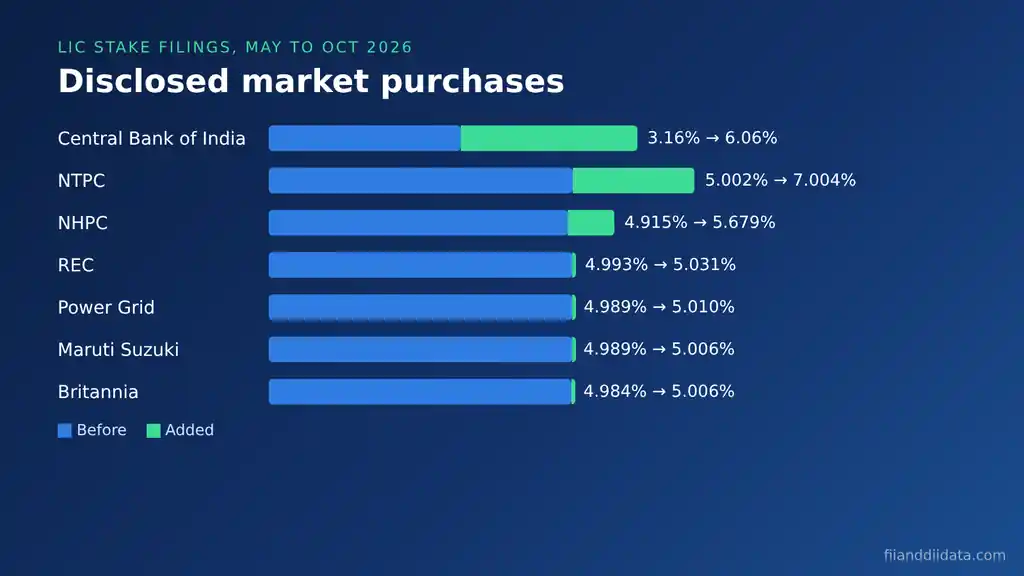
The table below lists the SAST filings we could verify from published reports of BSE and NSE disclosures. All were open market purchases. The list is not complete: LIC may have bought other stocks without crossing a disclosure line.
| Company | Purchase date | Shares bought | Stake before | Stake after |
|---|---|---|---|---|
| Central Bank of India | 22 May 2026 | 26.26 crore | 3.16% | 6.06% |
| NHPC | 2 Jun 2026 | 7.68 crore | 4.915% | 5.679% |
| Maruti Suzuki | 3 Jun 2026 | 51,750 | 4.989% | 5.006% |
| Power Grid | 17 Aug 2026 | 19.09 lakh | 4.989% | 5.010% |
| REC | 7 Sep 2026 | 9.93 lakh | 4.993% | 5.031% |
| Britannia | 16 Sep 2026 | 53,260 | 4.984% | 5.006% |
| NTPC | 10 Oct 2025 to 19 Oct 2026 | 19.41 crore | 5.002% | 7.004% |
Two filings stand out. In Central Bank of India, LIC bought 26.26 crore shares on 22 May 2026, the day the government launched an offer for sale of up to 8% of the bank, which was subscribed 2.36 times. In NTPC, LIC added 19.41 crore shares over about a year, taking its stake from 5.002% to 7.004%.
The other five filings look very different once you check the share counts. The worked example below shows why.
How to Read an LIC Stake Filing: A Worked Example
A headline such as “LIC raises stake above 5%” sounds like a strong buy call. The numbers inside the filing tell you whether it really was.
Example 1: an LIC buying stocks 2026 filing in REC
On 7 September 2026, LIC held 13,14,87,799 REC shares (4.993%). It bought 9,93,000 more, taking its holding to 13,24,80,799 shares (5.031%).
- Change in stake: 5.031% minus 4.993% = 0.038 percentage points.
- Growth in LIC’s own position: 9,93,000 divided by 13,14,87,799 = about 0.76%.
- Value, for illustration only: at an assumed price of ₹400 a share, 9,93,000 shares cost about ₹39.7 crore. Use the actual market price on the trade date for a real estimate.
For an investor with ₹59 lakh crore under management, that is a routine top-up. The filing exists because the purchase crossed 5%, not because the purchase was large. The same is true for Power Grid (+0.021 points), Britannia (+0.022 points) and Maruti Suzuki (+0.017 points).
Example 2: Central Bank of India
LIC’s stake rose from 3.16% to 6.06%, a jump of 2.90 percentage points. In relative terms, LIC’s holding grew by about 92% in a single session. This was a deliberate, sizeable purchase, made while the government was selling shares. That is the kind of filing that tells you something about LIC’s intent. With these two readings in hand, the broader pattern becomes easier to see.
What the 2026 Pattern Tells Us
A clear tilt to state-owned companies. Five of the seven names are government-controlled: Central Bank of India, NTPC, NHPC, REC and Power Grid. Three of them are power sector companies. LIC is itself majority government-owned, and buying into public sector share sales has long been part of its role.
Large, steady consumer names. Maruti Suzuki and Britannia are the two private companies on the list. Both top-ups were small, which suggests rebalancing rather than a new theme.
Buying and selling happen together. LIC trims as often as it adds. In the June 2025 quarter, for example, it raised stakes in 94 stocks and trimmed 72, ending with 345 listed holdings, as reported by Moneycontrol. In the September 2025 quarter it cut stakes in 94 companies and raised them in 68, according to Samco. Expect the same two-way activity in 2026, which is why one filing should never be read alone.
The full picture comes later. September 2026 shareholding patterns and LIC’s results will show the stocks where LIC changed holdings without a SAST trigger. We cover the wider domestic picture in our list of stocks where DIIs increased their stake in Q2 FY27. The checklist below turns all this into a routine you can follow.

A 5-Step Checklist Before You Follow LIC
- Check the filing itself. Read the date, the number of shares, and the stake before and after. Headlines often round these numbers.
- Size the trade. Work out the change in percentage points and in LIC’s own holding, as in the REC example. A 0.02-point top-up and a 2.9-point jump are not the same signal.
- Read the context. Was there a government offer for sale, an index change, or a results event? Purchases during an OFS reflect LIC’s role as much as its view on the stock.
- Check valuation. Compare the price with earnings, book value and peers. LIC invests for decades; your time frame may be weeks.
- Set your own plan. Decide your entry, stop-loss and holding period before you buy. Then track daily institutional flows on our FII and DII data dashboard and the FII DII data today page.
Even with a checklist, a few habits lead investors astray. Here are the most common ones.
Common Mistakes When Following LIC’s Trades
- Treating every 5% filing as a big bet. As shown above, most 2026 filings came from purchases worth a tiny fraction of LIC’s position.
- Ignoring the sell side. LIC trims dozens of holdings each quarter. A stock it bought last year may already be on its sell list.
- Reading a missing name as an exit. Below 1%, LIC simply drops out of the shareholding pattern.
- Copying the time frame. An insurer matching long-term policy liabilities can hold a falling stock for years. A trader cannot.
- Mixing up LIC stock news with LIC’s investments. The 2026 OFS and the stakes bought by SBI and ICICI group funds are about LIC shares, not LIC’s portfolio.
- Calling the data live. SAST filings arrive within two working days and shareholding data comes quarterly. Daily DII totals are released after market close, around 6 PM IST on trading days.
Event-driven flows add another layer. Our note on MSCI rebalancing in November 2026 covers how index changes, including those involving LIC’s own shares, can move prices. The FAQs below answer the questions readers ask most.
FAQs
Which stocks did LIC buy in 2026?
Verified SAST filings show market purchases by LIC in Central Bank of India, NHPC, Maruti Suzuki, Power Grid, REC, Britannia and NTPC between May and October 2026. Other purchases that did not cross a disclosure threshold will appear only in quarterly shareholding data.
Where can I see LIC buying stocks 2026 data?
Check SAST disclosures on the BSE and NSE corporate announcement pages, the quarterly shareholding pattern of each company, and LIC’s quarterly results. SAST filings are the quickest, since they are due within two working days.
Is LIC an FII or a DII?
LIC is a domestic institutional investor (DII). Its trades are included in the daily DII cash market figures that the exchanges publish after market close.
Should I buy a stock because LIC bought it?
Not on that basis alone. Many LIC filings reflect very small top-ups, and LIC invests for decades with policyholder money. Check the size of the purchase, the context and the valuation, and set your own plan first.
When will LIC announce its Q2 FY27 results?
LIC’s board is scheduled to meet on 5 November 2026 to approve results for the quarter ended 30 September 2026, as per its exchange filing dated 14 October 2026.
The Bottom Line
The 2026 filings show LIC doing what it usually does: supporting government-owned companies, taking part in state share sales and topping up large, stable businesses. Only two filings, Central Bank of India and NTPC, reflect sizeable new buying. The rest are small purchases that happened to cross the 5% line.
LIC’s buying is a useful input, not a trading signal on its own. A practical next step is to note the seven stocks above, then compare them with the September 2026 shareholding patterns and LIC’s Q2 FY27 numbers as they come in. For more data-led explainers, browse the FIIAndDIIData.com blog.
Sources: Kotak Neo, Central Bank of India stake (26 May 2026); PSU Connect, NTPC stake (22 Oct 2026); PSU Connect, NHPC (3 Jun 2026) and Maruti Suzuki (5 Jun 2026) filings; InvestyWise, Power Grid (18 Aug 2026), REC (8 Sep 2026) and Britannia (18 Sep 2026) filings; Kotak Neo, LIC Q1 FY27 results (7 Aug 2026); Goodreturns, LIC Q2 FY27 board meeting (23 Oct 2026); Business Standard, LIC OFS (16 Aug 2026); Trade Brains, stake purchases in LIC (4 Nov 2026); 5paisa, DII equity buying (10 Aug 2026); Legal Mantra, SAST Regulation 29; Moneycontrol, LIC Q1 FY26 portfolio changes; Samco, LIC Q2 FY26 portfolio changes (6 Nov 2025).
Disclaimer: This article is for educational purposes only and is not investment advice. Please consult a SEBI-registered advisor before making investment decisions.