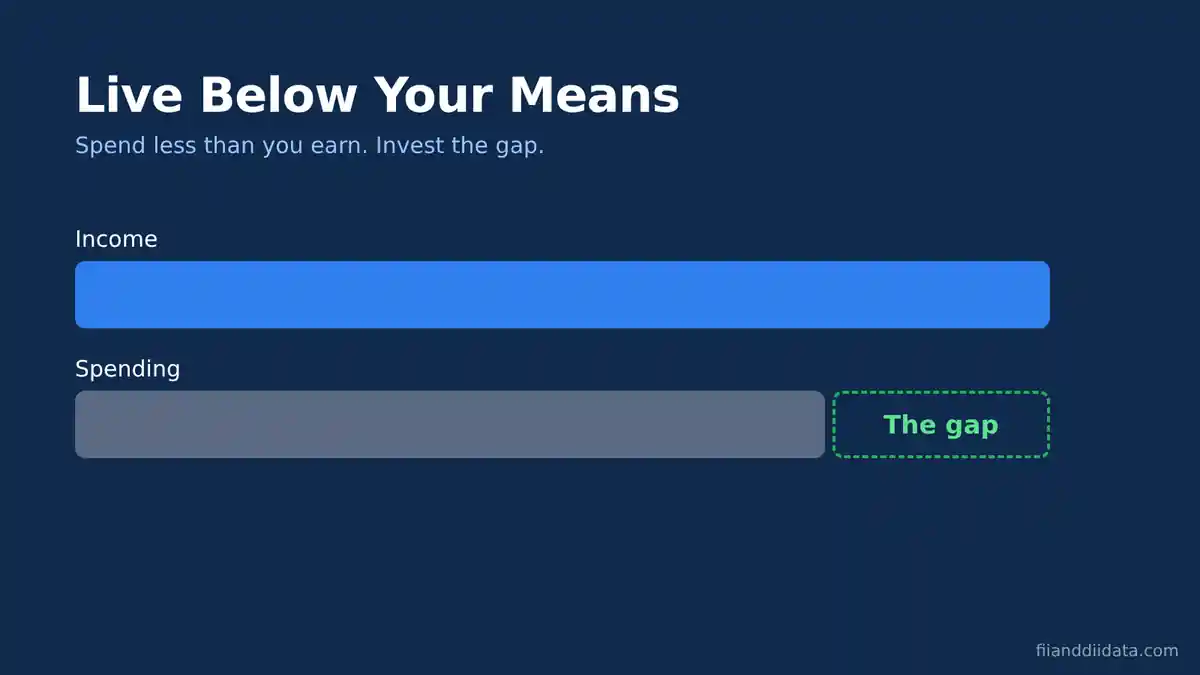
How to live below your means comes down to one rule: spend less than you take home every month and send the gap to savings before you spend it. That habit matters more now, because retail inflation rose to 5.54% in September 2026 and food inflation to 7.74%, according to the government’s latest CPI release. This guide gives you a simple test, seven steps and a worked ₹60,000 salary plan.
Key Takeaways
- Living below your means means your spending stays clearly under your take-home pay, not just equal to it.
- A savings rate of 20% or more is a sound target; under 10% means you are close to living at your means.
- Retail inflation was 5.54% in September 2026, so fixed savings habits lose ground unless they grow.
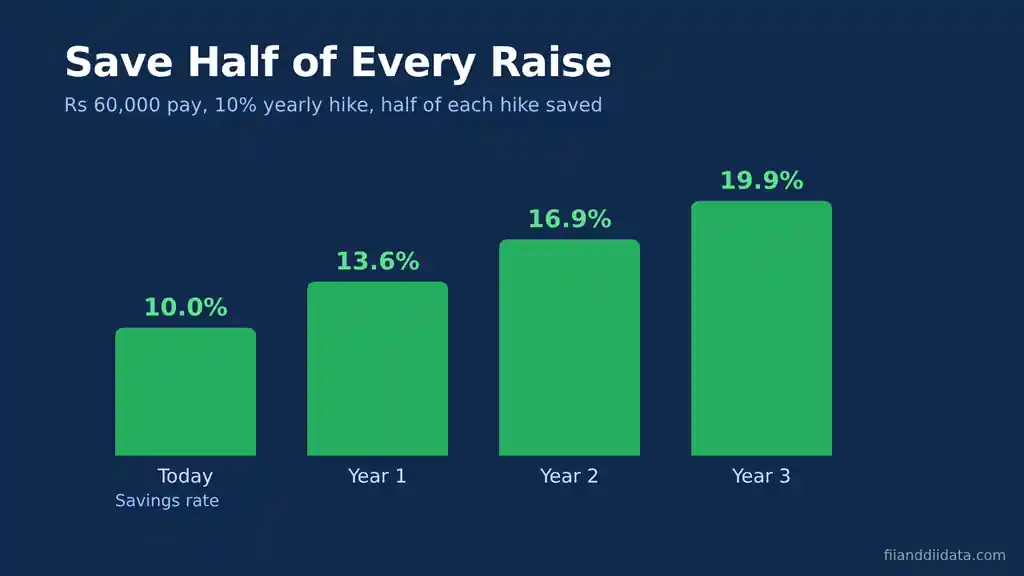
- Saving half of every pay hike can lift a 10% savings rate to about 20% in three years.
- Fix the big three costs first: housing, transport and loan EMIs.
- What living below your means really means
- The means test: check where you stand
- Why it matters more when prices rise
- How to live below your means in 7 steps
- Cut the big three costs first
- The raise rule: a worked example
- Common mistakes when you try to live below your means
- A monthly checklist
- FAQs
- The Bottom Line
What Living Below Your Means Really Means
Living below your means is a gap, not a lifestyle label. If your take-home pay is ₹60,000 and you spend ₹60,000, you are living at your means. If you spend ₹48,000 and save or invest ₹12,000, you are living below them. The gap is what pays for emergencies, goals and, later, financial independence.
It does not mean being cheap or giving up everything you enjoy. It means choosing a spending level that your income can carry with room to spare, and then protecting that room. The National Centre for Financial Education (NCFE) puts it simply: a budget helps you see what is actually spent each month, which shows you what can be trimmed. You can read its guidance on financial planning basics.
So how do you know which side of the line you are on today? The next section gives you a two-minute test.
The Means Test: Check Where You Stand
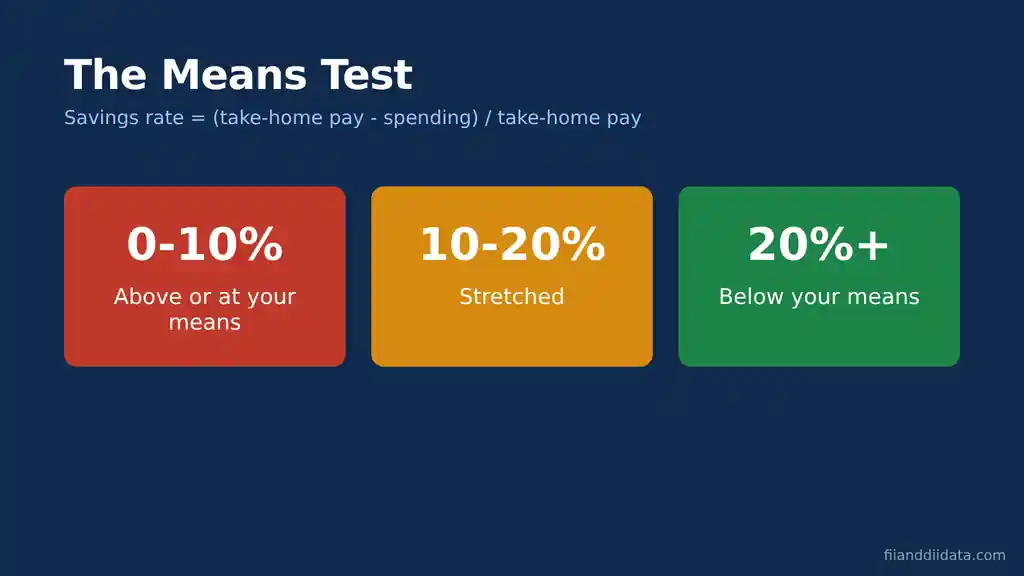
Your savings rate is the clearest measure. Use this formula: savings rate = (take-home pay minus spending) divided by take-home pay. Count only money that leaves your account for savings, investments or extra loan prepayment as “saved”.
Worked example: a ₹60,000 take-home salary
Say Rohit earns ₹60,000 a month after tax and PF. His rent, groceries, EMI, fuel, bills, eating out and shopping add up to ₹54,000. His savings rate is (₹60,000 minus ₹54,000) divided by ₹60,000, which is 10%. He is not in debt, but one job loss or hospital bill would push him there.
To reach a 20% savings rate, Rohit needs to cap his monthly spending at ₹48,000. That is a cut of ₹6,000 a month, or about ₹200 a day. It sounds hard, but most of it can come from two or three decisions rather than daily sacrifice, as we show below.
| Savings rate | What it signals | Next move |
|---|---|---|
| Below 0% | Living above your means | Stop new debt, list every EMI and cut one fixed cost |
| 0% to 10% | At or near your means | Track spending for 30 days and set a spending cap |
| 10% to 20% | Stretched but positive | Automate savings on salary day and apply the raise rule |
| 20% and above | Living below your means | Build a six-month buffer and invest the surplus |
Once you know your number, the next question is why a 10% savings rate is not enough. The answer is inflation.
Why It Matters More When Prices Rise
Prices in India are rising faster than a few months ago. The Ministry of Statistics and Programme Implementation (MoSPI) reported in its October 2026 release that all-India CPI inflation rose to 5.54% in September 2026, up from 4.83% in August. Food inflation jumped to 7.74% from 5.97%. You can check the figures in the official CPI press release.
| Measure (all-India, combined) | August 2026 (final) | September 2026 (provisional) |
|---|---|---|
| Headline CPI inflation | 4.83% | 5.54% |
| Rural CPI inflation | 5.24% | 6.08% |
| Urban CPI inflation | 4.31% | 4.88% |
| Food inflation (CFPI) | 5.97% | 7.74% |
Inflation hurts people who live at their means the most. If your household spends ₹40,000 a month today and prices rise at an assumed 6% a year, the same lifestyle would cost about ₹71,600 a month in 10 years and about ₹1.28 lakh in 20 years. Your income has to keep pace just to stand still. A savings gap gives you the buffer to absorb price shocks without borrowing.
The good news is that you control the gap. Here is how to build it.
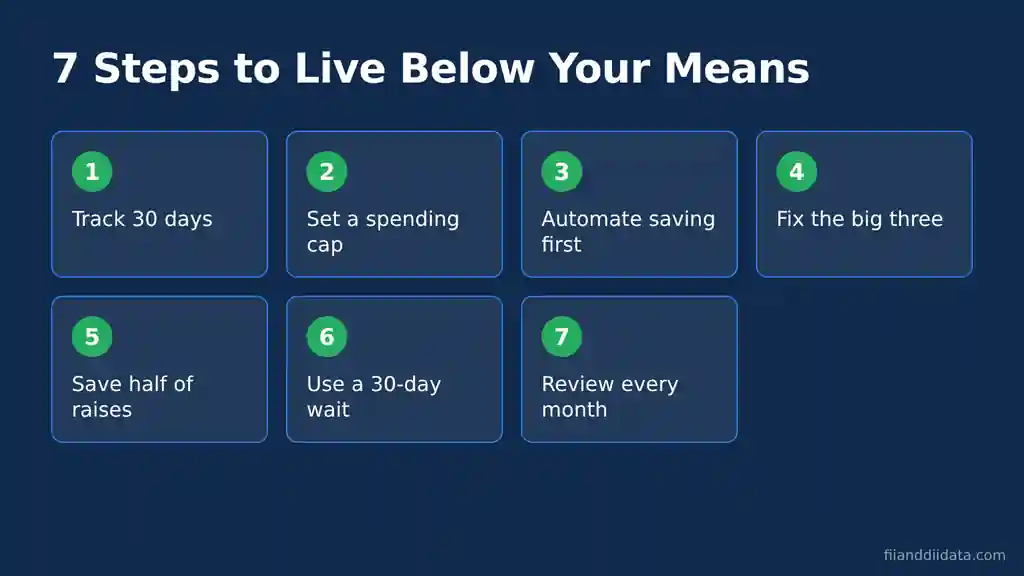
How to Live Below Your Means in 7 Steps
These steps work best in order. Each one makes the next easier, and none of them asks you to give up everything you enjoy.
Step 1: Track every rupee for 30 days
Before you cut anything, find out where the money goes. Use your bank app, a UPI spending summary or a simple notebook. Our guide on how to track monthly expenses lists six methods. Most people find two or three leaks they did not know about, such as unused subscriptions or frequent food delivery.
Step 2: Set a spending cap, not just a savings target
Decide the maximum you will spend each month, based on your target savings rate. For Rohit, that cap is ₹48,000. Split it into fixed costs (rent, EMI, school fees) and flexible costs (food, travel, shopping). A written monthly budget makes the cap real.
Step 3: Pay yourself first on salary day
Set up an auto-debit or standing instruction so savings leave your account the day your salary arrives. A SIP, a recurring deposit or a transfer to a separate savings account all work. What you do not see, you do not spend.
Step 4: Fix the big three before small expenses
Housing, transport and loan EMIs usually take the biggest share of income. One good decision here saves more than a hundred small ones. We cover this in detail in the next section.
Step 5: Save half of every raise
When your salary rises, raise your SIP or savings transfer by half of the hike before you upgrade anything. You still enjoy a better lifestyle, but your savings rate climbs every year.
Step 6: Use a 30-day wait for big wants
For any non-essential purchase above a set amount, say ₹5,000, write it down and wait 30 days. If you still want it and the money is in your flexible budget, buy it. Many impulse wants fade within a week.
Step 7: Review once a month
Spend 20 minutes at the end of each month comparing actual spending with your cap. Adjust one category at a time. Small monthly corrections stop lifestyle creep before it settles in.
Step 4 deserves a closer look, because it is where most of the savings hide.
Cut the Big Three Costs First
Small cuts like skipping coffee add up slowly. Big fixed costs set your baseline for years. Get these three right and living below your means becomes the default.
- Housing: moving from a ₹22,000 flat to a ₹15,000 flat saves ₹7,000 a month, or ₹84,000 a year. Even a smaller upgrade than planned makes a large difference.
- Transport: a car bought on a long EMI adds fuel, insurance and upkeep on top of the instalment. Price the full monthly cost before you buy, not just the EMI.
- Loan EMIs: NCFE gives the example of a person with no loans a decade ago who now pays almost ₹40,000 a month in instalments alone, which leaves little room to adjust. Keep total EMIs to a level that still lets you save every month.
With fixed costs under control, every future raise can go further. The next section shows how much further.
The Raise Rule: A Worked Example
Let us go back to Rohit. He takes home ₹60,000, spends ₹54,000 and saves ₹6,000 (a 10% savings rate). Assume he gets a 10% raise every year and saves half of each raise while spending the other half.
| Year | Take-home pay | Monthly savings | Savings rate |
|---|---|---|---|
| Today | ₹60,000 | ₹6,000 | 10.0% |
| Year 1 | ₹66,000 | ₹9,000 | 13.6% |
| Year 2 | ₹72,600 | ₹12,300 | 16.9% |
| Year 3 | ₹79,860 | ₹15,930 | 19.9% |
In three years his spending rises from ₹54,000 to about ₹63,900, so his lifestyle improves. Yet his savings rate doubles to almost 20%. That is how to live below your means without feeling deprived: you never cut, you just grow spending slower than income.
The extra savings compound. As an illustration only, ₹5,000 a month invested for 15 years at an assumed 10% yearly return grows to about ₹20.9 lakh, against ₹9 lakh actually invested. Returns are not guaranteed, and equity investments can fall in value. If you invest through mutual funds, it helps to understand how money flows into Indian markets, which our FII and DII data pages track daily.
Good habits can still fail if you fall into a few common traps.
Common Mistakes When You Try to Live Below Your Means
- Cutting everything at once. Extreme budgets rarely last. Keep a small amount for things you enjoy so the plan survives.
- Skipping insurance to save money. One uninsured hospital stay can wipe out years of savings. Health and term cover protect the gap you build.
- Treating credit as income. NCFE warns that credit cards and buy-now-pay-later schemes can encourage overspending. If you cannot pay the full bill, you cannot afford the purchase.
- Forgetting yearly costs. School fees, insurance premiums and festival spending arrive once a year. Divide them by 12 and save for them monthly.
- Letting savings sit idle. Money parked in a low-interest account loses value to inflation. Match each rupee to a goal and a suitable product.
Our list of common money mistakes covers more traps. To make the habit stick, use the short checklist below.
A Monthly Checklist
- Savings left your account on salary day.
- Total spending stayed under your monthly cap.
- Total EMIs are at a level that still leaves room to save.
- No new credit card balance was carried forward.
- Emergency fund is growing toward 3 to 6 months of expenses (₹1.62 lakh to ₹3.24 lakh for ₹54,000 spending).
- One spending category was reviewed and adjusted.
- Any raise or bonus was split, with at least half saved.
If you can tick five of these seven each month, you are living below your means. For more ways to grow the gap, read our guide on how to save money every month.
FAQs
How to live below your means on a low salary?
Start by tracking spending for 30 days, then save a fixed amount on salary day, even if it is only 5% of pay. Cut the largest fixed cost you can, such as rent or a costly phone plan, and raise savings by half of every pay hike.
Is living below your means the same as being frugal?
Not quite. Frugality is about spending carefully on each item. Living below your means is about the overall gap between income and spending. You can spend freely on things you value and still live below your means if the total stays under your cap.
What percentage of income should I save in India?
A common planning target is 20% or more of take-home pay. If that is not possible yet, start with 10% and increase it each year using the raise rule. The right number also depends on your goals, age and existing debt.
How do I know if I am living above my means?
Warning signs include carrying a credit card balance, using one loan to pay another, having no emergency fund, and running out of money before the next salary. A negative or near-zero savings rate confirms it.
Can I live below my means and still enjoy life?
Yes. Keep a fixed fun budget inside your spending cap and spend it without guilt. The aim is to protect the gap between income and spending, not to remove every treat.
The Bottom Line
Living below your means is less about cutting and more about controlling the gap between what you earn and what you spend. With CPI inflation at 5.54% in September 2026, a household that spends every rupee it earns has no buffer when prices rise.
Start with your savings rate. If it is under 10%, track spending for 30 days, set a cap and automate savings on salary day. Then let every raise widen the gap. Over time, that gap becomes your emergency fund, your goals and your financial freedom number.
Your next step: work out your savings rate today using last month’s bank statement. More personal finance guides are on our blog.
Sources: MoSPI CPI press release for September 2026 (PIB); National Centre for Financial Education, Financial Planning FAQs. Example calculations by FIIAndDIIData.com.
Disclaimer: This article is for educational purposes only and is not investment advice. Please consult a SEBI-registered advisor before making investment decisions.