To learn how to achieve financial freedom, start with one number: your yearly expenses multiplied by 30. Once your investments reach that figure, they can pay your bills while you choose how much to work. With retail inflation at 5.54% in September 2026 and PPF still at 7.1% for October to December 2026, the gap between safe returns and rising prices is thin, so a clear plan matters more than ever.
Key Takeaways
- Financial freedom means your investments cover your living costs, so a job becomes a choice.
- A practical Indian target is 30 times your yearly expenses, which implies a withdrawal rate near 3.3%.
- Your savings rate decides the timeline more than returns: 20% takes about 45 years, 50% about 20 years in our model.
- PPF at 7.1% earns only about 1.5% above September 2026 inflation, so long-term goals need some equity.
- Protect the plan first with an emergency fund, term cover and health insurance.
Table of contents
- What financial freedom means
- How to calculate your financial freedom number
- Why savings rate matters more than returns
- How to achieve financial freedom in 7 steps
- Worked example: a ₹60,000 household
- Where safe returns stand in October 2026
- Common mistakes that delay freedom
- Financial freedom checklist
- FAQ
- The Bottom Line
What Financial Freedom Means
Financial freedom is the point where income from your savings and investments pays for your lifestyle. You may still work, but you no longer need a salary to pay rent, school fees or groceries. Many people also call this financial independence, or FI.
It is not the same as being rich. A family that spends ₹40,000 a month can become free with a far smaller corpus than one that spends ₹2 lakh. That is why the goal starts with your spending, not with someone else’s net worth.
Three levels of freedom
- Security: your corpus covers basic needs such as housing, food, utilities and insurance.
- Independence: it covers your current lifestyle, including travel and hobbies.
- Abundance: it covers your lifestyle with a buffer for gifts, upgrades and surprises.
Most people aim for independence first. Security is a useful milestone on the way because it removes the fear of a job loss. Next, we turn that idea into a number you can track.
How to Achieve Financial Freedom: Calculate Your Number
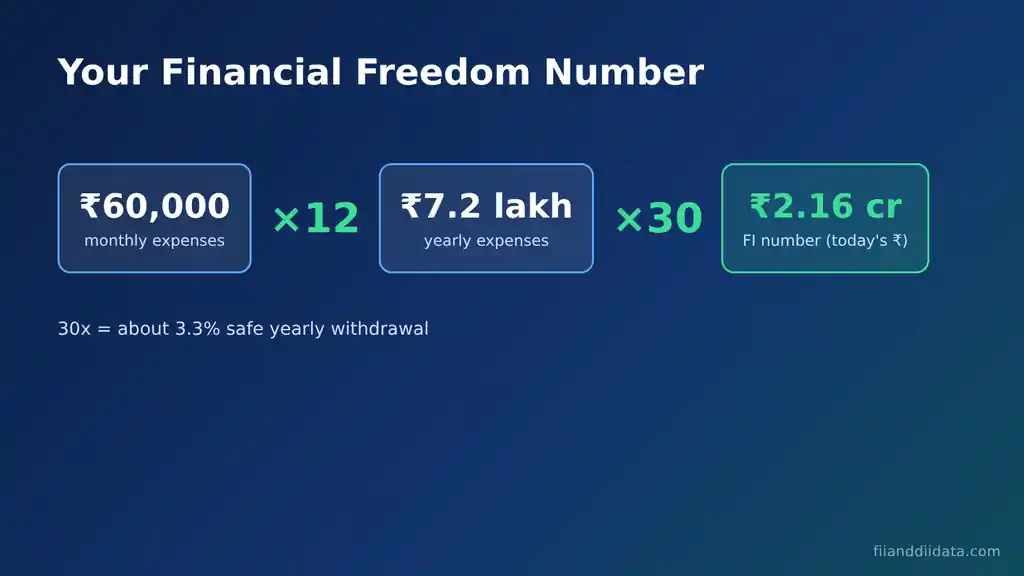
Your financial freedom number, or FI number, is the corpus that can fund your yearly expenses for life. The formula is simple: monthly expenses × 12 × 30.
Many global articles use 25 times expenses, based on the 4% withdrawal rule drawn from US market history. We prefer 30 times for Indian readers. Our inflation has usually run higher than in the US, and a longer retirement in your 40s or 50s needs a safer withdrawal rate. Thirty times expenses means you withdraw about 3.3% of the corpus in the first year.
Quick FI number calculation
A household spending ₹60,000 a month spends ₹7.2 lakh a year. At 30 times, its FI number is ₹2.16 crore in today’s money. At 25 times, it would be ₹1.8 crore, which leaves less room for bad market years.
Keep three adjustments in mind. Add any big future costs, such as a child’s college fees, as separate goals. Subtract any assured pension income from your yearly expenses before you multiply. And remember that this figure is in today’s rupees, so it will grow with inflation each year.
Once you know the target, the next question is how fast you can reach it. The answer depends mostly on one ratio.
Why Savings Rate Matters More Than Returns
Your savings rate is the share of take-home pay you invest each month. It works twice: a higher rate adds more money to your corpus, and it also lowers the expenses the corpus must cover. That double effect makes it the strongest lever you control.
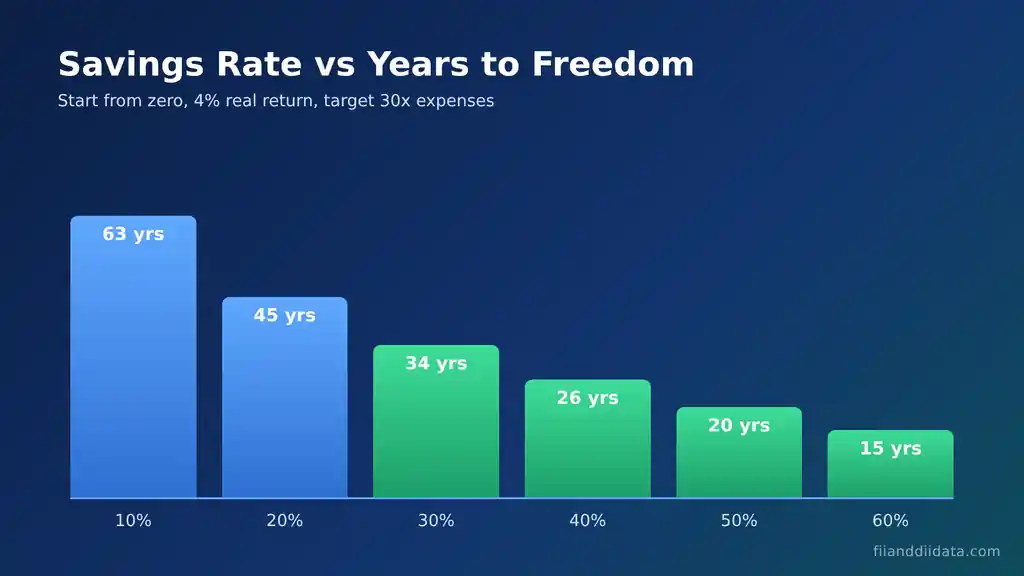
We modelled a person starting from zero, earning a 4% return above inflation and aiming for 30 times their yearly spending. The table shows how many years it takes at each savings rate.
| Savings rate | Years to financial freedom |
|---|---|
| 10% | About 63 |
| 20% | About 45 |
| 30% | About 34 |
| 40% | About 26 |
| 50% | About 20 |
| 60% | About 15 |
Moving from 20% to 30% cuts roughly 11 years. A one-point gain in returns rarely does that, and returns are not in your control. Raising your savings rate is. If you need help getting started, our guide on how to save money every month breaks it into small steps.
With the target and the main lever clear, here is the full plan.
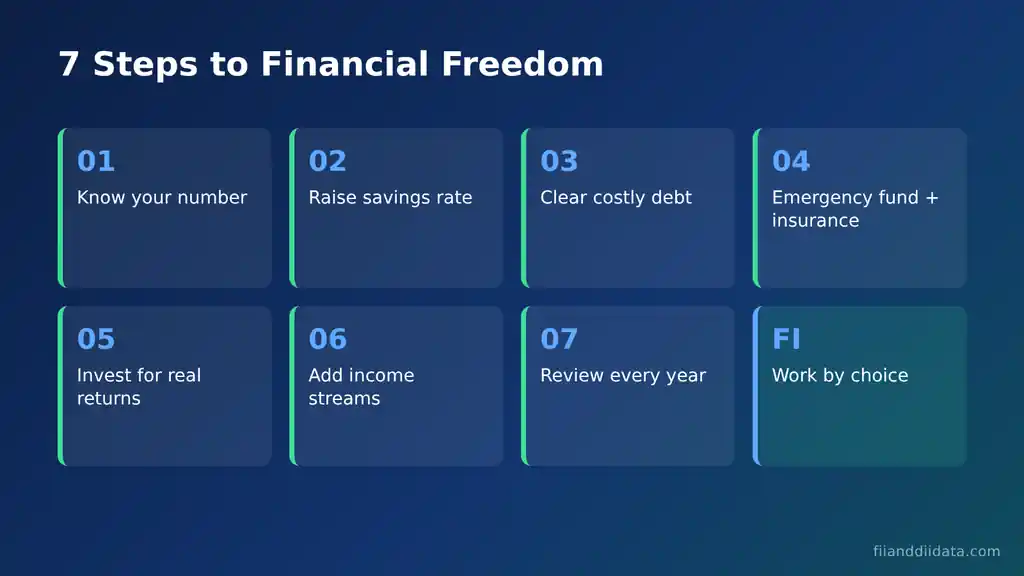
How to Achieve Financial Freedom in 7 Steps
1. Track spending for 90 days
You cannot calculate an FI number without real expense data. Track every rupee for three months, including yearly bills such as insurance premiums and school fees divided by 12. Use the average as your monthly figure.
2. Raise your savings rate step by step
Automate a SIP or recurring deposit on salary day so saving happens before spending. Then commit to investing at least half of every pay rise. This keeps lifestyle growth slower than income growth.
3. Clear costly debt
Credit card dues and personal loans often cost more than any investment can safely earn. Pay these off before you raise equity investments. A home loan is different because its rate is lower and it builds an asset, but plan to close it before your target date.
4. Build an emergency fund and buy insurance
Keep six months of expenses in a savings account, sweep FD or liquid fund. Buy a term plan if anyone depends on your income, and a health policy separate from your employer’s cover. One hospital bill or a lost job should not force you to sell investments in a falling market.
5. Invest for returns above inflation
Use EPF, PPF and NPS for a stable base, and diversified equity mutual funds for growth over 10 years or more. Equity markets swing with global events and large institutional flows, which you can follow on our FII and DII data page, but long holding periods smooth much of that noise.
6. Add a second income stream
Freelance work, tutoring, rental income or a small business can speed up the plan. Even ₹10,000 a month of side income, fully invested, raises your savings rate without cutting your lifestyle.
7. Review once a year
Each year, update your expenses, raise your FI number for inflation, rebalance your asset mix and check insurance cover. A yearly review keeps the plan honest. Our guide to financial planning for beginners includes a simple review template.
Steps are easier to follow with real numbers, so let us run one household through the plan.
Worked Example: A ₹60,000 Household
Take a 32-year-old couple whose household spends ₹60,000 a month and who want freedom in 20 years, at 52. Here is how the numbers work.
- Today’s FI number: ₹60,000 × 12 × 30 = ₹2.16 crore.
- Adjust for inflation: at an assumed 6% a year, monthly spending grows to about ₹1.92 lakh in 20 years. The FI number becomes about ₹6.93 crore.
- Flat SIP needed: about ₹70,000 a month at an assumed 12% yearly return, or about ₹91,200 at 10%.
- Step-up SIP needed: if they raise the SIP by 10% every year, they can start at about ₹35,200 a month at 12%, or about ₹43,300 at 10%.
- Emergency fund first: six months of expenses, or ₹3.6 lakh, kept outside the FI corpus.
The step-up route is the more realistic path for most salaried families, because it matches rising pay. The 6% inflation and 10% to 12% returns are assumptions, not forecasts. Markets can deliver less, so build in a margin and recalculate every year.
If a starting SIP of ₹35,000 sounds out of reach, start smaller and grow it. Our article on building wealth from scratch shows how to begin with a modest salary. Next, let us check what safe options pay right now.
Where Safe Returns Stand in October 2026
The Ministry of Finance kept small savings rates unchanged for 1 October to 31 December 2026 in an office memorandum dated 30 September 2026. Retail inflation, measured by the Consumer Price Index, rose to 5.54% in September 2026 from 4.83% in August, with food inflation at 7.74%. The table compares safe options with that inflation reading.
| Option | Rate | Return above 5.54% inflation |
|---|---|---|
| Post office savings account | 4.0% | About -1.5% |
| 5-year post office RD | 6.7% | About 1.1% |
| PPF | 7.1% | About 1.5% |
| NSC | 7.7% | About 2.0% |
| EPF (FY 2025-26) | 8.25% | About 2.6% |
| Senior Citizens Savings Scheme | 8.2% | About 2.5% |
The lesson is plain. Safe options protect capital, but after tax most of them only just beat inflation. That is why the worked example assumes some equity exposure for a 20-year goal, while short-term money stays in safe products.
Rates and returns are only half the story. Behaviour causes most delays, which brings us to the common mistakes.
Common Mistakes That Delay Financial Freedom
- Using today’s number for a future date. A ₹2.16 crore target today becomes about ₹6.93 crore after 20 years at 6% inflation.
- Ignoring health costs. Without your own health cover, one illness can wipe out years of savings.
- Lifestyle creep. Spending every raise keeps the savings rate flat, so the date never moves closer.
- Keeping everything in FDs. Returns barely above inflation make the corpus grow too slowly.
- Taking too much risk near the finish line. A market fall just before your target date can push it back by years.
- Stopping SIPs in a falling market. Selling or pausing in a correction locks in losses.
We cover more of these in our list of common money mistakes Indian earners make. Now, a short checklist to put all of this into action.
How to Achieve Financial Freedom: A 10-Point Checklist
- Track 90 days of spending and find your true monthly average.
- Calculate your FI number at 30 times yearly expenses.
- Pick a target age and convert the number into future rupees.
- Set your savings rate and automate it on salary day.
- Close credit card and personal loan dues.
- Keep six months of expenses as an emergency fund.
- Buy term cover and an independent health policy.
- Split long-term money between safe products and diversified equity.
- Invest at least half of every pay rise or bonus.
- Review the plan every year and rebalance.
Below are answers to the questions readers ask most often.
FAQ
How to achieve financial freedom on a salary in India?
Track your expenses, set a target of about 30 times yearly spending, automate a monthly SIP, clear costly debt, keep an emergency fund and insurance, and raise your investment by at least half of every pay rise. A higher savings rate shortens the timeline the most.
How much money do I need to be financially free in India?
A common rule is 25 times yearly expenses, but we suggest 30 times for India because of higher inflation and longer retirements. A household spending Rs 60,000 a month needs about Rs 2.16 crore in today’s money.
What is the 4% rule for financial freedom?
The 4% rule says you can withdraw 4% of your corpus in the first year and adjust for inflation afterwards. It comes from US market history. A 3% to 3.5% rate, which matches 30 times expenses, offers more safety in India.
How long does it take to become financially free?
It depends mostly on your savings rate. In our model with a 4% real return, saving 20% of income takes about 45 years, 40% takes about 26 years and 50% takes about 20 years.
Is financial freedom the same as early retirement?
No. Financial freedom means you do not need a salary to cover your costs. Many people keep working after reaching it, often in work they enjoy more. Early retirement is one way to use that freedom.
The Bottom Line
Financial freedom is a number, not a feeling. Multiply your yearly expenses by 30, convert that figure into future rupees, and work backwards to a monthly investment you can sustain. Your savings rate will move the date more than any fund choice.
Safe products such as PPF and EPF give a stable base, but with inflation at 5.54% in September 2026 they leave little real growth. A balanced mix, solid insurance and a yearly review give you the best chance of getting there on time.
Your next step: track your spending for the next 90 days and calculate your own FI number. For more help, browse our personal finance guides.
Sources: MoSPI, CPI press release for September 2026; Business Today, small savings rates for Oct-Dec 2026 (Ministry of Finance OM, 30 Sep 2026); Business Today, EPFO 8.25% rate for FY 2025-26 (2 Mar 2026). Disclaimer: This article is for educational purposes only and is not investment advice. Please consult a SEBI-registered advisor before making investment decisions.