The best financial goals for beginners are specific, priced and dated: a fully funded emergency fund, one or two short-term purchases, and an early start on retirement. A goal with a rupee figure, a deadline and a monthly amount gets done; a wish to “save more” does not. Prices are moving fast, too. Retail inflation in India was 5.54% in September 2026, as per MoSPI data released on 12 October 2026, so every goal needs an inflation-adjusted target. This guide shows how to set one, step by step.
Key Takeaways
- A financial goal needs four things: a name, a cost, a date and a monthly amount.
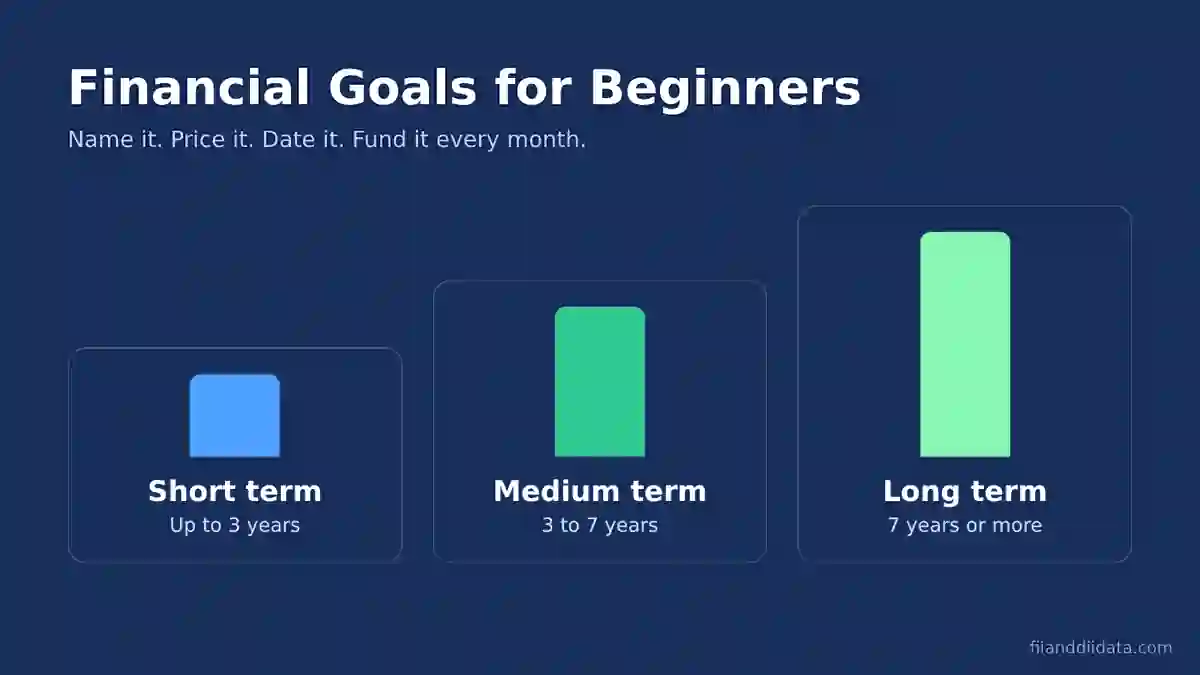
- Sort goals by time: up to 3 years, 3 to 7 years, and 7 years or more.
- At 6% inflation, a ₹10 lakh goal costs about ₹17.91 lakh in 10 years.
- Starting three years late can raise the monthly amount for that goal from ₹8,742 to ₹14,806.
- Build the emergency fund first, then fund other goals in order of date and importance.
Table of contents
- What are financial goals?
- How to set financial goals for beginners: 6 steps
- Short, medium and long-term goals
- Why inflation changes every goal
- Financial goals for beginners: a ₹60,000 salary example
- Where to keep money for each goal
- Common goal-setting mistakes
- A one-page goal checklist
- Frequently asked questions
- The Bottom Line
What Are Financial Goals?
A financial goal is a future expense or target that you plan and fund in advance. Buying a laptop next year is a goal. So is a home down payment in eight years, or retiring at 60 with enough income to live on. The difference between a goal and a hope is detail: you know what it costs, when you need the money, and how much to set aside each month.
Goals turn a budget into a purpose. Without them, savings sit in a bank account with no job and are easy to spend. With them, each rupee has a destination. If you have not made a budget yet, start with our guide on how to create a monthly budget, because goals are funded from the gap between income and spending.
What makes a goal SMART
A common test is the SMART framework: Specific, Measurable, Achievable, Relevant and Time-bound. “Save for a car” fails the test. “Save ₹3 lakh for a car down payment by March 2029 by putting aside ₹8,000 a month” passes it. The six steps below turn any wish into a SMART goal.
How to Set Financial Goals for Beginners: 6 Steps
Follow these steps for each goal. Write the answers down; a goal on paper is harder to ignore.
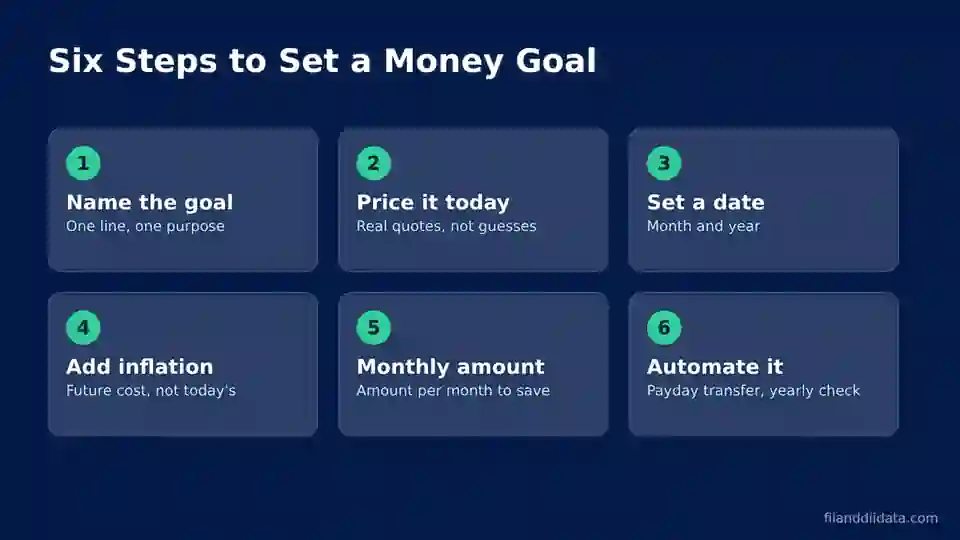
1. Name the goal
Use one line and one purpose: “Emergency fund”, “Laptop”, “Home down payment”. Avoid mixing goals in one pot, because you will not know which one is on track.
2. Price it in today’s money
Get a real quote, not a guess. Check current laptop prices, ask a bank what down payment a home loan needs, or add up six months of your essential expenses for an emergency fund.
3. Set a target date
Pick a month and year. The date decides the time horizon, and the time horizon decides where the money should be kept.
4. Add inflation
Convert today’s price into the price on the goal date. The formula is: future cost = today’s cost × (1 + inflation rate) ^ years. At 6%, a ₹80,000 laptop bought two years from now costs about ₹89,888.
5. Find the monthly amount
Divide the future cost into monthly instalments, allowing for the return your savings may earn. Any SIP or RD calculator does this. You can also work backwards: if the monthly figure is too high, push the date out or lower the target.
6. Automate it and review once a year
Set a standing instruction, recurring deposit or SIP for the day after your salary credit. Review every goal once a year, or after a raise, a new job or a change in family plans.
Short, Medium and Long-Term Financial Goals
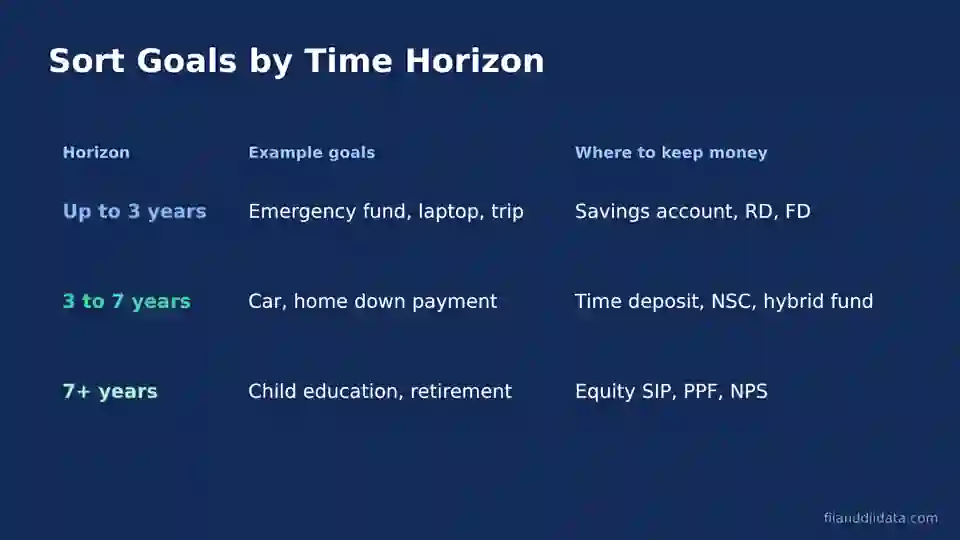
Sorting goals by time horizon is the most useful thing a beginner can do, because time decides how much risk the money can take. Definitions vary between planners; we use the bands below.
| Type | Time horizon | Typical goals | Risk the money can take |
|---|---|---|---|
| Short term | Up to 3 years | Emergency fund, laptop or phone, a trip, clearing a credit card balance | Very low |
| Medium term | 3 to 7 years | Car, home down payment, higher studies, wedding | Low to moderate |
| Long term | 7 years or more | Child’s education, retirement, financial freedom | Moderate to high |
Short-term financial goals for beginners come first
For most first-time earners, the order is simple. First, an emergency fund of three to six months of essential expenses. Second, clear any high-interest debt, such as a credit card balance. Third, start a small long-term investment, even ₹1,000 to ₹3,000 a month, so that time works for you. Medium-term goals like a car can then be added as income grows.
Long-term goals are where beginners gain the most by starting early, but they are also the goals most often delayed. The next section shows why delay is expensive.
Why Inflation Changes Every Goal
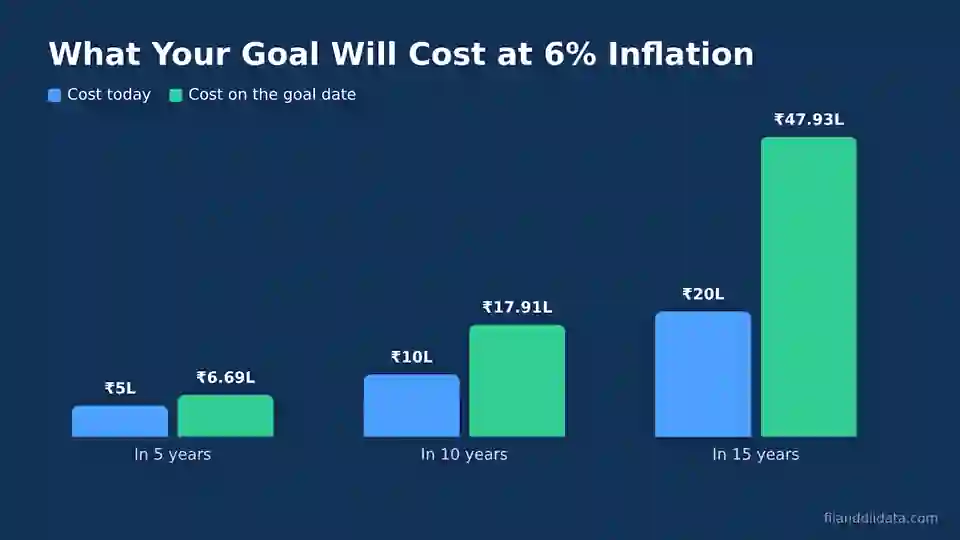
Inflation is the rise in the general price level. The Consumer Price Index rose 5.54% year on year in September 2026, with food prices up 7.74%, according to the MoSPI release published on PIB on 12 October 2026. For planning, many people use a round 6% a year. That is an assumption, not a forecast, and some costs such as education often rise faster.
| Cost today | Years to goal | Cost at 5.54% inflation | Cost at 6% inflation |
|---|---|---|---|
| ₹5,00,000 | 5 | ₹6,54,720 | ₹6,69,113 |
| ₹10,00,000 | 10 | ₹17,14,632 | ₹17,90,848 |
| ₹20,00,000 | 15 | ₹44,90,414 | ₹47,93,116 |
The cost of starting late
Take a goal that costs ₹10 lakh today and is due in 10 years. At 6% inflation it will cost about ₹17.91 lakh. If your investments earn an assumed 10% a year, you need about ₹8,742 a month starting now. Wait three years and you need about ₹14,806 a month for the remaining seven years. You would also put in more of your own money: about ₹12.44 lakh in total instead of ₹10.49 lakh. Returns of 10% are not guaranteed; the point is the gap, which appears at any rate.
Financial Goals for Beginners: A ₹60,000 Salary Example
Meet Ananya, 26, who takes home ₹60,000 a month and has essential monthly costs of ₹25,000. She has four goals. The figures below are an illustration, not a recommendation; the return rates are assumptions, and all numbers were computed on 30 October 2026.
| Goal | Cost today | When | Cost on goal date (6% inflation) | Assumed return | Monthly amount |
|---|---|---|---|---|---|
| Emergency fund (6 months) | ₹1,50,000 | In 2 years | ₹1,50,000 (target) | Not counted | ₹6,250 |
| Laptop | ₹80,000 | In 2 years | ₹89,888 | 6.5% | ₹3,517 |
| Retirement (starter SIP) | Open-ended | In 34 years | Grows with step-ups | 10% | ₹3,000 |
| Home down payment | ₹10,00,000 | In 9 years | ₹16,89,479 | 10% | ₹13,968 from year 3 |
How Ananya phases her goals
- Phase 1 (first 24 months): emergency fund ₹6,250 + laptop ₹3,517 + retirement SIP ₹3,000 = ₹12,767 a month, or 21% of her take-home pay.
- Phase 2 (years 3 to 9): the emergency fund and laptop are done, so that money moves to the home down payment. She needs ₹13,968 for seven years plus the ₹3,000 SIP, or ₹16,968 a month. That is 28% of ₹60,000, or about 24% if her take-home pay rises to ₹70,000.
- Retirement check: ₹3,000 a month for 34 years, until she turns 60, at an assumed 10% grows to about ₹1.03 crore on ₹12.24 lakh invested. In today’s money at 6% inflation, that is only about ₹14.2 lakh, so she plans to raise the SIP with every increment.
The lesson is not the exact figures. It is that goals compete for the same salary, so they need an order. A short emergency phase followed by a bigger long-term phase is a pattern that suits most beginners. For a broader money plan around this, read our step-by-step financial plan for beginners.
Where to Keep Money for Each Goal
Match the product to the goal date. Money needed within three years should not fall in value just before you need it, so it belongs in deposits. Money for goals seven or more years away can take market risk for higher expected growth. The Ministry of Finance kept small savings rates unchanged for 1 October to 31 December 2026 in an office memorandum dated 30 September 2026, as Business Today reported; current rates are listed on the India Post savings schemes page.
| Goal horizon | Option | Rate (1 Oct to 31 Dec 2026) | Note |
|---|---|---|---|
| Any time | Post Office Savings Account | 4.0% | Emergency buffer |
| Up to 3 years | Post Office Time Deposit (1, 2, 3 years) | 6.9%, 7.0%, 7.1% | Lump sums for known dates |
| Up to 5 years | Post Office 5-year Recurring Deposit | 6.7% | Fixed monthly saving |
| 5 years | National Savings Certificate | 7.7% | Compounded yearly, paid at maturity |
| 15 years | Public Provident Fund | 7.1% | Long-term, low-risk |
| Daughter’s education (up to 21 years) | Sukanya Samriddhi Account | 8.2% | For a girl child |
| 7 years or more | Equity mutual fund SIP | Market-linked | Value can fall in the short term |
Bank deposits are insured by DICGC up to ₹5 lakh per depositor per bank, covering principal and interest together, as per the DICGC guide to deposit insurance. Mutual funds and shares are not covered. Equity SIPs suit long goals because short-term swings tend to even out over many years, though there is no guarantee. Our SIP inflow report tracks how much Indian savers put into SIPs each month, and if you invest in shares directly, tracking FII and DII data helps explain why markets move.
Common Goal-Setting Mistakes
- Vague goals. “Save more” has no amount or date. Give every goal a rupee figure and a month.
- Using today’s price. A goal ten years away priced at today’s cost will fall short by a large margin.
- Too many goals at once. Spreading ₹10,000 across eight goals funds none of them well. Fund three or four, in order.
- Skipping the emergency fund. Without it, one hospital bill or job loss breaks every other goal.
- Wrong product for the date. Equity for a goal due next year, or a savings account for retirement, both go wrong.
- Never reviewing. Salaries, rates and family plans change; a goal set at 24 needs a check at 25.
Most of these mistakes come from skipping one of the six steps. A short written checklist prevents them.
A One-Page Goal Checklist
Copy this list into a notebook or spreadsheet and fill it in for each goal.
- Goal name and why it matters to you
- Cost today, from a real quote
- Target month and year
- Inflation-adjusted cost on that date
- Monthly amount needed, and the return you assumed
- Product chosen, matched to the time horizon
- Date of the automatic transfer each month
- Review date (at least once a year)
If the monthly total is more than you can save, read our guide on how to save money every month to free up cash, and see how to work out your financial freedom number for the biggest long-term goal.
Frequently Asked Questions
What are good financial goals for beginners?
Good first goals are an emergency fund of three to six months of essential expenses, clearing high-interest debt such as credit card balances, health and term insurance cover, and a small monthly investment for retirement. Add short purchases and medium-term goals once these are in place.
What are the three types of financial goals?
Short-term goals are due within about three years, medium-term goals in three to seven years, and long-term goals in seven years or more. The time horizon decides how much risk the money can take.
What is a SMART financial goal?
A SMART goal is Specific, Measurable, Achievable, Relevant and Time-bound. For example: save ₹3 lakh for a car down payment by March 2029 by setting aside ₹8,000 a month.
How much of my salary should go towards financial goals?
A common starting point is 20% of take-home pay. If that is not possible, start at 10% and raise it with every increment. The right figure depends on how many goals you have and how soon they are due.
Should I invest in equity for a short-term goal?
Usually not. Money needed within three years is better kept in deposits such as an RD or time deposit, because equity prices can fall sharply just before you need the cash. Equity suits goals seven or more years away.
The Bottom Line
Financial goals work when they are concrete: a name, a cost, a date and a monthly amount. Sort them by time, price them with inflation in mind, and fund them in order, starting with an emergency fund. With retail inflation at 5.54% in September 2026, a goal priced at today’s cost will almost always fall short.
Rates on deposits and small savings schemes change every quarter, and market returns are never fixed, so review your goals at least once a year. Your next step: write down your top three goals today with a cost and a date for each, and set up one automatic transfer this payday. For more practical money guides, visit our blog.
Sources: PIB, CPI press release for September 2026 (12 October 2026); India Post, savings schemes interest rates; Business Today, small savings rates unchanged for Oct-Dec 2026 (30 September 2026); DICGC, guide to deposit insurance; Ministry of Finance (DEA) office memorandum on small savings rates, 30 September 2026.
Disclaimer: This article is for educational purposes only and is not investment advice. Please consult a SEBI-registered advisor before making investment decisions.