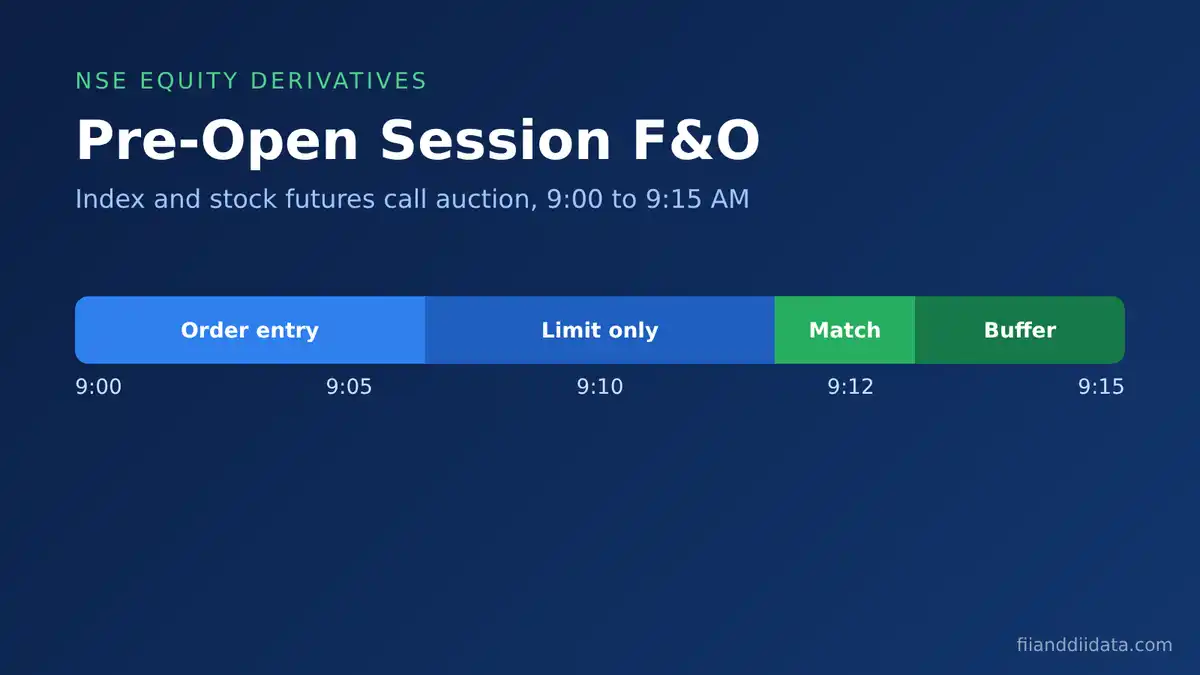
The pre open session F&O is a 15-minute call auction from 9:00 AM to 9:15 AM in which NSE collects orders for index and stock futures and fixes one opening price for each contract. It went live on 8 December 2025, and NSE reworked its internal timings from 7 September 2026, so market orders now close at 9:05 AM. Here is how the auction works today, with a worked example of the opening price.
Key Takeaways
- NSE runs a pre-open call auction for futures from 9:00 AM to 9:15 AM, live since 8 December 2025.
- From 7 September 2026, market orders are allowed only until 9:05 AM; after that, only limit orders until a random close before 9:10 AM.
- Only current-month index and stock futures take part; next-month futures join in the last five trading days before expiry. Options are excluded.
- The opening price is the single price at which the largest quantity can trade.
- Unmatched limit orders move to the normal market with their original time stamp.
In this guide:
- What is the pre open session in F&O?
- Pre open session F&O timings for 2026
- Which contracts are eligible
- How the opening price is set: a worked example
- Order rules: what you can and cannot do
- How traders use the pre open session F&O: a checklist
- Common mistakes to avoid
- Cash market pre-open vs F&O pre-open
- FAQs
- The Bottom Line
What Is the Pre Open Session in F&O?
Before December 2025, futures on NSE simply started trading at 9:15 AM. The first trade of the day set the opening price, and that first trade could be a small order hitting a thin order book. On gap days, this often produced a sharp first tick that did not reflect where most buyers and sellers actually wanted to deal.
The pre-open session changes that. For 15 minutes before normal trading, the exchange only collects orders. It does not match them one by one. At the end of the order collection window, it calculates one price, called the equilibrium price, at which the maximum quantity can be traded. All matched orders trade at that single price, and it becomes the official open for that futures contract.
Why NSE Added a Pre Open Session for F&O
NSE announced the change through a circular dated 4 November 2025 and started it on 8 December 2025, according to Business Standard. The stated goals were better price discovery, more liquidity at the open and less volatility in the first minutes of trade. It also brought futures in line with the cash market, which has used a similar call auction for years.
For anyone who tracks FII index futures data, the open now carries more information. It is the price at which overnight orders from all participants met, not just the price of whoever clicked first. The next section shows exactly when each step of this auction happens.
Pre Open Session F&O Timings for 2026
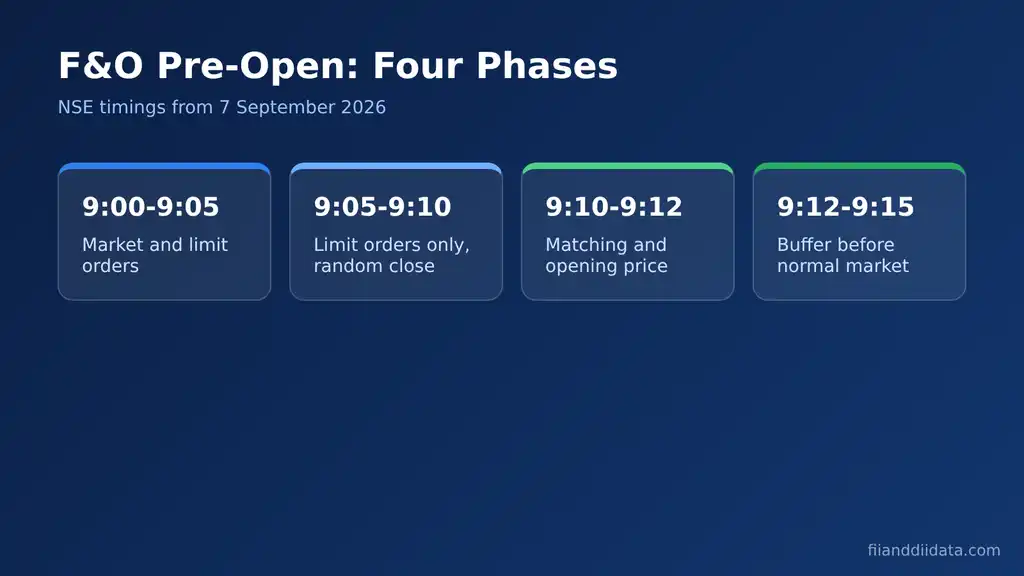
The session still runs from 9:00 AM to 9:15 AM, but its four phases were reorganised from 7 September 2026. NSE moved the start of matching from 9:08 AM to 9:10 AM and added a separate limit-only window. As per a Kotak Neo note dated 4 September 2026, the aim was to align the opening auction with the Closing Auction Session (CAS) that started in the cash market on 4 August 2026.
| Phase | Time (IST) | What happens |
|---|---|---|
| Order entry 1 | 9:00 to 9:05 AM | Place, modify or cancel market and limit orders |
| Order entry 2 | 9:05 to 9:10 AM | Limit orders only; market orders rejected; random close in the last 2 minutes |
| Matching | 9:10 to 9:12 AM | Equilibrium price found, orders matched, trades confirmed |
| Buffer | 9:12 to 9:15 AM | Transition to normal market |
| Normal market | 9:15 AM | Continuous trading starts |
The random close matters. Order entry can end at any moment in the final two minutes of the second window, roughly between 9:08 AM and 9:10 AM. Nobody can wait for the last second to place a large order and move the price, because nobody knows when that last second is.
What Changed From the December 2025 Version
| Feature | 8 Dec 2025 launch | From 7 Sep 2026 |
|---|---|---|
| Order entry window | 9:00 to 9:07/9:08 AM | 9:00 to 9:10 AM (random close) |
| Market orders allowed | Whole entry window | Only 9:00 to 9:05 AM |
| Matching period | 9:08 to 9:12 AM | 9:10 to 9:12 AM |
| Buffer | 9:12 to 9:15 AM | 9:12 to 9:15 AM |
Knowing the clock is only half the picture. You also need to know which contracts are in the auction at all.
Which Contracts Are Eligible (and Which Are Not)
The auction covers futures only. According to the NSE pre-open session page, these contracts take part:
- Current-month index futures, such as Nifty and Bank Nifty futures.
- Current-month single stock futures.
- Next-month futures, but only during the last five trading days before the current-month expiry, when most open interest rolls over.
Options are not part of the auction. Business Standard’s November 2025 report also noted that spread contracts and contracts on corporate action ex-dates are excluded. So if you trade Nifty options, your first trade still happens in the normal market at 9:15 AM, but the underlying futures price you see at that moment has already been set by the auction.
Lot size, tick size and price band in the pre-open session are the same as in the normal market. Now let us see how the exchange turns hundreds of orders into one opening price.
How the Opening Price Is Set: A Worked Example
NSE defines the equilibrium price as the price at which the maximum volume is executable. If two prices give the same volume, it picks the one with the smallest order imbalance, and then the one closest to the previous close. If only market orders exist on both sides, the base price becomes the open.
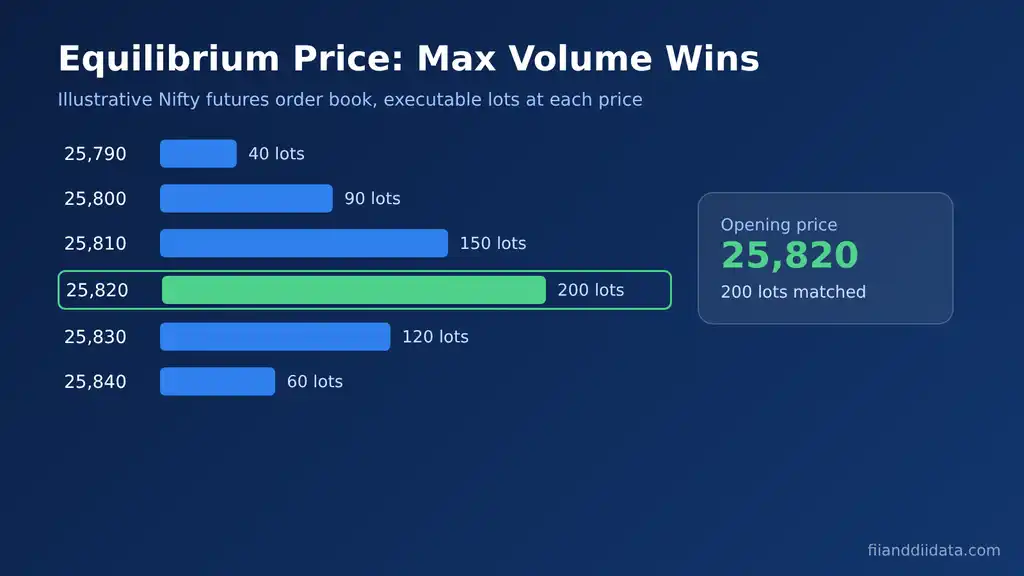
Take a simple, made-up order book for Nifty current-month futures. The previous close is 25,790. Buyers have also placed 20 lots of market buy orders and sellers 10 lots of market sell orders. At each price, cumulative demand counts every buyer willing to pay that price or more, and cumulative supply counts every seller willing to sell at that price or less.
| Price | Buy limit lots at this price | Sell limit lots at this price | Cumulative demand | Cumulative supply | Tradable lots |
|---|---|---|---|---|---|
| 25,790 | 0 | 30 | 320 | 40 | 40 |
| 25,800 | 70 | 50 | 320 | 90 | 90 |
| 25,810 | 50 | 60 | 250 | 150 | 150 |
| 25,820 | 80 | 90 | 200 | 240 | 200 |
| 25,830 | 60 | 70 | 120 | 310 | 120 |
| 25,840 | 40 | 0 | 60 | 310 | 60 |
The tradable quantity at each price is the smaller of demand and supply. It peaks at 200 lots at 25,820, so 25,820 becomes the opening price. That is a gap-up of 30 points, or about 0.12%, over the previous close of 25,790.
What happens to everyone else? All 200 lots of demand trade at 25,820, including the 20 lots of market buy orders. On the sell side, 240 lots were willing to sell at 25,820 or lower, so 40 lots are left over. Those unmatched sell limit orders move into the normal market at 9:15 AM and keep their original time stamp, so they stay ahead in the queue at their price.
The example also shows why the order type you choose matters so much. That is the subject of the next section.
Order Rules: What You Can and Cannot Do
The pre-open window has stricter rules than the normal market. Here is a summary based on the NSE page and the launch reports:
- Allowed: limit orders for the full entry window; market orders only from 9:00 to 9:05 AM.
- Not allowed: stop-loss orders and Immediate or Cancel (IOC) orders.
- Market orders after 9:05 AM are rejected with the message “Market orders are currently not allowed.”
- No changes during matching: you cannot modify or cancel an order once matching starts.
- Margin check first: every order is checked against available margin. If your capital does not cover it, the order is not accepted for the session.
- Trades are final: trades executed in the pre-open session cannot be cancelled later.
- Unmatched market orders are given the equilibrium price and sent to the normal market as limit orders.
These rules are separate from the wider changes SEBI made to derivatives trading. For lot sizes, weekly expiry limits and position rules, read our guide to SEBI’s new F&O trading rules. If you track how big players are positioned, our explainer on delta-based open interest covers how SEBI now measures exposure. With the rules clear, here is a practical routine for the morning.
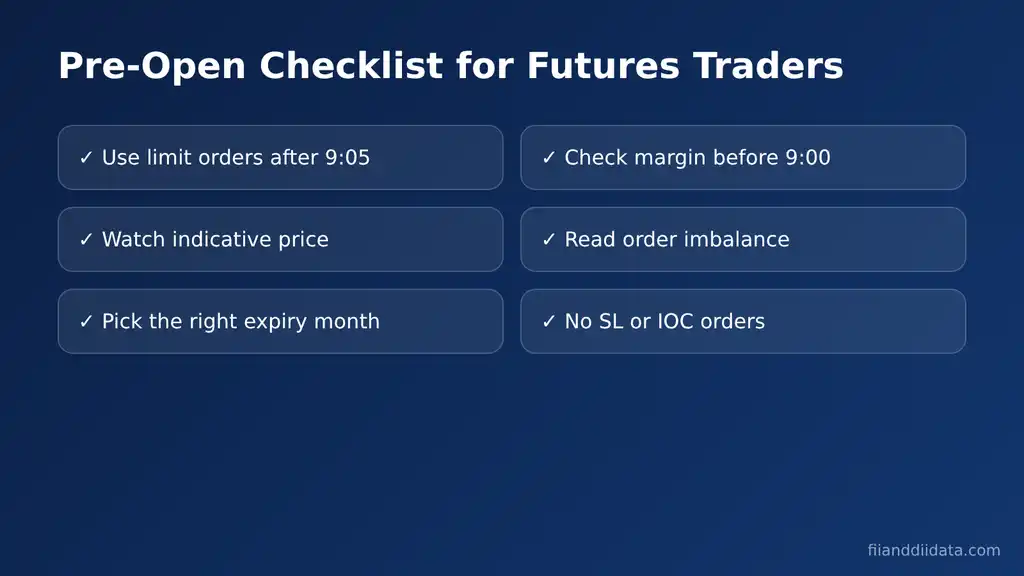
How Traders Use the Pre Open Session F&O: A Checklist
The auction is most useful on days with big overnight news, such as a sharp move in US markets, a crude oil spike or a policy surprise. Use this six-step checklist:
- Check margin before 9:00 AM. An order without enough margin is simply not accepted.
- Decide your order type early. If you want a market order, place it before 9:05 AM. After that, use a limit order.
- Watch the indicative price and order imbalance. NSE shows these during the session. A large buy imbalance hints at a gap-up open.
- Pick the right month. In the last five trading days before expiry, both near-month and next-month futures are in the auction. Make sure you are bidding on the contract you mean to trade.
- Set a sensible limit. A buy limit far below the likely open will not fill, and a buy limit far above it gives you the auction price anyway. Use the indicative price as a guide.
- Review the open against positioning data. Compare the opening gap with the previous evening’s FII long short ratio and participant wise OI to judge whether the gap is supported by positioning.
Even with a checklist, a few habits from the old opening keep tripping traders up.
Common Mistakes to Avoid
- Sending a market order at 9:06 AM. Since 7 September 2026 it will be rejected. Many traders still assume market orders work until 9:08 AM, as they did at launch.
- Placing a stop-loss order before 9:15 AM. Stop-loss and IOC orders are not allowed in the pre-open session, so your protection is not in place until the normal market starts.
- Expecting options to open in the auction. Only futures are eligible. Options still begin at 9:15 AM.
- Treating the indicative price as final. It keeps changing until order entry closes, and the close itself is random.
- Reading the open as institutional flow. The auction mixes orders from retail clients, proprietary desks and institutions. It does not tell you who bought. Official FII DII data today comes only after the close: NSE provisional figures around 6 PM IST and NSDL final FPI data on the next working day.
The last point is a common source of confusion, so it helps to compare the F&O auction with the older cash market version.
Cash Market Pre-Open vs F&O Pre-Open
Both sessions use the same call auction idea and, since 7 September 2026, the same internal clock. The main differences are in what is traded and why it matters for derivatives traders.
| Point | Cash market pre-open | F&O pre-open |
|---|---|---|
| Instruments | Equity shares, including SME, InvITs and REITs | Current-month index and stock futures (plus next month near expiry) |
| Options | Not applicable | Excluded |
| Timing | 9:00 to 9:15 AM | 9:00 to 9:15 AM |
| Market order cutoff | 9:05 AM | 9:05 AM |
Because both auctions now end at the same time, the opening price of Nifty futures and the opening prices of the 50 Nifty stocks are discovered side by side. That makes the futures premium at 9:15 AM a cleaner reading than it was before December 2025. To see how foreign and domestic institutions acted after the day ends, track FII and DII data on our home page.
FAQs
What are the pre open session F&O timings?
The session runs from 9:00 AM to 9:15 AM IST. From 7 September 2026, market and limit orders are accepted from 9:00 to 9:05 AM, only limit orders from 9:05 to 9:10 AM with a random close in the last two minutes, matching happens from 9:10 to 9:12 AM, and 9:12 to 9:15 AM is a buffer before normal trading.
Are options included in the F&O pre-open session?
No. Only current-month index futures and stock futures take part, plus next-month futures in the last five trading days before expiry. Options start trading in the normal market at 9:15 AM.
Can I place a market order in the F&O pre-open session?
Yes, but only between 9:00 AM and 9:05 AM. Market orders entered after 9:05 AM are rejected. Stop-loss and IOC orders are not allowed at any time in the session.
What happens if my pre-open order is not matched?
Unmatched limit orders move to the normal market at 9:15 AM and keep their original time stamp. Unmatched market orders are given the equilibrium price and moved to the normal market as limit orders.
How is the opening price decided in the pre-open session?
NSE picks the equilibrium price, which is the single price at which the largest quantity can be traded. If two prices tie, it chooses the one with the smallest order imbalance and then the one closest to the previous close.
The Bottom Line
The F&O pre-open session turns the first minutes of futures trading from a race into an auction. Since 7 September 2026, the rules are tighter: market orders stop at 9:05 AM, order entry ends at a random moment before 9:10 AM, and one equilibrium price sets the open for each eligible future.
The auction does not remove gap risk, and it does not tell you who is buying. It does give a fairer, more transparent opening price. As a practical next step, check your broker’s order screen before tomorrow’s open, confirm which order types it allows before 9:15 AM, and read more guides on our blog.
Sources: NSE, Equity Derivatives Pre-Open Session; Business Standard, 4 November 2025; Kotak Neo, 4 September 2026; Outlook Business, 3 September 2026.
Disclaimer: This article is for educational purposes only and is not investment advice. Please consult a SEBI-registered advisor before making investment decisions.