Delta based open interest SEBI rules measure F&O positions by their real price exposure, not by a raw count of contracts. Under this future equivalent (FutEq) method, 1,000 lots of a call option with a delta of 0.35 count as just 350. On 27 October 2026, Ambuja Cements, Kaynes Technology and SAIL sat in the F&O ban list, and every one of them was judged on this delta-adjusted number. Here is how it works and what it means for your trades.
Key Takeaways
- SEBI replaced notional open interest with delta-based FutEq OI through its circular of 29 May 2025.
- FutEq OI weights every option by its delta, so a far out-of-the-money option counts for very little.
- MWPL is now the lower of 15% of free float or 65 times average daily delivery value, with a 10% floor.
- A stock enters the F&O ban above 95% of MWPL and exits only when FutEq OI falls to 80%.
- During a ban, any trade must lower your net FutEq OI, checked using 2 PM deltas.
In this article
- What is delta based open interest under SEBI rules?
- Why SEBI moved away from notional OI
- How FutEq OI is calculated: worked examples
- New MWPL and F&O ban rules
- Key numbers and dates at a glance
- What it means for traders and FII data
- Checklist for trading under FutEq OI
- Common mistakes to avoid
- Frequently asked questions
- The bottom line
What Is Delta Based Open Interest Under SEBI Rules?
Open interest (OI) is the number of derivative contracts that are still open at the end of a day. Until 2025, exchanges added up OI on a notional basis. Every futures lot and every options lot counted as one, whatever its risk.
Delta based open interest, which SEBI calls future equivalent open interest or FutEq OI, changes that. Delta tells you how much an option’s price moves when the underlying moves by ₹1. A future has a delta of 1. A call option has a delta between 0 and +1, and a put between 0 and -1. FutEq OI multiplies each position by its delta, so it shows how much stock exposure a position really carries.
SEBI introduced the method in its circular SEBI/HO/MRD/TPD-1/P/CIR/2025/79 dated 29 May 2025, as part of a wider package that also reworked position limits and the market-wide position limit (MWPL). NSE Clearing computes it per portfolio as the net delta-adjusted position across all futures and options on one underlying. The sum across all client codes decides ban entry and exit.
Where the delta numbers come from
You do not have to calculate delta yourself for compliance. The clearing corporations publish contract deltas in their SPAN risk parameter files at the beginning of day, during the day and at the end of day, according to NSE Clearing’s FAQ on the new framework. For ban monitoring, the 2 PM file is the one that counts. With the definition clear, the next question is why SEBI felt the old count was broken.
Why SEBI Moved Away From Notional OI
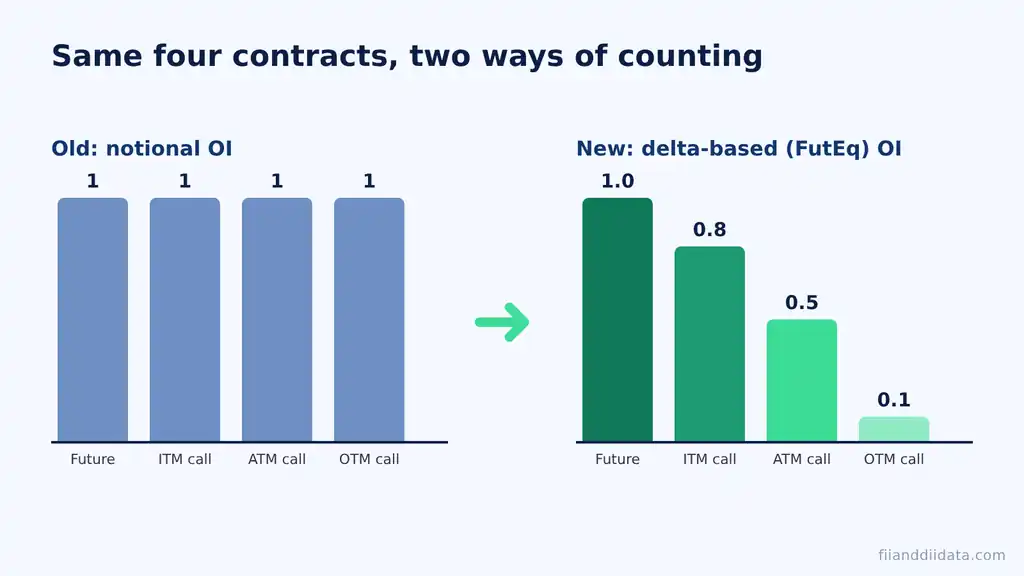
Notional OI treated a deep in-the-money option, which moves almost like a future, the same as a far out-of-the-money option that barely moves at all. That created two clear problems.
- False bans. Heavy buying of cheap OTM options could push a stock’s notional OI past its limit and trigger an F&O ban, even though the real exposure was small. Business Today reported on 29 May 2025 that FutEq should stop bans being imposed artificially.
- Gaming of limits. Zerodha’s July 2025 brief on the measures noted that some large players held big short positions near the money and then bought cheap deep OTM options to stay inside notional limits. The count looked fine while the real risk did not.
Zerodha’s analyst estimated that delta OI would be roughly 40% to 60% of notional OI, depending on how positions are spread across strikes. The image below shows why.
How Delta Based Open Interest Is Calculated: Worked Examples
The formula is simple: FutEq OI = number of contracts × delta, added across every futures and options position on the same stock, with longs as positive and shorts as negative. The round numbers below are for illustration only.
Example 1: A one-sided options buyer
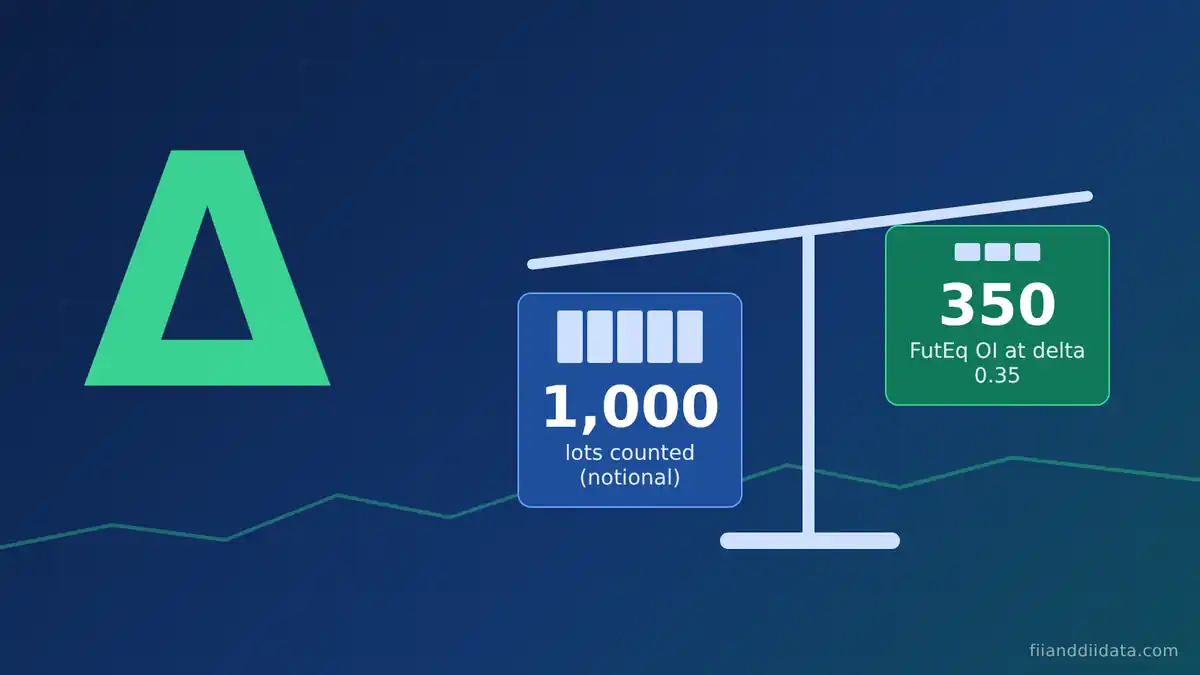
A trader buys 1,000 lots of an out-of-the-money call with a delta of 0.35. Under the old method this added 1,000 lots to OI. Under the delta based open interest SEBI method it adds 1,000 × 0.35 = 350 lots FutEq.
Example 2: A hedged portfolio
Now take a trader in stock XYZ with three positions:
| Position | Lots | Delta | FutEq lots |
|---|---|---|---|
| Long futures | +10 | 1.00 | +10.0 |
| Short calls | -20 | 0.30 | -6.0 |
| Long puts | +10 | -0.40 | -4.0 |
| Net | 40 gross | 0.0 |
The old method saw 40 open lots. The new method sees a net FutEq position of zero, because the short calls and long puts offset the long futures. A hedged book adds little to delta-based OI; a one-way bet adds a lot.
Example 3: Same position, different day
Delta is not fixed. Suppose the stock rallies and the call in Example 1 moves closer to the money, lifting its delta from 0.35 to 0.60. The trader has done nothing, yet the FutEq OI rises from 350 to 600 lots. Most traders miss this, and it matters once a stock nears its ban limit, covered next.
New MWPL and F&O Ban Rules Under Delta Based Open Interest
The market-wide position limit is the ceiling on total open positions in a stock’s derivatives across all exchanges. Under the May 2025 circular, MWPL is the lower of 15% of the stock’s free float or 65 times its average daily delivery value (ADDV) in the cash market, converted into shares. It cannot fall below 10% of free float. NSE Clearing recomputes MWPL every quarter using the previous three months of delivery data.
Worked MWPL example
- Free float: 50 crore shares, so 15% = 7.5 crore shares and the 10% floor = 5 crore shares.
- ADDV: ₹40 crore at a price of ₹200 = 20 lakh shares a day. 65 times that = 13 crore shares.
- MWPL = lower of 7.5 crore and 13 crore = 7.5 crore shares (above the floor, so it stands).
- Ban entry at 95% = 7.125 crore shares of FutEq OI. Ban exit at 80% = 6 crore shares.
How the ban works now
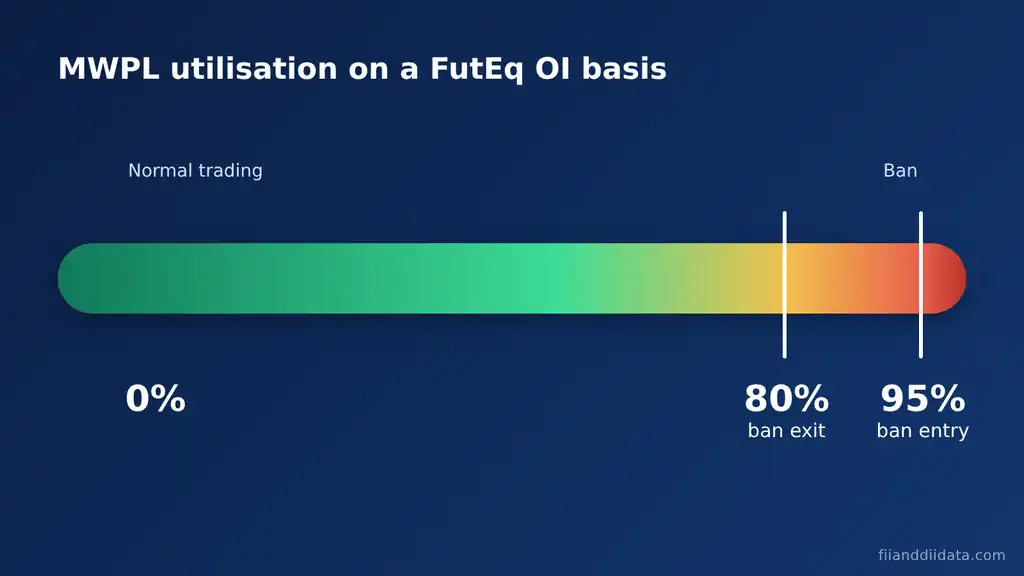
At the end of each day, if a stock’s market-wide FutEq OI is above 95% of MWPL, it enters the ban from the next trading day. It leaves the ban only when combined FutEq OI across exchanges falls to 80% of MWPL. NSE Clearing records each entity’s position on the day a stock enters the ban as a base position. On the following days, end-of-day positions are revalued with the 2 PM delta. If your FutEq OI is at or below the base, with no change in sign, there is no violation.
The trading rule also loosened. Earlier, a banned stock allowed only exits. Now you may trade, including rollovers, as long as the trade reduces your net FutEq OI on an end-of-day basis. ICICI Direct’s F&O help page notes this revised ban-period rule applied from 8 December 2025. A breach costs the lower of 1% of the excess quantity’s value or ₹1,00,000 per stock per day, with a minimum of ₹5,000, charged to the clearing member, per NSE Clearing.
The next section pulls every key number into one table.
Key Numbers and Dates at a Glance
| Rule | Old | New (FutEq basis) | Effective |
|---|---|---|---|
| OI measure | Notional, each lot = 1 | Net delta-adjusted FutEq OI | Announced 29 May 2025 |
| MWPL | 20% of free float | Lower of 15% of free float or 65 × ADDV, floor 10% | 1 Oct 2025 |
| Ban entry / exit | 95% / 80% of MWPL (notional) | 95% / 80% of MWPL (FutEq) | With new MWPL |
| Trading in a banned stock | Exits only | Any trade that cuts net FutEq OI | 8 Dec 2025 |
| Client stock limit | Higher of 1% free float or 5% of OI | 10% of MWPL | 1 Oct 2025 |
| FPI Cat I / MF / TM (prop + client) | 20% of MWPL | 30% of MWPL | 1 Oct 2025 |
| Index options, per entity | ₹500 crore net notional | ₹1,500 crore net, ₹10,000 crore gross FutEq | Phased July to Dec 2025 |
| Intraday checks | End of day only | At least 4 random snapshots a day | 3 Nov 2025 |
Under SEBI’s September 2025 measures, the intraday net limit for index options is ₹5,000 crore per entity, on top of the end-of-day caps above. We explain that and the other derivatives changes in our guide to the delta based open interest SEBI framework and the wider F&O rules. Next, what this means for daily decisions.
What Delta Based Open Interest Means for Traders and FII Data
For option buyers: buying cheap OTM options in a stock near its limit is less likely to tip it into a ban, because those contracts carry small deltas.
For option sellers and hedgers: a hedged book now gets credit for its hedge. A covered or spread position adds far less to FutEq OI than a naked one. But because delta moves with price, a short option position can grow in FutEq terms during a sharp rally or fall without any new trade.
For large investors: category I FPIs and mutual funds got a higher single-stock limit of 30% of MWPL, while index option limits moved to delta terms.
Reading FII positions after the delta based open interest SEBI change
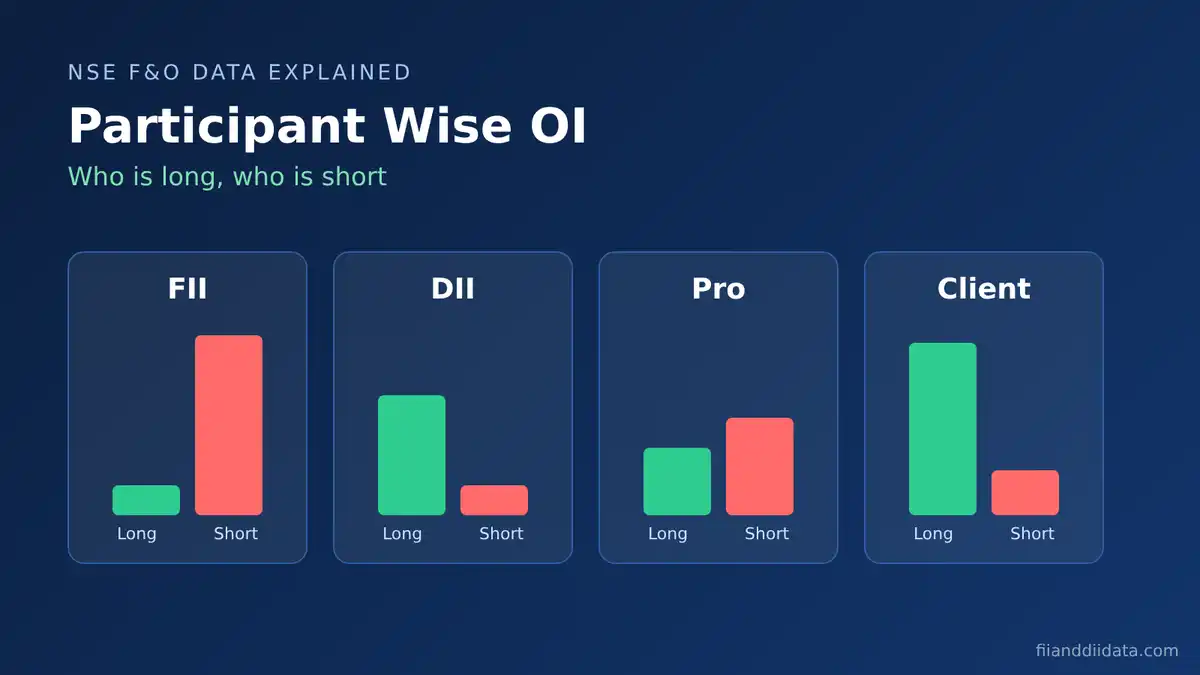
The FutEq change applies to limits, bans and surveillance. The NSE participant wise open interest data that we track daily still shows client, DII, FII and pro positions in contracts. So when you read a large FII put position there, remember it is a contract count. A pile of deep OTM puts looks big in that report but carries little delta. Pair it with the FII options activity tracker and the FII long short ratio to judge real direction, and check FII DII F&O data for index futures, where delta is always 1.
The checklist below turns this into a routine.
Checklist for Trading Under FutEq OI
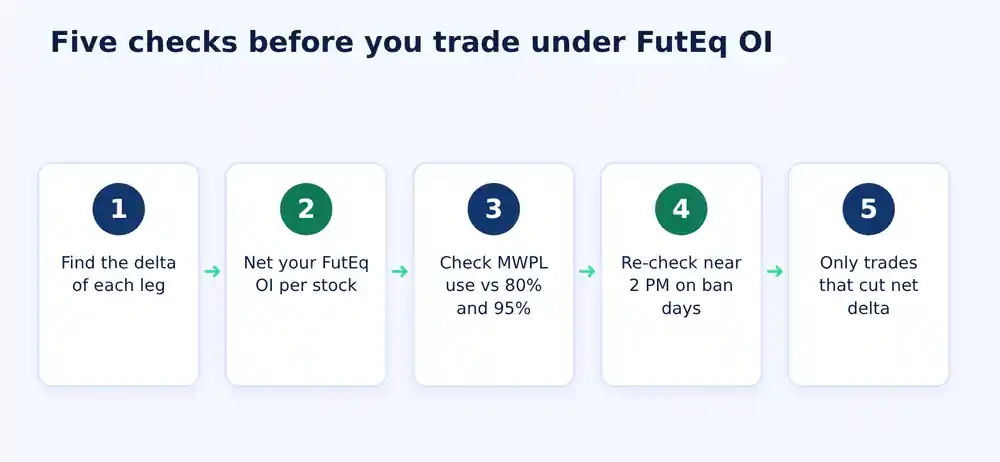
- Note the delta of every leg you hold. Most broker option chains show it.
- Net your FutEq OI per stock by adding contracts × delta across all legs, with shorts negative.
- Check the stock’s MWPL use on the exchange ban list page. Be careful above 80% and very careful near 95%.
- If a stock is in the ban, review your position before 2 PM, since that delta is used to test your end-of-day position.
- Place only trades that reduce your net FutEq OI in a banned stock. Closing just the hedge leg can raise it.
- Recheck after big price moves, because deltas, and so your FutEq OI, change even if you do not trade.
Even so, a few errors keep showing up.
Common Mistakes With Delta Based Open Interest
Squaring off only the hedge in a banned stock. Kotak Neo’s explainer gives a clear case. A trader holds +100 futures and is short 100 calls with a delta of 0.40, a net FutEq of +60. Buying back the calls alone lifts net exposure to +100. That raises FutEq OI, so the order can be rejected or the position cut by the broker.
Comparing old and new OI charts. Notional OI and FutEq OI are different units. A fall in a FutEq figure compared with an older notional chart does not mean positions were cut.
Assuming the ban list works as before. The 95% and 80% thresholds are the same, but they now apply to a delta-adjusted number against a smaller MWPL.
Frequently Asked Questions
What is the delta based open interest SEBI method?
It is a way of measuring F&O open interest by multiplying each contract by its delta, called future equivalent (FutEq) OI. SEBI introduced it through its circular of 29 May 2025 so that limits and bans reflect real price exposure rather than a raw count of contracts.
How is FutEq OI calculated?
Multiply the number of contracts in each position by its delta and add them up for the same underlying, with long positions positive and short positions negative. Futures have a delta of 1. The clearing corporations publish contract deltas in their SPAN files.
When does a stock enter the F&O ban under the new rules?
A stock enters the ban from the next trading day when its market-wide FutEq OI is above 95% of MWPL at the end of the day. It exits only when combined FutEq OI across exchanges falls to 80% of MWPL.
Can I trade a stock that is in the F&O ban period?
Yes, but only trades that reduce your net FutEq OI on an end-of-day basis, tested using the 2 PM delta. Rollovers are allowed if they lower your net exposure. A trade that increases it is a violation and attracts a penalty.
What is the new MWPL formula?
MWPL is the lower of 15% of the stock’s free float or 65 times its average daily delivery value in the cash market, with a floor of 10% of free float. It applies from 1 October 2025 and is recomputed every quarter.
The Bottom Line
Delta based open interest gives a more honest picture of risk than the old contract count. Hedged positions get credit, cheap OTM option buying no longer creates false bans, and limits now track real exposure. The trade-off is that your FutEq OI moves with the market, so a position can grow without a single new order.
Our practical next step: before your next F&O trade in a stock that is above 80% of MWPL, work out your net FutEq OI using the deltas on your broker’s option chain. For daily institutional flows, see the daily FII DII cash market summary, browse more guides on our blog, or open the FII and DII data dashboard.
Sources: Business Standard, SEBI unveils new OI metric (29 May 2025); NSE Clearing FAQ on position limits and ban period (October 2025); Zerodha Z-Connect brief (4 July 2025); ICICI Direct F&O ban FAQ. Also Business Today (29 May 2025), IANS (30 September 2025), Kotak Neo bulletin and Angel One (27 October 2026).
Disclaimer: This article is for educational purposes only and is not investment advice. Please consult a SEBI-registered advisor before making investment decisions.