The fpi investment limit decides how much of an Indian company a foreign portfolio investor may own. One FPI must stay below 10% of a company’s paid-up equity, while all FPIs together are held to a company-level cap of 24%, 49% or 74%, or the sector cap if that is lower. Knowing these numbers explains why a stock can go quiet for foreign buyers, and it adds depth to any reading of FII and DII data.
Key Takeaways
- A single FPI, with its investor group, must hold below 10% of a company’s paid-up equity on a fully diluted basis.
- The combined FPI limit equals the sector cap. A company can set it at 24%, 49% or 74% and raise it with a board and special resolution.
- A depository checks holdings at the end of each day and raises a red flag when the room left is 3% or less.
- A breach means selling the excess within 5 trading days or treating it as foreign direct investment.
- The June 2026 rule change lifted limits for individual foreign investors to 10% and 24%. It did not double the limit for SEBI-registered FPIs.
Contents
- What the limit means
- How the limits are monitored
- What happens on a breach
- Aggregate and sector ceilings
- Banks and debt limits
- Individual investors and the June 2026 change
- Checklist and common mistakes
- Frequently asked questions
- The bottom line
What the Limit Means
A foreign portfolio investor (FPI) buys listed Indian shares and bonds without taking control of the company. Foreign money can enter and leave quickly, so the rules cap how much of one company foreign investors may hold. These caps work at three levels: one investor, all FPIs together, and the sector the company belongs to. If you are new to the investor type, our guide to foreign portfolio investment in India explains who qualifies and how they invest.
Every FPI purchase is counted against these caps. When a cap is reached, buying by that group stops until room opens up. That is why some heavily owned stocks stop attracting foreign buying even when the price looks fair.
The single FPI cap: below 10%
A single FPI, together with its investor group, must hold less than 10% of the paid-up equity capital of an Indian company, measured on a fully diluted basis. This ceiling is described in the Mondaq summary of FPI regulation (2 October 2026) and in NSE’s FPI guidance. The words “investor group” matter. Funds under common control are added together, so spreading shares across several related funds does not create extra room.
Crossing the 10% line does not make the holding illegal. It changes the investor’s status, because a stake above the line must be reduced or treated as foreign direct investment. Our note on FII vs FDI explains how the two routes differ.
How the Limits Are Monitored
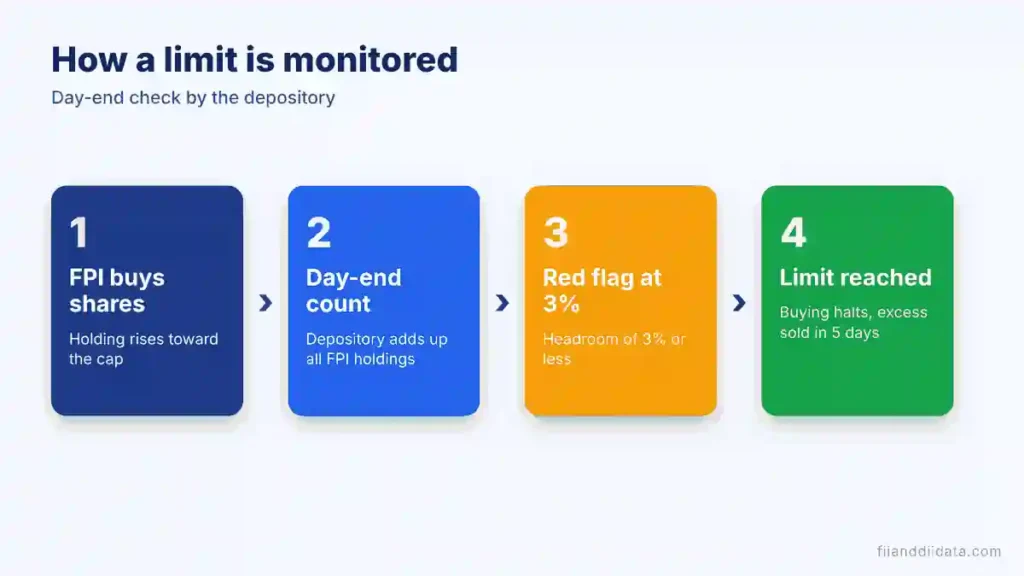
Limits are tracked by the depository, not by the company. NSDL’s foreign investment limit monitoring page (last updated 13 November 2026) describes day-end monitoring of foreign holdings against each company’s limits. When the room left under the aggregate FPI limit, the NRI limit or the sector cap falls to 3% or less, the system raises a red flag alert.
The steps are simple. An FPI buys shares and the holding rises. At the end of the day, the depository adds up all FPI holdings in that company. If the room left drops into the red flag zone, an alert goes out. When the limit is reached, buying halts and any excess must be sold within a fixed window. You can read the process on the NSDL limit monitoring page.
Do not confuse this with the daily flow release. NSE publishes provisional FII and DII figures around 6 PM IST, and NSDL final data for foreign investors follows on the next working day. Those figures show buying and selling. They do not tell you how close a company is to its foreign ownership cap.
What Happens on a Breach
The consequence depends on which limit is crossed. If one FPI goes above 10%, it has two options. It can divest the excess within 5 trading days of settlement, selling only to domestic investors. Or it can reclassify the excess as foreign direct investment, subject to the usual FDI rules and reporting. The RBI notification of 11 November 2024 set the 5 trading day window for reclassification, as reported by India Briefing on 12 November 2024. SEBI’s parallel guidelines took effect on 30 May 2024.
The custodian reports the breach to SEBI and halts further purchases. If the aggregate FPI limit is reached, all FPIs are stopped from buying more. If the sector cap is reached, every foreign investor is stopped, not only FPIs.
A simple worked example
This is an illustration with round numbers, not reported data. A company has 100 crore fully diluted shares and an aggregate FPI limit of 24%. FPI A holds 9.6 crore shares, which is 9.6%. It buys 0.6 crore more and now holds 10.2 crore, or 10.2%. That crosses the single FPI cap by 0.2%. FPI A must sell down to below 10 crore shares within 5 trading days, to domestic buyers only, or reclassify the excess as FDI.
Now look at the company level. All FPIs together hold 21.5 crore shares, or 21.5%. The room left under the 24% limit is 2.5%, which is inside the 3% red flag zone. The depository raises an alert. When holdings touch 24%, no FPI can buy until some shares are sold.
Aggregate and Sector Ceilings
Since 1 April 2020, the combined limit for all FPIs in a company equals the sector cap. A company can set the limit at 24%, 49% or 74%, or at the sector cap if that is lower, and can raise it with a board resolution followed by a special resolution of shareholders, under the FEMA non-debt instruments rules. The default most investors quote is 24%.
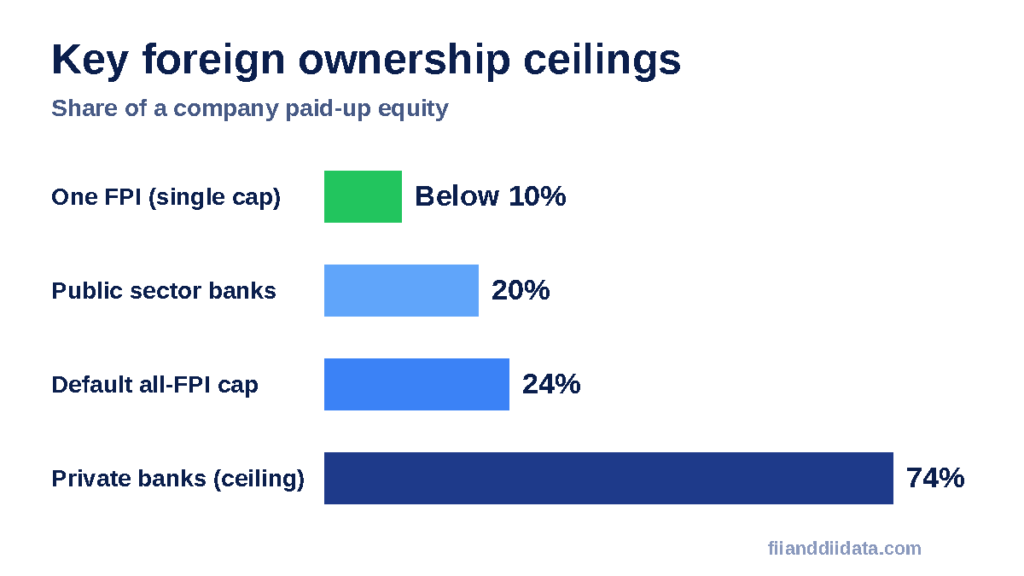
| Level | Ceiling |
|---|---|
| One FPI with its investor group | Below 10% of paid-up equity |
| All FPIs, default company limit | 24% |
| All FPIs, other company limits | 49% or 74%, up to the sector cap |
| Public sector banks (all foreign investors) | 20% |
| Private banks (all foreign investors) | Up to 74% |
| Individual foreign investor, from 12 June 2026 | 10% single, 24% in total |
These caps change how you read ownership data. A company close to its limit leaves little room for foreign demand, which can cap upside from fresh inflows. Our page on the FII shareholding pattern shows how to find the current foreign share, and the list of stocks with the highest FII holding shows where room is tight.
Banks and Debt Limits
Banks
Banks have their own ceilings. Private banks can have foreign ownership up to 74%, with 49% allowed under the automatic route and the rest needing government approval. Public sector banks are capped at 20%, as stated by Minister of State for Finance Pankaj Chaudhary on 2 to 3 December 2025 and reported by Business Standard and Angel One. The Free Press Journal reported on 21 October 2026 that the Centre is considering raising the public sector bank cap to 49%, based on a draft Cabinet note. That is a report, not a confirmed decision.
Actual foreign holdings are usually far below the ceiling. According to Upstox (8 October 2026), foreign holding in HDFC Bank fell from 41.83% in the June 2026 quarter to 39.40% in the September 2026 quarter. That is well under the 74% private bank ceiling, so the cap was not the reason for the fall.
Debt
Bonds have separate limits. For FY27 under the general route, FPIs may hold up to 6% of outstanding central government securities, 2% of state development loans and 15% of corporate bonds. In June 2026 the RBI removed the short-term, security-wise and concentration limits for government securities under the general route, according to the Mondaq summary dated 2 October 2026. Equity and debt limits are tracked separately, so room in one does not help the other.
Individual Investors and the June 2026 Change
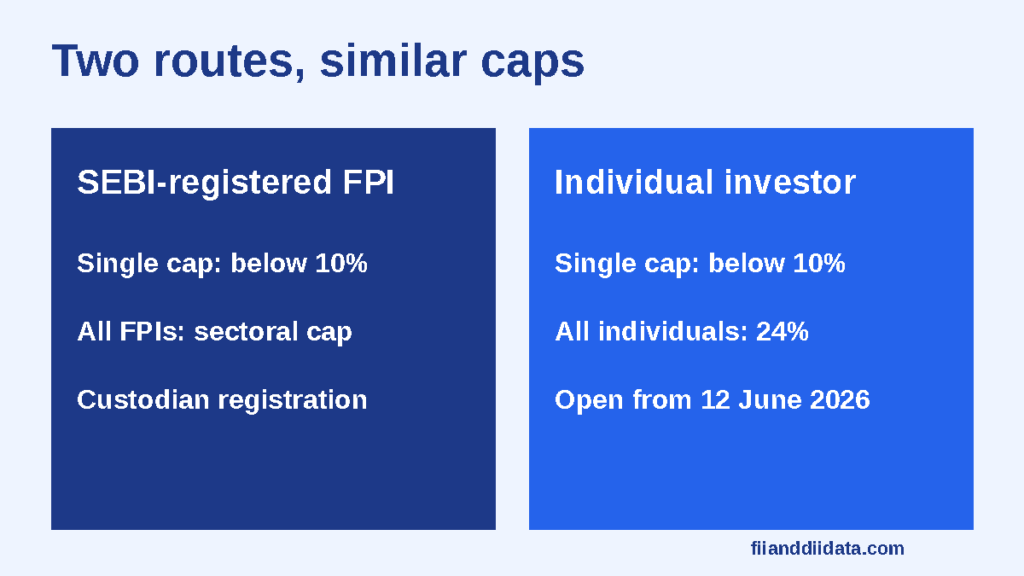
Some summaries describe a recent change as a doubling of the FPI limit. That is not accurate. The Foreign Exchange Management (Non-debt Instruments) (Third Amendment) Rules, 2026, effective 12 June 2026, let individual persons resident outside India buy and sell listed equity without SEBI FPI registration. Their individual limit rose from 5% to 10% and their combined limit from 10% to 24%, as explained by Vinod Kothari on 19 June 2026.
The same 5 trading day rule applies if an individual crosses the limit: divest or treat the excess as FDI. Private bank limits for NRIs stay stricter, at 5% for a single holder and 10% in total. So the change widened the door for individuals. It did not change the cap for institutional FPIs, who still follow the registration route in our FPI registration process guide.
If you also want to see how FPIs differ from the older FII label, read the difference between FII and FPI.
Checklist and Common Mistakes
Limits matter most when foreign money is moving fast. Business Today reported on 30 September 2026 that FPI outflows in 2026 passed Rs 2.5 lakh crore, a record and about 50% above the Rs 1,66,286 crore seen in all of calendar 2025. In a year like this, headroom is rarely the problem for most stocks, but it still matters for names with heavy foreign ownership. Use this checklist when a stock looks stuck.
- Find the foreign share. Check the latest shareholding pattern for the FPI percentage.
- Find the company limit. Look for the aggregate FPI limit, which is 24%, 49%, 74% or the sector cap.
- Measure the room. Subtract the foreign share from the limit. If the room is 3% or less, a red flag zone is near.
- Check the flow. Compare the picture with FII DII data today to see whether foreigners are buying or selling.
Common mistakes
The first mistake is mixing up the three levels. The 10% cap applies to one investor group, the aggregate limit to all FPIs, and the sector cap to all foreign investors. The second is assuming 24% is fixed. Companies can raise it with shareholder approval. The third is treating provisional flow data as limit data. The fourth is repeating the “doubling” claim, which applies to individuals, not to registered FPIs.
Frequently Asked Questions
What is the FPI investment limit for a single investor?
A single FPI, together with its investor group, must hold below 10% of a company’s paid-up equity on a fully diluted basis.
What is the aggregate limit for all FPIs?
The combined FPI limit equals the sector cap. A company can set it at 24%, 49% or 74% and raise it with a board resolution and a special resolution.
What happens if an FPI crosses the limit?
It must divest the excess within 5 trading days of settlement, selling only to domestic investors, or treat the excess as foreign direct investment.
What is a red flag alert?
The depository raises a red flag when the room left under a limit falls to 3% or less. Monitoring is done at the end of each day.
Did the June 2026 rule double the FPI limit?
No. The change applies to individual foreign investors, whose limits rose to 10% single and 24% in total. SEBI-registered FPIs follow their existing limits.
The Bottom Line
The rules are layered but easy to remember: below 10% for one FPI group, 24%, 49% or 74% for all FPIs, and sector caps for every foreign investor. The depository watches the numbers each day, and a breach means selling within 5 trading days or moving to the FDI route.
Check the foreign share and the company limit before assuming foreign buying can continue. Pair that with the daily flow release to see the full picture.
Sources: Mondaq, 2 October 2026; NSDL, last updated 13 November 2026; Vinod Kothari, 19 June 2026; India Briefing, 12 November 2024; Business Today, 30 September 2026; Free Press Journal, 21 October 2026; Upstox, 8 October 2026.
Disclaimer: This article is for educational purposes only and is not investment advice. Please consult a SEBI-registered advisor before making investment decisions.