FPI tax in India decides how much of a foreign investor’s gross profit actually leaves the country. Every time Foreign Portfolio Investors (FPIs) sell Indian shares, collect dividends or earn bond interest, the Income-tax Department takes a share first. This guide explains the current rates, the legal sections behind them, what changed in 2026, and how tax shapes the FII flow numbers you see on this site every evening.
This article is for information only and is not tax advice. Rates exclude surcharge and 4% health and education cess unless stated, and individual treaty positions differ.
Quick answer: how are FPIs taxed in India?
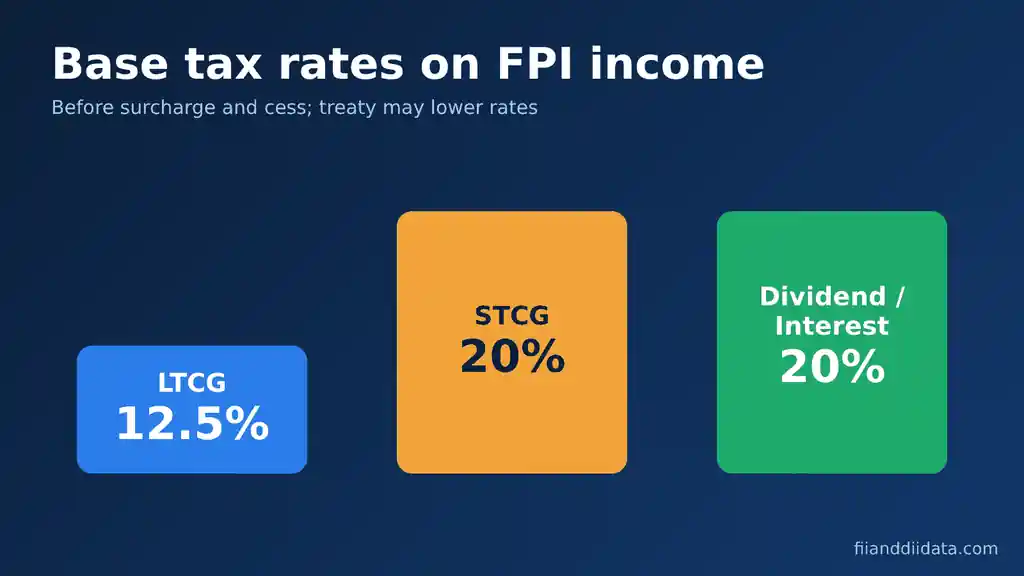
- Long-term capital gains (LTCG) on listed equity: 12.5% on gains above Rs 1.25 lakh, where Securities Transaction Tax (STT) is paid.
- Short-term capital gains (STCG) on listed equity: 20% where STT is paid.
- Dividends and interest: generally 20% on income from securities, with possible relief under a tax treaty (DTAA).
- TDS: 20% on income from securities; no TDS on capital gains for FPIs under the special regime.
- Government securities (G-Secs): interest exempt for specified securities from 1 April 2026, after the June 2026 ordinance.
Who is an FPI and why does the tax rulebook differ?
An FPI is a foreign fund, pension plan, insurer or asset manager registered with SEBI through a Designated Depository Participant (DDP). The registration route is covered in our guide to the FPI registration process in India. For tax, FPIs are notified as Foreign Institutional Investors (FIIs), which unlocks a special regime for securities income.
Until 31 March 2026, that special regime sat in Section 115AD of the old Income-tax Act, 1961. From 1 April 2026 the new Income-tax Act, 2025 replaced it. The FPI provision now sits in Section 210, with the capital gains rates in Sections 196 (short-term, STT paid) and 198 (long-term, STT paid). The rates carried over, but the section numbers that tax advisers quote have changed.
FPI tax rates in India at a glance
| Income type | Base rate | Notes |
|---|---|---|
| LTCG on listed equity (STT paid) | 12.5% | Applies to gains above Rs 1.25 lakh in a year |
| STCG on listed equity (STT paid) | 20% | Holding period up to 12 months |
| Dividend income | 20% | Treaty rate may be lower |
| Interest on debt securities | 20% | Specified G-Sec interest exempt from 1 April 2026 |
| TDS on income from securities | 20% | No TDS on capital gains for FPIs |
Surcharge and cess are added on top, and the effective surcharge depends on the FPI’s legal status and income size. As a rough guide, the 20% STCG rate becomes about 20.8% after cess, and the 12.5% LTCG rate about 13%, before any surcharge. Surcharge on capital gains is capped, which is why large FPIs usually pay less than the maximum headline rate on equity gains.
Capital gains tax for FPIs
Capital gains are where most FPI tax is paid, because FPIs trade far more than they hold dividend-paying stocks for income. The treatment depends on the holding period and on whether STT was paid.
Short-term capital gains (STCG)
Gains on listed equity shares sold within 12 months, with STT paid, are taxed at 20%. Gains on other assets or on trades without STT follow different rules, so FPIs that deal off-market or in unlisted securities need separate analysis.
Long-term capital gains (LTCG)
Listed equity held for more than 12 months is taxed at 12.5% on total gains above Rs 1.25 lakh in the year. The old indexation benefit is not available. Because FPI portfolios are large, the Rs 1.25 lakh threshold hardly changes the final bill for institutions.
Futures and options
Derivative profits are generally treated as business income rather than capital gains, and tax treatment can be contested. The 2026 Budget raised STT on futures from 0.02% to 0.05% and on option premiums from 0.10% to 0.15%, effective 1 April 2026. That is a direct cost increase for FPIs running index arbitrage and hedging books, and it is a common reason cited when derivative turnover falls.
Dividend, interest and TDS
Dividends paid by Indian companies to FPIs are taxed at 20% under the special regime, and the company deducts tax at source before paying. TDS on income from securities is also 20% (now under Section 393 of the new Act). FPIs that qualify under a tax treaty can claim a lower rate, but they need a Tax Residency Certificate (TRC) and must meet the treaty’s conditions.
Capital gains, by contrast, carry no TDS for FPIs under the special regime. The custodian or the FPI computes and pays the tax through advance tax and a return. Many FPIs file India returns mainly to claim refunds, set off losses or support treaty claims.
G-Sec interest exemption: what changed in June 2026
One of the biggest FPI tax changes of 2026 involved government bonds. The Income-tax (Amendment) Ordinance, 2026, issued on 5 June 2026, exempted interest on specified government securities for FPIs, with effect from 1 April 2026. The relief is meant to keep foreign money in Indian government bonds, especially bonds that qualify for global bond index inclusion.

Check the exact list of exempt securities in the notification before assuming a bond qualifies, because the exemption applies only to the securities specified in the schedule. Interest on other debt, including corporate bonds, should be checked separately against the notification and the treaty position.
Treaty benefits and the GAAR risk
Many FPIs invest through Mauritius, Singapore, Luxembourg, Ireland or other treaty jurisdictions. A Double Taxation Avoidance Agreement (DTAA) can reduce the tax on dividends and interest, and sometimes on capital gains. To claim it, the FPI generally needs a TRC and a commercial rationale for the structure.
The Supreme Court’s judgment in the Tiger Global case on 15 January 2026 made this more serious. The Court upheld the tax department’s position that treaty benefits can be denied where an arrangement lacks commercial substance and the General Anti-Avoidance Rule (GAAR) applies. FPIs with thin, tax-driven holding structures now face a higher chance of challenge, and many have reviewed their setups.
How tax turns a trade into a net return
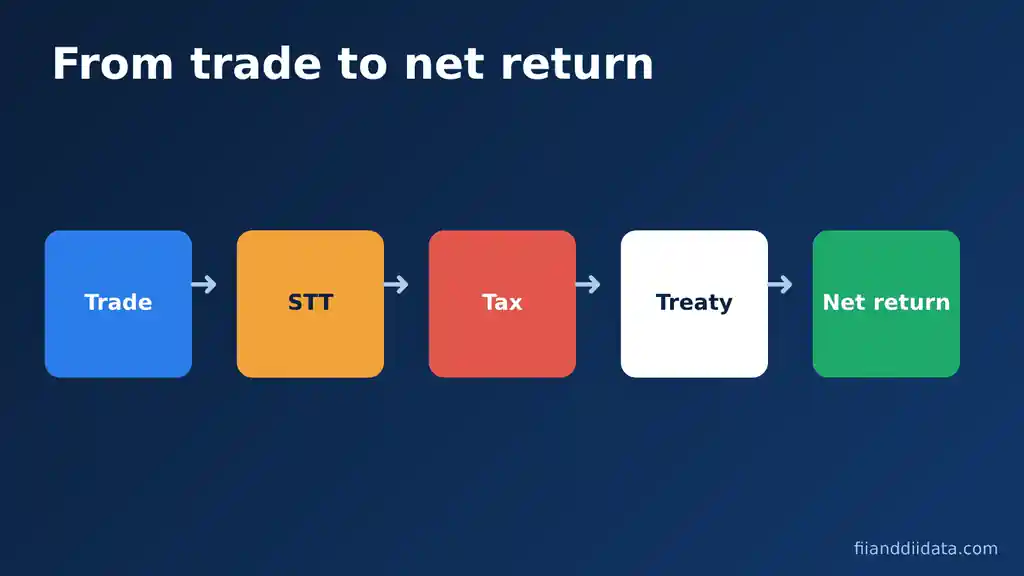
Think of an FPI trade as passing through a short chain: the trade itself, STT on the transaction, income tax on the gain, and any treaty relief. A fund that books a 10% gross gain on an equity position held under 12 months pays STT on the trade, then 20% tax (plus cess and surcharge) on the profit, so the net return is closer to 8% before brokerage and currency effects.
Currency matters just as much. An FPI reports in dollars or euros, so a rupee fall can erase the post-tax gain. That is why global funds track tax, rupee and valuations together when deciding how much to hold in India.
Does FPI tax affect FII flows?
Tax rarely drives the day-to-day buying and selling you see in the daily FII and DII data. Global liquidity, US yields, the dollar and earnings usually matter more. Tax becomes a flow driver when rules change suddenly, such as the 2024 capital gains increase, the 2026 STT hike on derivatives, or the G-Sec exemption that supports debt inflows.
It also interacts with ownership caps. FPIs must stay within the limits explained in our article on the FPI investment limit, so a fund that is capped in a stock cannot simply buy more to offset a higher tax bill. Tax and limits together shape where foreign money can go.
What to watch next
- Union Budget 2027: market commentary suggests the government may review capital gains tax and STT. Nothing is confirmed, so treat this as speculation until the Budget speech.
- Treaty and GAAR litigation: follow-up cases after the Tiger Global judgment can tighten or clarify treaty claims.
- G-Sec notifications: additions to the list of exempt securities would widen the relief.
- CBDT circulars: clarifications on the new Act’s section numbering and TDS rules.
For official explanations, see the NSE guide to income tax for foreign investors. For a daily view of what FPIs actually did in the market, check our FII DII data pages.
- Common mistake 1: quoting old section numbers. Section 115AD no longer applies from 1 April 2026. Reports, contracts and compliance checklists that still cite it need updating to Section 210 and its related sections.
- Common mistake 2: ignoring STT. The 12.5% and 20% capital gains rates apply where STT is paid. Trades outside the exchange can attract different treatment, so do not apply the headline rate blindly.
- Common mistake 3: assuming treaty relief is automatic. A Tax Residency Certificate is the starting point, not the finish line. Commercial substance and beneficial ownership are tested, especially after the 2026 Supreme Court ruling.
- Common mistake 4: comparing gross returns across countries. India’s post-tax return on equity is what a global allocator compares with other markets, so tax changes move allocation at the margin even when headlines focus on valuations.
Frequently asked questions
What is the tax rate for FPIs in India?
For listed equity with STT paid, FPIs pay 12.5% on long-term capital gains above Rs 1.25 lakh and 20% on short-term gains. Dividends and most interest are taxed at 20%, plus surcharge and cess, subject to treaty relief.
Which section governs FPI taxation now?
From 1 April 2026, Section 210 of the Income-tax Act, 2025 replaced Section 115AD of the old Act. Capital gains rates sit in Sections 196 and 198.
Is TDS deducted on FPI capital gains?
No. Under the special FPI regime there is no TDS on capital gains. TDS of 20% applies to income from securities such as dividends and interest.
Is G-Sec interest tax-free for FPIs?
Interest on specified government securities is exempt for FPIs from 1 April 2026 under the June 2026 ordinance. Only securities listed in the notification qualify.
Can FPIs claim tax treaty benefits?
Yes, if they hold a Tax Residency Certificate and meet the treaty conditions. After the Supreme Court’s Tiger Global judgment in January 2026, structures without commercial substance risk losing treaty relief under GAAR.