Financial literacy for adults means knowing enough about budgeting, saving, borrowing, investing, insurance and fraud to make money decisions without being misled. You do not need a finance degree; you need six practical skills and the habit of checking facts before you sign or pay. The Reserve Bank of India (RBI) ran its Financial Literacy Week from 9 to 13 February 2026 on one basic idea, KYC as the first step to safe banking, which shows how much of this is about simple habits.
Key Takeaways
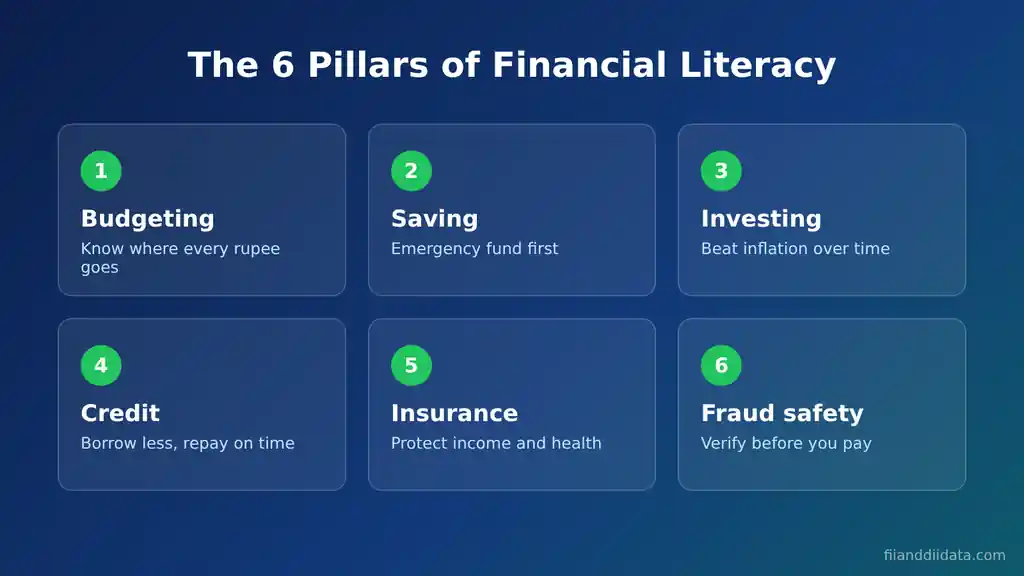
- Financial literacy is a set of six skills: budgeting, saving, investing, credit, insurance and fraud safety.
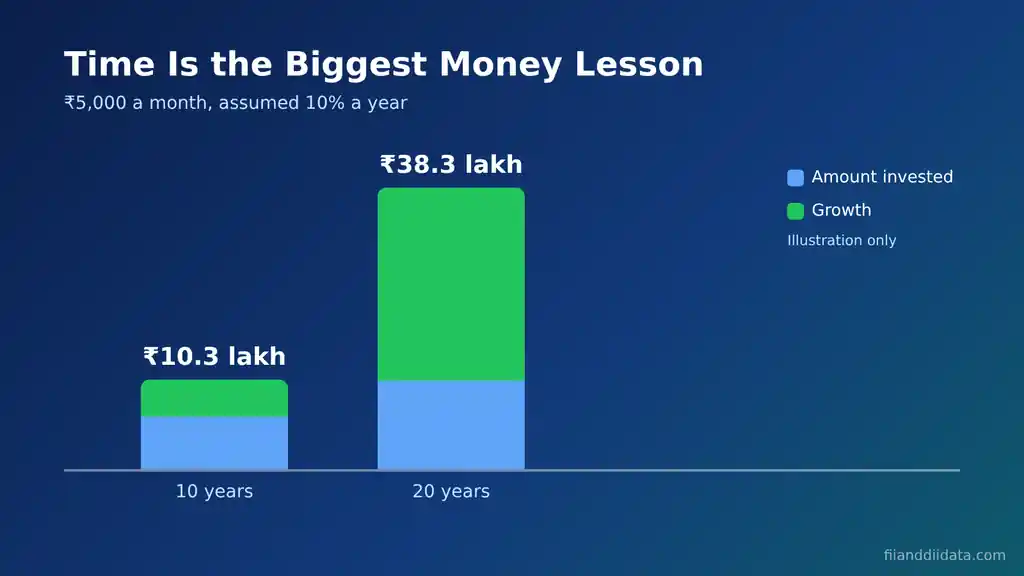
- Time matters more than amount: ₹5,000 a month at an assumed 10% grows to about ₹10.3 lakh in 10 years but about ₹38.3 lakh in 20 years.
- Inflation quietly cuts value: at an assumed 6%, ₹1 lakh buys only about ₹55,839 worth of today’s goods after 10 years.
- DICGC insures bank deposits up to ₹5 lakh per depositor per bank, principal and interest together.
- For online money fraud, call 1930 and report on cybercrime.gov.in as fast as possible.
Table of contents
- What Is Financial Literacy for Adults?
- Why Money Skills Matter More After 25
- The 6 Pillars of Financial Literacy for Adults
- Worked Example: Time, Inflation and Interest
- India’s Official Money Safety Nets
- How to Protect Yourself From Financial Fraud
- A 30-Day Plan to Build Your Money Skills
- Common Mistakes Adults Make With Money
- FAQs
- The Bottom Line
What Is Financial Literacy for Adults?
Financial literacy is the ability to understand how money works in daily life and to use that knowledge in real decisions. For an adult, it covers questions like these: How much of my salary should I save? Is this loan affordable? Does my bank deposit carry any guarantee? Is this “guaranteed return” scheme real?
It has three parts. Knowledge is knowing the concepts, such as interest, inflation and risk. Behaviour is what you actually do, such as paying bills on time and tracking spending. Attitude is how you think about the future, such as preferring long-term security over short-term spending. India’s National Centre for Financial Education (NCFE) measures financial literacy through national surveys and used its 2019 survey findings to frame the National Strategy for Financial Education 2020-25.
A literate adult is not someone who never makes mistakes. It is someone who can spot a bad deal early, ask the right questions and recover quickly. The next section explains why this matters more once you start earning.
Why Money Skills Matter More After 25
In your twenties and thirties, money decisions start to carry long-term weight. A first salary, a home loan or a family health emergency can shape your finances for years. Without basic skills, people tend to borrow at high cost, keep idle cash that loses value, or buy insurance and investment products they do not understand.
Money is also more digital now. UPI, instant loans and app-based investing make transactions faster, and they make mistakes and scams faster too. That is why RBI chose KYC and account hygiene as the 2026 theme for its Financial Literacy Week. If you are just starting, our guide to personal finance tips for everyday decisions is a good companion to this article.
So what exactly should an adult learn? The answer fits into six pillars.
The 6 Pillars of Financial Literacy for Adults
Think of these six pillars as a house. Budgeting and saving are the foundation, investing and credit are the walls, and insurance and fraud safety are the roof that protects everything else.
1. Budgeting: know where every rupee goes
A budget is a plan for your income before you spend it. A common starting rule is 50/30/20: 50% for needs, 30% for wants and 20% for savings. On a take-home pay of ₹60,000, that means ₹30,000 for needs, ₹18,000 for wants and ₹12,000 for savings. Treat it as a starting point, not a law. Our step-by-step guide on how to create a monthly budget shows how to set one up.
2. Saving: build an emergency fund first
An emergency fund is money kept aside for job loss, medical bills or urgent repairs. A widely used guideline is three to six months of essential expenses. If your monthly essentials are ₹35,000, six months means ₹2,10,000. Keep it in a safe, easy-to-access place such as a savings account or a sweep-in fixed deposit, not in shares.
3. Investing: make money grow faster than prices
Saving protects money; investing grows it. The key ideas are compounding (earning returns on past returns), diversification (not putting everything in one asset) and matching the product to your time horizon. Money needed within a year or two should not sit in volatile assets.
4. Credit: borrow less and repay on time
Credit means loans and credit cards. Learn the difference between the interest rate and the total cost, why paying only the minimum due on a card is expensive, and how late payments hurt your credit history. A simple rule: borrow for assets that last longer than the loan, not for daily spending.
5. Insurance: protect income and health
Insurance moves a large, rare loss to an insurer for a small, regular premium. Most working adults need health cover and, if others depend on their income, term life cover. Insurance is protection, not an investment, so be careful with products that mix the two.
6. Fraud safety: verify before you pay
This is the newest pillar and often the most urgent. It covers OTP and PIN safety, fake loan apps, fake investment schemes and knowing exactly where to report a problem. We cover it in detail below. First, here is what these ideas look like in numbers.
Worked Example: How Time, Inflation and Interest Change Your Money
Numbers make these ideas real. The examples below use assumed rates for illustration only; actual returns, inflation and interest rates vary.
Example 1: Starting early beats investing more
Riya invests ₹5,000 a month for 20 years. Arjun invests the same amount but starts 10 years later, so he invests for 10 years. At an assumed 10% annual return, compounded monthly, Riya ends with about ₹38.3 lakh on ₹12 lakh invested. Arjun ends with about ₹10.3 lakh on ₹6 lakh invested. Riya put in twice the money but ended with almost four times the corpus, because her money had more time to compound.
Example 2: Inflation shrinks idle money
If prices rise 6% a year, something that costs ₹1 lakh today will cost about ₹1,79,085 in 10 years. Put differently, ₹1 lakh kept as cash will buy only about ₹55,839 worth of today’s goods. If a savings account paid an assumed 3% while inflation ran at 6%, the real return would be about −2.83% a year.
Example 3: Revolving credit card debt
Suppose a card charges an assumed 3.5% a month on unpaid balances. A ₹50,000 balance left unpaid and compounding for 12 months grows to about ₹75,553, an increase of about 51%. Check your own card’s rate in its key fact statement; the lesson is that carrying card debt is one of the costliest habits an adult can have.
| Scenario | Assumption | Result |
|---|---|---|
| ₹5,000 a month for 10 years | 10% a year, monthly compounding | About ₹10.3 lakh (₹6 lakh invested) |
| ₹5,000 a month for 20 years | 10% a year, monthly compounding | About ₹38.3 lakh (₹12 lakh invested) |
| ₹1 lakh held for 10 years | 6% inflation a year | Buys about ₹55,839 of today’s goods |
| ₹50,000 card balance for 12 months | 3.5% a month interest | Grows to about ₹75,553 |
| Emergency fund | ₹35,000 monthly essentials × 6 | ₹2,10,000 |
Next, let us look at the official protections that already exist for Indian savers.
India’s Official Money Safety Nets Every Adult Should Know
Many costly mistakes happen because people do not know which protections exist or where to complain. These are worth remembering:
| Safety net | What it does | Key fact |
|---|---|---|
| DICGC deposit insurance | Insures deposits in insured banks if a bank fails | Up to ₹5 lakh per depositor per bank, principal and interest combined |
| National Cyber Crime Helpline 1930 | Reports online financial fraud | Available 24 hours; report quickly so action can start |
| National Cybercrime Reporting Portal | Online complaint filing for cyber fraud | cybercrime.gov.in |
| RBI Sachet portal | Check if an entity may accept deposits; file complaints about illegal deposit schemes | Launched by RBI (press release dated 4 August 2016) |
| RBI financial education page | Free booklets, posters and videos | Materials in 13 languages |
One practical point on deposit insurance: because the ₹5 lakh limit applies per bank, a family with large deposits may prefer to spread them across more than one bank. Deposits held in the same capacity across branches of the same bank are added together for the limit, according to DICGC’s guide.
Knowing these safety nets helps, but the best protection is not getting cheated in the first place.
How to Protect Yourself From Financial Fraud
Most frauds work by creating urgency or greed: a fake bank call about a “blocked” account, a loan app asking for contact access, or a scheme promising returns far above bank rates. Follow these rules:
- Never share an OTP, UPI PIN, card CVV or net banking password, with anyone, including callers who say they are from your bank.
- Before putting money in any deposit scheme, check the entity on RBI’s Sachet portal and confirm it is allowed to accept deposits.
- Be wary of anyone promising fixed high returns with no risk. Real investments carry risk, and returns are never guaranteed.
- Keep KYC, mobile number and email updated with your bank so you receive every transaction alert.
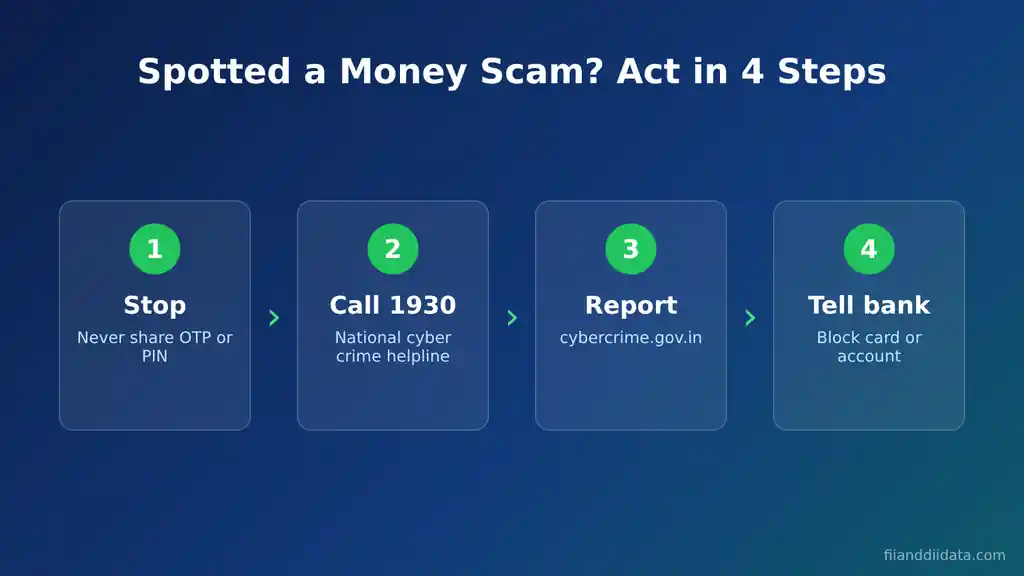
If something goes wrong, act within minutes. Call 1930, file a complaint on the National Cybercrime Reporting Portal, and ask your bank to block the card or account. Our guide on how to file a UPI fraud complaint walks through the exact steps.
A 30-Day Plan to Build Your Money Skills
You can cover the basics in a month with about 20 minutes a day. Here is a simple plan:
- Week 1, know your numbers: list your income, fixed bills, EMIs and the last three months of spending. Calculate your net worth (what you own minus what you owe).
- Week 2, set up the base: create a budget, automate a fixed saving on salary day and start building an emergency fund.
- Week 3, fix protection and debt: check your health and life cover, list every loan with its interest rate, and plan to clear the costliest one first.
- Week 4, learn and secure: read one RBI financial education booklet from the RBI Financial Education page, update KYC and alerts, and write down one long-term goal with a target amount and date.
Financial literacy for adults: a quick self-check
Answer yes or no. Every “no” is your next task.
- Do I know my exact monthly take-home pay and essential expenses?
- Do I have at least three months of expenses set aside for emergencies?
- Do I pay my credit card bill in full every month?
- Do I have health insurance that covers my family?
- Can I explain, in one line, what every investment I own does and what it costs?
- Do I know my bank deposits are insured up to ₹5 lakh per bank, and where to report fraud?
Common Mistakes Adults Make With Money
- Spending first, saving later: whatever is left at month-end is usually nothing. Save first, then spend.
- Treating insurance as investment: mixed products often give weak cover and low returns.
- Keeping too much idle cash: as the inflation example shows, idle money loses value every year.
- Chasing tips: buying shares on social media advice without understanding the business or the risk.
- Signing without reading: loan and card documents list the real cost; read the key fact statement first.
For more examples, see our list of common money mistakes to avoid. If you later start investing in shares, it also helps to understand how big institutions move the market; our FII and DII data page tracks how foreign and domestic institutions buy and sell Indian stocks every trading day.
FAQs
What is financial literacy for adults?
Financial literacy for adults is the practical ability to manage money well: making a budget, saving for emergencies, borrowing sensibly, investing for long-term goals, choosing the right insurance and avoiding fraud. It combines knowledge, daily habits and a long-term attitude.
What are the basic components of financial literacy?
The core components are budgeting, saving, investing, credit and debt management, insurance, and fraud safety. Together they cover earning, protecting and growing money.
How can an adult improve financial literacy quickly?
Start with your own numbers: track one month of spending, make a simple budget, automate savings and list every loan with its interest rate. Then spend 20 minutes a day reading trusted free material, such as the RBI financial education booklets.
Is it too late to learn about money at 40 or 50?
No. You have fewer years for compounding, so the priority shifts to clearing costly debt, protecting health and income, and saving a larger share of income. Small improvements still make a large difference over 10 to 20 years.
Where can Indians learn financial literacy for free?
The RBI Financial Education page offers free booklets, posters and videos in 13 languages, and the National Centre for Financial Education (NCFE) runs financial literacy programmes and surveys. Your bank’s financial literacy centre may also run free sessions.
The Bottom Line
Financial literacy is not about predicting markets or finding the perfect product. It is about a few steady habits: spend less than you earn, keep an emergency fund, avoid expensive debt, insure what you cannot afford to lose, invest early for long-term goals and verify before you pay.
None of this requires a large income. It requires attention. Start this week with one step: write down your monthly income and essential expenses, then set up an automatic saving on salary day. For more practical guides, browse our blog.
Sources: Reserve Bank of India, Financial Education; DICGC, A Guide to Deposit Insurance; RBI press release on Sachet, 4 August 2016; NCFE, Financial Literacy and Inclusion Survey; National Cybercrime Reporting Portal. All accessed 2 November 2026.
Disclaimer: This article is for educational purposes only and is not investment advice. Please consult a SEBI-registered advisor before making investment decisions.