
The simplest way to approach how to save money for a child’s education is to price the course in future rupees, pick a date, and invest a fixed amount every month in products that match the years left. A degree that costs ₹15 lakh today could cost about ₹47.6 lakh in 15 years at 8% yearly education inflation, so the monthly number matters more than the product you choose.
Key Takeaways
- Always plan in future rupees: a ₹15 lakh course today becomes about ₹47.6 lakh in 15 years at 8% inflation.
- Starting when the child is 3 needs about ₹11,400 a month at a 10% return; starting at 8 needs about ₹23,000.
- For October to December 2026, Sukanya Samriddhi Yojana pays 8.2% and PPF pays 7.1%.
- Sukanya Samriddhi allows only 50% of the balance to be withdrawn for education once the girl turns 18 or passes Class 10.
- Move the fund from equity to deposits over the last three to four years before college.
Table of contents
- How Much Your Child’s Education Will Really Cost
- How to Save Money for a Child’s Education: A Worked 15-Year Plan
- Why Starting Five Years Earlier Halves the Monthly Amount
- Where to Invest: Options Compared With October to December 2026 Rates
- Sukanya Samriddhi and PPF Rules Parents Should Know
- Shift to Safety as the College Year Gets Closer
- Protect the Plan: Insurance and Tax Points
- Common Mistakes When You Save Money for a Child’s Education
- Yearly Checklist for Your Child’s Education Fund
- FAQs
- The Bottom Line
How Much Your Child’s Education Will Really Cost
Most parents start with a feeling, not a number. The better first step is to write down the course your child may take, the year it starts, and what it costs today.
For this guide, we take an example of a four-year professional degree at a private college that costs ₹15 lakh in total today, including fees, hostel and books. Your figure may be lower for a government college or much higher for medicine or study abroad, so check current fee pages of two or three colleges.
The inflation step most parents skip
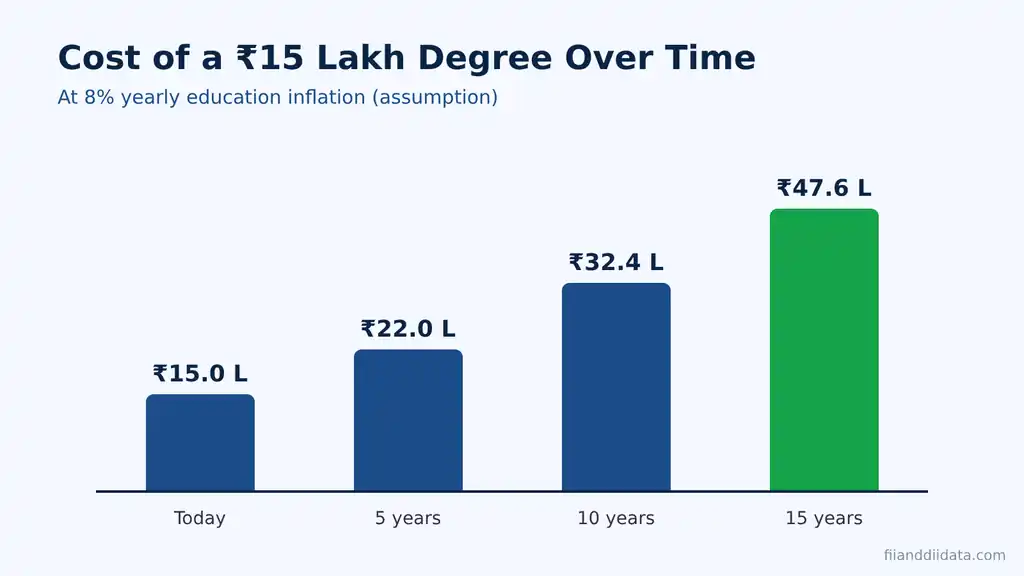
Education inflation is the yearly rise in the cost of school and college. India has no single official figure for it, so we assume 8% a year for illustration. This is our assumption, not a forecast. At 8%, today’s ₹15 lakh grows like this:
| Years from today | Cost of the same degree |
|---|---|
| Today | ₹15.0 lakh |
| 5 years | ₹22.0 lakh |
| 10 years | ₹32.4 lakh |
| 15 years | ₹47.6 lakh |
That is more than three times today’s cost. Once you have the future cost, you can work out the monthly saving.
How to Save Money for a Child’s Education: A Worked 15-Year Plan
Take a child who is 3 today. College starts at 18, so the family has 15 years to build ₹47.6 lakh. The monthly amount depends on the return, so we show three levels.
| Assumed yearly return | Monthly saving for 15 years | Total you put in |
|---|---|---|
| 7.1% (close to the current PPF rate) | ₹14,800 | ₹26.6 lakh |
| 10% (balanced equity and debt) | ₹11,400 | ₹20.5 lakh |
| 12% (mostly equity, higher risk) | ₹9,400 | ₹17.0 lakh |
Equity returns are not fixed; 10% or 12% is a planning assumption and real returns can be lower. That is why many parents use a mix: a safe, fixed-rate product for part of the goal and an equity mutual fund SIP for the rest. A SIP, or systematic investment plan, is a fixed monthly investment into a mutual fund.
A blended plan for a daughter
Suppose the child is a girl and the family puts ₹50,000 a year (about ₹4,200 a month) into a Sukanya Samriddhi account for 15 years. At 8.2%, the balance reaches about ₹14.9 lakh by the time she is 18. Only half of that, about ₹7.5 lakh, can be withdrawn for education at that point. The remaining gap of about ₹40.1 lakh needs an equity SIP of roughly ₹9,600 a month at a 10% return. The half left in the account keeps earning until maturity and could grow to about ₹12 lakh, useful for a master’s degree later. These figures assume today’s 8.2% rate holds, which it may not, since the government resets it every quarter.
To find room for these amounts in a monthly budget, the 50 30 20 budgeting rule is a good starting split. Next, see how much a delay costs.
Why Starting Five Years Earlier Halves the Monthly Amount
Time does more work than return. Keep the same ₹47.6 lakh target at age 18 and the same 10% return, and change only the start date:
- Start at child’s age 3: about ₹11,400 a month for 15 years. Total invested: ₹20.5 lakh.
- Start at child’s age 8: about ₹23,000 a month for 10 years. Total invested: ₹27.6 lakh.
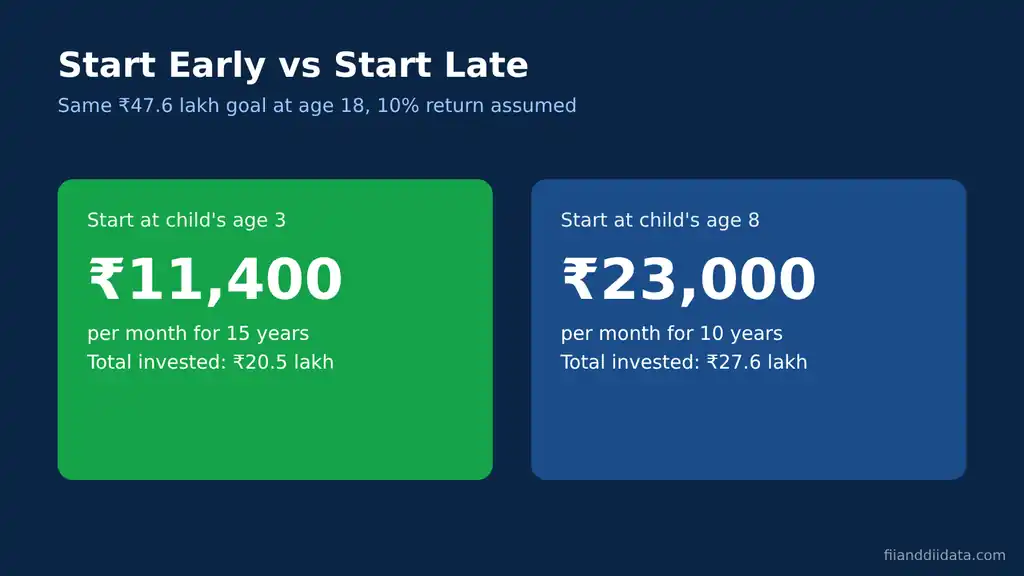
A five-year delay doubles the monthly amount and adds about ₹7 lakh to what you put in from your own pocket. If you are starting late, begin with what you can, raise the SIP each year as your salary rises, and plan a smaller education loan for any gap. The next question is where the money should go.
Where to Invest: Options Compared With October to December 2026 Rates
The Ministry of Finance kept small savings rates unchanged for the October to December 2026 quarter, as reported by Business Today on 30 September 2026 and listed on Indian Bank’s small savings page. Here is how the main options compare for an education goal:
| Option | Return (Oct to Dec 2026) | Lock-in or access | Best use |
|---|---|---|---|
| Sukanya Samriddhi Yojana | 8.2%, fixed each quarter | 21 years; 50% for education from 18 | Daughters under 10, safe core |
| Public Provident Fund | 7.1%, fixed each quarter | 15 years; limited early access | Safe core for any child |
| Post Office time deposit (5 years) | 7.5% | 5 years | Last five years before college |
| Post Office time deposit (1 to 3 years) | 6.9% to 7.1% | 1 to 3 years | Final one to three years |
| Equity mutual fund SIP | Market-linked, not fixed | Usually none; depends on the fund | Growth when 8+ years remain |
| Bank FD or RD | Varies by bank | Chosen tenure | Parking money close to the date |
There is no single best product. Fixed-rate schemes protect what you have built, while equity funds give the growth needed to beat education inflation. Our SIP inflow data for September 2026 shows how many Indian families kept investing through a weak market. Since two government schemes form the safe core of most plans, their rules deserve a closer look.
Sukanya Samriddhi and PPF Rules Parents Should Know
How to save money for a child’s education with Sukanya Samriddhi
As per Indian Bank’s Sukanya Samriddhi Account page and SBI’s scheme page, the main rules are:
- A guardian can open the account for a girl child under 10 years of age.
- Deposits range from ₹250 to ₹1.5 lakh per financial year.
- Deposits are made for 15 years; the account matures 21 years from the opening date.
- Up to 50% of the balance can be withdrawn for education once the girl turns 18 or passes Class 10, whichever comes first.
- A guardian can open accounts for up to two daughters, with an exception for twins or triplets.
- Documents: the girl’s birth certificate and the guardian’s KYC, PAN and Aadhaar.
The 50% limit is the detail many parents miss: if your whole plan sits in this scheme, only half is available when first-year fees fall due.
PPF in a child’s name
A parent can open a PPF account for a minor child of either gender. ICICI Bank’s guide states a minimum of ₹500 and a maximum of ₹1.5 lakh per financial year, a 15-year lock-in, and premature closure only after five years for specific reasons such as higher studies. Value Research notes one trap: the ₹1.5 lakh limit is combined across the parent’s own PPF and the child’s PPF. If you already put ₹1.5 lakh into your own account, you cannot add more to your child’s account that year.
As the college year gets closer, the mix of the whole fund needs to change.
Shift to Safety as the College Year Gets Closer
A glide path is a plan to move money from growth assets to safe ones as a goal date nears. It protects you from a market fall in the year the fees are due.
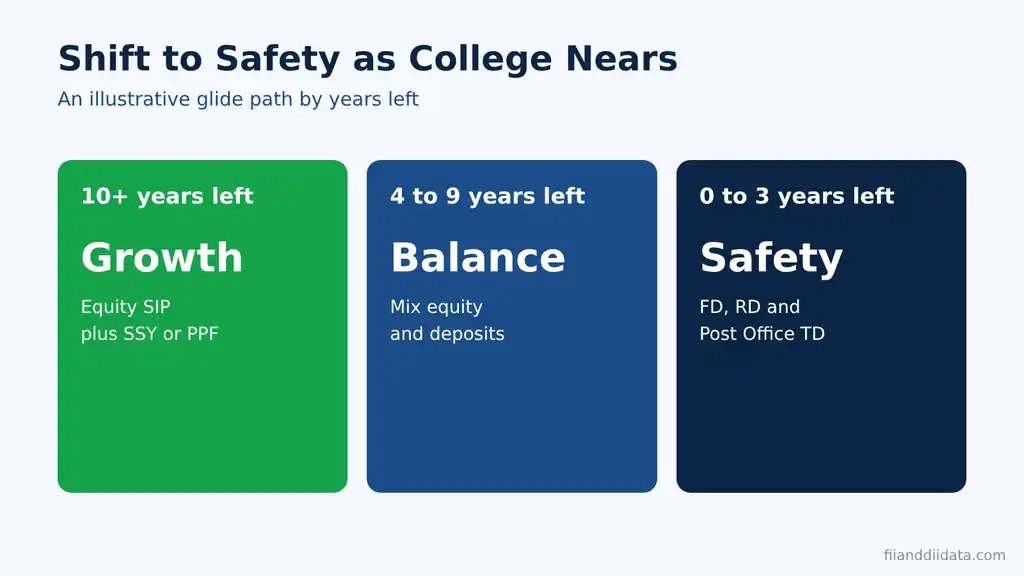
| Years left to college | Suggested focus | What to do |
|---|---|---|
| 10 or more | Growth | Equity SIP plus Sukanya Samriddhi or PPF |
| 4 to 9 | Balance | Keep the SIP, start moving gains to deposits each year |
| 0 to 3 | Safety | Hold the fund in FDs, RDs or Post Office deposits |
Make the shift in steps, once a year, instead of all at once. A plan can still fail if the earning parent is not there to fund it, which brings us to protection.
Protect the Plan: Insurance and Tax Points
Term insurance first. The biggest risk to an education fund is the loss of the parent who pays into it. A term plan on the earning parent, with cover large enough to fund the remaining goal and household costs, protects the child’s education better than any investment product. Keep insurance and investment separate.
Emergency fund second. Without one, a job loss or medical bill can force you to stop SIPs or break deposits early. Our guide on building an emergency fund explains how much to keep and where.
Tax points. The Income-tax Act, 2025 came into force on 1 April 2026, as stated on the Income Tax Department’s e-filing portal. Business Today reported on 24 March 2026 that the old Section 80C deduction now sits under Section 123, with the same ₹1.5 lakh yearly limit, and that it continues to cover PPF, Sukanya Samriddhi and children’s tuition fees. This deduction helps only if you choose the old tax regime. SBI’s scheme page describes Sukanya Samriddhi as tax-free at deposit, interest and withdrawal, while gains from mutual funds are taxable, so check the current rules before you withdraw.
Even with the right products, a few habits can quietly undo the plan.
Common Mistakes When You Save Money for a Child’s Education
- Planning in today’s rupees. Ignoring inflation can leave you with one-third of what you need.
- Putting everything in one scheme. Sukanya Samriddhi releases only 50% at 18, and PPF has a long lock-in.
- Keeping all of it in equity until the last year. A market fall near admission time leaves no room to recover.
- Mixing insurance and investment. Buy term cover for protection and invest separately.
- Breaching the PPF limit. The ₹1.5 lakh cap is shared between your PPF and your child’s PPF.
- Never raising the SIP. Increase it with each salary hike so it keeps pace with fees.
More everyday slips are covered in our guide to setting financial goals, which also shows how to add inflation to any target. A short yearly review keeps you on course.
Yearly Checklist for Your Child’s Education Fund
- Update today’s cost of the target course using current college fee pages.
- Recalculate the future cost and compare it with the fund’s value.
- Raise the monthly SIP if your income has gone up.
- Make this year’s Sukanya Samriddhi or PPF deposit before 31 March.
- Check that your own PPF and your child’s PPF together stay within ₹1.5 lakh.
- Move part of the equity fund to deposits if fewer than nine years remain.
- Confirm that term cover and the emergency fund are still adequate.
FAQs
How to save money for a child’s education in India?
Estimate the future cost of the course with inflation, fix the year it starts, and invest a fixed amount every month. Use Sukanya Samriddhi or PPF as a safe core, an equity SIP for growth while 8 or more years remain, and shift to deposits in the last three to four years.
How much should I save monthly for my child’s education?
It depends on the target and time left. In our example, a degree costing ₹15 lakh today needs about ₹47.6 lakh in 15 years at 8% inflation. That works out to about ₹11,400 a month at a 10% return, or about ₹14,800 a month at 7.1%.
Is Sukanya Samriddhi Yojana good for a daughter’s education?
It is a safe option with an 8.2% rate for October to December 2026 and tax-free interest. But only 50% of the balance can be withdrawn for education once she turns 18 or passes Class 10, so plan the other half from another source.
Can I open a PPF account for my child?
Yes. A parent can open a PPF account for a minor. Deposits range from ₹500 to ₹1.5 lakh a year, but the ₹1.5 lakh limit is shared with the parent’s own PPF account. The account has a 15-year lock-in.
Which is better for child education, SIP or PPF?
Both have a role. PPF gives a fixed 7.1% rate for October to December 2026 with no market risk, while an equity SIP can earn more over long periods but can fall in value. Many parents use PPF or Sukanya Samriddhi as the base and a SIP for growth.
The Bottom Line
Saving for a child’s education is less about finding a clever product and more about getting the target right. Price the course in future rupees, start as early as you can, and split the money between a safe core like Sukanya Samriddhi or PPF and an equity SIP for growth. Then move steadily to deposits as the college year approaches.
Your next step: note your child’s age, the course you have in mind and its fee today, then use the tables above to find your monthly number. If you are also planning a home, our guide on saving for a house shows how to run two goals side by side. Equity markets move with big investor flows, which you can follow on our FII and DII data page. For more guides, visit our blog.
Sources: Indian Bank, small savings scheme rates (1 Oct to 31 Dec 2026); Indian Bank, Sukanya Samriddhi Account rules; Income Tax Department, Income-tax Act 2025 FAQs; Business Today, Section 80C becomes Section 123 (24 March 2026); Business Today, small savings rates for Q3 FY27 (30 September 2026); SBI, Sukanya Samriddhi Yojana page; ICICI Bank, PPF account for minors; Value Research, PPF rules for minors.
Disclaimer: This article is for educational purposes only and is not investment advice. Please consult a SEBI-registered advisor before making investment decisions.