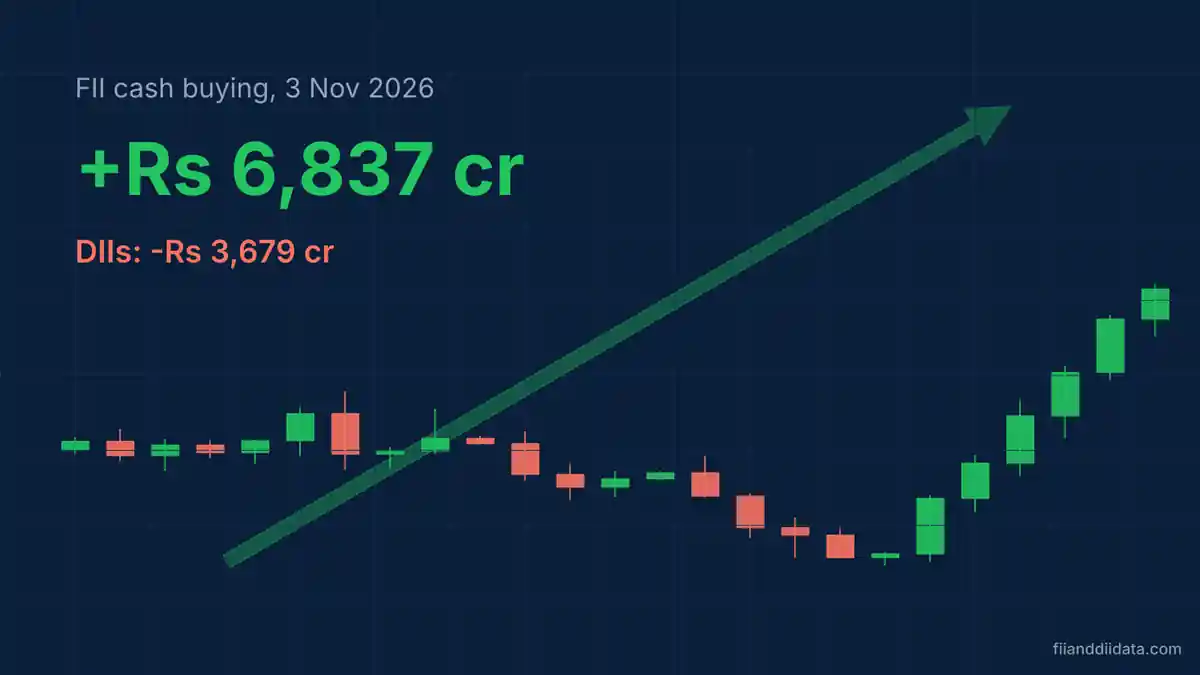
FII record buying lifted Indian equities on Tuesday, 3 November 2026, as foreign institutional investors bought a net Rs 6,836.81 crore in the cash market, their biggest single-day purchase since October 2025. Domestic institutions moved the other way and sold Rs 3,678.85 crore. The Nifty 50 closed 1.58% higher at 23,810.85, its fourth straight gain. Here is what drove the flows, how to read them, and what to watch next.
Key Takeaways
- FIIs bought a net Rs 6,836.81 crore on 3 November 2026, the largest one-day figure since 28 October 2025.
- DIIs sold a net Rs 3,678.85 crore, so combined institutional buying was about Rs 3,158 crore.
- Two-day FII buying (2 and 3 November) reached about Rs 9,951 crore after months of heavy selling.
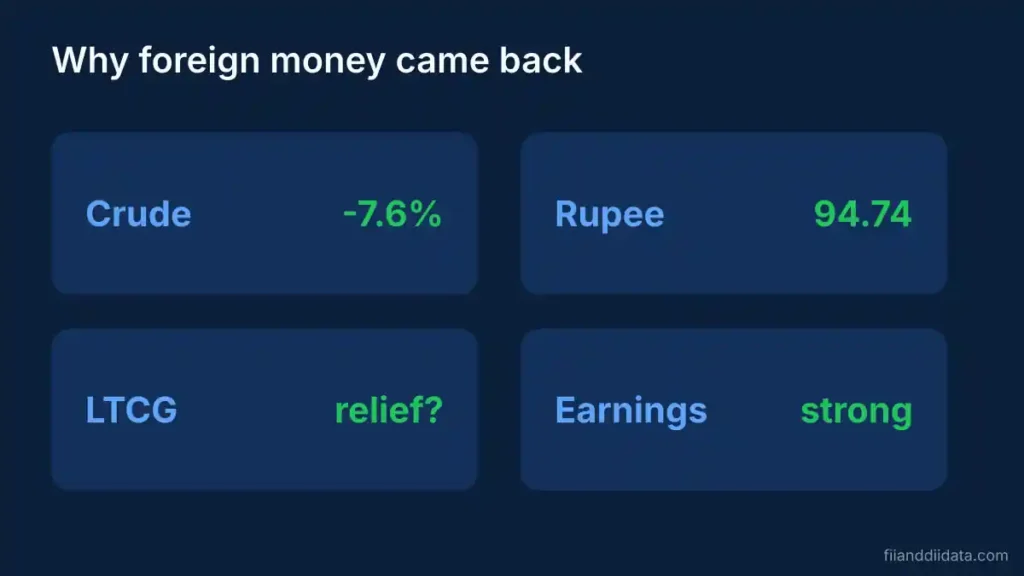
- Lower crude, a firmer rupee, strong earnings and talk of LTCG tax relief for FPIs drove the move.
- One big day is not a trend. Watch NSDL data, the buying streak and FII futures positions.
In this article:
- FII record buying on 3 November 2026: the numbers
- Why FIIs turned buyers
- Why DIIs sold into the rally
- How to read the data: a worked example
- Does FII record buying mean the selling is over?
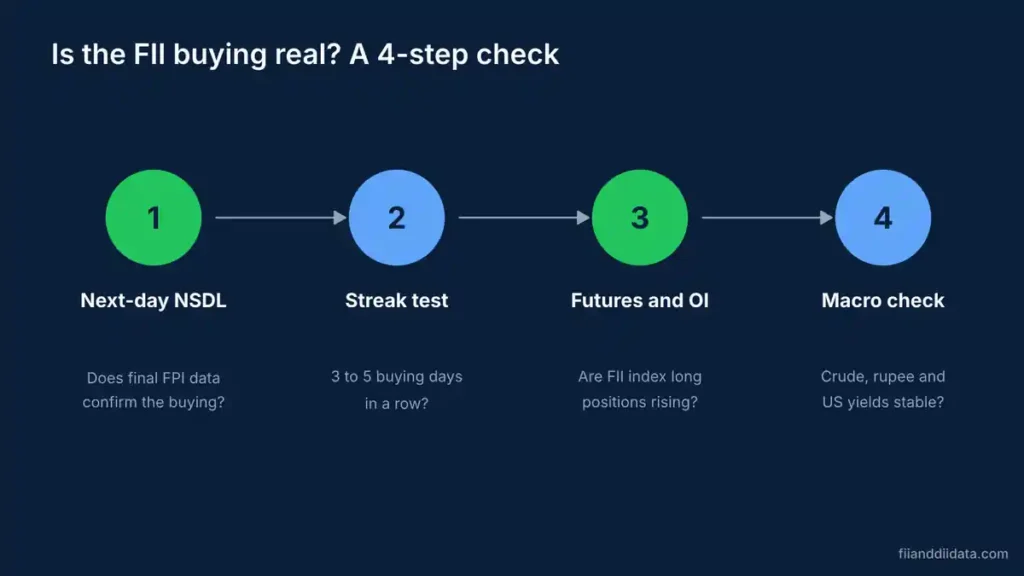
- What to track next: a 4-step checklist
- FAQ
- The Bottom Line
FII Record Buying on 3 November 2026: The Numbers
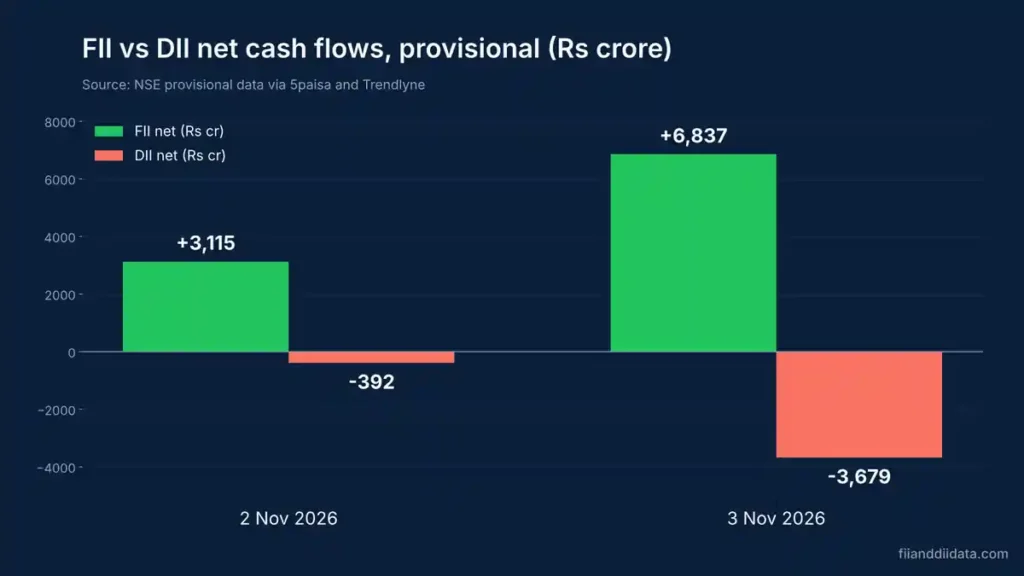
Provisional NSE data, released after market close, shows FIIs bought shares worth Rs 20,970.5 crore and sold Rs 14,133.7 crore on 3 November. That leaves a net purchase of Rs 6,836.8 crore. Business Standard reported this as the biggest single-day FPI net buying since 28 October 2025, when FIIs bought Rs 10,340 crore.
DIIs, which include mutual funds, insurers and pension funds, bought Rs 16,723.9 crore and sold Rs 20,402.8 crore. Their net sale of Rs 3,678.85 crore was the reverse of their usual role in 2026, when they absorbed most foreign selling.
| Date | FII net (Rs crore) | DII net (Rs crore) | Nifty 50 close |
|---|---|---|---|
| 2 Nov 2026 | +3,114.68 | -392.20 | 23,440.80 |
| 3 Nov 2026 | +6,836.81 | -3,678.85 | 23,810.85 (+1.58%) |
| Two-day total | +9,951.49 | -4,071.05 | +370.05 points on 3 Nov |
The Sensex rose 1,225.07 points (1.62%) to 76,917.85, and NSE-listed companies added about Rs 4.71 lakh crore in market value, according to Upstox. You can compare these figures with earlier sessions on our FII DII data today page. So what changed for foreign funds?
Why FIIs Turned Buyers: Three Big Triggers
No single factor explains a move this size. Three triggers lined up within a few days.
1. Crude oil and the rupee
Brent crude fell about 7% on Monday, 2 November, on renewed US-Iran diplomatic contact, as reported by Business Standard and IIFL. India imports most of its oil, so cheaper crude eases inflation and the trade deficit. The rupee firmed to 94.74 per dollar from 94.90, which lifts dollar returns for foreign investors.
2. Talk of LTCG relief for FPIs
On 2 November, Business Standard, citing Reuters, reported that SEBI has recommended scrapping long-term capital gains (LTCG) tax on FPI equity gains. FPIs now pay 12.5% LTCG and 20% short-term gains tax. The proposal is not binding; the Centre decides, possibly before the February 2027 Union Budget. We cover the policy angle in our Budget 2027 stock market preview.
3. Earnings and the AI-trade unwind
Strong results from FMCG firms such as ITC and Marico supported buying, and Nifty FMCG rose 3.65%. Globally, investors trimmed expensive AI-linked technology stocks, which made cheaper markets like India look more attractive on a relative basis. Why, then, did domestic funds sell?
Why DIIs Sold Into the Rally
DII selling on a strong up-day is usually profit booking, not panic. Domestic funds bought heavily through 2026 while FIIs sold, so a four-day rally gives them room to trim positions at better prices. Somil Mehta of Mirae Asset Sharekhan said, as quoted by Business Standard, that “some profit booking cannot be ruled out after the recent rally.”
Mutual funds also manage redemptions and portfolio rebalancing, which can show up as net sales even when SIP inflows stay healthy. One day of DII selling says little about domestic demand. The next section shows how to read both sides together.
How to Read the Data: A Worked Example
Net flow is simply gross purchases minus gross sales. Using the 3 November figures:
- FII net = Rs 20,970.5 crore bought minus Rs 14,133.7 crore sold = +Rs 6,836.8 crore
- DII net = Rs 16,723.9 crore bought minus Rs 20,402.8 crore sold = -Rs 3,678.9 crore (rounded)
- Combined institutional net = 6,836.8 minus 3,678.9 = about +Rs 3,158 crore
The combined figure matters because it shows how much fresh institutional demand actually hit the market. Here it was positive, which fits a 1.58% Nifty gain. Also check gross turnover: FII gross activity of about Rs 35,104 crore shows the buying was broad, not a single block deal. For month-level context, see our monthly FII DII data.
Does FII Record Buying Mean the Selling Is Over?
Not yet. FPIs withdrew Rs 34,843 crore from Indian equities in October and Rs 35,861 crore in September, and total 2026 outflows reached about Rs 2.95 trillion by end-October, according to PTI data cited by Business Standard. Against that, two strong days are a small dent.
Analysts are cautious. JM Financial, quoted by Business Today, estimates that removing LTCG would add about 2.2 percentage points to a foreign investor’s average yearly dollar return, but called it “a small lever beside valuation.” Nirav Karkera of W by Groww said lasting conviction “will have to come from earnings delivery, reasonable valuations and confidence in the rupee.” Our earlier note on FII buying in November 2026 tracks how the month started.
Common mistakes when reading FII record buying
- Treating provisional NSE data as final. NSDL publishes final FPI figures the next working day, and the numbers can differ.
- Ignoring the derivatives side. Cash buying can be paired with short futures as a hedge.
- Reading one day as a trend. Reversals usually show up as streaks over several sessions.
What to Track Next: A 4-Step Checklist
- Confirm with NSDL. Check whether next-day NSDL data shows similar FPI equity inflows.
- Test the streak. Three to five buying days in a row signal real intent. One day can be index or block-deal driven.
- Watch derivatives. Rising FII index long positions in our participant-wise open interest data, our FII DII F&O data and the FII options activity tracker would back the cash buying.
- Check macro risk. Crude, the rupee and US bond yields can reverse flows quickly.
Frequently Asked Questions
How much did FIIs buy on 3 November 2026?
FIIs bought a net Rs 6,836.81 crore in the cash market on 3 November 2026, based on provisional NSE data. It was their biggest single-day net purchase since 28 October 2025.
Why is FII record buying important for the Nifty?
Large FII purchases add fresh demand for index heavyweights and usually support the rupee. On 3 November the Nifty 50 rose 1.58% to 23,810.85 as FIIs bought and DIIs sold.
Why did DIIs sell when FIIs were buying?
DIIs bought heavily through 2026 while FIIs sold. A strong rally lets them book profits and rebalance, so net DII selling on an up-day is common and not a sign of weak domestic demand.
When is FII DII data released?
NSE publishes provisional FII and DII cash market data after market close, usually around 6 PM IST on trading days. NSDL releases final FPI data on the next working day.
Will LTCG tax be removed for foreign investors?
Not yet. SEBI has reportedly recommended scrapping LTCG tax on FPI equity gains, but the proposal is not binding. The government will decide, possibly before the February 2027 Union Budget.
The Bottom Line
The Rs 6,837 crore FII purchase on 3 November 2026 is the strongest foreign buying signal India has seen in a year. Cheaper crude, a steadier rupee, solid earnings and possible tax relief all pushed in the same direction, while DIIs used the rally to book profits.
Still, Rs 9,951 crore over two days is small next to roughly Rs 2.95 trillion of 2026 outflows. Treat it as an early signal, not a confirmed reversal. A practical next step: track the daily flows on our FII and DII data dashboard for the rest of this week and look for a buying streak backed by NSDL figures.
Sources: 5paisa FII DII data (NSE provisional); Trendlyne FII DII data; Upstox market wrap, 3 Nov 2026; Business Standard on SEBI’s LTCG proposal, 2 Nov 2026; Business Standard market report, 3 Nov 2026; Business Today; IIFL Securities.
Disclaimer: This article is for educational purposes only and is not investment advice. Please consult a SEBI-registered advisor before making investment decisions.