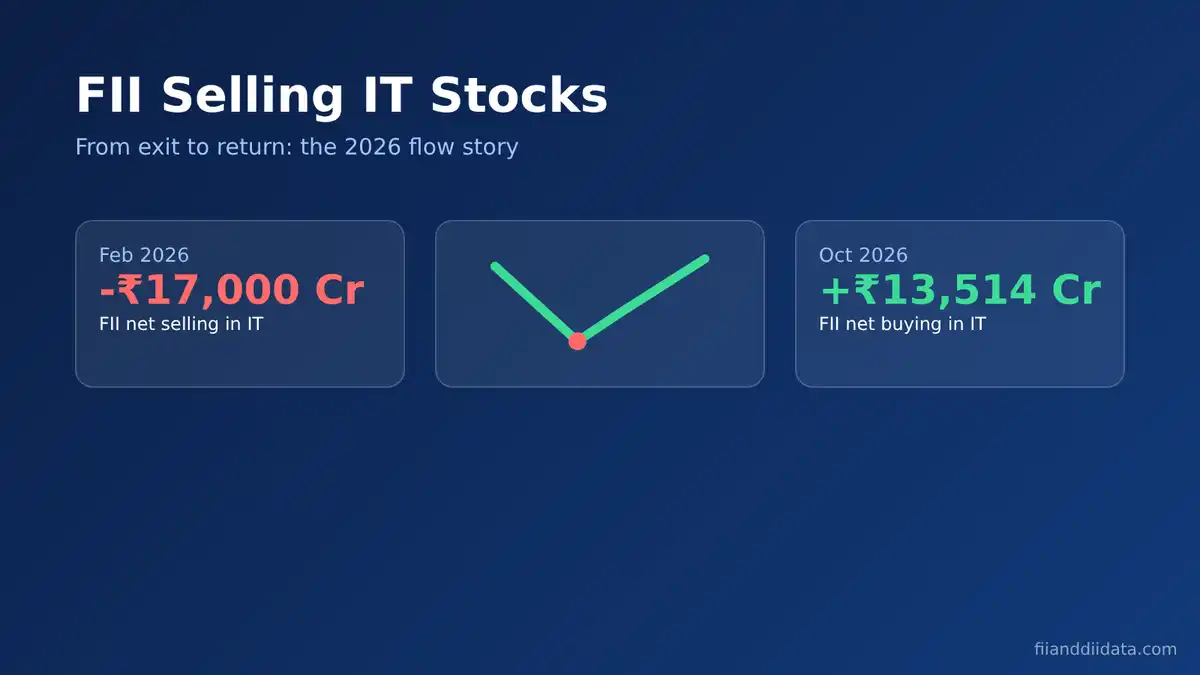
Diwali Muhurat trading 2026 FII activity will be read closely this year, because foreign investors walk into the special session on Sunday, 8 November 2026 after selling heavily for two months. The session runs from 2:20 PM to 3:30 PM IST, and FPIs pulled ₹34,843 crore out of Indian equities in October. Here is what the session is, how foreign money is positioned, and which numbers to check once the bell rings.
Key Takeaways
- Muhurat trading 2026 is on Sunday, 8 November, with the normal market open from 2:20 PM to 3:30 PM IST.
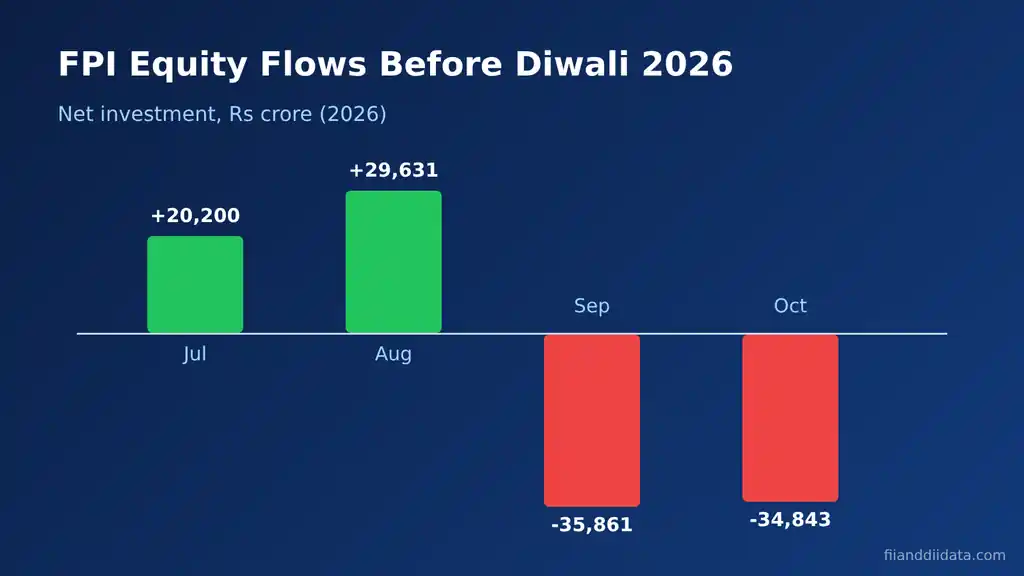
- FPIs sold ₹35,861 crore in September and ₹34,843 crore in October 2026, after buying in July and August.
- Nifty closed higher in the 2023, 2024 and 2025 Muhurat sessions, but each gain was below 1%.
- FIIs can trade in the session, yet a 70-minute window rarely shows their real intent.
- The useful signal comes from the first week of Samvat 2083, not from the ceremonial hour.
In this article
- What is Muhurat trading?
- Muhurat trading 2026 date and timings
- Can FIIs trade in the Muhurat session?
- How foreign money enters Samvat 2083
- What past Muhurat sessions show
- How to read FII data after the session
- Common mistakes to avoid
- Frequently asked questions
- The bottom line
What Is Muhurat Trading?
Muhurat trading is a short, special trading session that NSE and BSE hold on Diwali (Lakshmi Puja). It marks the start of Samvat, the traditional Hindu accounting year. In 2026, the session opens Samvat 2083. Many investors buy a few shares on this day as a token of good fortune for the year ahead, and many brokers open new account books.
The tradition is old. According to Business Today, BSE began it in 1957 and NSE followed in 1992. For most of that history the session was held in the evening. In 2025 it moved to the afternoon for the first time, and the 2026 session stays in the afternoon.
One point matters more than the ceremony. Every trade in the session is a real trade. The exchange circulars say all trades create settlement obligations, so a buy order is not symbolic once it is filled. With that clear, let us look at the exact clock.
Muhurat Trading 2026 Date and Session Timings
NSE and BSE announced the schedule on 19 October 2026. The session falls on Sunday, 8 November 2026. This is also the first Muhurat session after the closing auction session (CAS) was introduced. CAS is a short auction at the end of the day that sets the closing price for eligible stocks.
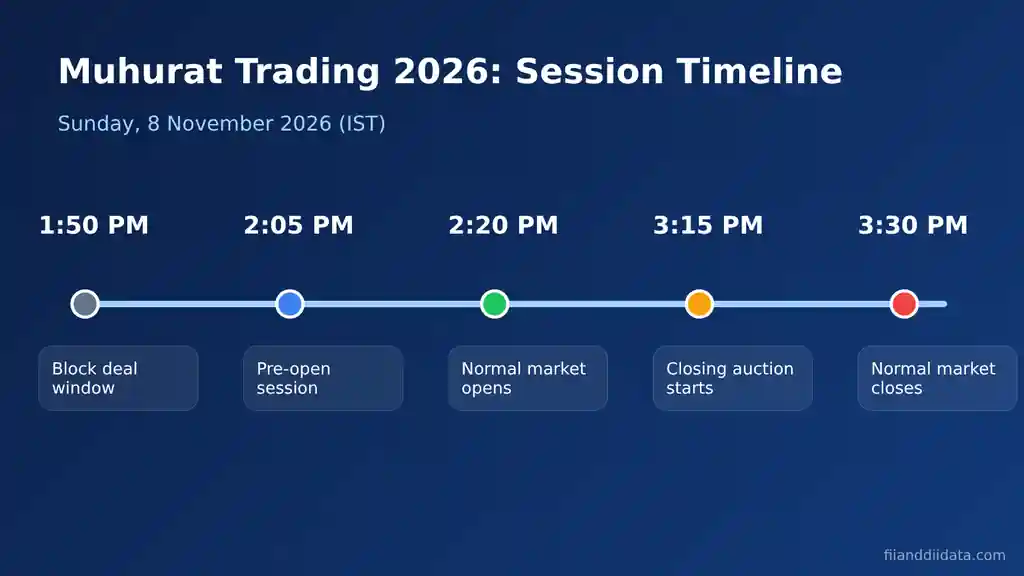
| Session (cash market) | Time (IST) |
|---|---|
| Block deal window | 1:50 PM to 2:05 PM |
| Pre-open session | 2:05 PM to 2:20 PM |
| Normal market (continuous trading) | 2:20 PM to 3:30 PM |
| Closing auction session | 3:15 PM to 3:35 PM |
| Trading holiday (Diwali Balipratipada) | Tuesday, 10 November 2026 |
Two details help traders. First, in the pre-open, both market and limit orders are accepted until 2:10 PM, after which only limit orders are taken. Second, for CAS-eligible stocks, the closing reference price is the volume weighted average price (VWAP) of trades between 3:00 PM and 3:15 PM. So the last few minutes can behave differently from a normal day.
Seventy minutes of continuous trading is short. A regular session runs from 9:15 AM to 3:30 PM, or 375 minutes. That gap is the key to reading foreign investor numbers from the day, which we cover next.
Can FIIs Trade in the Muhurat Session?
Yes. Foreign institutional investors, now formally called foreign portfolio investors (FPIs), can trade in the Muhurat session through their custodians and local brokers, as on any trading day. Angel One noted in October 2025 that block deals are also allowed in the Muhurat block deal window, and that the afternoon slot is easier for investors in Europe and Asia than the old evening slot.
In practice, large foreign funds rarely use the session to make big moves. Liquidity is thin, the window is short, and many global desks treat it as a normal Sunday. Their real decisions usually show up in the regular sessions before and after Diwali. If you want a refresher on who these investors are, our guide on why NSE and NSDL foreign investor figures differ explains how each body counts them.
So the better question is not what FIIs do in one hour, but how they arrive at Diwali. That is where the 2026 data tells a clear story.
Diwali Muhurat Trading 2026 FII Context: How Foreign Money Enters Samvat 2083
Foreign investors bought Indian shares in the middle of the year and then reversed hard. Free Press Journal, citing depository data on 1 November 2026, reported the following monthly equity flows.
| Month (2026) | FPI net equity flow (₹ crore) |
|---|---|
| July | +20,200 |
| August | +29,631 |
| September | -35,861 |
| October | -34,843 |
| July to October total | -20,873 |
| Calendar 2026 so far | About -2.95 lakh crore |
Three things stand out. Two months of buying were more than wiped out by two months of selling. Calendar 2026 outflows of about ₹2.95 lakh crore are well above the ₹1.66 lakh crore FPIs pulled out in all of 2025, as reported by the same paper on 11 October 2026. And yet FPIs bought about ₹6,300 crore between 26 and 30 October, turning net buyers in three of the last four sessions.
Analysts quoted in that report linked the October selling to high crude oil prices, global interest rates and uncertain corporate earnings. Our detailed tracker of FPI outflow in 2026 breaks down the earlier months, and the FII DII weekly report for the week to 30 October covers the late-month turn.
This sets up the real test for Samvat 2083. Was the late-October buying a one-week pause in selling, or the start of a return? Past Muhurat sessions give some perspective.
What Past Muhurat Sessions Show
Muhurat sessions have a mild upward bias. Business Today reported in October 2025 that benchmark indices ended higher in eight of the previous ten Muhurat sessions, with average gains of 0.4% to 0.9%. The last three sessions fit that pattern, and the FII mood going into each was very different.
| Muhurat session | Nifty close and change | FII cash activity on previous trading day |
|---|---|---|
| 2023 (Samvat 2080) | Up about 0.6% | Not reported in source |
| 1 November 2024 (Samvat 2081) | 24,304.35, up 99 points (0.41%) | Net sold ₹5,813.30 crore (31 October) |
| 21 October 2025 (Samvat 2082) | 25,869, up 26 points (0.10%) | Net bought ₹790 crore (20 October) |
Notice the 2024 row. FIIs had dumped more than ₹5,800 crore the day before, yet Nifty still rose 0.41% in the Muhurat hour. The session is driven by small retail token buying and light volumes. It is not a vote by foreign funds.
Worked example: reading Diwali Muhurat trading 2026 FII numbers in context
First, check the size of the index move. In 2025, Nifty rose 26 points to close at 25,869, so the previous close was 25,843. The change is 26 ÷ 25,843 = 0.10%. On a normal day, that would be called flat.
Next, scale any FII figure for time. Suppose, purely as an illustration, that FIIs net sell ₹1,000 crore in the 70-minute session. Spread across a full 375-minute day at the same pace, that equals about ₹1,000 × 375 ÷ 70 = ₹5,357 crore. A modest-looking number can hide a strong pace, and a large one can come from a single block deal. Always ask what drove it before drawing a conclusion.
With that habit in place, here is the routine we suggest once the session ends.
How to Read Diwali Muhurat Trading 2026 FII Data After the Bell
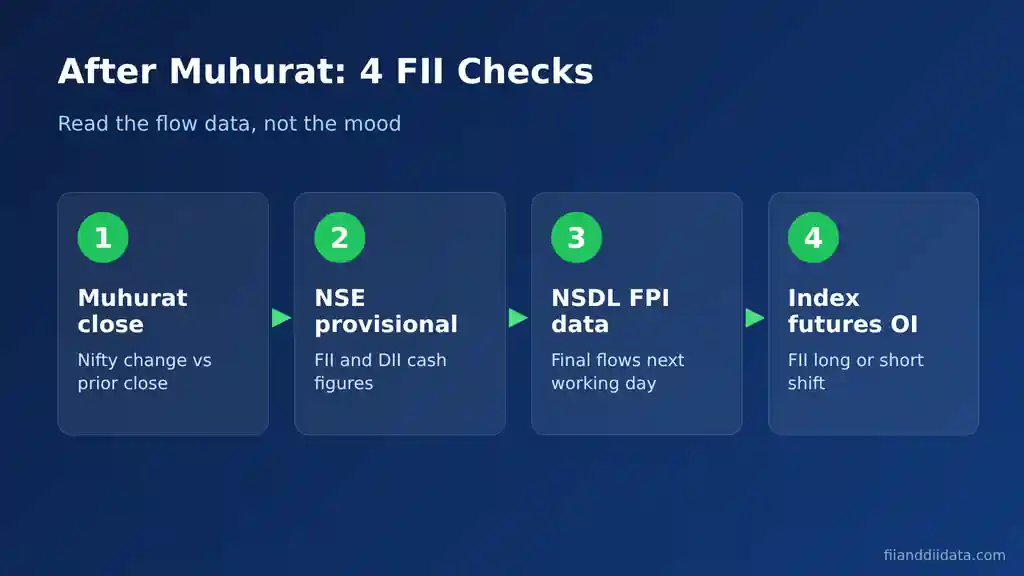
Official FII and DII figures are never live. NSE publishes provisional cash market figures after the close, usually around 6 PM IST on a normal trading day, and NSDL publishes final FPI data on the next working day. Use this four-step checklist.
- Note the Muhurat close. Compare Nifty with Friday’s close and treat any move under 0.5% as normal for this session.
- Read the NSE provisional numbers. Check FII and DII net buying or selling in the cash market. Our FII DII data today page shows the daily figures once they are released.
- Confirm with NSDL. The depository figure on the next working day includes primary market and other deals. If it differs from NSE, the reason is usually scope, not error.
- Check derivatives positioning. A cash buy with rising index futures shorts is a hedged bet, not a bullish one. Track FII index futures positions through the first week of Samvat 2083.
Then widen the lens. Watch whether the late-October buying carries into the 9 to 13 November week, keeping in mind that Tuesday, 10 November is a market holiday. A run of net buying days is far more meaningful than any single session. Many investors still make avoidable errors here.
Common Mistakes to Avoid
Treating the Muhurat close as a forecast. A green Muhurat session does not promise a good year. Samvat 2081 opened higher in November 2024, yet Business Standard noted on 21 October 2025 that equities gave only moderate gains that year and lagged gold and silver.
Comparing session figures with full days. A 70-minute session will almost always show smaller rupee flows. Scale for time, as in the worked example, before calling it quiet or active.
Forgetting that trades are real. Every order filled during the session settles like a normal trade. Do not place a large order just because the day feels auspicious.
Reading one week of FPI buying as a trend. The ₹6,300 crore inflow in late October followed about ₹70,700 crore of selling over September and October. One good week does not reverse that by itself.
Frequently Asked Questions
What is the date and time of Muhurat trading 2026?
Muhurat trading 2026 is on Sunday, 8 November 2026. The pre-open session runs from 2:05 PM to 2:20 PM IST and the normal market from 2:20 PM to 3:30 PM IST, as announced by NSE and BSE on 19 October 2026.
Diwali Muhurat trading 2026 FII rules: can foreign investors take part?
Yes. FIIs, also called FPIs, can trade in the Muhurat session through their custodians and brokers, and block deals are allowed in the block deal window. Large funds usually trade lightly because the session is short and volumes are thin.
Is Muhurat trading a real trading session?
Yes. All trades executed during the Muhurat session create normal settlement obligations, according to the exchange circulars. A buy order that is filled must be paid for like any other trade.
Has Nifty gone up in past Muhurat trading sessions?
Mostly, but by small amounts. Nifty rose about 0.6% in 2023, 0.41% in 2024 and 0.10% in 2025. Business Today reported that indices ended higher in eight of the ten Muhurat sessions before 2025.
When will FII DII data for the Muhurat session be available?
NSE publishes provisional FII and DII cash market figures after the close, usually around 6 PM IST on a normal trading day. NSDL publishes final FPI figures on the next working day. Official figures are never live.
The Bottom Line
The Muhurat session is a tradition first and a market signal a distant second. Nifty has tended to close slightly higher in it, but those small gains have said little about the year that followed. This year, the more useful story is the FPI turn: heavy selling in September and October, then a week of buying just before Diwali.
Our practical next step: note the Muhurat close on 8 November, then track daily FII and DII cash figures and index futures positions through the first full week of Samvat 2083. If foreign buying holds for several sessions, that matters far more than the ceremonial hour. For daily numbers, charts and free tools, visit our FII and DII data home page, and browse the blog for related analysis.
Sources: Business Today, Muhurat trading 2026 schedule (19 October 2026); Free Press Journal, FPI flows in October 2026 (1 November 2026); Business Standard, Samvat 2082 Muhurat session (21 October 2025); The Week, Samvat 2081 Muhurat session (1 November 2024). Also Free Press Journal (11 October 2026), PL India November 2026 holiday list, Upstox Muhurat 2026 schedule and market report (21 October 2025), HDFC Sky (16 October 2025), Angel One (October 2025) and Business Today (21 October 2025).
Disclaimer: This article is for educational purposes only and is not investment advice. Please consult a SEBI-registered advisor before making investment decisions.