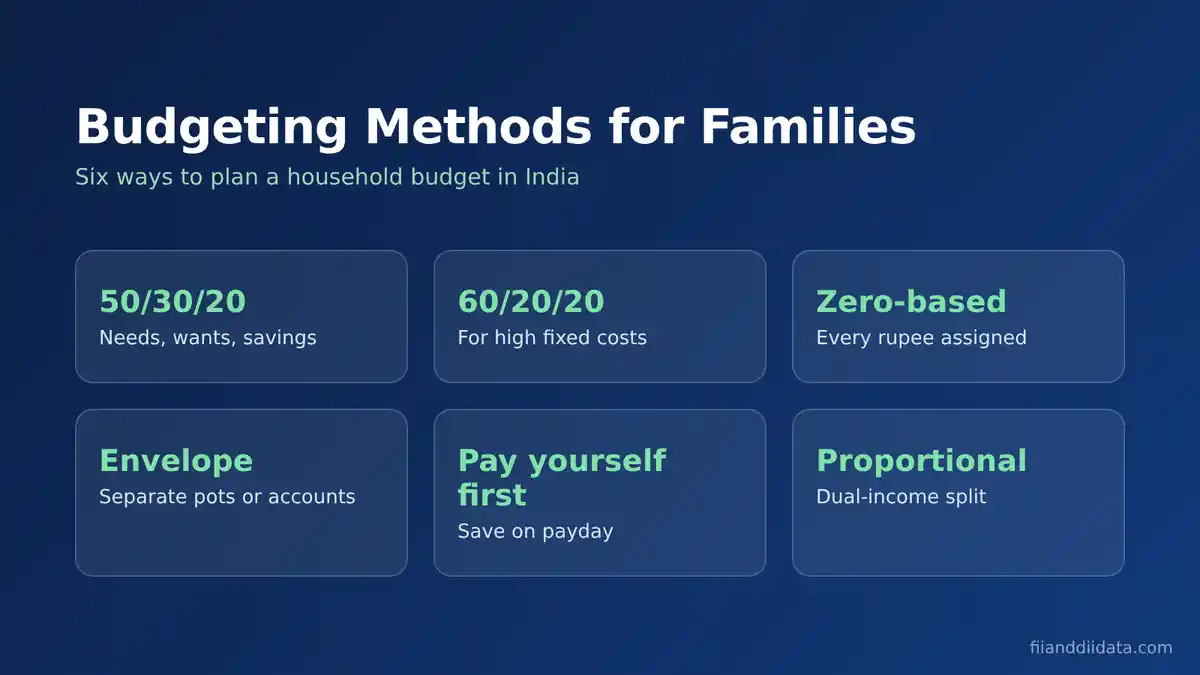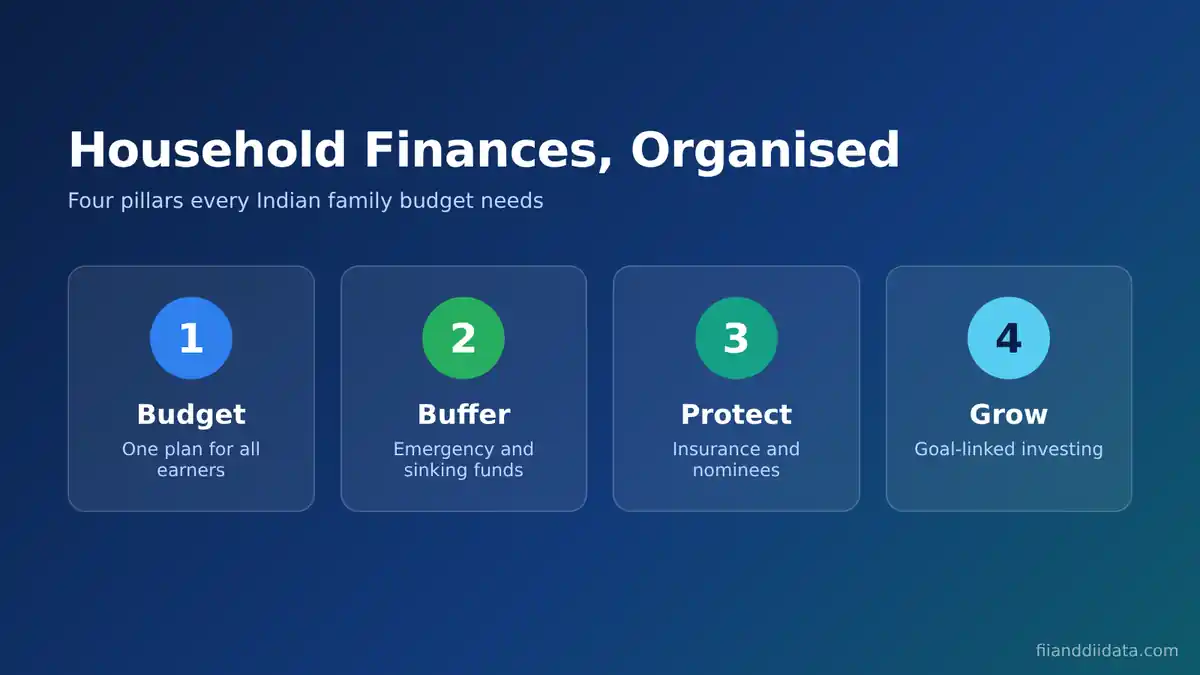
Learning how to manage household finances comes down to one shared system: a single family budget, a cash buffer, proper protection and goal-linked saving, reviewed together every month. The rules around family money have also changed. Since 1 November 2025, a bank depositor in India can name up to four nominees on a deposit account, so it is a good time to review how your family’s money is organised. This guide shows the full system with a worked example.
Key Takeaways
- Run the house on one written budget that every earning member can see.
- Split shared costs in proportion to income, not 50:50, when pay levels differ.
- Keep 6 months of essential expenses as an emergency fund and use sinking funds for known yearly bills.
- DICGC insures bank deposits up to ₹5 lakh per depositor per bank, so spread large balances.
- Hold a 30-minute money meeting each month and update nominees on every account.
Table of contents
- What Managing Household Finances Really Means
- How to Manage Household Finances in 7 Steps
- Worked Example: A ₹1.2 Lakh Two-Earner Budget
- How to Split Money Between Partners Fairly
- Protecting Household Money: Rules Every Family Should Know
- The Monthly Money Meeting and Household Checklist
- Common Mistakes When You Manage Household Finances
- Frequently Asked Questions
- The Bottom Line
What Managing Household Finances Really Means
Personal finance usually means one person and one salary. Household finance is different. It covers every rupee that comes into the home, from salaries and rent received to a parent’s pension, and every commitment that goes out, from school fees and EMIs to a grandparent’s medicines. More than one person earns, spends and makes decisions, so the system has to work for all of them.
That is why most household money problems are not about income. They come from three gaps: nobody has the full picture, bills that arrive once a year catch the family off guard, and protection such as insurance and nominations is left half done. A good household system closes all three.
Personal finance vs household finance
| Area | Personal finance | Household finance |
|---|---|---|
| Income | One salary | Two or more incomes, plus rent, pension or business income |
| Decisions | Made alone | Shared between partners, sometimes parents |
| Big costs | Rent, travel, gadgets | School fees, health cover for parents, home loan, festivals |
| Main risk | Overspending | Unclear ownership, missing nominees, no shared plan |
If you are still building your own money habits first, our personal finance tips cover the basics. The rest of this guide is about running money as a family unit.
How to Manage Household Finances in 7 Steps
Here is the order we suggest. Each step builds on the one before it, so do not skip ahead to investing before the first four are in place.
Step 1: Put every income and fixed bill on one page
List each source of money with its date of credit, then every fixed outflow: rent or EMI, school fees, insurance premiums, utilities, domestic help and SIPs. Use a shared spreadsheet or notebook that both partners can open. Our guide to tracking monthly expenses shows simple ways to capture UPI and card spending.
Step 2: Build one household budget
Group spending into essentials, lifestyle, sinking funds, emergency savings and long-term investing. A common starting point is to keep essentials near half of take-home pay. If you have never written one, follow our step-by-step monthly budget method and adapt it for the whole family.
Step 3: Choose an account structure
Many families use a three-bucket setup. Each partner keeps a personal account for salary and personal spending. A joint account, or one designated account, receives fixed contributions for shared bills. A separate account holds the emergency fund so it is not spent by mistake.
Step 4: Create sinking funds for yearly costs
A sinking fund is money you set aside every month for a known future bill. If annual school fees are ₹78,000, saving ₹6,500 a month means the fee is ready when it is due. Do the same for insurance renewals, festivals, travel and vehicle servicing.
Step 5: Build the emergency fund
Aim for 6 months of essential expenses in a savings account, sweep-in deposit or liquid fund that you can reach within a day or two. Households with one earner, variable income or dependent parents should consider a larger buffer.
Step 6: Protect the family
Before investing more, make sure the main earners have term life cover and the family has health insurance, including parents if they depend on you. Then check nominations on every bank account, deposit, demat account and insurance policy.
Step 7: Invest for named goals
Only now direct surplus money to long-term goals such as a child’s education, a home down payment or retirement. Give each goal a target amount and a date. Our guide on how to set clear financial goals explains how to price each goal.
The steps are easier to follow with real numbers, so the next section applies them to one family.
Worked Example: A ₹1.2 Lakh Two-Earner Budget
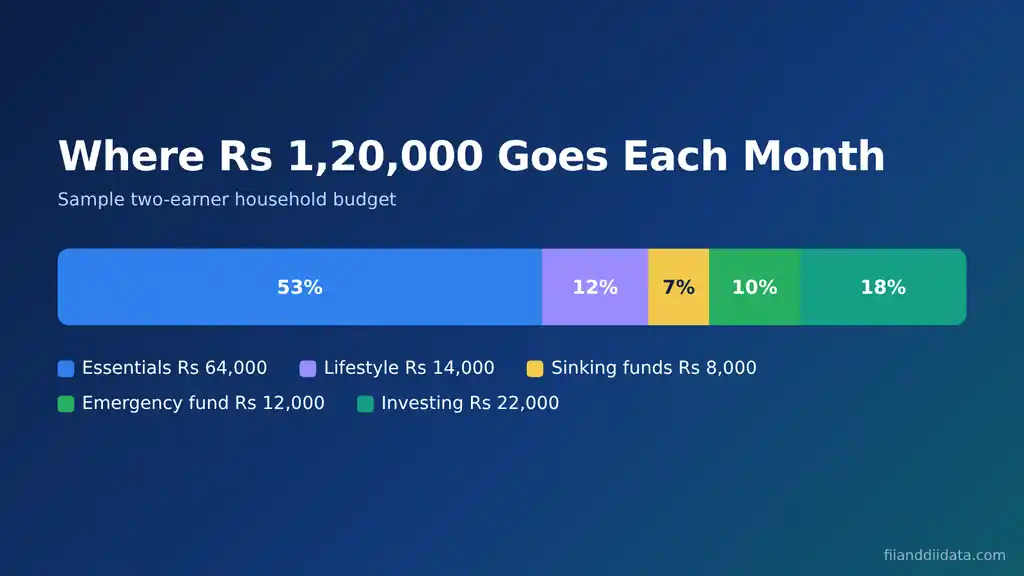
Take a family in a metro city where one partner earns ₹70,000 and the other ₹50,000 a month after tax, for a combined take-home of ₹1,20,000. They pay rent, have one school-going child and want to build an emergency fund while investing every month.
| Category | Monthly amount | Share of income |
|---|---|---|
| Rent | ₹25,000 | 20.8% |
| Groceries and household supplies | ₹14,000 | 11.7% |
| Utilities (power, gas, internet, mobile) | ₹5,500 | 4.6% |
| Transport and fuel | ₹6,000 | 5.0% |
| School fees and tuition (₹78,000 a year) | ₹6,500 | 5.4% |
| Insurance premium set-aside (₹36,000 a year) | ₹3,000 | 2.5% |
| Domestic help | ₹4,000 | 3.3% |
| Essentials total | ₹64,000 | 53.3% |
| Lifestyle (eating out, shopping, OTT) | ₹14,000 | 11.7% |
| Sinking funds (festivals, travel, repairs) | ₹8,000 | 6.7% |
| Emergency fund top-up | ₹12,000 | 10.0% |
| Long-term investing (SIPs, PPF, NPS) | ₹22,000 | 18.3% |
| Total | ₹1,20,000 | 100% |
How to manage household finances with these numbers
- Emergency target: 6 months of essentials is 6 × ₹64,000 = ₹3,84,000.
- Gap: they already hold ₹1,50,000, so they need ₹2,34,000 more.
- Timeline: at ₹12,000 a month, the gap closes in about 20 months. After that, the ₹12,000 can move to investing.
- Savings rate: emergency top-up plus investing is ₹34,000, or 28.3% of take-home pay, before counting sinking funds.
Notice that annual bills are converted to monthly amounts. This one habit removes most of the “where did the money go” months that families face in June (school fees) or October (festivals). The next question is who pays for what.
How to Split Money Between Partners Fairly
A 50:50 split feels fair but can strain the partner who earns less. A proportional split asks each person to contribute the same percentage of their income to shared costs, so both keep a similar share of their pay for personal use.
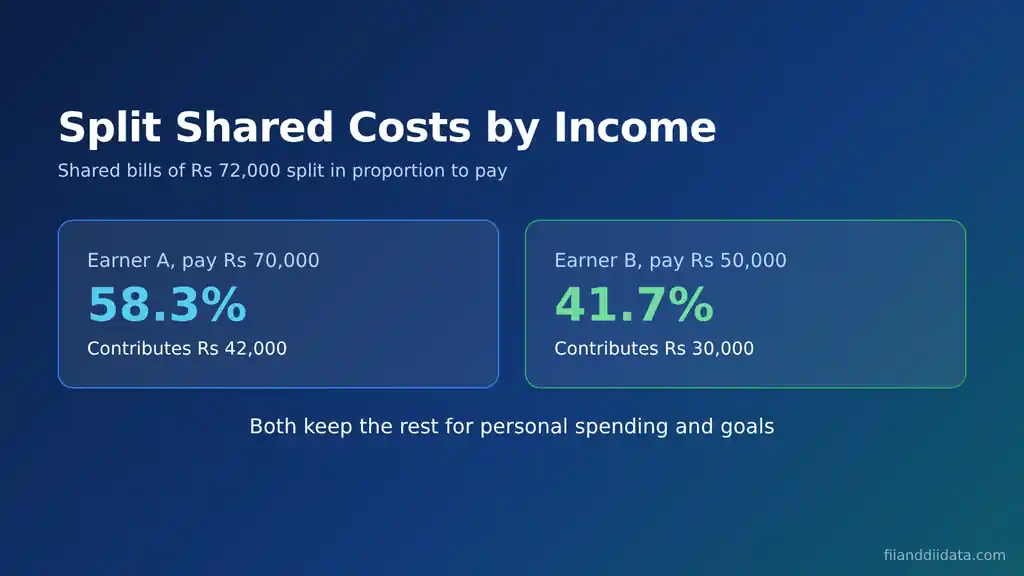
In our example, shared costs are the essentials (₹64,000) plus sinking funds (₹8,000), or ₹72,000 a month. The partner earning ₹70,000 has 58.3% of household income and puts in ₹42,000. The partner earning ₹50,000 has 41.7% and puts in ₹30,000. Each contributes 60% of their own pay, and the rest covers personal spending, emergency savings and SIPs in their own names.
Three common setups compared
| Method | How it works | Best for |
|---|---|---|
| Fully pooled | All income goes to one account; joint decisions on everything | Single-earner homes, couples with very similar goals |
| Proportional | Each pays the same % of income to a joint account | Two earners with different salaries |
| By category | One pays fixed bills, the other pays variable costs | Couples who prefer clear ownership of tasks |
Whatever you choose, write it down and review it when either income changes. With roles settled, the next job is to make sure the money is safe.
Protecting Household Money: Rules Every Family Should Know
Protection is the step most families leave half done. A few official rules matter for almost every Indian household, and each one changes how you should hold and monitor money.
| Rule | What it says | Why it matters for families |
|---|---|---|
| Deposit insurance | DICGC insures deposits up to ₹5,00,000 per depositor per bank, covering principal and interest held in the same right and capacity | Balances above ₹5 lakh in one bank, in one name, are not fully insured |
| Multiple nominees | From 1 November 2025, depositors can name up to four nominees, either simultaneously (with percentage shares) or successively | Families can split a deposit among a spouse and children in clear shares |
| Lockers | Only successive nomination is allowed for lockers and safe custody articles | Name a clear order of nominees for the family locker |
| Unauthorised transactions | Zero customer liability for a third-party breach if reported within 3 working days; bank must credit the amount within 10 working days of notification | Every family member should know how to report fraud fast |
A worked check on deposit insurance
Suppose a family keeps ₹7,00,000 in fixed deposits in one bank, all in one person’s name. Only ₹5,00,000 is covered by DICGC, leaving ₹2,00,000 uninsured. The fix is simple: spread the money across two banks, or note that joint accounts with a different order of names are insured separately under DICGC rules.
The RBI framework also caps liability at ₹10,000 for most savings accounts when a third-party fraud is reported on day 4 to 7 after the bank’s alert. Speed matters, so keep the bank’s fraud helpline saved on every phone in the house and read our guide on how to file a UPI fraud complaint.
Rules protect money only if someone checks them regularly, which is what the monthly meeting is for.
The Monthly Money Meeting and Household Checklist
The single habit that holds the system together is a short monthly meeting. Pick the first weekend after salaries are credited and keep it to 30 minutes.

- Track: total last month’s spending from bank, card and UPI statements.
- Review: compare actual spending with the budget and agree on one fix.
- Pay: confirm rent, EMIs, fees and premiums are paid or scheduled.
- Save: move money to the emergency fund, sinking funds and SIPs.
- Plan: list any large costs in the next 60 days.
Quarterly and yearly household checklist
- Check balances per bank against the ₹5 lakh DICGC limit.
- Confirm nominees on every account, FD, demat account and insurance policy.
- Review health cover for parents and children before renewal.
- Store policy numbers, account details and a list of investments in one secure place both partners can reach.
- Revisit the income split after any raise, job change or new baby.
Even with a checklist, a few habits tend to undo good plans.
Common Mistakes When You Manage Household Finances
- Only one person knows the details. If that person falls ill, the family cannot reach accounts or policies.
- Ignoring annual bills. School fees and insurance renewals then land on a credit card.
- Mixing the emergency fund with spending money. It gets used for sales and holidays.
- Investing before insuring. A hospital bill can wipe out years of SIPs.
- Old or missing nominations. Claims take longer and cost more for the family.
- Keeping all deposits in one bank and one name. Amounts above ₹5 lakh are not covered by DICGC.
For more pitfalls that apply to individuals as well as families, see our list of common money mistakes.
Frequently Asked Questions
How to manage household finances when only one person earns?
Use the fully pooled method with one budget, keep a larger emergency fund of 6 to 12 months, and make term life cover on the earner a priority. The non-earning partner should still know every account, policy and password location.
What percentage of household income should a family save?
There is no fixed rule, but the popular 50:30:20 guideline sets aside 20% of take-home pay for savings. In our example, the family saves 28.3% through the emergency fund and investments, plus 6.7% in sinking funds for known yearly costs.
Should husband and wife have a joint bank account in India?
A joint account is useful for shared bills and makes access easier in an emergency. Many couples keep personal accounts too. Note that for DICGC cover, joint accounts with the same names in the same order share one ₹5 lakh limit per bank.
How much emergency fund does an Indian family need?
A common target is 6 months of essential expenses, not total income. For a family with ₹64,000 of essentials a month, that is ₹3,84,000. Single-income or self-employed households may want more.
How do I protect my family’s bank money if something happens to me?
Add nominees on every deposit account. Since 1 November 2025 you can name up to four, with percentage shares. Keep deposits within DICGC limits per bank and share a list of accounts with your partner.
The Bottom Line
Managing household money well is less about earning more and more about running one clear system. A shared budget, monthly sinking funds, a proper emergency buffer, insurance and up-to-date nominees protect a family far better than any single investment product.
The rules also keep changing, as the 2025 nomination reform shows, so a short monthly review is worth the time. As a next step, block 30 minutes this weekend, list every income and fixed bill on one page, and check the nominee on each bank account. More guides are on the FIIAndDIIData.com blog.
Sources: DICGC, A Guide to Deposit Insurance; Press Information Bureau, Ministry of Finance, 23 October 2025; Reserve Bank of India, Customer Protection circular, 6 July 2017.
Disclaimer: This article is for educational purposes only and is not investment advice. Please consult a SEBI-registered advisor before making investment decisions.