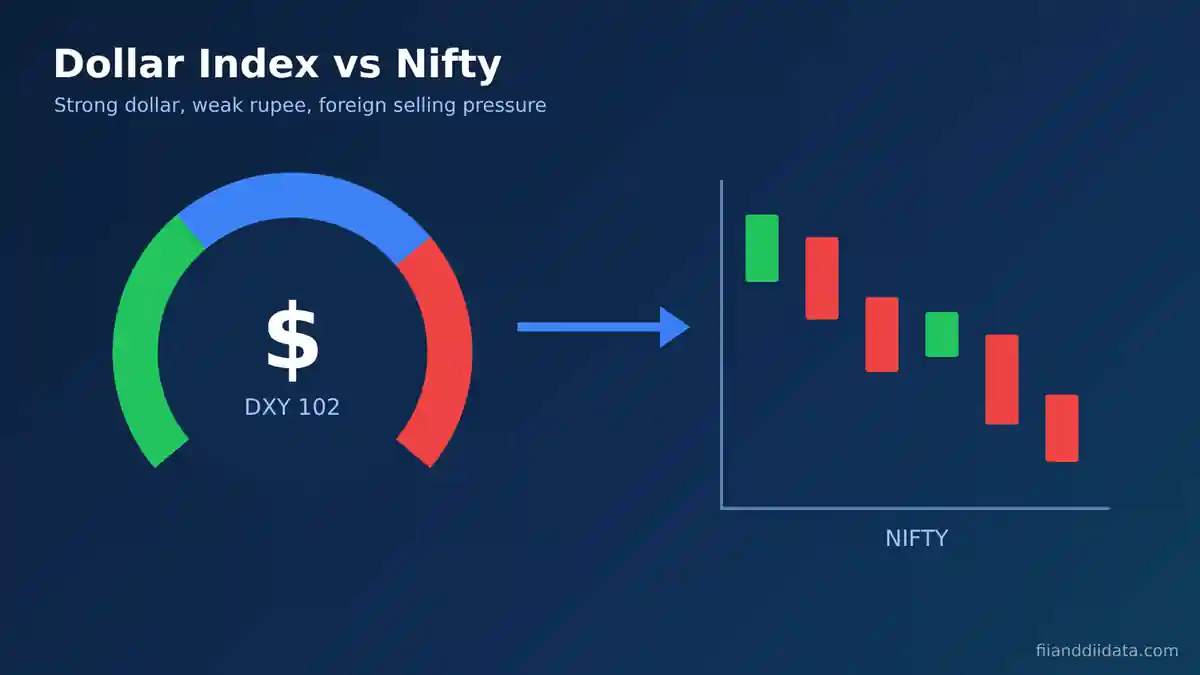
The dollar index impact on Nifty works mostly through the rupee and foreign money: when the US dollar strengthens, the rupee tends to weaken, foreign portfolio investors (FPIs) earn less in dollar terms and they often sell Indian shares. That link was on show this autumn. The dollar index (DXY) rose about 2% in September 2026 and FPIs sold ₹35,861 crore of Indian equities that month, while on 29 October 2026 a softer dollar after the US Fed meeting coincided with a 1.05% Nifty rally.
Key Takeaways
- The dollar index (DXY) tracks the US dollar against six major currencies; the euro alone is 57.6% of it.
- A rising DXY usually means a weaker rupee, lower dollar returns for FPIs and more foreign selling in Nifty heavyweights.
- DXY rose 2.03% in September 2026 and FPIs sold ₹35,861 crore; it fell in July and August, when FPIs were net buyers.
- The link is not one-way: in 2022 FPIs bought ₹51,204 crore in August even as the dollar kept climbing.
- Traders should read DXY together with USD/INR, US yields, crude oil and daily FII data, not on its own.
In this article
- What Is the Dollar Index (DXY)?
- How the Dollar Index Impacts Nifty: 4 Channels
- Worked Example: How a Strong Dollar Cuts FPI Returns
- Dollar Index Impact on Nifty in 2026: Latest Data
- Lessons From 2022, When DXY Hit 114.77
- Sectors That Gain and Lose When the Dollar Rises
- How Traders Use the Dollar Index: A 6-Step Checklist
- Common Mistakes When Judging the Dollar Index Impact on Nifty
- Frequently Asked Questions
- The Bottom Line
What Is the Dollar Index (DXY)?
The US Dollar Index, quoted as DXY on most screens and as USDX for its futures, measures the value of the US dollar against a fixed basket of six currencies. When the index rises, the dollar is getting stronger against that basket. When it falls, the dollar is getting weaker.
The basket is heavily tilted towards Europe. According to ICE, the exchange that publishes the index, the weights are as follows.
| Currency | Weight in DXY |
|---|---|
| Euro | 57.6% |
| Japanese yen | 13.6% |
| British pound | 11.9% |
| Canadian dollar | 9.1% |
| Swedish krona | 4.2% |
| Swiss franc | 3.6% |
Notice what is missing: the Indian rupee, the Chinese yuan and every other emerging market currency. So DXY does not measure the rupee directly. It measures broad dollar strength, which then spills over into the rupee and into global fund flows. That spillover is what Nifty traders care about, and it is the subject of the next section.
How the Dollar Index Impacts Nifty: 4 Channels
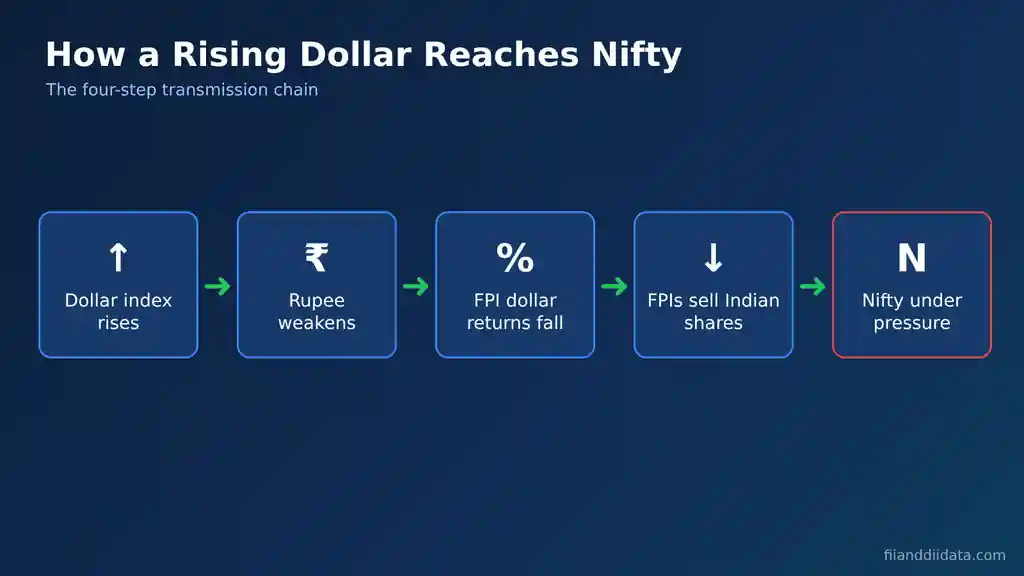
A stronger dollar reaches Indian shares through four main routes. In practice they often work at the same time, which is why a DXY rally can feel heavier on Dalal Street than the index move alone suggests.
1. The rupee weakens
When global investors buy dollars, most emerging market currencies lose ground, and the rupee is no exception. On 29 October 2026 the USD/INR rate was 95.37, according to Trading Economics, after touching a record 99.82 per dollar in March 2026. Our explainer on how the rupee-dollar rate drives FII outflows covers this link in detail.
2. FPI returns shrink in dollar terms
A US or European fund measures its performance in dollars or euros. If Nifty rises 5% but the rupee falls 7%, the fund has lost money. When the dollar looks set to keep rising, many FPIs cut Indian holdings to protect returns, and that selling falls mostly on large, liquid Nifty stocks such as private banks and IT.
3. US interest rates and yields
The dollar usually rises when US interest rates or bond yields rise, because dollar assets then pay more. On 28 October 2026 the US Federal Reserve held its policy rate at 3.75% to 4.00% in a 10 to 2 vote, with two members preferring a hike. Higher US yields raise the bar that Indian equities must clear, a theme we cover in US bond yields and the Indian market.
4. Costlier imports and inflation
India pays for most of its crude oil in dollars. A strong dollar plus high oil prices widens the import bill, puts pressure on the current account and can keep inflation sticky. With Brent near $114 a barrel in late October 2026, this channel is active. See crude oil’s effect on FII flows for the oil side of the story.
Why the dollar index impact on Nifty is not one-way
These channels describe pressure, not certainty. Strong domestic buying by mutual funds and insurers, good earnings or cheap valuations can offset a firm dollar. The numbers in the next section show how much the currency effect alone can cost a foreign investor.
Worked Example: How a Strong Dollar Cuts FPI Returns
Take a hypothetical US fund that invested $10 million in Nifty stocks when USD/INR was 88.63. That is roughly where the rupee stood a year ago, given that it has lost about 7.6% against the dollar over the past 12 months, according to Trading Economics.
- Money invested: $10 million × 88.63 = ₹88.63 crore.
- Nifty gains 5%: the holding grows to ₹93.06 crore.
- Convert back at 95.39: ₹93.06 crore ÷ 95.39 = about $9.76 million.
- Result in dollars: a loss of about 2.4%, even though the shares rose 5%.
- Break-even: the rupee fell about 7.6%, so the stocks needed to rise about 7.6% just to stand still in dollar terms.
This is the dollar index impact on Nifty in its simplest form, and it is why foreign investors watch the dollar so closely. A domestic investor sees a 5% gain; the same portfolio shows a loss on a fund manager’s screen in New York. When the dollar index is climbing, many FPIs decide it is cheaper to sell first and wait, which brings us to the 2026 numbers.
Dollar Index Impact on Nifty in 2026: Latest Data
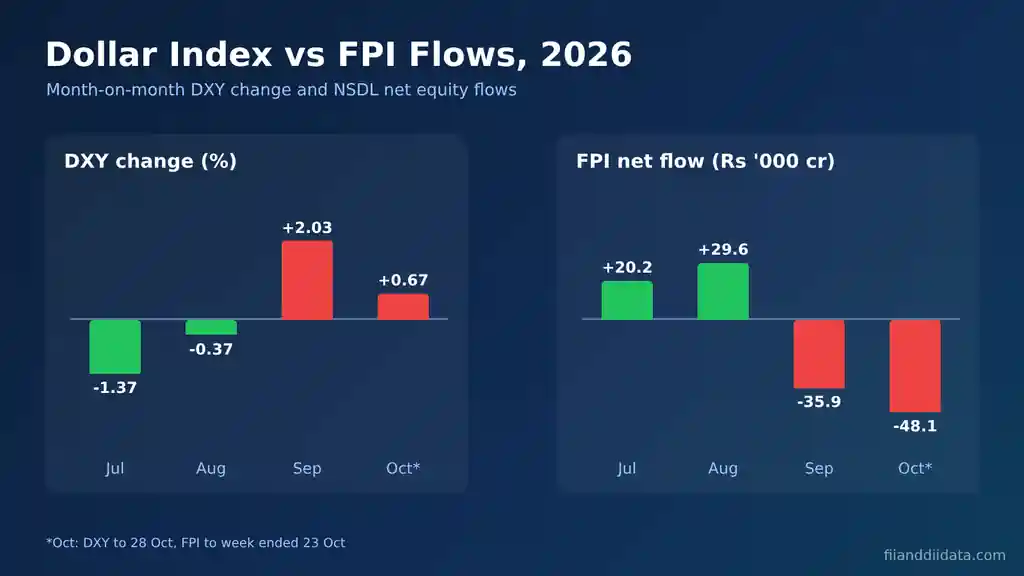
The table below lines up month-end DXY levels with net FPI flows into Indian equities from NSDL data, as reported by PTI. The direction match over the last four months is clear.
| Month (2026) | DXY month-end | DXY change | FPI net equity flow |
|---|---|---|---|
| June | 101.19 | Base | Not shown (base month) |
| July | 99.80 | -1.37% | +₹20,200 crore |
| August | 99.43 | -0.37% | +₹29,631 crore |
| September | 101.45 | +2.03% | -₹35,861 crore |
| October | 102.13 (28 Oct) | +0.67% | -₹48,056 crore (to the week ended 23 Oct) |
When the dollar eased in July and August, FPIs were net buyers of about ₹49,800 crore combined. When DXY jumped in September, they turned sellers, and the selling grew in October as the index touched 102.40 on 27 October, its highest since 14 October. Total FPI selling in 2026 reached ₹3.08 lakh crore by late October, against ₹1.66 lakh crore for all of 2025. Our page on month-wise FPI outflow data for 2026 has the full series.
The latest session shows the reverse effect. After the Fed held rates on 28 October, the dollar index slipped about 0.2% and traded near 101.97 on the morning of 29 October. Nifty closed that day at 22,936.75, up 237.90 points or 1.05%, and the Sensex gained 905 points. Many factors were at work, including earnings, but a softer dollar removed one source of pressure. Four months of data is still a short window, so it helps to look at a full dollar cycle.
Lessons From 2022, When DXY Hit 114.77
The last big dollar surge came in 2022, when the US Fed raised rates aggressively. The dollar index peaked at 114.77 on 28 September 2022, a 20-year high, according to FXStreet. Today’s reading of about 102 is roughly 11% below that peak.
FPIs pulled out a then-record net ₹1.21 lakh crore from Indian equities in 2022, according to PTI data reported by Outlook Business. Most of it left early: ₹2.17 lakh crore went out in the first half of the year. Then something interesting happened. FPIs bought ₹4,989 crore in July and ₹51,204 crore in August 2022, even though the dollar index kept climbing to its September peak.
Two lessons follow. First, FPIs tend to sell hardest at the start of a dollar rally, not at its end. Second, once Indian prices have corrected enough, foreign buyers can return even with a strong dollar. The 2022 record has since been passed: 2025 saw ₹1.66 lakh crore of selling and 2026 is already near twice that. Sector moves tell the same story in more detail.
Sectors That Gain and Lose When the Dollar Rises
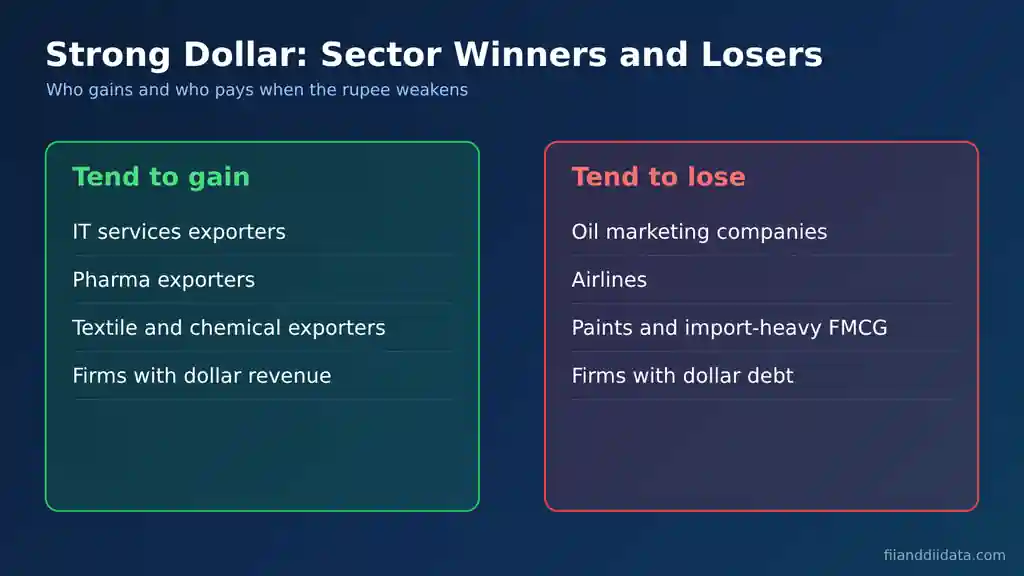
A strong dollar does not hurt every Nifty stock equally. Companies that earn in dollars and spend in rupees gain from a weaker rupee, while importers and companies with dollar loans lose.
| Tend to gain | Why | Tend to lose | Why |
|---|---|---|---|
| IT services | Most revenue billed in dollars | Oil marketing companies | Crude is bought in dollars |
| Pharma exporters | US generics sales | Airlines | Fuel and aircraft leases priced in dollars |
| Textile and chemical exporters | Better rupee realisation | Paints, some FMCG | Imported raw materials |
| Firms with dollar revenue | Margin boost | Firms with dollar debt | Higher repayment cost in rupees |
There is a catch. Even IT, the classic “weak rupee” winner, often falls when FPIs sell, because foreign funds own large stakes in the big IT names. The currency gain shows up in earnings a quarter or two later, while the selling hits prices now.
How Traders Use the Dollar Index: A 6-Step Checklist
DXY works best as a background filter, not a trade signal. Here is a simple routine you can run each evening.
- Check the trend, not the tick. Note whether DXY is above or below its level a month ago. A 2% monthly move matters far more than a 0.2% daily swing.
- Confirm with USD/INR. If DXY rises but the rupee holds steady, often because of RBI dollar sales, the pressure on FPIs is smaller.
- Look at US yields and the Fed. Rising US 2-year and 10-year yields usually back a firm dollar. The next FOMC decision is due on 10 December 2026.
- Read the daily FII cash figure. After about 6 PM IST, check FII DII data today to see whether foreign selling actually picked up.
- Check DII buying. Strong buying by mutual funds and insurers has absorbed much of the 2026 FPI selling, which softens the hit to Nifty. Our monthly FII DII tracker shows the balance.
- Adjust sector exposure. In a firm dollar phase, favour exporters and reduce importers; reverse that when DXY turns down.
You can follow official flows on our free FII and DII data dashboard, which updates after market close. Knowing what to watch is half the job; avoiding the usual misreads is the other half.
Common Mistakes When Judging the Dollar Index Impact on Nifty
- Treating DXY as a rupee index. The rupee is not in the basket. Always check USD/INR alongside it.
- Forgetting the euro. With a 57.6% weight, a European Central Bank decision can move DXY more than US data on some days.
- Expecting an instant Nifty reaction. FPI selling often follows a dollar rally with a lag of days or weeks.
- Ignoring domestic flows. Record SIP and insurance money can keep Nifty steady even while FPIs sell.
- Using one day of data. A single-day DXY move after a Fed meeting can reverse within hours, as it did on 28 October 2026.
With these points in mind, the common questions about the dollar and Nifty become easier to answer.
Frequently Asked Questions
What is the dollar index impact on Nifty?
A rising dollar index usually weakens the rupee and lowers dollar returns for foreign investors, which often leads to FPI selling in large Nifty stocks. A falling dollar index tends to ease that pressure. In September 2026, DXY rose 2.03% and FPIs sold ₹35,861 crore of Indian equities.
Is a rising dollar index bad for the Indian stock market?
It is usually a headwind, because it encourages foreign selling and raises import costs. It is not always negative: exporters such as IT and pharma can gain, and strong domestic buying can offset FPI outflows.
Which sectors benefit when the dollar index rises?
Companies that earn in dollars, such as IT services, pharma exporters and textile or chemical exporters, tend to benefit from a weaker rupee. Oil marketing companies, airlines and firms with dollar debt tend to suffer.
How does the dollar index affect the rupee?
The rupee is not part of the DXY basket, but a broadly stronger dollar usually pulls most emerging market currencies lower, including the rupee. RBI dollar sales can slow that fall, so always check USD/INR as well.
Does a falling dollar index mean Nifty will rise?
Not on its own. A weaker dollar removes one source of pressure and can bring FPIs back, as in July and August 2026, but earnings, crude oil prices, valuations and domestic flows also decide the direction of Nifty.
The Bottom Line
The dollar index impact on Nifty comes down to one thing: the dollar shapes what foreign investors earn, and therefore how much they buy or sell. The 2026 pattern is clear: FPIs bought when DXY eased in July and August and sold heavily when it climbed in September and October.
Still, DXY is one input among several. Domestic institutions have absorbed much of this year’s foreign selling, and 2022 showed that FPIs can return before the dollar peaks. The practical step is to add a weekly DXY and USD/INR check to your routine, then confirm it against the daily FII cash figure before changing positions. For more market explainers, browse our blog.
Sources: ICE, US Dollar Index weights; Federal Reserve FOMC statement, 28 October 2026; Trading Economics, USD/INR; USMacro DXY history (Yahoo Finance data); Vantage Markets USDX analysis, 29 October 2026; PTI via Millennium Post (25 October 2026) and The Hans India (12 October 2026) on NSDL FPI data; PTI via Outlook Business on 2022 FPI flows; FXStreet on the 2022 DXY peak; 5paisa and Business Standard market close reports, 29 October 2026.
Disclaimer: This article is for educational purposes only and is not investment advice. Please consult a SEBI-registered advisor before making investment decisions.