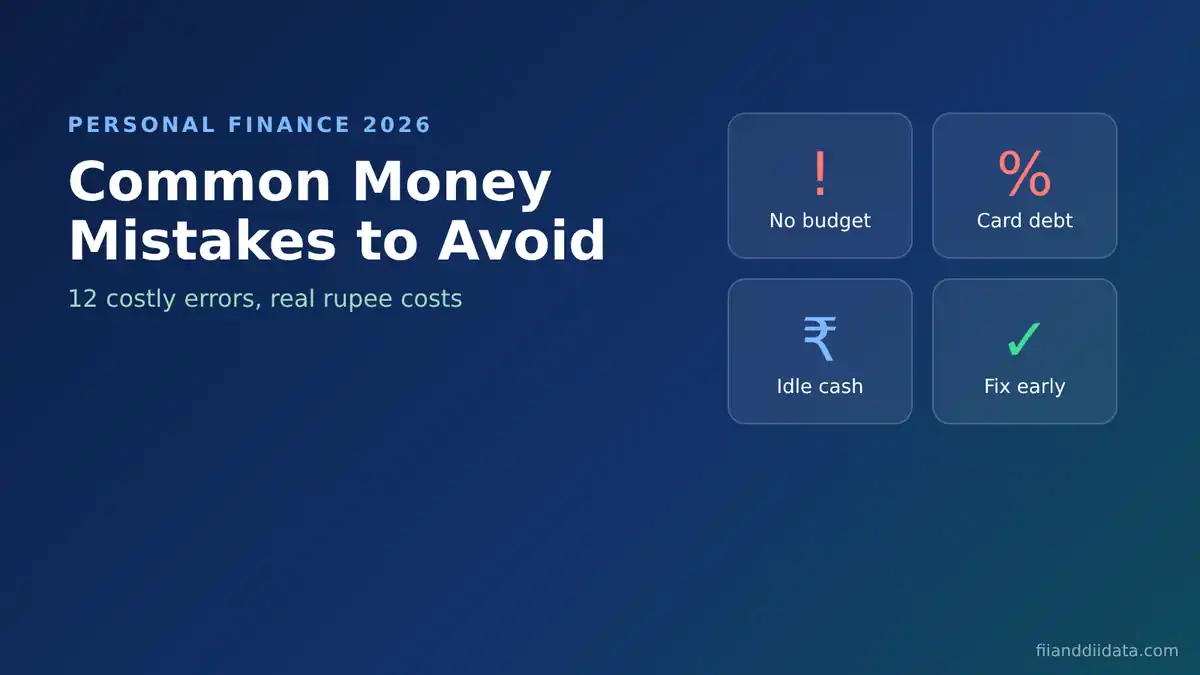
The common money mistakes to avoid are rarely dramatic: no budget, no emergency fund, paying only the minimum due on a credit card, idle cash losing to inflation and buying insurance as an investment. With retail inflation at 5.54% in September 2026 and card interest near 3.75% a month, each of these small errors now costs real rupees. This guide shows 12 of them, what each one costs, and how to fix it.
Key Takeaways
- Most money mistakes are habits, not one-off events, so they compound quietly every month.
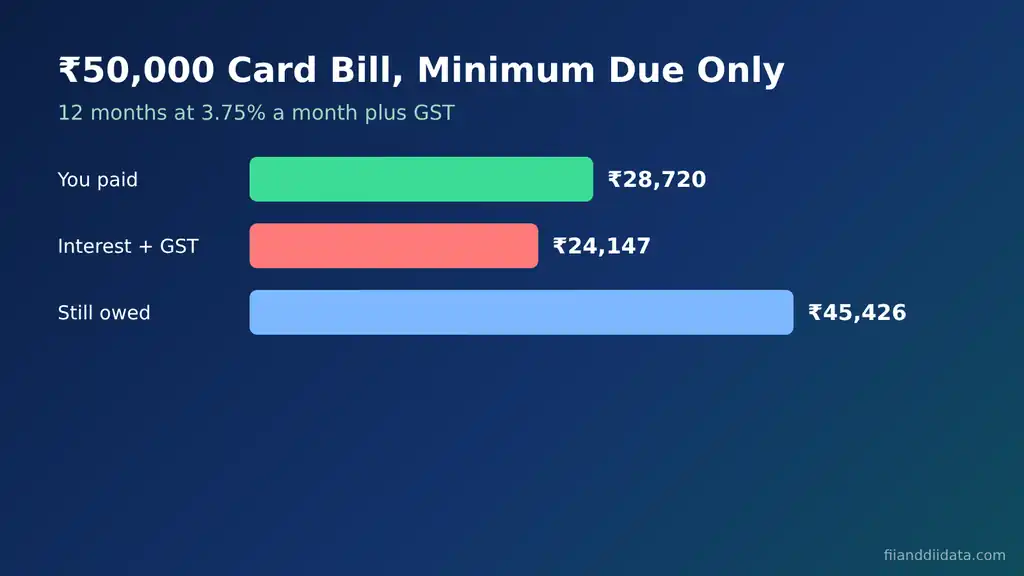
- Paying only the minimum due on a ₹50,000 card bill can leave about ₹45,426 still owed after a year.
- Cash parked at 4% loses buying power when inflation runs at 5.54%.
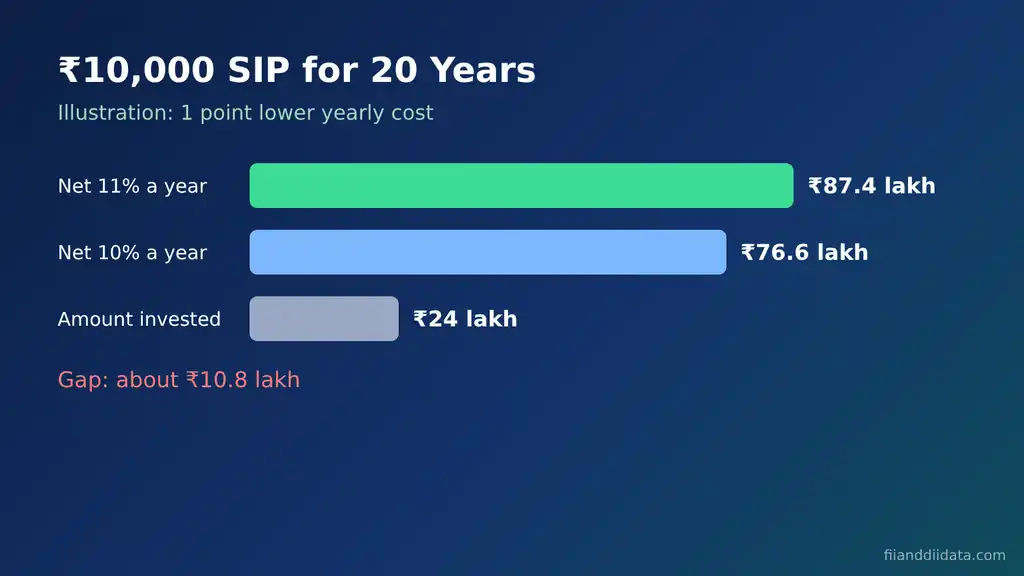
- A 1 percentage point higher yearly cost can shave about ₹10.8 lakh off a 20-year ₹10,000 SIP.
- Report an unauthorised bank transaction within 3 working days to get zero liability under RBI rules.
Table of contents
- Why Small Money Mistakes Cost More Than They Look
- Common Money Mistakes to Avoid in Spending and Saving
- Debt and Credit Card Mistakes
- Insurance Mistakes That Leave Families Exposed
- Investing Mistakes: Idle Cash, High Costs and Late Starts
- Fraud and Safety Mistakes
- What These Money Mistakes Cost in Rupees
- A 10-Minute Money Mistake Checklist
- FAQs
- The Bottom Line
Why Small Money Mistakes Cost More Than They Look
A money mistake is any repeated choice that moves your cash in the wrong direction: paying more interest than you earn, keeping savings where inflation eats them, or leaving your family without cover. One bad month rarely hurts. The damage comes from repetition, because interest and inflation both compound.
The numbers in late 2026 make this sharper. Retail inflation rose to 5.54% in September 2026 from 4.83% in August, based on MoSPI data released on 12 October 2026. Safe options pay less than that in some cases: the Post Office savings account pays 4%, while PPF pays 7.1% for October to December 2026 after the government kept small savings rates unchanged on 30 September 2026. On the other side, many credit cards charge 3.75% a month on unpaid dues, which is 45% a year before GST.
That gap between what you earn on savings and what you pay on debt is where most money leaks. The next section starts with the everyday habits behind it.
Common Money Mistakes to Avoid in Spending and Saving
1. Not having a written budget
Without a budget, spending decisions happen one UPI payment at a time and nobody sees the total. A budget is simply a plan that gives every rupee of salary a job before the month starts. If you have never made one, our guide on how to build a monthly budget walks through seven steps with a family example.
2. Saving whatever is left at month end
Most people plan to save what remains after expenses, and most months nothing remains. Flip the order. Move a fixed amount to savings or a SIP on salary day through an auto-debit, then spend the rest. Our step-by-step plan to save money every month shows how to set this up on a ₹50,000 salary.
3. Letting lifestyle creep eat every raise
Lifestyle creep means spending rises every time income rises: a bigger phone, more food delivery, a costlier car EMI. A simple rule helps. Send at least half of every increment to savings before you upgrade anything. If a ₹6,000 monthly raise goes half to a SIP, that is ₹36,000 a year invested without cutting your current lifestyle.
4. Skipping the emergency fund
An emergency fund is cash set aside for job loss, medical bills or urgent repairs. Without it, the first shock lands on a credit card or a personal loan. A common target is six months of essential expenses. For a household spending ₹50,000 a month, that is ₹3,00,000, kept in a savings account, sweep FD or liquid fund where you can reach it within a day.
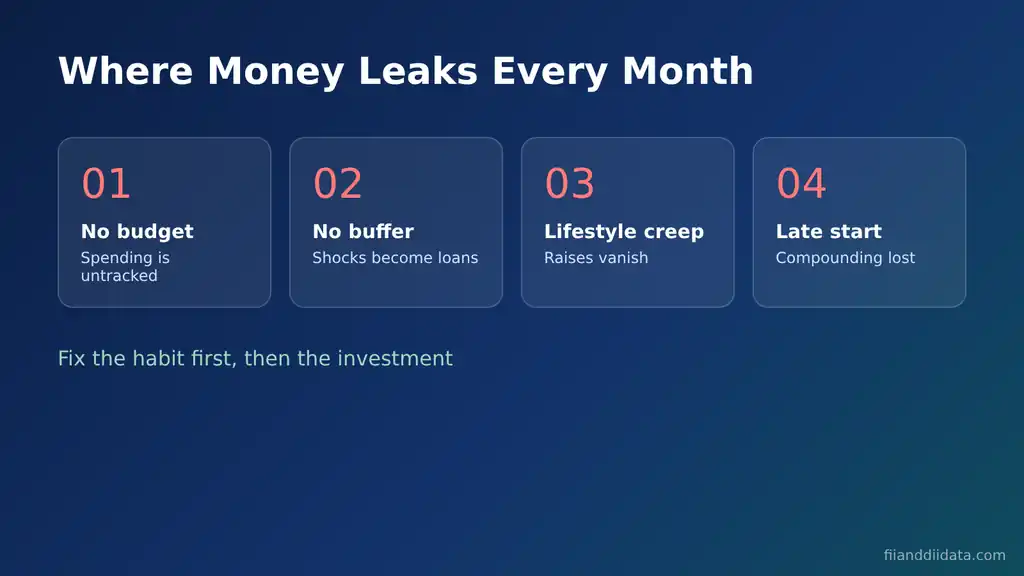
When there is no buffer, debt fills the gap. That is where the costliest mistakes sit.
Debt and Credit Card Mistakes
5. Paying only the minimum amount due
The minimum amount due (MAD) is the smallest payment that avoids a late fee, often 5% of the outstanding amount. It does not stop interest. Once you carry a balance, you also lose the interest-free period on new purchases. One bank’s terms, for example, list finance charges of 3.75% a month (45% a year) from 22 July 2024, with GST on top.
Worked example: you owe ₹50,000 and pay only 5% each month, with no new spending. In month one, interest is ₹1,875 plus 18% GST, or ₹2,212.50. After 12 months, you would have paid ₹28,720, of which about ₹24,147 went to interest and GST, and you would still owe ₹45,426. Paying the full bill instead costs zero interest. This is a simplified model; actual interest is calculated daily from the transaction date, so the real cost can be higher.
6. Borrowing for wants, not needs
Personal loans, “no-cost” EMIs and buy-now-pay-later plans make a phone or holiday feel affordable today. The rule of thumb is simple: borrow for assets that grow or protect income, such as a home or education, and save up for things that lose value. If your total EMIs already take a large share of take-home pay, stop adding new ones until the oldest loan closes. Late payments also hurt: the same bank terms note that an account can be reported as delinquent to credit bureaus if the minimum due stays unpaid three days after the due date.
Debt drains money slowly. A missing insurance policy can drain it all at once, which is the next set of mistakes.
Insurance Mistakes That Leave Families Exposed
7. No term life or health cover
If someone depends on your income, term life insurance pays a lump sum if you die during the policy term. Health insurance pays hospital bills that could otherwise wipe out years of savings. Relying only on an employer’s group cover is risky because it usually ends when the job ends.
For people on tight budgets, two government schemes give a basic layer. PMJJBY offers ₹2 lakh life cover for ₹436 a year (ages 18 to 50 to join), and PMSBY offers ₹2 lakh accidental death cover for ₹20 a year (ages 18 to 70), per scheme terms published by participating banks and checked on 29 October 2026. Together that is ₹456 a year. They are a floor, not a substitute for a proper term plan.
8. Buying insurance as an investment
Endowment and money-back plans mix protection with savings. The result is often low cover and modest returns, because the premium pays for both. Many buyers pick them only to save tax in March. Keep the two jobs separate: buy pure term cover for protection and invest the difference in instruments chosen for returns, liquidity and tax treatment.
Once protection is in place, the next leaks are on the investing side, and they are easy to miss.
Investing Mistakes: Idle Cash, High Costs and Late Starts
9. Keeping too much cash idle
Cash beyond your emergency fund should work for you. Suppose ₹2,00,000 sits for a year at 4%. It grows to ₹2,08,000. But with inflation at 5.54%, that sum buys only what about ₹1,97,082 bought a year earlier, a real loss of roughly ₹2,918. Inflation is the silent tax on idle money.
10. Ignoring costs and commissions
Every mutual fund scheme has a direct plan, introduced after SEBI circular CIR/IMD/DF/21/2012 of 13 September 2012. A direct plan carries a lower expense ratio because no distributor commission is paid. The gap looks tiny each year but compounds. Illustration: a ₹10,000 monthly SIP for 20 years grows to about ₹87.4 lakh at 11% a year net, but to about ₹76.6 lakh at 10% net. That 1 point difference costs about ₹10.8 lakh on ₹24 lakh invested. The returns here are assumptions, not forecasts; actual expense ratio gaps differ by scheme.
11. Starting late, stopping early and chasing tips
Time matters more than the amount. At an assumed 10% a year, ₹5,000 a month from age 25 to 60 grows to about ₹1.91 crore. Start at 35 and it reaches about ₹66.9 lakh. The extra ₹6 lakh invested in those first ten years ends up worth about ₹1.25 crore more.
Stopping SIPs when markets fall breaks the same compounding. Falls are when a SIP buys more units. Many Indian savers kept investing through the 2026 correction, as record SIP inflows in September 2026 showed. Tips from social media and messaging groups are the other trap. If you trade, base decisions on data you can check, such as daily FII and DII data, not on forwarded screenshots.
The last mistake does not involve markets at all, yet it can empty an account in minutes.
Fraud and Safety Mistakes
12. Sharing details and reporting fraud late
No bank, RBI official or courier company needs your OTP, UPI PIN or card CVV. Remember that you never enter a UPI PIN to receive money. Fraud often starts with a “refund” or “KYC update” call that creates urgency.
Speed matters if something goes wrong. Under RBI’s customer protection circular of 6 July 2017, a customer has zero liability for a third-party breach if they report it within 3 working days of receiving the bank’s alert. Reporting within 4 to 7 working days limits the liability. The bank must credit the disputed amount (a shadow reversal) within 10 working days of your report and resolve the complaint within 90 days. Keep SMS alerts on and save your bank’s fraud number.
With all 12 mistakes covered, the table below puts a rupee figure on the biggest ones.
What These Money Mistakes Cost in Rupees
| Mistake | Example | Approximate cost | Fix |
|---|---|---|---|
| Minimum due only | ₹50,000 card bill, 12 months at 3.75% a month + GST | ₹24,147 in interest; ₹45,426 still owed | Pay the full bill; move the balance to a cheaper loan |
| Idle cash | ₹2,00,000 at 4% for a year, inflation 5.54% | About ₹2,918 lost in buying power | Keep only the emergency fund in cash |
| High yearly cost | ₹10,000 SIP for 20 years, 10% vs 11% net | About ₹10.8 lakh lower corpus | Compare expense ratios; prefer direct plans if you can choose funds yourself |
| Starting 10 years late | ₹5,000 a month to age 60 at 10% | About ₹1.25 crore lower corpus | Start a small SIP now |
| No basic cover | PMJJBY + PMSBY | ₹456 a year for ₹2 lakh life and ₹2 lakh accident cover | Add a term plan sized to your income |
Seeing the rupee cost is useful. Acting on it is what matters, so here is a short checklist you can run tonight.
A 10-Minute Money Mistake Checklist
How to use this list of common money mistakes to avoid
Answer each question yes or no. Every “no” is your next action, starting from the top, since the early items protect you from the later ones.
- Do I have a written budget for this month?
- Does a fixed amount leave my account for savings on salary day?
- Is my emergency fund equal to at least three to six months of essential costs?
- Did I pay my last credit card bill in full?
- Are my total EMIs at a level I can still pay if my income drops for three months?
- Do I have term cover and health cover of my own, not only from my employer?
- Do I know the expense ratio of every fund I hold?
- Is any cash above my emergency fund sitting idle?
- Are SMS alerts on for every bank account and card?
- Do I know my bank’s fraud reporting number?
Fixing one item a month is enough. To turn these fixes into routines, see our list of good financial habits from daily to yearly.
FAQs on Common Money Mistakes to Avoid
What are the most common money mistakes to avoid?
The most common ones are not budgeting, saving only what is left, having no emergency fund, paying only the minimum due on credit cards, buying insurance as an investment, keeping too much idle cash and starting to invest late.
What happens if I pay only the minimum due on my credit card?
You avoid a late fee, but interest keeps running on the unpaid balance and you lose the interest-free period on new spends. At 3.75% a month plus GST, a ₹50,000 balance can still be about ₹45,426 after a year of minimum payments.
How much emergency fund should I keep?
A common target is three to six months of essential expenses. For a household spending ₹50,000 a month, six months is ₹3,00,000, kept where you can access it within a day.
Is it a mistake to keep money in a savings account?
Keeping your emergency fund there is sensible. Keeping much more than that is a mistake when inflation is higher than the interest rate, as it was in September 2026 at 5.54% against a 4% Post Office savings rate.
What should I do if money is taken from my account without permission?
Report it to your bank at once. Under RBI rules, reporting a third-party breach within 3 working days of the bank’s alert gives zero liability, and the bank must credit the amount within 10 working days of your report.
The Bottom Line
Money mistakes rarely come from one bad decision. They come from small habits repeated for years: no plan, card balances carried forward, cash left idle, costs ignored and protection postponed. The good news is that each one has a simple fix, and most fixes cost nothing.
Start with the order of the checklist: budget, automatic saving, emergency fund, zero card debt, then insurance and low-cost investing. As a practical next step, set up one auto-debit to savings on your next salary day. For more practical guides, browse the FIIAndDIIData.com blog.
Sources: RBI, Customer Protection: Limiting Liability of Customers in Unauthorised Electronic Banking Transactions (6 July 2017); South Indian Bank OneCard credit card MITC (finance charges w.e.f. 22 July 2024); Business Today, small savings rates unchanged for Q3 FY27 (30 September 2026); Free Press Journal, MoSPI CPI for September 2026 (12 October 2026); Department of Posts SB Order 12/2026 (30 September 2026); SEBI circular CIR/IMD/DF/21/2012 (13 September 2012).
Disclaimer: This article is for educational purposes only and is not investment advice. Please consult a SEBI-registered advisor before making investment decisions.