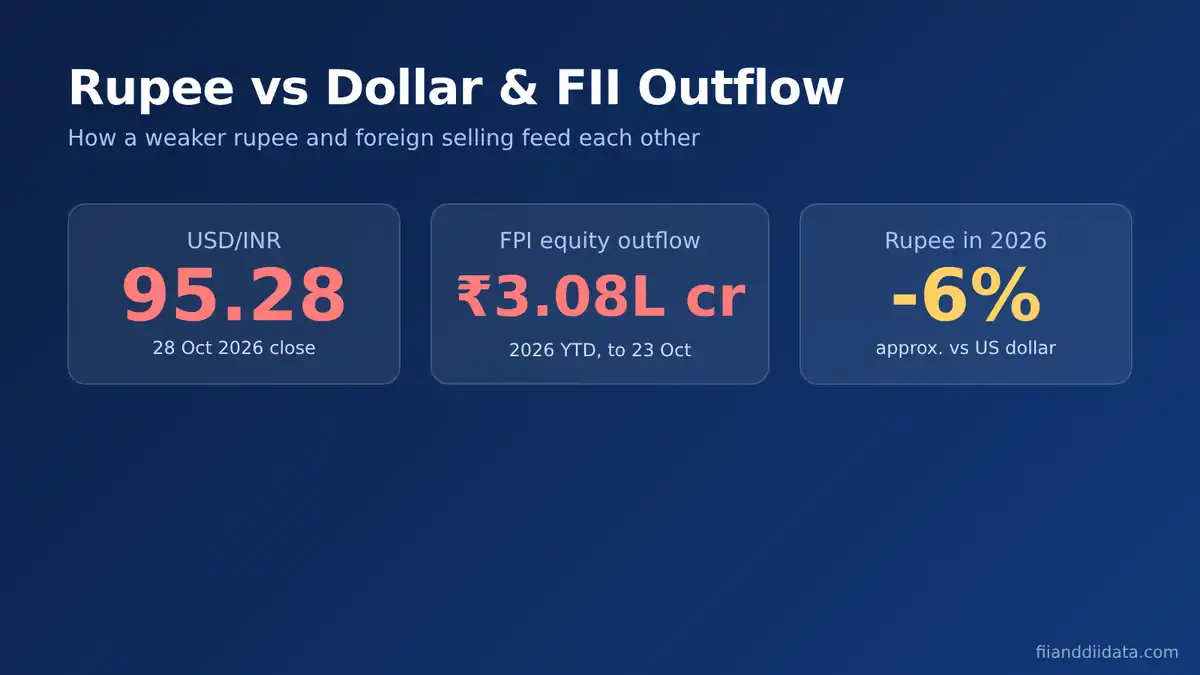
The rupee vs dollar FII outflow link is simple: when foreign investors sell Indian shares, they convert rupees into dollars, which pushes the rupee down, and a weaker rupee then cuts their dollar returns and invites more selling. On 28 October 2026 the rupee closed at 95.28 per dollar, while foreign portfolio investors (FPIs) had pulled out ₹3.08 lakh crore from Indian equities in 2026 by 23 October.
Key Takeaways
- FII selling creates dollar demand, so heavy outflows usually weaken the rupee.
- A weaker rupee lowers the dollar value of Indian holdings, which can trigger more selling.
- The rupee was about 6% weaker in 2026 as of 27 October, per Reuters, and hit a record low of 96.96.
- FPIs sold ₹48,056 crore of Indian equities in October 2026 up to 23 October, per NSDL data reported by PTI.
- Watch USD/INR, the dollar index, US yields, Brent crude and RBI reserves together, not in isolation.
In this article:
- What rupee vs dollar FII outflow means
- Why FII selling pushes the rupee down
- How a weak rupee shrinks FII returns
- Rupee vs dollar FII outflow data for 2026
- How the RBI responds
- A weekly checklist for traders
- Common mistakes
- Rupee, crude, yields and the dollar index compared
- FAQs
- The Bottom Line
What Rupee vs Dollar FII Outflow Means
Foreign institutional investors (FIIs), now officially called foreign portfolio investors (FPIs), are overseas funds that buy Indian shares and bonds. Their home currency is usually the US dollar. They bring dollars in, convert them to rupees, buy stocks, and later convert the rupees back to dollars when they sell.
An “outflow” is simply net selling: FPIs sell more Indian assets than they buy. The rupee vs dollar exchange rate (written USD/INR) tells you how many rupees one dollar buys. When USD/INR goes up, from 90 to 95 for example, the rupee has weakened.
These two numbers move together for a mechanical reason and a behavioural one. The mechanical reason is dollar demand at the time of exit. The behavioural reason is that foreign funds judge their performance in dollars, not rupees. A fund that earns 10% on Nifty stocks but loses 6% on the currency has made far less than it looks. We track the daily side of this story in our FII and DII data dashboard.
To see why the rupee falls on heavy selling days, it helps to follow the money step by step.
Why FII Selling Pushes the Rupee Down
When an FPI sells ₹10,000 crore of shares, it does not want rupees. It wants dollars to send home. Its custodian bank buys dollars in the currency market, and that extra demand lifts USD/INR. At the 28 October close of 95.28, ₹10,000 crore converts to roughly $1.05 billion. That is a large single block of dollar demand for the market to absorb.
This creates a loop that can feed itself:
- FIIs sell Indian shares.
- The rupee proceeds are converted into dollars.
- Dollar demand weakens the rupee.
- A weaker rupee reduces the dollar value of the shares FIIs still hold.
- Funds that track dollar returns cut exposure further, and the loop repeats.
The loop rarely runs in isolation. In 2026 it has been fed by outside pressure. On 28 October, PTI reported that the rupee slipped 21 paise as Brent crude futures rose to $115.08 a barrel and the dollar index (DXY) traded at 102.40. India imports most of its oil, so costly crude means oil companies need more dollars too. Our guides on how crude oil affects FII flows and how US bond yields hit Indian markets cover those two drivers in detail.
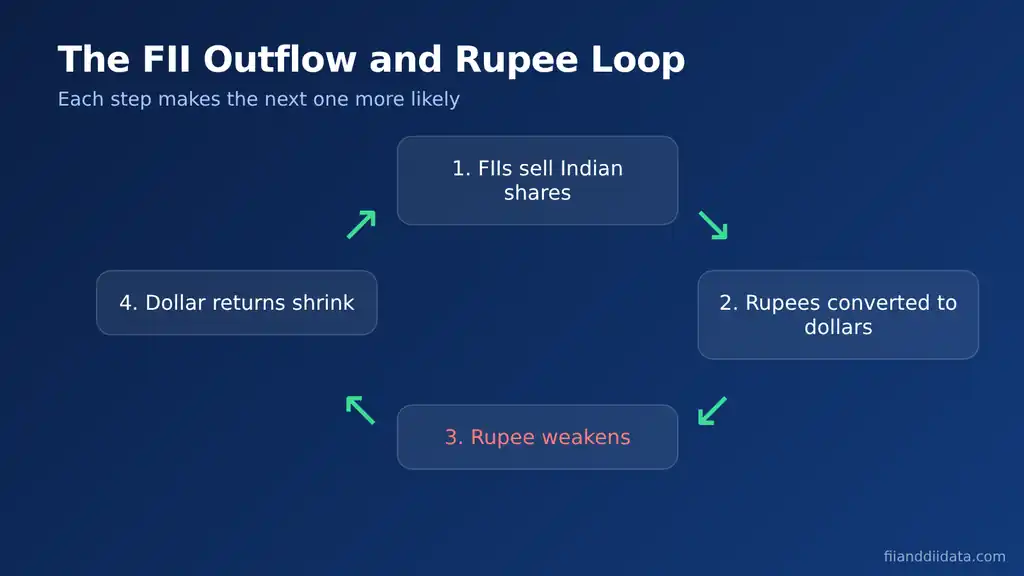
The loop explains the direction. The next section shows how much a currency move can cost a foreign fund in hard numbers.
How a Weak Rupee Shrinks FII Returns: A Worked Example
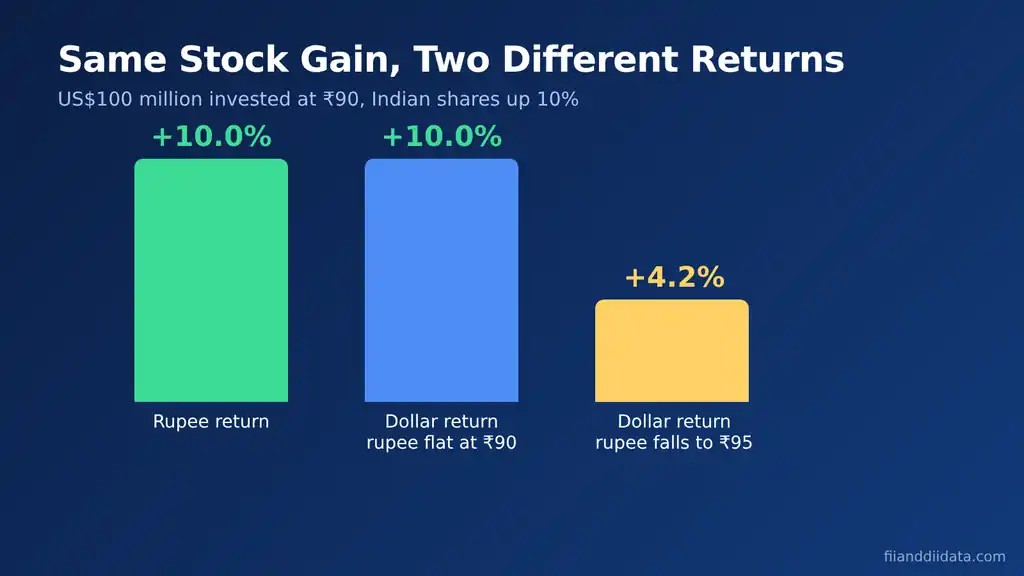
Take a simple, hypothetical case. A US fund invests $100 million in Indian shares when USD/INR is 90. It receives ₹900 crore. A year later, its shares are up 10%, so the holding is worth ₹990 crore.
- If the rupee stays at 90: ₹990 crore converts back to $110 million. The dollar return is 10%, the same as the rupee return.
- If the rupee weakens to 95: ₹990 crore converts to about $104.2 million. The dollar return falls to 4.2%.
More than half of the stock market gain disappears in the currency conversion. For a fund manager reporting to clients in dollars, that 4.2% must be compared with what the same money could earn elsewhere.
Rupee vs dollar FII outflow math: the break-even return
On 11 October 2026, Geojit’s VK Vijayakumar noted that the US 10-year Treasury yield was above 5.2%, as reported by Business Standard. A foreign fund can earn that with very little risk. So how much must Indian stocks deliver in rupees just to match it after a currency fall?
| Rupee fall vs dollar in a year | Rupee return needed to match a 5.2% US yield |
|---|---|
| 3% | 8.5% |
| 4% | 9.6% |
| 6% | 11.9% |
With the rupee down about 6% in 2026 and Nifty down 13.87% for the year as of 11 October, Indian equities have fallen far short of that hurdle in dollar terms. As a rough illustration, a 13.87% index loss combined with a 6% currency loss works out to about a 19% loss for a dollar-based investor. The exact figure depends on dates and holdings, but the direction is clear.
Some funds hedge currency risk with forward contracts. Hedging is not free. The cost roughly tracks the gap between Indian and US interest rates, which is why many long-only funds leave the currency exposure open and simply cut positions when the rupee slides.
Now look at what has actually happened to the rupee and FPI flows in 2026.
Rupee vs Dollar FII Outflow Data for 2026
The table below brings together the latest verified figures on the currency, reserves and FPI equity flows. Each number carries the date it applies to.
| Indicator | Value | Date |
|---|---|---|
| USD/INR close (provisional) | 95.28 (down 21 paise) | 28 Oct 2026 |
| Rupee record low | 96.96 per dollar | Earlier in 2026 |
| Rupee change in 2026 | About 6% weaker | As of 27 Oct 2026 |
| India forex reserves | $726 billion (fifth weekly fall) | Week to 9 Oct 2026 |
| Record-high reserves | $785.71 billion | 4 Sep 2026 |
| FPI equity flow, July | +₹20,200 crore | July 2026 |
| FPI equity flow, August | +₹29,631 crore | August 2026 |
| FPI equity flow, September | -₹35,861 crore | September 2026 |
| FPI equity flow, October | -₹48,056 crore | 1 to 23 Oct 2026 |
| FPI equity outflow, 2026 so far | ₹3.08 lakh crore | To 23 Oct 2026 |
| FPI equity outflow, full 2025 | ₹1.66 lakh crore | 2025 |
Two points stand out. First, the turn from inflows in July and August to heavy selling in September and October came alongside a sharp fall in reserves. Reserves dropped by about $59.7 billion from the 4 September peak to the week of 9 October, partly reflecting dollar sales by the central bank. Second, the 2026 outflow is already close to double the full-year 2025 figure.
Converted at the 28 October rate of 95.28, October’s ₹48,056 crore of selling equals roughly $5 billion. The actual dollar amount differs slightly because the exchange rate changed through the month. For the full month-by-month picture, see our FPI outflow 2026 breakdown and the FII DII monthly data page.
Flows have not been one-way every day. PTI reported that FIIs bought ₹4,240.39 crore of equities on 27 October, and FPI selling eased in the week to 23 October. The central bank’s response helps explain why the rupee has held below its record low.
How the RBI Responds and Why It Matters for FIIs
The Reserve Bank of India does not target a fixed exchange rate. It steps in to slow sharp moves by selling dollars from its reserves. In the week to 9 October, the RBI sold about $9.8 billion, according to IDFC First Bank’s chief economist, as quoted by Business Standard. The rupee then posted a 1.9% weekly gain to close at 94.96 on 16 October, its best week in seven months.
On 10 October the RBI also announced targeted steps:
- A dedicated dollar window for state-owned oil marketing companies, so their large dollar purchases do not hit the open market.
- Tighter rules on foreign exchange derivatives.
- A foreign exchange risk reserve requirement for certain derivative trades.
Former RBI governor Raghuram Rajan told Reuters on 27 October that India should not run down reserves to defend a particular rupee level. He noted that more than $140 billion was raised through special measures earlier in 2026, with about half already used. For FIIs, this matters because a stable rupee reduces the currency penalty on their returns. If intervention slows, the loop described above can speed up again.
Knowing the drivers is useful only if you can turn them into a routine. Here is the one we follow.
How Traders Use Rupee Signals: A Weekly Checklist
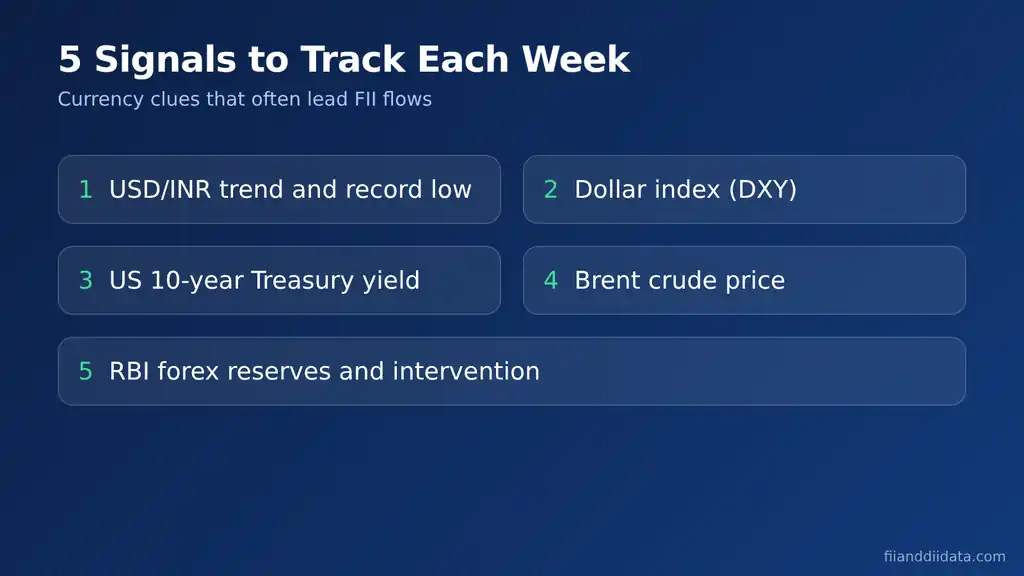
Currency moves often show stress before it appears in equity flow data. A simple weekly review can help you read the mood of foreign money:
- Check USD/INR and its distance from the record low. A fast move towards 96.96 usually comes with heavy FPI selling.
- Check the dollar index. A rising DXY means the dollar is strong against most currencies, so pressure on the rupee is global, not India-specific.
- Check the US 10-year yield. Higher yields raise the hurdle that Indian equities must clear in dollar terms.
- Check Brent crude. Expensive oil adds to dollar demand from importers and worsens the current account deficit.
- Check RBI reserves every Friday. A falling reserve figure signals active intervention; a rebound suggests pressure is easing.
- Match all this with flows. Compare the signals with FII DII data today, released by NSE around 6 PM IST on trading days, and the NSDL figures that follow the next working day.
When three or more signals point the same way, the odds of continued selling or a turn in flows rise. A weaker DXY, softer yields and a steadier rupee together have often come before foreign buying returns, a theme we explore in will FIIs come back to India.
Even with a checklist, a few common errors can lead to the wrong conclusion.
Common Mistakes When Reading the Rupee and FII Flows
- Assuming one-way cause and effect. FII selling weakens the rupee, but a weak rupee also causes FII selling. Both feed each other, and outside forces like crude and US yields often start the cycle.
- Reading a single day. One big buying day, like 27 October, does not end a trend. Look at weekly and monthly totals.
- Ignoring the dollar index. If every Asian currency is falling against a strong dollar, the rupee’s move says less about India itself.
- Treating a weak rupee as good for every stock. Exporters such as IT and pharma companies can gain, but importers, oil marketers and companies with dollar debt usually suffer.
- Mixing up NSE and NSDL numbers. NSE provisional data and NSDL FPI data use different methods and timing, so they rarely match exactly.
Finally, it helps to see how the rupee compares with the other big drivers of foreign flows.
Rupee, Crude, Yields and the Dollar Index Compared
| Driver | Latest reading | How it affects FII flows |
|---|---|---|
| USD/INR | 95.28 (28 Oct 2026) | A weaker rupee lowers dollar returns and can trigger selling. |
| Dollar index (DXY) | 102.40 (28 Oct 2026) | A strong dollar pulls money out of emerging markets broadly. |
| US 10-year yield | Above 5.2% (11 Oct 2026) | Higher risk-free returns raise the bar for Indian stocks. |
| Brent crude | $115.08 (28 Oct 2026) | Costly oil raises India’s import bill and dollar demand. |
| RBI forex reserves | $726 billion (week to 9 Oct 2026) | Larger reserves give the RBI room to calm the rupee. |
The rupee often acts as the meeting point of the other four. Crude, US yields and a strong dollar push money out, and the rupee shows the combined pressure. That is why currency charts deserve a place next to your flow data.
FAQs
How does rupee vs dollar movement affect FII outflow?
A falling rupee reduces the dollar value of Indian holdings, so foreign funds that measure returns in dollars may sell. Their selling then creates more dollar demand, which can weaken the rupee further.
Why does the rupee fall when FIIs sell?
FIIs convert their rupee sale proceeds into dollars before sending money home. That extra demand for dollars in the currency market pushes USD/INR higher, which means a weaker rupee.
Can a weak rupee attract FIIs back to India?
Sometimes. Once the rupee looks cheap and stable, Indian assets become less expensive in dollar terms. Foreign buying usually returns when the rupee stops falling, not while it is still sliding.
How does the RBI stop the rupee from falling?
The RBI sells dollars from its forex reserves to meet demand and can add measures such as special dollar windows for oil companies or tighter derivative rules. It aims to slow sharp moves rather than fix a level.
Which stocks benefit from a weak rupee?
Companies that earn in dollars, such as IT services and many pharma exporters, can gain because their revenue is worth more in rupees. Importers and firms with large dollar loans usually lose.
The Bottom Line
The rupee and foreign outflows are tied together in both directions. FII selling weakens the rupee, and a weaker rupee makes Indian stocks less rewarding for dollar-based funds. In 2026, high crude prices, US yields above 5% and a strong dollar have kept this loop running, with the rupee about 6% weaker and FPI equity outflows at ₹3.08 lakh crore by 23 October.
The picture is not one-sided. The RBI has slowed the fall, FIIs had large buying days in late October, and a stable rupee would remove much of the currency penalty. A practical next step is to add USD/INR and the dollar index to your daily watchlist and read them alongside FII flows. You can find more explainers on our blog.
Sources: PTI via Telangana Today, 28 Oct 2026; Business Standard, forex reserves, 16 Oct 2026; Reuters via Business Standard, 27 Oct 2026; Business Standard, FPI flows, 11 Oct 2026; PTI report on NSDL FPI data, 26 Oct 2026.
Disclaimer: This article is for educational purposes only and is not investment advice. Please consult a SEBI-registered advisor before making investment decisions.