Learning how to build wealth from scratch starts with one plain rule: spend less than you earn, protect that surplus, and let it compound for years. With retail inflation at 5.54% in September 2026 and a savings deposit paying 4%, money that sits idle is losing value every month. This guide gives you a five-stage plan, a worked ₹40,000 salary example and a monthly checklist you can follow from zero.
Key Takeaways
- Wealth is the gap between income and spending, invested for long periods. Income alone does not build it.
- Follow an order: track money, build an emergency fund, buy insurance, clear costly debt, then invest.
- After 5.54% inflation (September 2026), a 4% savings deposit gives a real return of about minus 1.46%.
- ₹5,000 a month from age 25 can grow to about ₹1.42 crore by 55 at an assumed 11%; starting at 35 gives about ₹43.7 lakh.
- Raising your SIP by 10% a year can roughly double the final corpus compared with a flat SIP.
In this guide
- What building wealth from scratch means
- Why starting from zero in 2026 needs a plan
- How to build wealth from scratch in five stages
- Worked example: a ₹40,000 salary with zero savings
- The compounding math: why time beats amount
- Where to put the money
- Common mistakes that keep people at zero
- Your monthly wealth checklist
- FAQs
- The Bottom Line
What Building Wealth From Scratch Really Means
Wealth is not your salary. It is your net worth: everything you own (bank balance, fixed deposits, EPF, mutual funds, gold) minus everything you owe (credit card dues, personal loans, EMIs). Someone earning ₹1 lakh a month with a large car loan and no savings can have a lower net worth than someone earning ₹35,000 who invests a fixed amount every month.
Starting from scratch usually means one of three positions: zero savings, a small balance with no plan, or a negative net worth because of debt. The steps are the same for all three. Only the time spent in each stage changes.
Here is a quick net worth example. Suppose you hold ₹60,000 in a savings account, a ₹1 lakh fixed deposit, ₹1.8 lakh in EPF and ₹1.2 lakh in mutual funds, which adds up to ₹4.6 lakh of assets. Against this you owe ₹25,000 on a credit card and ₹70,000 on a bike loan, so ₹95,000 in total. Your net worth is ₹3.65 lakh. Write this number down once a quarter. If it rises steadily, your plan is working, whatever the market does in a single month.
Knowing the target is half the job. The next section shows why parking money in the wrong place quietly pulls that number down.
Why Starting From Zero in 2026 Needs a Plan
Inflation is the hidden cost. India’s all-India CPI inflation rose to 5.54% in September 2026 from 4.83% in August, according to the Ministry of Statistics and Programme Implementation (MoSPI) release of 12 October 2026. When prices rise faster than your money grows, your purchasing power falls even though the balance looks the same.
The real return is the return left after inflation. It is calculated as (1 + interest rate) ÷ (1 + inflation) minus 1. The table below uses the small savings rates the Finance Ministry kept unchanged for 1 October to 31 December 2026.
| Option | Rate (Oct-Dec 2026) | Real return at 5.54% CPI |
|---|---|---|
| Post office savings deposit | 4.0% | -1.46% |
| Public Provident Fund (PPF) | 7.1% | +1.48% |
| Monthly Income Scheme | 7.4% | +1.76% |
| Kisan Vikas Patra (matures in 115 months) | 7.5% | +1.86% |
| National Savings Certificate (NSC) | 7.7% | +2.05% |
| Sukanya Samriddhi Yojana | 8.2% | +2.52% |
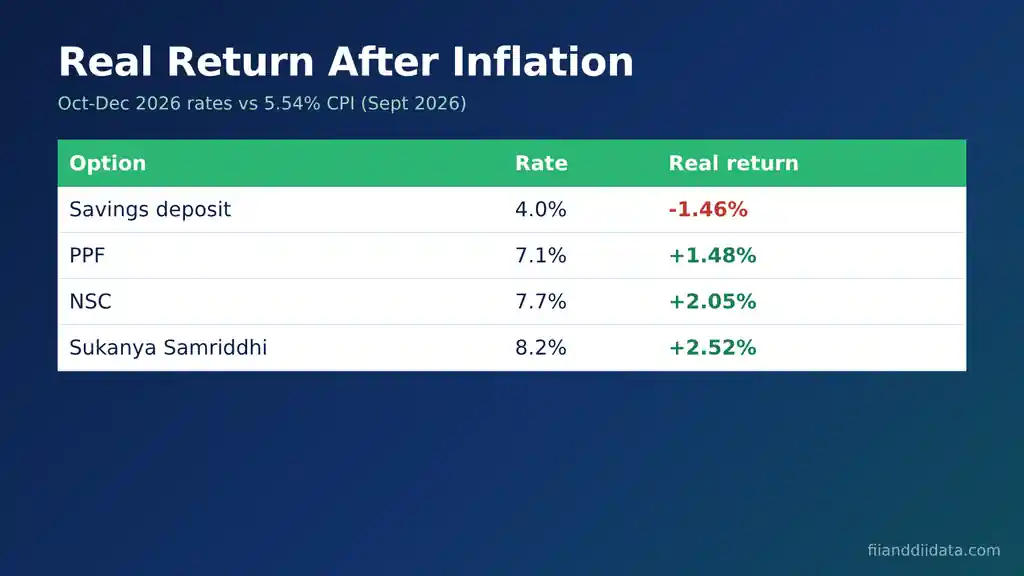
Put simply, ₹1 lakh that does not grow would buy only about ₹58,300 worth of today’s goods after 10 years if inflation stayed at 5.54%. Safe schemes keep you a little ahead of prices. Long-term wealth usually needs some exposure to growth assets such as equity mutual funds, which carry market risk and no fixed rate. The five stages below decide when, and how much.
How to Build Wealth From Scratch: The 5-Stage Order
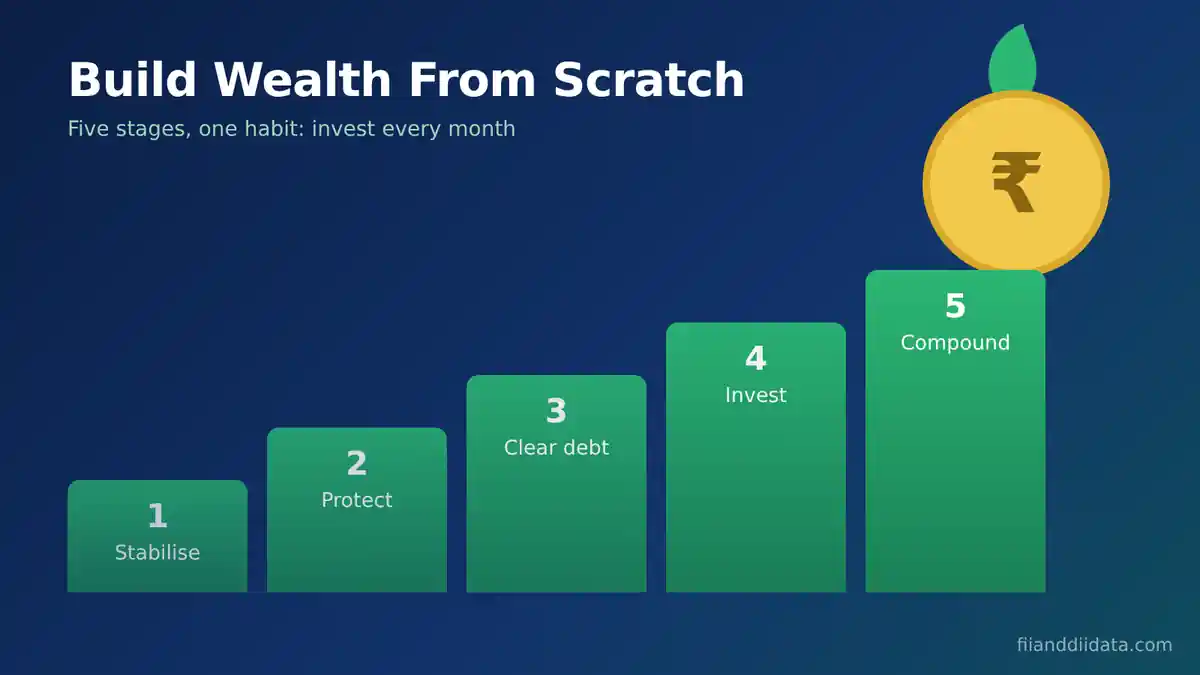
Most people fail not because they pick the wrong fund, but because they invest before they are stable. One hospital bill or job loss then forces them to sell at a bad time. Follow these stages in order. You can run two stages together once the first one is in place.
Stage 1: Track money and build the habit of saving first
List three months of spending from your bank and UPI statements. Then set an automatic transfer on salary day, so savings leave your account before spending starts. Our guide on how to save money every month shows how to find the first 10% to 20% of income.
Stage 2: Build an emergency fund
Keep three to six months of essential expenses in a liquid place such as a savings account, sweep-in FD or recurring deposit. This fund is not an investment. Its job is to stop you from breaking long-term investments or borrowing on a credit card when something goes wrong.
Stage 3: Protect your income with insurance
If anyone depends on your income, a pure term life plan comes first. A health insurance policy of your own, separate from any employer cover, protects the savings you are building. Avoid mixing insurance and investment in one product, because both jobs are usually done poorly.
Stage 4: Clear expensive debt
Credit card balances and high-cost personal loans usually charge far more than any investment can safely earn. Paying them off is a guaranteed return. List debts by interest rate and close the costliest first while paying the minimum on the rest.
Stage 5: Invest every month and let it compound
Split new money between safe options (PPF, EPF, NSC, RD) and growth options (diversified equity or index mutual funds through a SIP). Raise the SIP each time your salary rises. Households across India are already doing this at scale: monthly SIP inflows hit a record in September 2026, at ₹32,490 crore according to AMFI data.
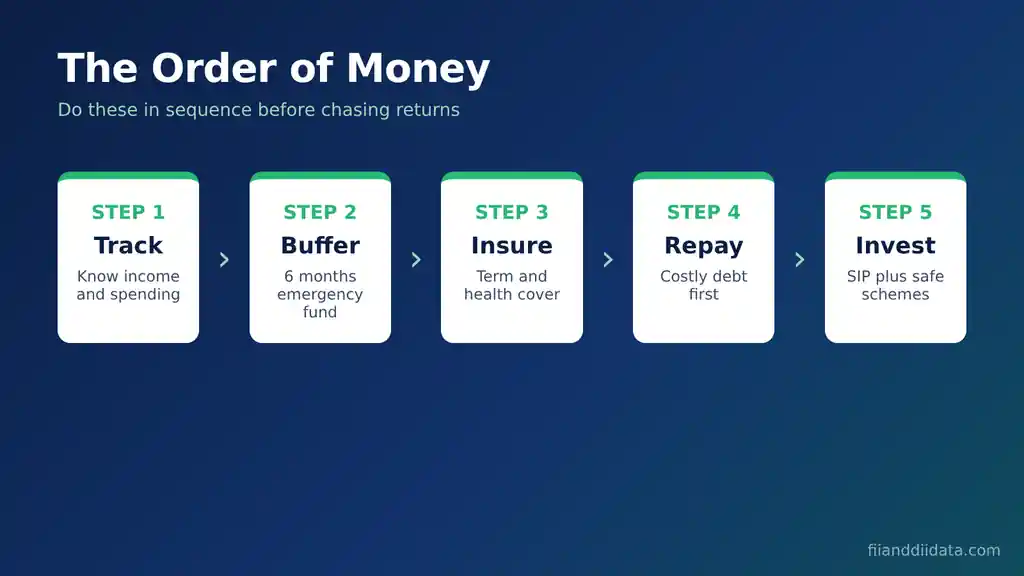
The order looks simple on paper. The next section puts real rupee amounts on it for a typical first-job salary.
Worked Example: A ₹40,000 Salary With Zero Savings
Meet Rohan, 26, who takes home ₹40,000 a month, spends ₹30,000 and has no savings. He can set aside ₹10,000 a month, or 25% of his pay. If that feels too high, start at 10% and raise it by a few percentage points every few months. A detailed budget method is in our guide to personal finance tips for Indian earners.
Year one: build the base
- ₹7,000 a month goes to an emergency recurring deposit. In 13 months this reaches ₹91,000, about three months of his expenses, before interest.
- ₹3,000 a month starts a SIP in a diversified equity or index fund, so the investing habit begins on day one. At an assumed 11% a year, the first 12 months grow to roughly ₹38,200.
- He buys a term plan and a personal health cover before raising investments.
Year two onwards: shift to growth
Once three months of expenses are parked, Rohan tops up the fund slowly towards six months and moves the main flow to investing: ₹6,000 a month in a SIP and ₹4,000 in PPF. The table shows what the ₹6,000 SIP alone could become over 20 years, with and without a yearly increase.
| SIP plan (20 years, assumed 11% a year) | Total invested | Estimated value |
|---|---|---|
| ₹6,000 a month, flat | ₹14.4 lakh | ₹52.4 lakh |
| ₹6,000 a month, raised 10% every year | ₹41.2 lakh | ₹1.07 crore |
The step-up row matters most. Rohan does not need a big salary today. He needs to pass a share of every raise to his SIP. The section below explains why the early years carry so much weight.
The Compounding Math: Why Time Beats Amount
Compounding means your returns start earning returns. The effect is small in the first few years and large later, which is why starting early matters more than starting big. Compare two people who each invest ₹5,000 a month until age 55 at an assumed 11% a year.
- Starts at 25: invests ₹18 lakh over 30 years. Estimated value: about ₹1.42 crore.
- Starts at 35: invests ₹12 lakh over 20 years. Estimated value: about ₹43.7 lakh.
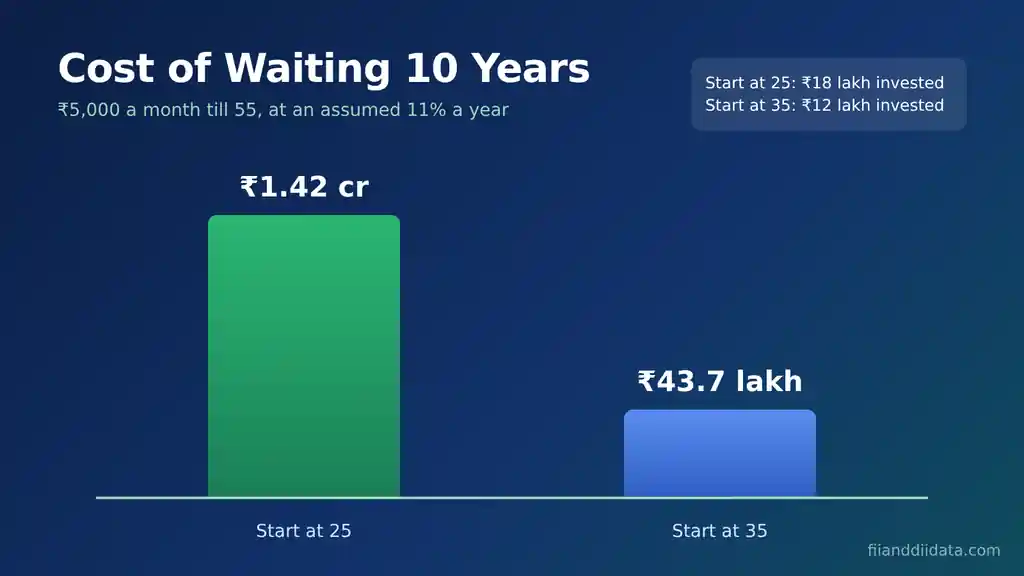
The late starter puts in only ₹6 lakh less but ends with nearly ₹98 lakh less. To catch up, the 35-year-old would need about ₹16,200 a month instead of ₹5,000. Delay is the most expensive habit in personal finance.
Use the Rule of 72 to build wealth from scratch faster
Divide 72 by the yearly return to estimate how long money takes to double. At PPF’s 7.1%, money doubles in about 10 years. At an assumed 11% equity return, it doubles in about 6.5 years. At a 4% savings rate, it takes 18 years, and inflation eats most of that gain. Now that the math is clear, the next step is choosing where each rupee goes.
Where to Put the Money: Match Each Goal to an Option
There is no single best investment. The right choice depends on when you need the money and how much fall in value you can live with. Use this as a starting map.
| Goal and time frame | Suitable options | What to know |
|---|---|---|
| Emergency fund (any time) | Savings account, sweep-in FD, RD | Easy access matters more than return |
| Goals in 1 to 3 years | Fixed deposits, RD, short-term debt funds | Avoid equity for money needed soon |
| Goals in 3 to 7 years | NSC (7.7%), KVP (7.5%), hybrid funds | Mix of fixed and market-linked |
| Retirement, 10+ years | EPF, PPF (7.1%), equity or index SIPs | Equity swings in the short run, rewards patience |
| Girl child’s future | Sukanya Samriddhi Yojana (8.2%) | Rate fixed for Oct-Dec 2026, reviewed quarterly |
As a long-term example, ₹1 lakh put into PPF at the start of every year for 15 years, at today’s 7.1% held constant, would grow to about ₹27.1 lakh on ₹15 lakh invested. Equity can grow faster, but it can also fall sharply in a bad year. If you are curious about who moves the Indian stock market day to day, our FII and DII data page tracks foreign and domestic institutional flows after market close. For goal-wise planning, read our financial planning guide for beginners.
Common Mistakes That Keep People at Zero
- Investing before an emergency fund exists. The first surprise expense forces a sale at a loss.
- Lifestyle creep. Every raise goes into a bigger phone or car EMI instead of a bigger SIP.
- Keeping everything in a savings account. As the table above shows, 4% trails 5.54% inflation.
- Chasing tips and quick trades. Building wealth is slow by design. Frequent trading adds costs and taxes.
- Stopping SIPs when markets fall. Falls let a fixed SIP buy more units. Stopping locks in the low point.
- Buying insurance as investment. Low-cover, high-premium policies leave you under-insured and under-invested.
- Ignoring tax. Check current capital gains and interest tax rules on the Income Tax Department website before you choose a product.
Avoiding these mistakes is easier with a short routine. The checklist below takes about 30 minutes a month.
Your Monthly Checklist to Build Wealth From Scratch
- Confirm the automatic savings transfer ran on salary day.
- Check last month’s spending against your budget and note one leak to fix.
- Check the emergency fund level against three to six months of expenses.
- Pay every credit card bill in full and on time.
- Confirm all SIPs, PPF and RD instalments went through.
- Once a quarter, update your net worth and compare it with the last figure.
- Once a year, raise your SIP by at least 10% and review insurance cover.
For more money guides like this one, browse the full FIIAndDIIData.com blog.
FAQs
How can I build wealth from scratch on a low salary?
Start with a fixed share of income, even 5% to 10%, and automate it on salary day. Build a small emergency fund first, then begin a small SIP. Raise the saving rate with every increment rather than waiting for a big salary.
How much should I invest every month to reach ₹1 crore?
At an assumed 11% yearly return, you would need about ₹21,800 a month for 15 years, about ₹11,450 for 20 years, or about ₹6,300 for 25 years. Actual returns can be higher or lower, so review the plan every year.
Should I pay off debt or start investing first?
Clear high-interest debt such as credit card dues and costly personal loans first, because no safe investment beats those rates. A low-cost, long-term home loan can run alongside your investments.
Can I build wealth with only PPF and fixed deposits?
Yes, but slowly. PPF at 7.1% against 5.54% inflation leaves a real return of about 1.5% a year. Most long-term plans add some equity exposure for growth, sized to the investor’s comfort with risk.
How long does it take to build wealth from zero?
The foundation, meaning an emergency fund, insurance and no costly debt, usually takes one to two years. A meaningful corpus takes 10 to 20 years of steady investing. Use the Rule of 72 to see how fast money doubles at a given return.
The Bottom Line
Building wealth from scratch is less about a high income and more about order and time. Track your money, build a cushion, insure your income, clear costly debt, and then invest a fixed amount every month that grows with your salary.
Returns are never guaranteed, and equity markets will have bad years. A steady plan that starts early still gives the best odds. Your next step: set up one automatic transfer on your next salary day, even if it is only ₹1,000.
Sources: MoSPI CPI press release for September 2026 (12 Oct 2026); Free Press Journal on small savings rates for Oct-Dec 2026 (30 Sep 2026), based on the Ministry of Finance (DEA) memorandum F.No.1/4/2019-NS of 30 Sep 2026; Kotak Neo on AMFI September 2026 data (12 Oct 2026). All examples calculated by FIIAndDIIData.com. Disclaimer: This article is for educational purposes only and is not investment advice. Please consult a SEBI-registered advisor before making investment decisions.