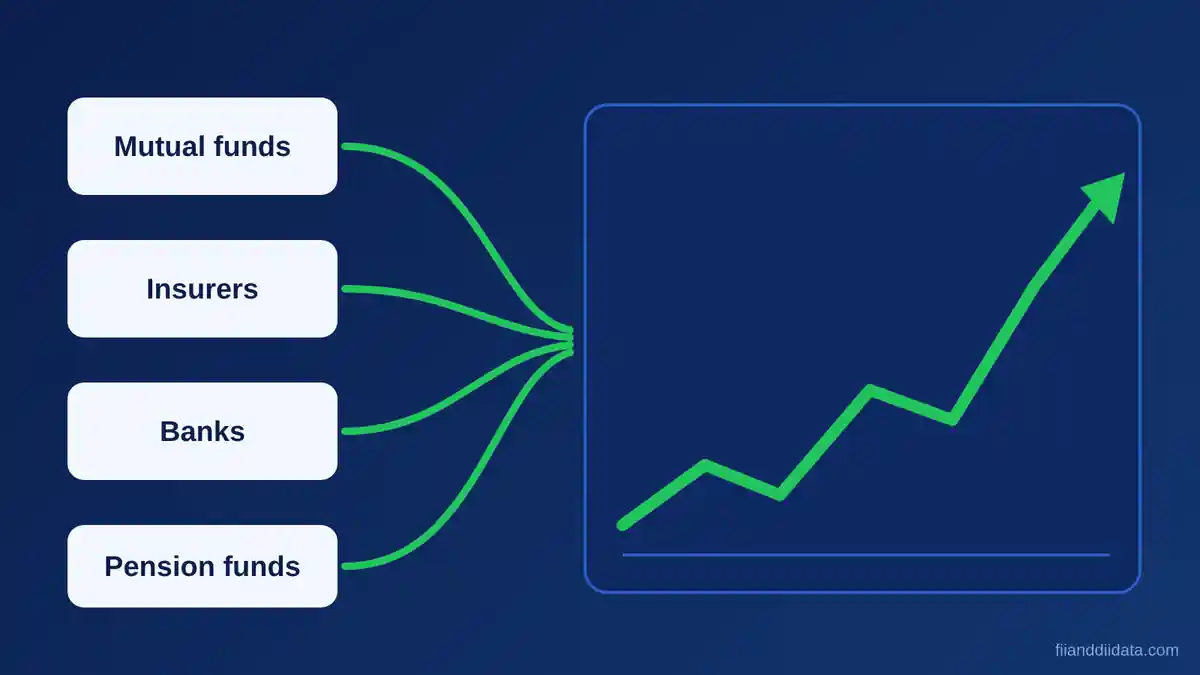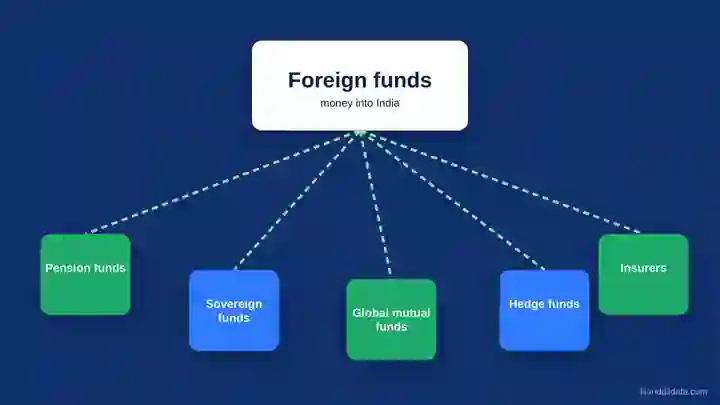
FII examples in India include pension funds, sovereign wealth funds, global mutual funds, hedge funds and insurers that buy Indian shares and bonds from abroad. Seeing who these investors are makes daily flow figures easier to read. This guide names real examples, shows how a foreign fund gets in, and uses June 2026 NSE data to size their share of the market.
Key Takeaways
- FIIs are overseas institutions such as pension funds, sovereign funds, global mutual funds, hedge funds and insurers.
- In India they trade under the FPI route, so SEBI and NSDL data use the term FPI for the same group.
- FPIs held 15.1% of NSE-listed companies in June 2026, against 19.5% for DIIs and 50.2% for promoters.
- Each type behaves differently: pension and sovereign funds hold for years, hedge funds can reverse in days.
Contents
- What are FII examples?
- Five types of FIIs
- Named examples of large foreign investors
- Worked example: FPI share of NSE ownership
- SEBI Category I and Category II
- How an FII invests in India
- Checklist for reading FII activity
- Common mistakes
- FAQs
- The Bottom Line
What Are FII Examples?
FII stands for Foreign Institutional Investor. It is an institution based outside India that invests in Indian securities. Retail traders see the group only as a daily number, a net buy or net sell figure in crores. Behind that number sit very different organisations with different goals, time horizons and rules.
Since 2014 SEBI has registered these investors as Foreign Portfolio Investors, or FPIs. Market commentary still says FII, so both words describe the same money. If you want the exact difference, read our note on FPI investment in India. For the daily buy and sell figures, the FII and DII data home page and the FII DII data today summary show the numbers as they are reported.
Five Types of FIIs With Examples
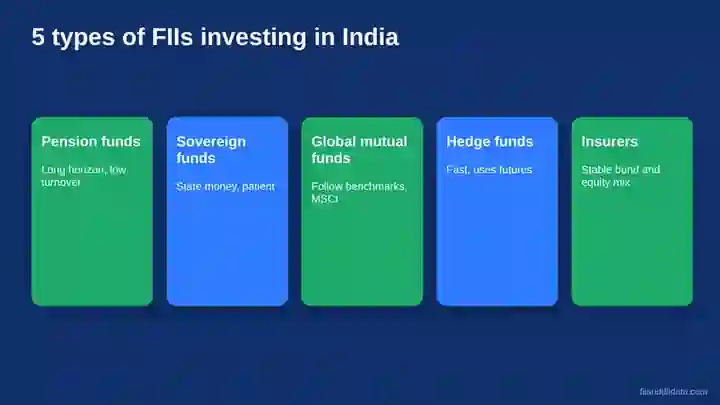
Most foreign institutions fit one of five groups. The type tells you how patient the money is likely to be.
Pension funds invest retirement savings for millions of members. They hold for many years and rarely react to one weak week. Large public pension managers from Canada, the Netherlands and the United States are typical examples.
Sovereign wealth funds invest a government surplus, often from oil or trade earnings. They build large positions in listed companies and stay for long periods. Singapore, Norway, Abu Dhabi and Kuwait run well-known funds of this kind.
Global mutual funds and ETFs pool money from many investors. Their buying rises and falls with fund inflows, so a global risk-off mood can force them to sell India even when they like the market.
Hedge funds chase returns using derivatives, leverage and short positions. They are the fastest movers, which is why they matter for F&O positioning and FII short covering.
Insurers and asset managers invest premium income and client money. They prefer steady, large companies and tend to add on dips rather than chase rallies.
Named Examples of Large Foreign Investors
Real names make the categories concrete. Government of Singapore (GIC), Norges Bank Investment Management, the Abu Dhabi Investment Authority and the Kuwait Investment Authority are sovereign funds that appear in Indian shareholding disclosures. Global asset managers such as BlackRock and Vanguard hold Indian shares through index and active funds. Large pension investors such as CPP Investments also take positions in Indian companies.
Exact stakes change every quarter, so treat these as examples of the type, not a ranked list. The reliable source is each company shareholding pattern filed on the exchange, which lists foreign holders above 1%. Our FII data guide explains how the reported buy, sell and net figures relate to those holdings.
Worked Example: FPI Share of NSE Ownership
The NSE ownership report for June 2026 gives a clear picture of where foreign money sits among all holders of NSE-listed companies.
| Holder group | Share of NSE-listed companies |
|---|---|
| Promoters | 50.2% |
| DIIs | 19.5% |
| FPIs (FIIs) | 15.1% |
| Direct individuals | 9.5% |
| Remainder (other holders) | 5.7% |
Take an illustration. If total market value were ₹100, FPIs would hold ₹15.1 and DIIs ₹19.5. DIIs therefore own about 1.29 times as much as FPIs, a gap of 4.4 percentage points. That gap is why heavy FII selling can be absorbed by domestic institutions, and it is also why the DII data deserves the same attention as foreign flows.

SEBI Category I and Category II
SEBI sorts FPIs into two categories by risk. Category I covers government-related investors, central banks, sovereign wealth funds and pension funds. Category II covers other eligible foreign investors, typically broad-based funds such as mutual funds and most hedge funds. The category decides the checks a fund faces at registration. Details sit in the SEBI FPI regulations.
How an FII Invests in India
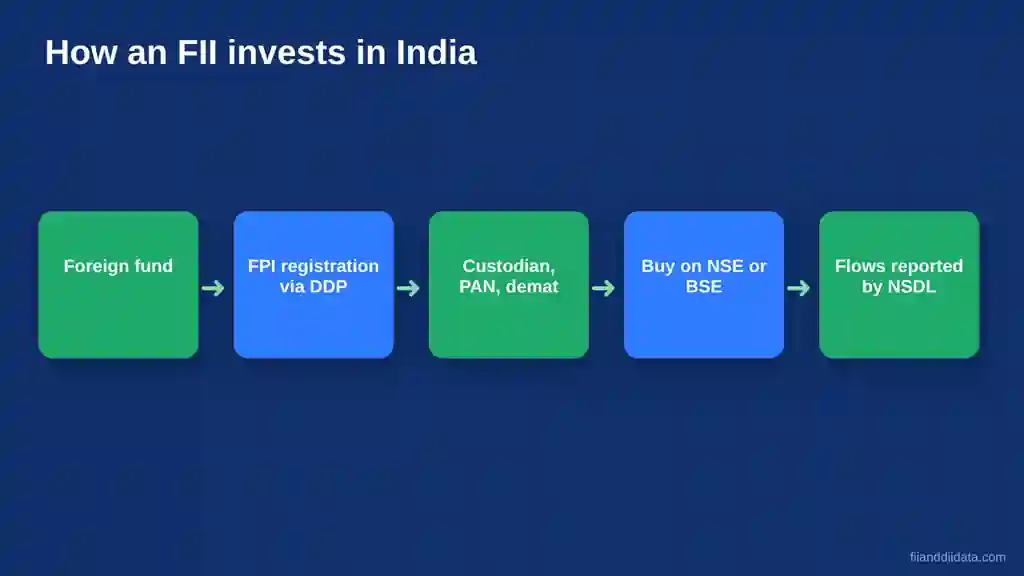
A foreign fund cannot simply log in and buy. It follows a fixed path: registration through a Designated Depository Participant, a custodian bank, a PAN and a demat account, then trades on NSE or BSE. Reported flows are collected by NSDL. NSE publishes provisional FII and DII data around 6 PM IST, and NSDL releases final FPI data on the next working day. The NSDL FPI Monitor carries the depository figures.
Checklist for Reading FII Activity
- Check net flow, then gross buy and gross sell, since a small net can hide heavy two-way trading.
- Compare cash flows with index futures and options positions before drawing a view.
- Place the figure beside DII buying to see who is absorbing the move.
- Look at a week or a month, not one day.
- Confirm provisional NSE data against NSDL final data when precision matters.
The steps are laid out further in how to use FII DII data for trading.
Why the Type of FII Changes How You Read Flows
The same ₹5,000 crore of net selling can mean very different things depending on who is behind it. If long-term pension and sovereign money is trimming, the move is usually slow and spread over weeks. If hedge funds are cutting positions, the same figure can arrive in two sessions and reverse just as fast.
Official data does not split flows by investor type each day, so you infer the mix from context. Heavy selling in the cash market with rising index futures shorts points to tactical funds. Steady selling with little change in derivatives positions points to slower portfolio reallocation. Global events also matter. A sharp rise in US yields or a stronger dollar tends to pull money from all emerging markets at once, whatever the type, and India feels it too.
Currency is the other link. A foreign fund earns in rupees but reports in dollars, so a weaker rupee reduces its return even when Indian shares rise. That is one reason foreign funds watch the exchange rate closely, as covered in our piece on the rupee and the stock market.
FII Examples Compared With DII Examples
Domestic institutions are the mirror group. Examples include mutual fund houses, life and general insurers, banks and pension funds such as the Employees Provident Fund. Their money comes from Indian savers, often through monthly SIP contributions, so it keeps arriving whether markets rise or fall. Foreign money depends on global allocation decisions and can leave quickly.
This difference explains a pattern seen often in 2026 data. When FIIs sell, DIIs frequently buy, which cushions index falls. When both buy together, rallies tend to be stronger. Tracking the two side by side gives a fuller view than either alone, and the smart money discussion shows how large buying by foreign institutions is usually read.
For a trader, the practical lesson is simple. Ask who is likely behind a flow, how long that type usually stays, and whether domestic institutions are on the other side. Those three questions turn a single headline number into a usable reading of the market.
Common Mistakes
The first mistake is treating all FIIs as one voice. A pension fund trimming a position and a hedge fund shorting futures can both appear as selling, yet they mean different things. The second is reading one negative day as a trend, which gross versus net selling shows to be misleading. The third is assuming foreign money always leads the market. Domestic institutions now hold more than foreign funds, so the two groups often offset each other.
FAQs on FII Examples
What are some FII examples in India?
FII examples include sovereign wealth funds such as GIC and Norges Bank Investment Management, global asset managers such as BlackRock and Vanguard, large pension funds, hedge funds and foreign insurers.
Are FII and FPI the same thing?
In practice yes. SEBI now registers foreign institutions as FPIs, while the market still uses the older term FII for the same investors.
How much of NSE-listed companies do FPIs own?
The NSE Ownership Report for June 2026 shows FPIs at 15.1%, against 19.5% for DIIs and 50.2% for promoters.
Which type of FII is the most volatile?
Hedge funds usually move fastest because they use derivatives and leverage. Pension and sovereign funds tend to hold for years.
Where can I see FII buying and selling data?
NSE publishes provisional FII and DII figures around 6 PM IST and NSDL publishes final FPI data on the next working day.
The Bottom Line
FII examples range from patient pension and sovereign funds to fast hedge funds, and each reads differently in the flow data. With FPIs at 15.1% of NSE-listed companies and DIIs at 19.5%, foreign money matters but no longer decides the market alone. Read net flows, gross flows and positioning together, and use the NSE and NSDL figures as your reference.
Sources: NSE India Ownership Report, June 2026; NSDL FPI Monitor; SEBI FPI Regulations.
Disclaimer: This article is for education only and is not investment advice. Named institutions are examples of investor types, not recommendations.