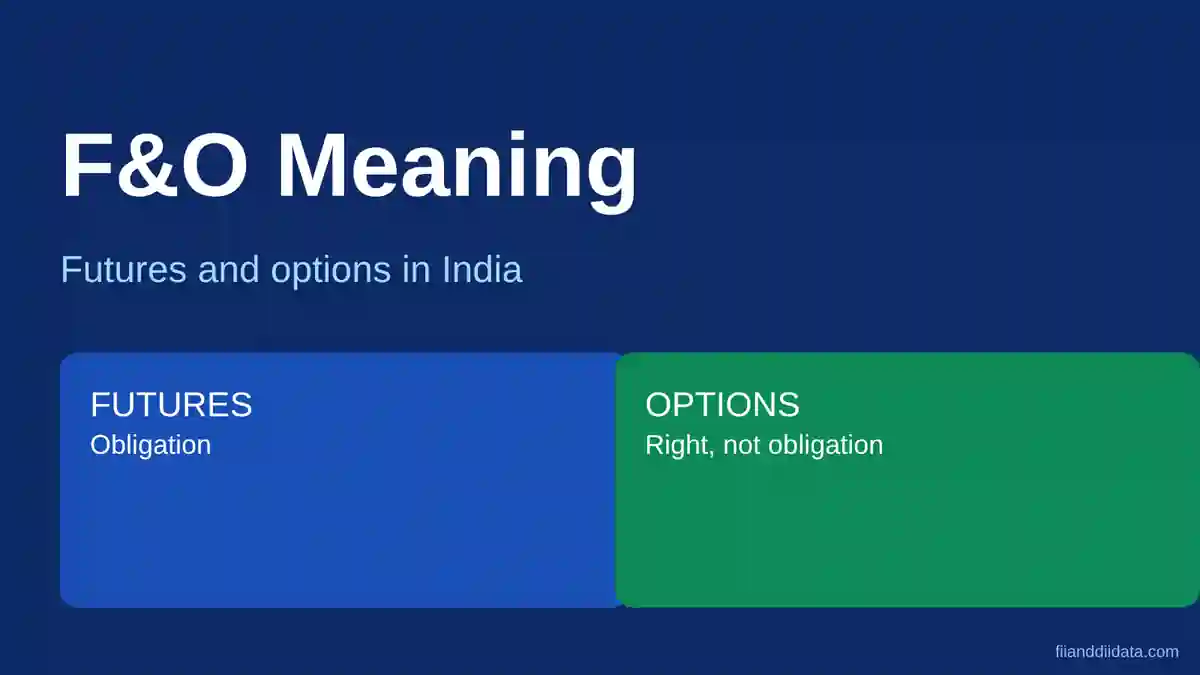
F&O meaning: F&O stands for Futures and Options, the two derivative contracts traded on NSE and BSE. A future is an obligation to buy or sell at a fixed price on a fixed date, while an option is a right, not an obligation, bought for a premium. On 9 November 2026, FIIs were net buyers of ₹7,212 crore in cash, yet still net short 90,741 index futures contracts (Quantsapp, provisional NSE data).
Key Takeaways
- Futures bind both sides to a trade. Options give the buyer a choice and cost a premium.
- One Nifty lot is 65 units from January 2026, so a 100-point move is about ₹6,500 per lot.
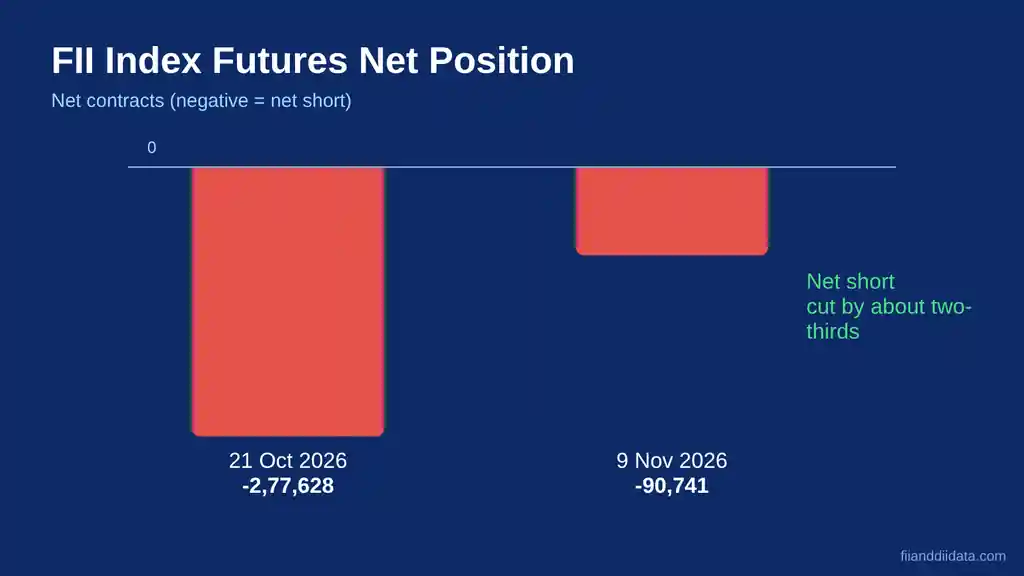
- FII index futures net short fell from 2,77,628 contracts (21 Oct 2026) to 90,741 (9 Nov 2026).
- A large FII net short is often a hedge on a share portfolio, not a bearish call.
- Read cash flows and F&O positions together, and compare several sessions.
In this guide
- F&O meaning in simple words
- Futures explained
- Options explained
- Futures vs options
- Why F&O matters for FII and DII data
- Real data: the FII net short in 2026
- Hedging vs directional bets
- Rules, risks and how to track positions
F&O Meaning in Simple Words
A derivative is a contract whose value comes from something else, called the underlying. In India the underlying is usually an index such as Nifty 50 or Bank Nifty, or a single stock. Instead of buying the shares, a trader buys or sells a contract linked to their price. That is why F&O is called derivatives trading.
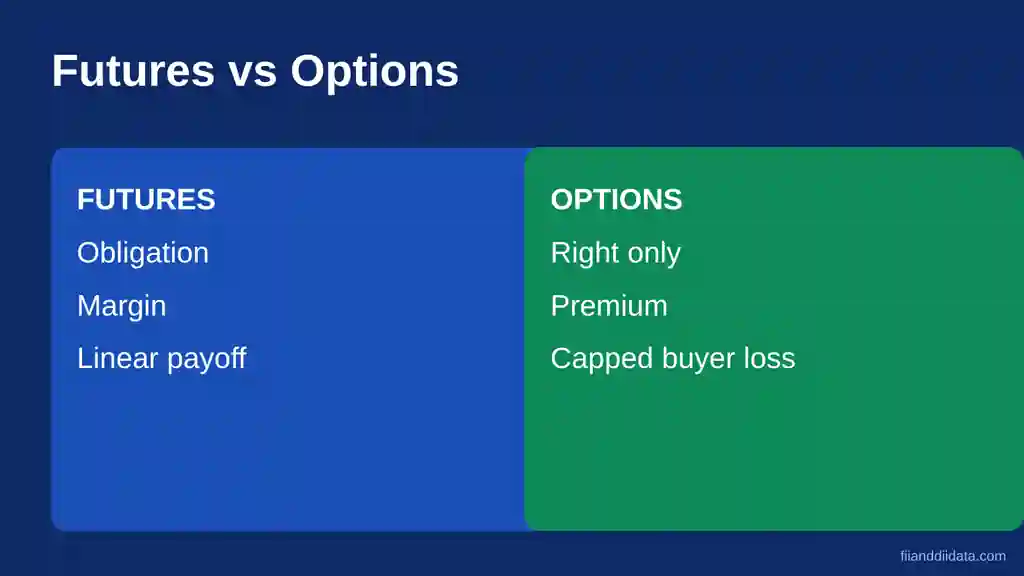
There are two building blocks. Futures lock in a price today for a transaction on a future date, and both sides must honour it. Options give the buyer a choice. The seller, called the writer, must perform only if the buyer chooses to exercise. Hedges, spreads and straddles are all built from combinations of these two.
Every contract has an expiry date. On NSE, weekly Nifty contracts expire on Tuesdays, and BSE Sensex weekly contracts expire on Thursdays, under the schedule effective 1 September 2025. At expiry the contract is settled, which is why open positions keep rolling forward every week and month. Next, we look at how a futures contract actually works.
Futures Explained: Obligation, Lot Size and Margin
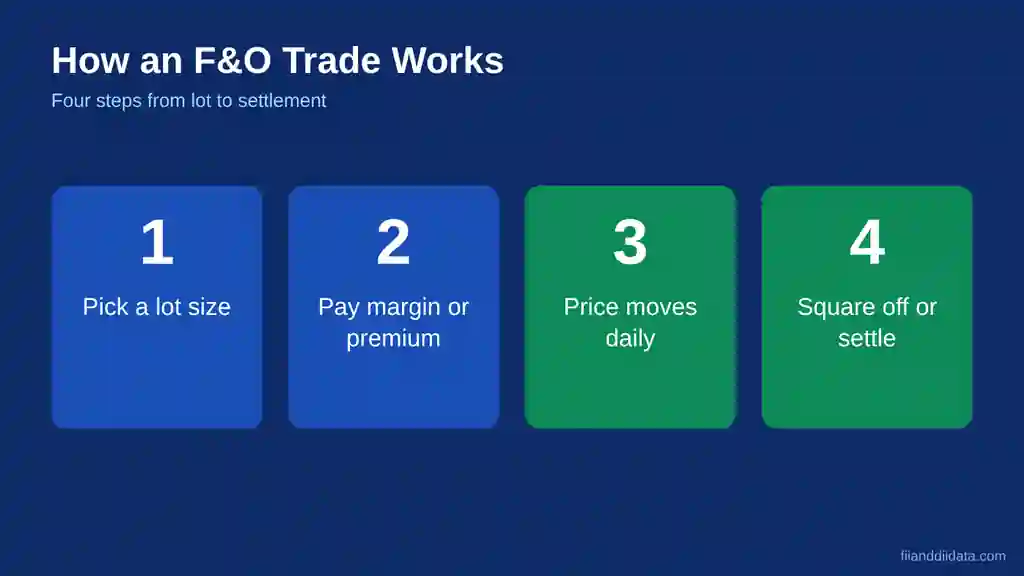
A futures buyer is “long” and profits when the underlying rises. A futures seller is “short” and profits when it falls. Neither side pays the full contract value up front. Each posts margin, a fraction of the contract value held as security, and gains and losses are settled every day through mark-to-market.
Contracts trade in fixed units called lots. From January 2026 the lot sizes are 65 for Nifty, 30 for Bank Nifty, 60 for Fin Nifty and 120 for Midcap Nifty, while Nifty Next 50 stays at 25, as reported by Business Standard on 31 December 2025. SEBI also requires a minimum contract value of ₹15 lakh, effective 20 November 2024, which is why lot sizes were revised over time.
Worked example: what F&O meaning looks like in rupees
Assume, purely as an illustration, that Nifty futures trade at 25,000. One lot of 65 then has a contract value of ₹16.25 lakh (25,000 × 65). A 100-point move changes profit or loss by ₹6,500 per lot (100 × 65). A long trader gains ₹6,500 if Nifty rises 100 points and loses the same if it falls. The 25,000 level is hypothetical and is used only to show the arithmetic.
Options Explained: A Right Without an Obligation
An option comes in two types. A call option gives the buyer the right to buy the underlying at a fixed price, called the strike. A put option gives the right to sell at the strike. The buyer pays a premium to the seller, and that premium is the buyer’s maximum loss. The seller keeps the premium but carries the risk if the market moves against them.
Take the same hypothetical Nifty at 25,000. Suppose you buy a 25,000 call for a premium of ₹100 per unit. One lot of 65 costs ₹6,500. If Nifty closes at 25,300 at expiry, the call is worth 300 points, a gross gain of ₹19,500 and a net gain of ₹13,000 after the premium. If Nifty ends at or below 25,000, you lose only the ₹6,500 premium. These figures are an illustration, not a market quote.
Option prices move with more than direction. Time decay, volatility and distance from the strike all matter, and the Greeks measure these sensitivities. Sellers collect premium most of the time, but one large move can erase many small gains. The table below puts the two contracts side by side.
Futures vs Options: The Key Differences
| Feature | Futures | Options |
|---|---|---|
| Nature of contract | Obligation for both sides | Right for buyer, obligation for seller |
| Upfront cost | Margin | Premium (buyer), margin (seller) |
| Maximum loss | Can exceed margin | Buyer: premium paid. Seller: large |
| Profit profile | Linear with price | Non-linear, depends on strike and time |
| Time decay | None on the contract itself | Erodes premium as expiry nears |
Futures are a clean, linear bet on direction or a straightforward hedge. Options let a trader shape risk, for example by capping the loss, but the price of that flexibility is the premium and time decay. With the basics done, let us see why this matters for people who follow institutional flows.
Why F&O Meaning Matters for FII and DII Data
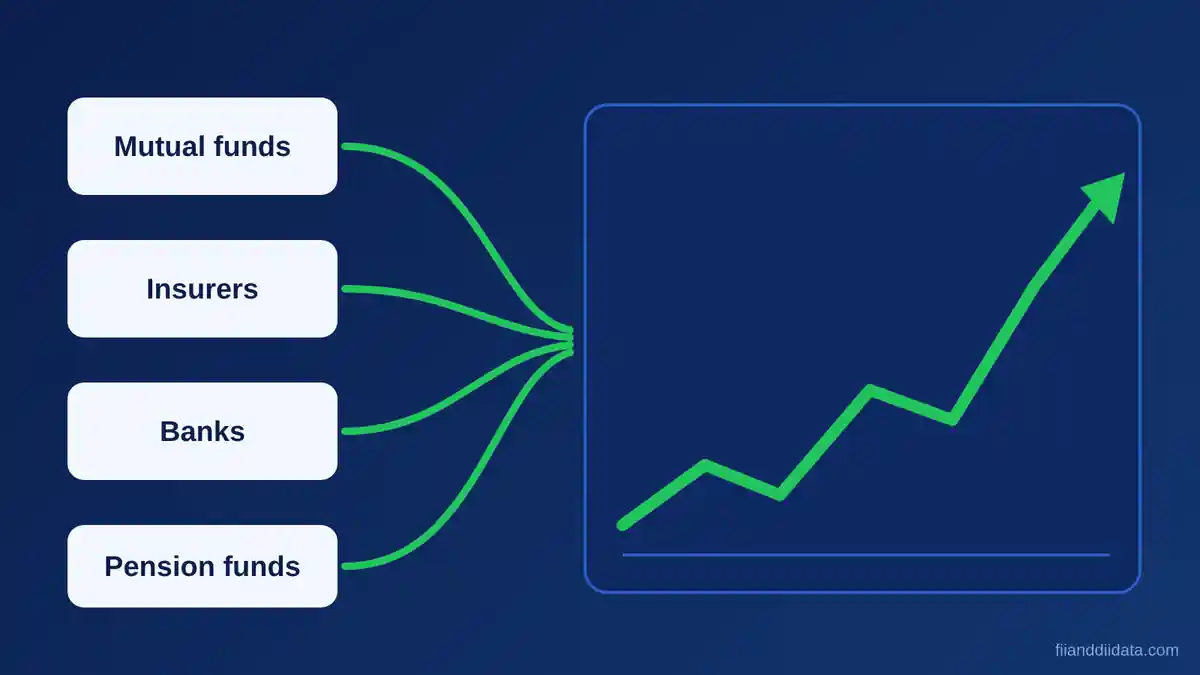
The daily FII and DII figure most people quote is the cash-market net buy or sell. Large foreign investors also hold big derivatives positions, and NSE publishes them each trading day in its participant-wise open interest file. That file splits positions across four groups: FII, DII, Pro (proprietary traders) and Client (largely retail). Our guide to participant-wise open interest shows how to read it, and the home page carries the latest FII and DII data.
On 9 November 2026, net positions in contracts (Quantsapp, provisional NSE data) were: FIIs -90,741 in index futures and +2.76 lakh in index options; Pro traders -20,475 and -40,968; Clients +80,759 and -3.53 lakh; DIIs +30,457 and +1.18 lakh. Positive means net long and negative means net short. Because every contract has a buyer and a seller, positions across groups offset each other. You learn who is leaning which way, not the total size of the market.
For the cash side, see FII DII data today, which is updated after the official release (NSE provisional figures come around 6 PM IST). Next, here is what the derivatives numbers did over three weeks.
Real Data: How the FII Net Short Shrank in Three Weeks
Our FII long short ratio page, citing NiftyTrader and Quantsapp, recorded FII index futures on 21 October 2026 at 32,598 long contracts against 3,10,226 short, a long ratio of 9.5% and a net position of -2,77,628. By 9 November 2026 the net short had narrowed to -90,741 contracts, a fall of roughly 1.87 lakh contracts in about three weeks.
| Date | FII index futures net position | Note |
|---|---|---|
| 21 Oct 2026 | -2,77,628 contracts | Long 32,598, short 3,10,226, long ratio 9.5% |
| 9 Nov 2026 | -90,741 contracts | Provisional NSE data via Quantsapp |
A shrinking net short happens in two ways: FIIs buy back shorts, or they add fresh longs. Either way, bearish pressure from that group eased. It fits the cash picture on 9 November 2026, when FIIs bought ₹20,311 crore and sold ₹13,099 crore for a net ₹7,212 crore, while DIIs bought ₹12,765 crore and sold ₹19,938 crore for a net sale of ₹7,173 crore (Quantsapp, provisional). Our note on FII short covering explains how to tell buy-backs from new longs.
Hedging vs Directional Bets: How FIIs Use F&O
Institutions use F&O for three broad reasons. The first is hedging, where futures or put options offset the risk of a share portfolio. The second is directional positioning, where the fund takes a view on the index. The third is arbitrage, where small price gaps between cash and futures are captured with offsetting trades. A single net number cannot tell you which motive dominates.
Marketcalls notes that net shorts are often hedges, and that the long ratio is a normalised measure that is easier to compare across days than raw contract counts. If a foreign fund holds a large portfolio of Indian shares, it may short index futures to protect against a fall. That earns nothing if the market rises, but it limits damage if the market drops.
That is why analysts watch the direction of change as much as the level. When the net short falls while the cash market also sees buying, as between late October and 9 November 2026, hedge unwinding and a bullish view point the same way. When the net short rises while cash buying continues, fresh hedging is the more likely reading.
Options add another layer. FIIs held +2.76 lakh net index options on 9 November 2026, but that figure mixes calls and puts. To see sentiment you need the split, and the put call ratio is the usual shortcut. A rising ratio can show protection demand as much as bearishness.
Rules, Risks and How to Track F&O Positions
Derivatives magnify both gains and losses because a small margin controls a large contract value. In the Nifty example above, a lot worth ₹16.25 lakh needs only a fraction of that as margin, so a modest adverse move can wipe out a large share of the deposit. Futures losses can exceed the margin, and option writers face very large losses.
Regulation has tightened. SEBI set limits on index options positions, with an intraday net options cap of ₹5,000 crore and an end-of-day net cap of ₹1,500 crore, effective 1 October 2025. Read more in our explainer on the SEBI F&O rules for 2026.
Common mistakes beginners make
- Treating a big FII net short as a sure bearish signal, when it is often a hedge.
- Reading one day of data instead of comparing the last several sessions.
- Ignoring time decay when buying options close to expiry.
- Sizing positions so large that one adverse move wipes out the margin.
- Quoting provisional NSE numbers as if they were final.
Checklist: how to track FII and DII F&O positions
- Check the cash-market FII and DII net figure after the NSE release.
- Open the participant-wise open interest file on NSE participant-wise open interest and note the FII index futures net position.
- Check the long ratio, not only the net number.
- Look at the options split between calls and puts.
- Compare all four readings with the previous few sessions before drawing a view.
Frequently Asked Questions About F&O Meaning
What is the F&O meaning and full form?
F&O stands for Futures and Options. They are derivative contracts whose value depends on an underlying such as the Nifty 50 index or a stock. Futures are an obligation to transact at a fixed price on a set date, while options give the buyer a right but not an obligation.
What is the difference between futures and options?
In futures both buyer and seller must complete the trade at expiry, and losses can exceed the margin. In options the buyer pays a premium and can walk away, so the buyer’s loss is limited to that premium, while the seller carries the larger risk.
What is lot size in F&O?
A lot is the fixed number of units in one contract. From January 2026, the Nifty lot size is 65, Bank Nifty is 30, Fin Nifty is 60 and Midcap Nifty is 120. You can trade only in multiples of the lot size.
Why do FIIs trade in F&O?
FIIs use F&O to hedge their share portfolios, take directional views and capture arbitrage between cash and futures prices. A large net short in index futures is often a hedge, not necessarily a bearish view.
Is F&O trading safe for beginners?
F&O magnifies exposure, so losses can be large and fast. Beginners should first learn how contracts, margin and premium work, start with positions they can afford to lose, and avoid relying on any single participant’s data as a signal.
The Bottom Line
F&O comes down to obligation versus right. Futures use margin and settle daily. Options charge a premium and lose value as expiry nears. FIIs use both to hedge, to take views and to capture price gaps, so a net short does not always mean a bearish stance.
The move from a net short of 2,77,628 contracts on 21 October 2026 to 90,741 on 9 November 2026 shows how quickly institutional positioning can change. Compare cash flows and derivatives positions together, and treat each number as context rather than a trading call.
Your next step: open the FII index futures net position for the last five sessions and note whether it is rising or falling before you read anything into a single day.
Sources: Quantsapp (9 Nov 2026, provisional NSE data), NSE India (participant-wise open interest and contract specifications), SEBI (minimum contract value and index options limits), Marketcalls (long ratio and hedging commentary), Business Standard (lot sizes, 31 Dec 2025), NiftyTrader (21 Oct 2026 via our long short ratio page). Disclaimer: This article is for educational purposes only and is not investment advice. Please consult a SEBI-registered advisor before making investment decisions.