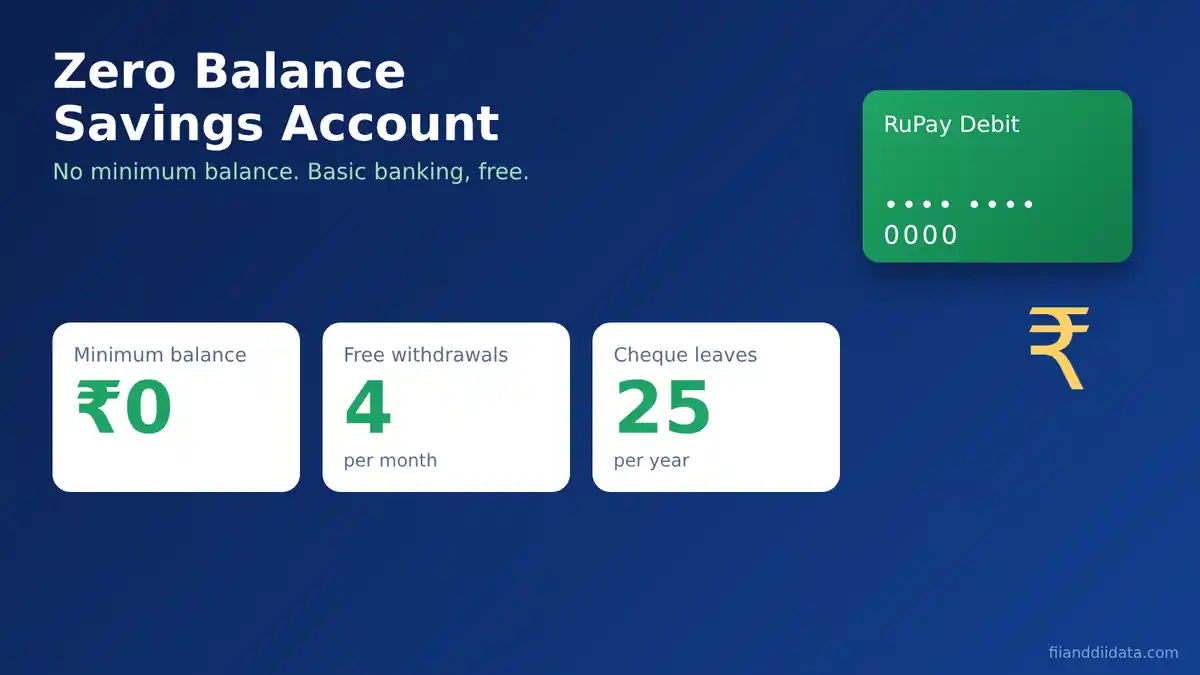
The main zero balance savings account benefits are simple: you can open and keep the account with no minimum balance, you pay no penalty for a low balance, and you still get a debit card, a cheque book, a passbook or statement and at least four free withdrawals a month. Since April 1, 2026, the Reserve Bank of India (RBI) has set these as the minimum free services every bank must give on a Basic Savings Bank Deposit (BSBD) account.
That matters if you are a student, a first-time earner, a gig worker with uneven income, or a parent who wants a clean account for a child’s scholarship money. A regular savings account can charge you when your average balance dips. A BSBD account cannot. This guide explains what the rules give you, what counts toward the free withdrawal limit, a worked month, the catches, and how to open one. Every rule below comes from RBI documents opened on November 9, 2026.
Zero balance savings account benefits under the RBI rules
The rules sit in the Reserve Bank of India (Commercial Banks – Responsible Business Conduct) Amendment Directions, 2025, issued on December 4, 2025 under reference RBI/2025-26/103. They apply from April 1, 2026, or from the date a bank adopts them, whichever is earlier. The directions use the name BSBD account, but most people still call it a zero balance account. Here is what the text says you get, in plain words.
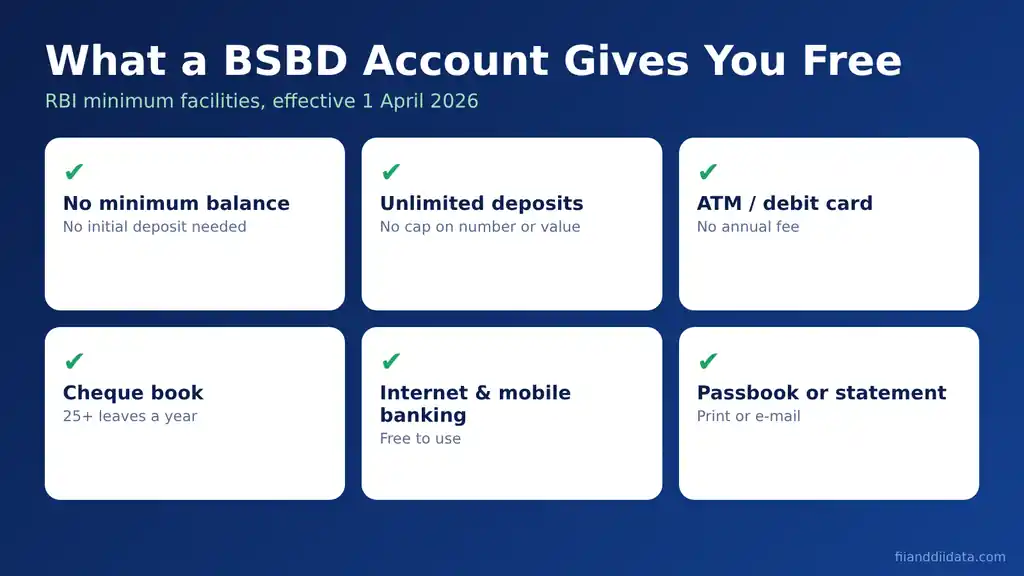
- No minimum balance. The basic facilities come without any requirement to maintain a minimum balance, and the bank cannot ask for an initial minimum deposit to open the account.
- Unlimited deposits. You can deposit cash at a branch or at an ATM or cash deposit machine, and receive money electronically or by cheque. There is no limit on the number or value of deposits in a month.
- A free debit card. An ATM or ATM-cum-debit card is given on request, and the bank cannot charge an annual fee when it issues or renews the card.
- A cheque book. A minimum of 25 cheque leaves per year. Holders of existing BSBD accounts can ask for it too.
- Passbook or statement. A passbook, or a monthly statement in print or by email in its place, on request. Continuation passbooks carry no charge.
- Internet and mobile banking. Offered free on request. The bank cannot force you to take it.
- At least four free withdrawals a month. This includes transfers and ATM transactions, at your own bank’s ATM or another bank’s ATM.
Banks may add extra services beyond this minimum. Those extras can be priced, but they must be optional, disclosed clearly and offered without discrimination. A bank also cannot make you hold a higher balance just because you chose an extra service.
Who gains the most from a zero balance account
The account suits anyone whose balance moves up and down. Think of a freelancer who gets paid in lumps, a student living on a monthly allowance, or a person who wants a second place to park a small emergency pot without worrying about charges. If you are building a safety net, a BSBD account can hold your first few thousand rupees while you work through our guide on how to build an emergency fund.
It is also a useful tool for budgeting. Because deposits are unlimited and withdrawals are capped at a small free number, the account nudges you to move money out only when you really need it. Pair it with a plan from how to create a monthly budget and the cap becomes a gentle spending brake rather than a nuisance.
Interest works the same as in a regular account. RBI’s Interest Rate on Deposits Directions, 2025 (issued April 1, 2025) set a uniform interest rate on savings balances up to Rs 1 lakh, so a basic account is not meant to earn less simply because it is basic. The rate itself differs by bank, so check your bank’s current rate before you open.
Zero balance account versus a regular savings account
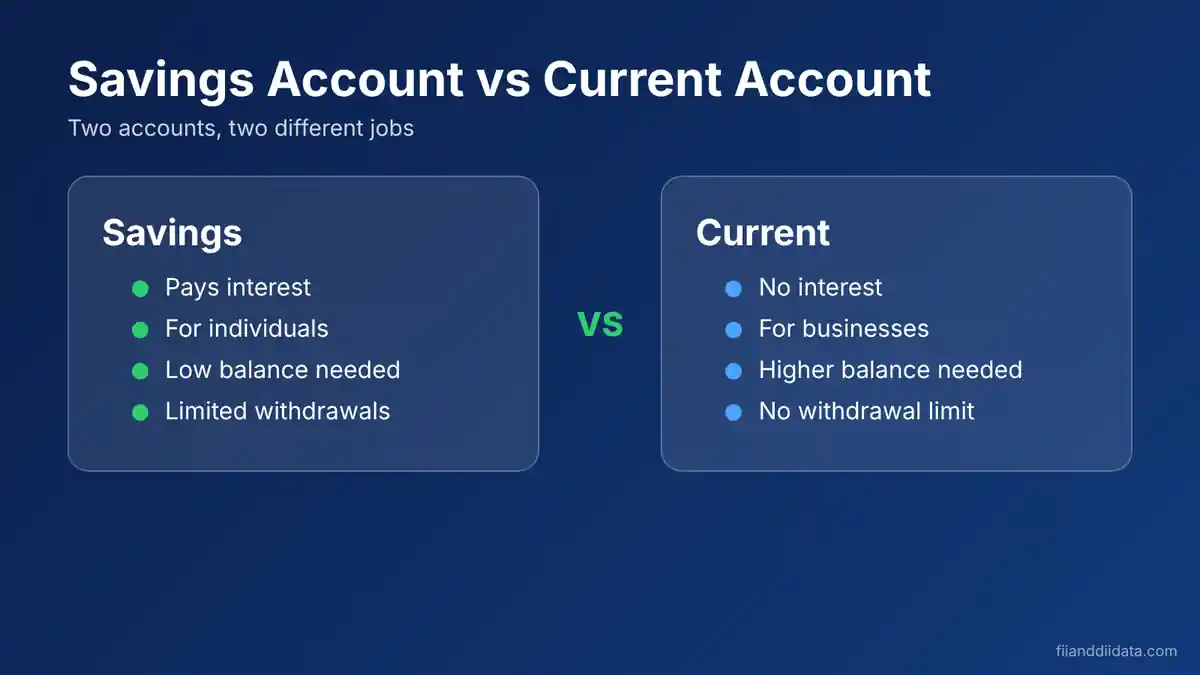
A regular savings account usually comes with its own bundle: a higher-tier debit card, a relationship manager, maybe sweep-in deposits or a lifestyle offer. In return, banks often ask for an average monthly balance and charge a fee when you miss it. A BSBD account trades those extras for certainty. You know the floor of what you receive, you know the balance rule is zero, and you know the free withdrawal count before the month starts.
The simplest test is your balance pattern. If you reliably keep a large balance and want premium features, a regular account may fit better. If your balance often dips near zero, or you simply want one low-risk account for small goals, the zero balance route costs less in the worst month. Many people run both ideas together: a BSBD account for a single goal such as a school fee fund, and a bigger account for salary. Remember the rule that you can hold only one BSBD account, so pick the bank with the best branch and app access for you.
What counts as a withdrawal, with a worked month
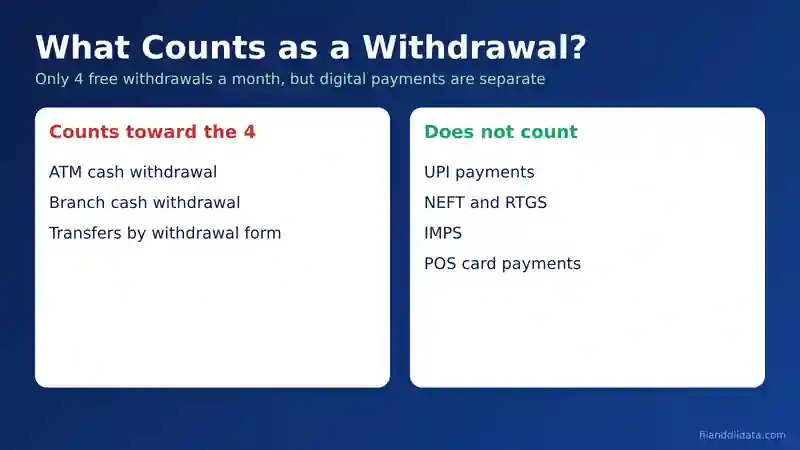
This is where most people get confused. The rule says the four free withdrawals include transfers and ATM transactions. It also says digital payments other than ATM transactions, such as point of sale transfers, NEFT, RTGS, UPI and IMPS, are not counted in that four. Charges on those digital payments follow the payment-system rules set by RBI, NPCI and the Government of India.
Here is a sample month, worked out with simple counting. In one month you take cash twice from an ATM and once at the branch counter. You also pay six bills through UPI and send one NEFT transfer to your landlord. Only the two ATM withdrawals and the one branch withdrawal count, which makes 3 of your 4 free withdrawals. The six UPI payments and the NEFT transfer fall outside the count, so you still have 1 free withdrawal left.
Over a year, four free withdrawals a month adds up to 48 counted withdrawals. The cheque book works out to 25 leaves a year, or about 2.08 leaves a month if you spread them evenly. If you use up your free limit, ask your bank what it charges for the next one. The RBI text fixes the free minimum, and any price above it is the bank’s own, which it must disclose.
Everyday zero balance savings account benefits in rupees
A small example shows the real gain. Suppose you keep Rs 20,000 in the account and your bank pays 2.5% a year. This rate is only an assumption to show the maths, not a quote from any bank. Simple interest for a year is Rs 20,000 x 2.5% = Rs 500, which is about Rs 41.67 a month. On a regular account with a minimum balance rule, one month of low balance could cost you a penalty that wipes out several months of that interest. On a BSBD account, that penalty risk is gone, because the minimum balance requirement itself is gone.
Savings habits matter more than the rate, though. If you want a system for the money that lands in the account, see how to save money every month. And if you are comparing banks before you decide, our list of the best savings account in India shows how regular accounts differ.
Limits and catches to know before you open
Three rules deserve attention. First, a BSBD holder cannot open another BSBD account in the same bank or any other bank, and the bank must take a declaration from you to that effect before it opens or converts the account. Second, KYC and anti-money-laundering rules still apply, so you need valid identity documents. Third, the free services are a floor, not a ceiling. Your bank may offer more or may tie extras to fees, so read the schedule of charges.
If you already hold a regular savings account, you can ask to convert it. The directions require the bank to convert an existing savings account to a BSBD account within seven days of your written request, and digital channels must allow the option too. Convert only after you check that you do not rely on features your bank links to the old account.
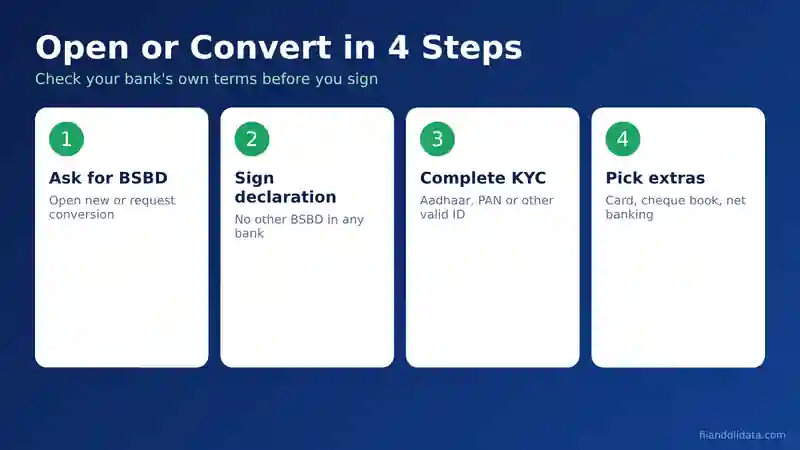
How to open a zero balance account in five steps
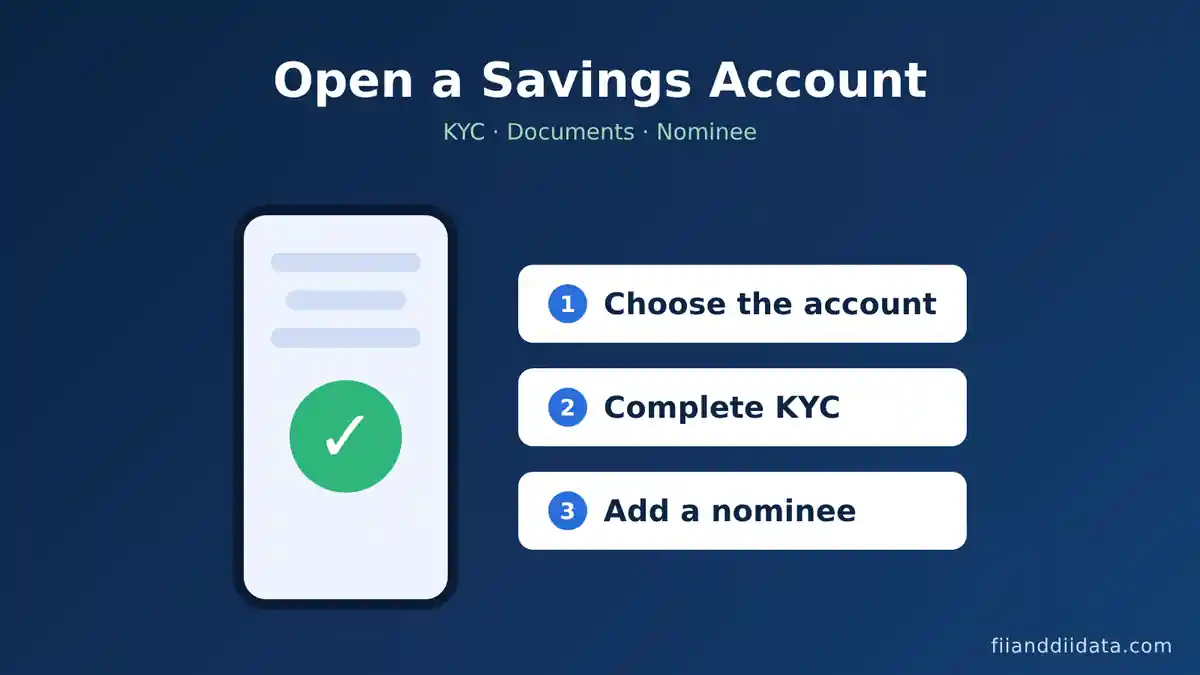
The process is the same as opening any savings account, with a few BSBD-specific points. Our full walkthrough is in how to open a savings account. In short:
- Choose a bank and ask specifically for a Basic Savings Bank Deposit account.
- Keep your identity and address proof ready for KYC.
- Sign the declaration that you hold no other BSBD account.
- Tell the bank which optional facilities you want, such as the debit card, internet banking or a passbook.
- Check that no initial deposit is demanded. The bank cannot require one.
Mistakes that waste the benefits
The first mistake is treating the four-withdrawal figure as a monthly limit on all spending. UPI and similar digital payments sit outside it, so you can pay daily bills without burning your count. The second is ignoring the account because the name sounds basic. The benefits are real, and for many people the account is the cheapest way to hold money. The third is forgetting that extras can be priced, so a fee can appear if you accept a paid add-on without reading it. Finally, if your costs are climbing, a low-cost account helps you cut leakage, and our piece on how to manage rising living costs shows where else to look.
Frequently asked questions
What are the main zero balance savings account benefits?
No minimum balance, no initial deposit, unlimited deposits, a debit card with no annual fee, a cheque book of at least 25 leaves a year, a passbook or monthly statement, free internet and mobile banking on request, and at least four free withdrawals a month.
Do UPI payments count toward the four free withdrawals?
No. The RBI text says digital payments other than ATM transactions, such as POS, NEFT, RTGS, UPI and IMPS, are not counted in the four free withdrawals. Transfers and ATM transactions are counted.
Can I have more than one zero balance account?
No. A BSBD holder cannot open another BSBD account in the same bank or any other bank, and the bank takes a declaration to this effect before opening or converting an account.
Can I convert my existing savings account to a zero balance account?
Yes. The directions require the bank to convert an existing savings account to a BSBD account within seven days of receiving your written request.
The bottom line
Zero balance savings account benefits come down to cost control: no minimum balance, no joining deposit, a free card, a cheque book and four free withdrawals. Count your ATM and branch withdrawals, keep digital payments for daily spending, and read the charges schedule before you add extras. For more money basics, browse the FIIAndDIIData blog.
Source and date: RBI, Commercial Banks – Responsible Business Conduct Amendment Directions, 2025 (RBI/2025-26/103, December 4, 2025, in force from April 1, 2026) at rbi.org.in, read on November 9, 2026. Bank rules can change, so confirm with your bank. This article is for education and is not financial advice.