The US Fed meeting impact on FII flows works through one simple question: is it more rewarding to hold dollars in America or rupee assets in India? On 28 October 2026 the Federal Reserve held its policy rate at 3.75% to 4.00%, but two officials voted for a hike. Within days, foreign investors turned net buyers of Indian shares after two heavy months of selling. Here is how each Fed decision travels to Dalal Street, and what to watch before the 8-9 December meeting.
Key Takeaways
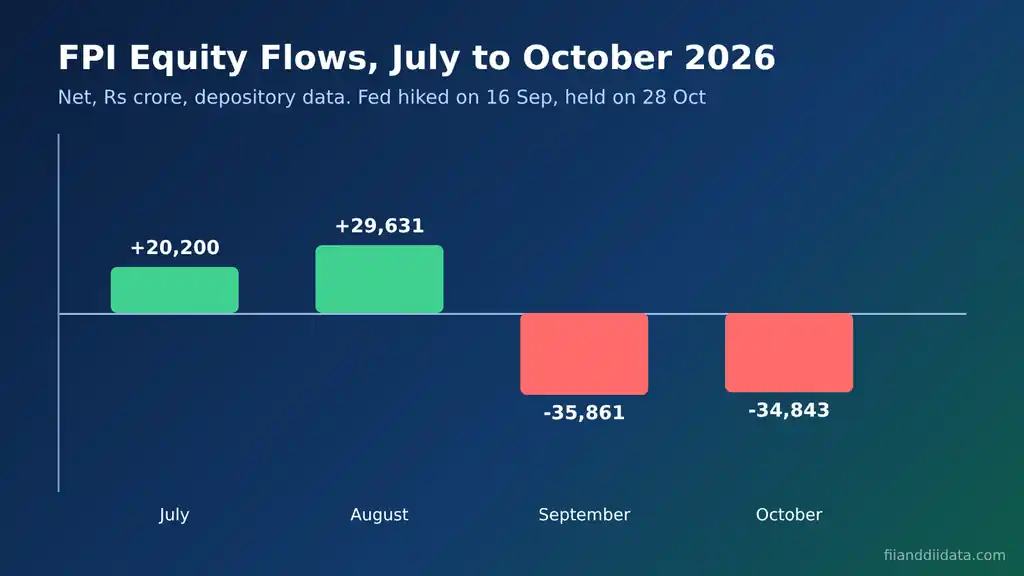
- The Fed hiked by 25 bps to 3.75%-4.00% on 16 September 2026 and held on 28 October with a 10-2 vote.
- FPIs sold a net ₹35,861 crore in September and ₹34,843 crore in October 2026, per depository data.
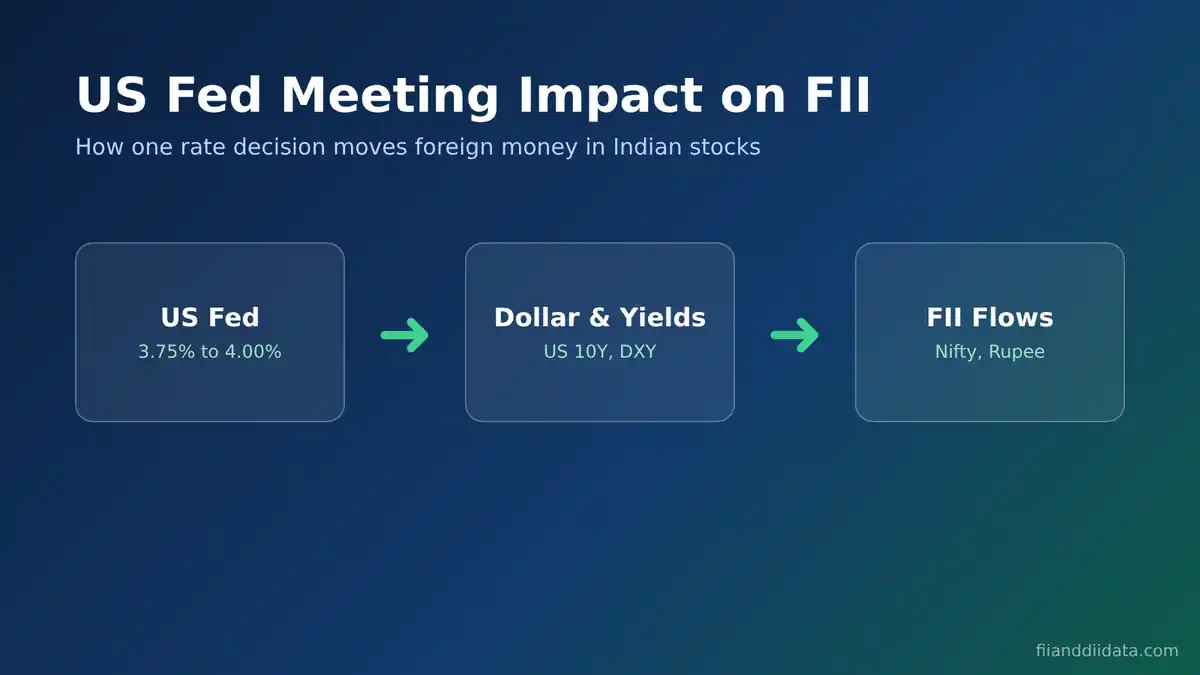
- Fed decisions reach FII flows through US yields, the dollar, the rupee and the India-US rate gap.
- The gap between the RBI repo rate (5.50%) and the top of the Fed range (4.00%) is now 1.50 percentage points.
- The next Fed statement lands at 12:30 AM IST on 10 December 2026, so Indian markets react the same morning.
Table of Contents
- What the US Fed Decides at Each Meeting
- Why the US Fed Meeting Matters for FII Flows
- Six Channels of US Fed Meeting Impact on FII
- Worked Example: How the Rupee Changes an FII Return
- Latest Data: US Fed Meeting Impact on FII Flows in 2026
- What Past Fed Cycles Did to FII Flows
- How Traders Use Fed Week: A Checklist
- Common Mistakes When Reading Fed News
- FAQs
- The Bottom Line
What the US Fed Decides at Each Meeting
The Federal Open Market Committee (FOMC) is the Fed body that sets the federal funds rate, the overnight rate at which US banks lend to each other. It meets eight times a year. Each meeting ends with a written statement, a vote count and, at most meetings, a press conference by the Fed chair, now Kevin Warsh.
Three things come out of every meeting, and markets react to all three:
- The decision: hike, hold or cut. A basis point (bp) is one hundredth of a percentage point, so 25 bps equals 0.25%.
- The vote split: dissents show which way the next move may lean. On 28 October 2026, Lisa Cook and Beth Hammack voted for a 25 bp hike while the majority held.
- The tone: the statement and press conference. In October the statement said “inflation remains elevated” and “the Committee will deliver price stability”, which markets read as a hawkish hold, meaning a pause with a bias to tighten.
Because the Fed sets the price of the world’s reserve currency, these three signals ripple into every emerging market. The next section explains why India’s foreign investors watch them so closely.
Why the US Fed Meeting Matters for FII Flows
Foreign institutional investors (FIIs), now formally called foreign portfolio investors (FPIs), are global funds that buy Indian shares and bonds. Most of them measure returns in US dollars. That makes the Fed rate their starting benchmark: if a near risk-free US Treasury pays close to 5%, an Indian stock has to offer a lot more to justify the extra risk and currency exposure.
When the Fed raises rates or signals more hikes, that hurdle rises and some money returns home. When the Fed cuts or turns softer, the hurdle falls and emerging markets like India look more attractive. We track the result every evening in the FII and DII data on our home page, where the cash market buy and sell figures show how quickly foreign funds respond.
The Fed is rarely the only driver. In 2026, crude oil near $114 a barrel, a weak rupee and an AI-led rally in North Asian markets also pulled money out of India. Still, the Fed sets the backdrop that makes every other factor stronger or weaker.
Six Channels of US Fed Meeting Impact on FII
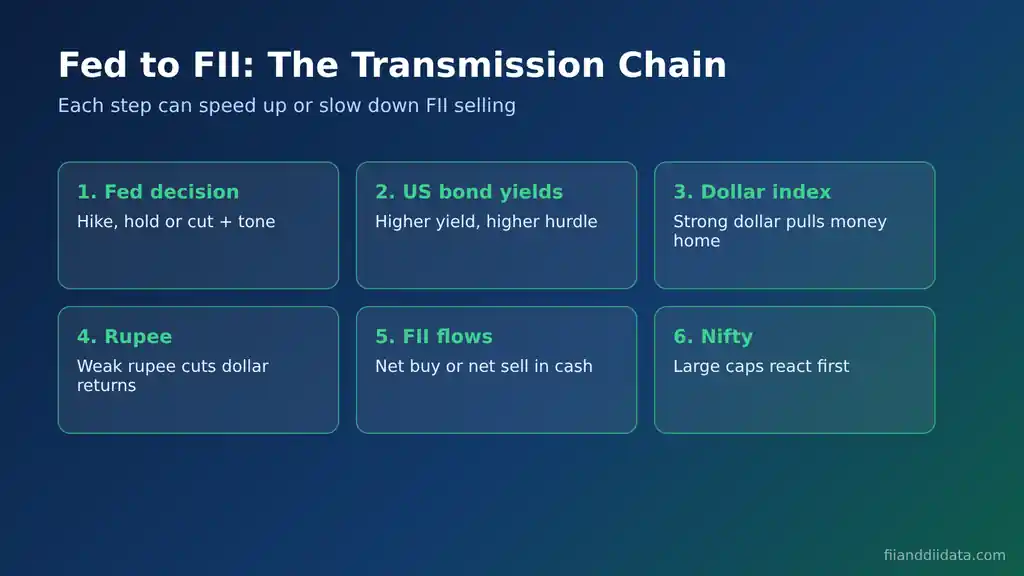
A Fed decision does not hit Indian stocks directly. It passes through a chain, and each link can amplify or soften the effect.
1. US Treasury yields: the core of the US Fed meeting impact on FII
Bond yields move on expectations of future Fed policy. The US 10-year yield climbed above 5.3% in early October 2026 and closed the month at 4.94%, 35 bps below September’s 5.29% close. Lower yields in late October coincided with FPIs turning net buyers. Our guide on how US interest rates drive FII flows covers this link in depth.
2. The dollar index
A hawkish Fed usually lifts the dollar index (DXY), which measures the dollar against six major currencies. A strong dollar pulls global money back to the US. On 30 October 2026 the DXY eased to 101.70. Read more on the dollar index and Nifty relationship.
3. The rupee
FPIs earn in rupees but report in dollars. A weaker rupee cuts their dollar return even if Indian stocks rise. The rupee opened at 95.22 per dollar on 30 October 2026, against a previous close of 95.26. Our note on the rupee and FII outflow link shows how this feeds back into selling.
4. The India-US interest rate gap
The RBI raised its repo rate by 25 bps to 5.50% on 7 October 2026. With the Fed range topping out at 4.00%, the gap is 1.50 percentage points. If the Fed hikes 25 bps in December and the RBI stands still, the gap shrinks to 1.25 points, making Indian debt less attractive. See our view on the RBI December 2026 policy.
5. Global risk appetite
Tighter Fed policy reduces liquidity across markets. Fund managers trim riskier positions first, and emerging markets sit at the risky end. India often feels this through large-cap selling, since FPIs hold more of the big, liquid names.
6. Relative valuations and competing markets
When money is scarce, it goes where valuations and earnings growth look best. In 2026, analysts linked part of the FPI exit to cheaper AI-driven markets in North Asia. A softer Fed does not guarantee a return to India if other markets look cheaper.
Worked Example: How the Rupee Changes an FII Return
Take a foreign fund that buys ₹1,000 crore of Nifty stocks when the rupee is at 95.26 per dollar. That costs about $104.98 million. Assume the stocks rise 5% in rupee terms, so the holding is worth ₹1,050 crore. The dollar return depends on where the rupee ends up:
| Rupee at exit (per $) | Value in rupees | Value in dollars | Dollar return |
|---|---|---|---|
| 97.00 (rupee weaker) | ₹1,050 crore | $108.25 million | 3.12% |
| 95.26 (unchanged) | ₹1,050 crore | $110.22 million | 5.00% |
| 94.00 (rupee stronger) | ₹1,050 crore | $111.70 million | 6.41% |
The same 5% stock gain becomes just 3.12% if the rupee slips to 97. Now compare that with a US 10-year Treasury paying 4.94% with almost no risk. A hawkish Fed tends to push the rupee weaker and US yields higher at the same time, squeezing the FII return from both sides. That is why one Fed meeting can tilt flows by thousands of crores.
Latest Data: US Fed Meeting Impact on FII Flows in 2026
The table below puts the key numbers from the last two Fed meetings side by side with Indian market data.
| Indicator | Value | Date |
|---|---|---|
| Fed funds target range | 3.75% to 4.00% (held, vote 10-2) | 28 Oct 2026 |
| Previous Fed move | +25 bps hike (vote 12-0) | 16 Sep 2026 |
| Market odds of a December hike (CME FedWatch) | About 78.4% | Late Oct 2026 |
| RBI repo rate | 5.50% (after 25 bp hike) | 7 Oct 2026 |
| US 10-year Treasury yield | 4.94% (5.29% at end-Sep) | 30 Oct 2026 |
| Dollar index (DXY) | 101.70 | 30 Oct 2026 |
| FPI net equity flow, September | -₹35,861 crore | Sep 2026 |
| FPI net equity flow, October | -₹34,843 crore | Oct 2026 |
| FPI net buying, final week of October | About +₹6,300 crore | 26-30 Oct 2026 |
| Nifty 50 close | 23,053.10 (+1.91% for October) | 30 Oct 2026 |
Two points stand out. First, the 25 bp hike on 16 September came in the month FPIs swung from a ₹29,631 crore inflow in August to a ₹35,861 crore outflow. Second, after the 28 October hold, FPIs bought a provisional ₹872 crore that day, their second straight session of buying, and ended the month’s last week as net buyers. Geojit’s VK Vijayakumar credited the Fed’s decision to hold rates as one reason for the renewed interest.
Note that exchange (provisional) data and depository data differ. Exchange cash market figures showed about ₹45,162 crore of FPI selling in October, against ₹34,843 crore in depository data, because the two count primary market deals and settlement dates differently. For a monthly view, use our month-wise FII DII data page.
What Past Fed Cycles Did to FII Flows
History supports the link, with limits. In 2022, when the Fed ended its pandemic-era easy money and raised rates aggressively, FPIs pulled a then-record net ₹1.21 lakh crore from Indian equities. In 2021, under near-zero US rates, they had put in a net ₹25,752 crore, and in 2020 about ₹1.7 lakh crore.
The 2026 pattern is even sharper. Free Press Journal reported cumulative FPI outflows of ₹2.95 lakh crore for 2026 by the end of October, far above the ₹1.66 lakh crore for all of 2025. Higher US yields, crude prices and the rupee all played a part. The lesson: a Fed tightening cycle rarely causes selling alone, but it turns other worries into exits.
Why the fall in Nifty was smaller than the selling
Domestic institutions, mainly mutual funds and insurers fed by monthly SIPs, absorbed much of the foreign selling. Angel One reported DIIs net invested ₹6.83 lakh crore in 2026 up to mid-October. That domestic cushion is why Nifty rose 1.91% in October even as FPIs sold.
How Traders Use Fed Week: A Checklist
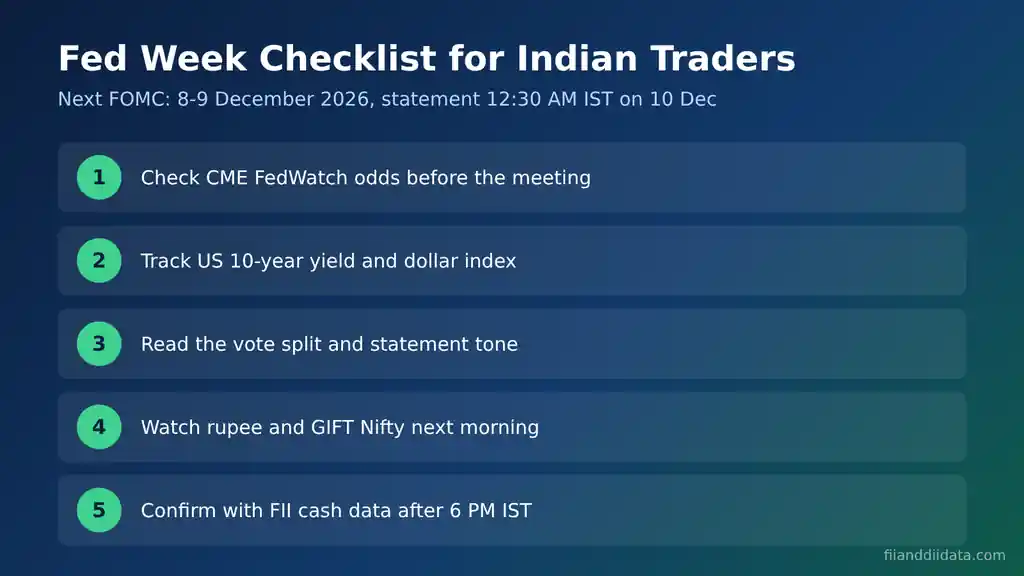
The next FOMC meeting runs on 8-9 December 2026. Because US clocks moved back in November, the statement comes at 2:00 PM Eastern, which is 12:30 AM IST on 10 December, and the press conference starts at 1:00 AM IST. Indian markets will price the outcome at the open that morning. Here is a simple routine:
- Check the odds a week before. CME FedWatch shows what is priced in. A surprise against the odds moves markets more than the decision itself.
- Track US yields and the DXY. Rising yields into the meeting usually mean FPI selling pressure is building.
- Read the vote split and statement. More dissents for a hike signal a hawkish path, even on a hold.
- Watch the rupee and GIFT Nifty early on 10 December. They show the first Indian reaction.
- Confirm with flows after 6 PM IST. NSE posts provisional figures in the evening; check FII DII data today to see whether FIIs actually bought or sold.
- Wait for two to three sessions. One day of flows can reflect block deals. A trend needs follow-through.
Common Mistakes When Reading Fed News
- Judging the decision, not the surprise. A hike that markets fully expected may barely move flows. A hold with hawkish dissents, as in October, can matter more than a hike.
- Ignoring the rupee. A falling rupee can keep FIIs selling even after the Fed turns softer.
- Treating one day of FII data as a trend. Provisional numbers include large one-off trades. Look at weekly and monthly totals.
- Forgetting the time zone. US decisions arrive after Indian markets close, so the reaction shows in the next session, not the same day.
- Assuming a Fed cut means instant buying. Crude prices, earnings and valuations in competing markets still decide where money goes.
With these traps in mind, the questions below cover what readers most often ask about the Fed and foreign flows. For more explainers, browse the FIIAndDIIData.com blog.
FAQs
What is the US Fed meeting impact on FII flows in India?
A hawkish Fed usually lifts US yields and the dollar, weakens the rupee and narrows the India-US rate gap, which pushes FIIs to sell Indian shares. A softer Fed tends to do the opposite. In 2026, FPIs sold ₹35,861 crore in September, the month of the Fed hike, and turned net buyers in late October after the Fed held.
Does a Fed rate hike always cause FII selling?
No. If a hike is fully expected, markets may already have priced it in. The surprise, the vote split and the Fed chair’s tone matter more than the decision alone. Crude oil, the rupee and Indian valuations also shape the response.
When is the next US Fed meeting and what time is it in India?
The next FOMC meeting is on 8-9 December 2026. The statement is due at 2:00 PM US Eastern time on 9 December, which is 12:30 AM IST on 10 December. The press conference starts at 1:00 AM IST.
How does the Fed affect the Indian rupee?
Higher US rates make dollar assets more attractive and strengthen the dollar. As FIIs sell Indian assets and take dollars out, demand for dollars rises and the rupee weakens. A weaker rupee then reduces the dollar returns of foreign investors.
Should retail investors trade based on Fed decisions?
Fed decisions are useful context, not a trading signal on their own. Confirm the market reaction with FII flow data, the rupee and Nifty over a few sessions before acting, and consult a SEBI-registered advisor for personal advice.
The Bottom Line
The Fed does not decide India’s market on its own, but it sets the price of money that every foreign fund compares against. In 2026, a September hike lined up with heavy FPI selling, while the October hold came just before foreign investors turned net buyers. The 10-2 vote and roughly 78% odds of a December hike mean that support is not yet secure.
The practical step: mark 10 December 2026 on your calendar, watch US yields, the dollar and the rupee into the meeting, and judge the outcome by the FII cash data in the sessions that follow rather than by the headline alone.
Sources: Federal Reserve FOMC statement, 28 Oct 2026; Chairman Warsh press conference transcript, 28 Oct 2026; Federal Reserve December 2026 calendar; TheStreet on CME FedWatch odds; Free Press Journal, FPI flows in October 2026 (1 Nov 2026); Free Press Journal on 2022 FPI outflows; Fistotex on the Fed and RBI rates; Nation Path India on Nifty and October flows; HDFC Sky market report, 29 Oct 2026; CNBC-TV18 rupee report, 30 Oct 2026; WRE News on the US 10-year yield, 30 Oct 2026; Angel One on CY26 FPI and DII flows.
Disclaimer: This article is for educational purposes only and is not investment advice. Please consult a SEBI-registered advisor before making investment decisions.